

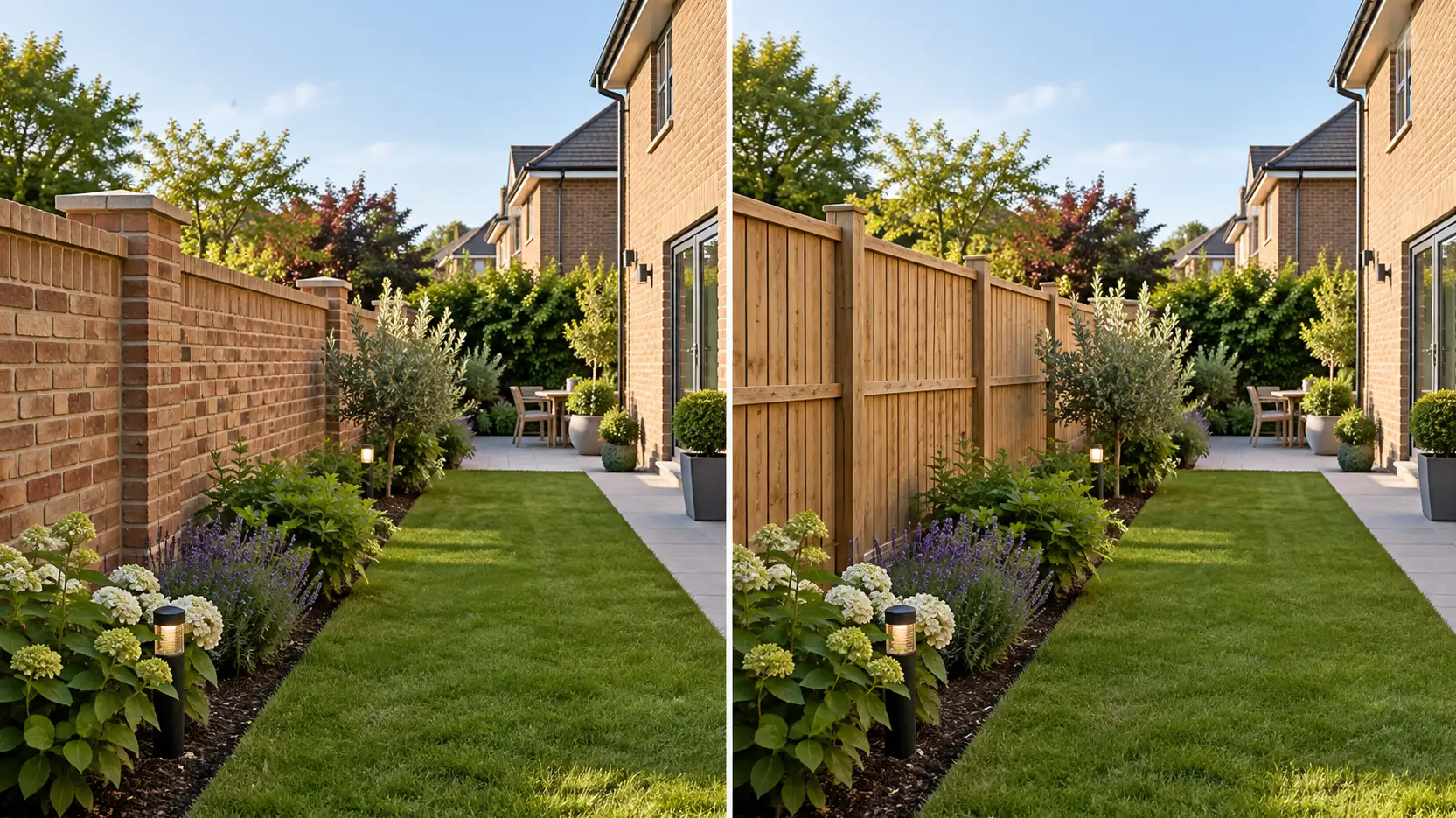
There’s no universally correct answer to whether a garden boundary should be fenced or walled — despite how confidently some landscapers will tell you otherwise. The right choice depends on what the boundary actually needs to do, how long you want it to last without much attention, and how much you’re prepared to spend upfront versus over time. Treated as a genuine decision rather than a default, the choice usually comes down to five or six factors pulling in different directions.
What each option is actually good at
A well-built masonry wall — brick, block or stone — is normally the lower-maintenance choice over the long term. It does not rot or need staining, damaged sections are less likely to need routine replacement, and a properly designed wall can provide a substantial and permanent-feeling boundary for decades. Masonry can also do something an ordinary fence structurally cannot: where it has been designed for the load, it can retain a change in ground level as well as divide one property from another.
Fencing wins on nearly everything else. It is quicker to install, usually cheaper upfront for an equivalent run, much easier to alter or replace in sections and — depending on the style — can be made either fully private or deliberately more open. Solid panels, hit-and-miss boards, slatted designs and trellis all let you trade privacy against light and airflow in a way a continuous masonry wall generally cannot without bringing in railings, openings or another material.
That is the underlying choice. A wall normally buys permanence, solidity and lower ongoing maintenance; a fence normally buys flexibility, speed and a lower initial bill.
The trade-offs, factor by factor
Upfront cost. Fencing is usually the cheaper starting point for the same length of ordinary domestic boundary. Current UK cost guides show why direct “per metre” comparisons need treating cautiously: fence cost changes with height, panel type, posts and access, while a brick wall varies with its height, thickness, foundations, piers, brick choice and site conditions. Checkatrade’s current guides to fence installation costs and brick wall costs nevertheless show the broad relationship clearly — conventional timber fencing generally involves the smaller initial spend, while a substantial masonry wall is a much bigger construction job.
Lifetime cost. This is where the calculation becomes less one-sided. Timber fencing is exposed constantly to weather and ground moisture, and posts, panels, fixings and finishes will eventually need attention or replacement. Masonry is not maintenance-free — mortar can deteriorate, individual bricks or copings can fail and walls can develop movement or weather damage — but a sound wall normally demands less recurring attention than a timber fence. The cheapest option on installation day is therefore not automatically the cheapest boundary over the next fifteen or twenty years.
Privacy and light. A solid wall gives permanent visual screening at whatever lawful and appropriate height it is built to, but an enclosed garden can also become noticeably darker and more closed-in, especially on a small plot. Fencing gives you more control. You can use solid panels where privacy matters, a more open or slatted design where light and airflow matter more, and different treatments along different parts of the same garden.
Security. The most secure boundary is not necessarily the tallest or most opaque one everywhere. At the side and rear of a property, a robust higher boundary can make access more difficult. At the front, however, a tall solid fence or wall can also give somebody working at a door or window cover from neighbours and passers-by. Police crime-prevention guidance on keeping burglars out of your property therefore favours maintaining visibility at the front while using more resistant boundaries where access around the sides and rear needs controlling.
That means privacy and security can sometimes pull in opposite directions. A six-foot opaque boundary may give excellent seclusion, but putting it in the wrong place can also reduce the natural surveillance that helps protect a property. Material alone does not settle the question: height, visibility, condition, gates and the route an intruder would actually have to take matter just as much.
Wind exposure. This is another area where there is no automatic winner. A tall solid timber fence can present a large surface to strong winds and is vulnerable if its posts, fixings or foundations are not adequate. A masonry wall avoids the panel-and-post failure mode, but it still has to be designed and founded to resist the wind loads acting on it; masonry is not immune simply because it is heavy. On an exposed or coastal site, the better question is therefore how the boundary should deal with wind. A properly designed wall may be the right answer, but so may an open, slatted or hit-and-miss fence that allows some air through rather than behaving like a solid sail.
Ground conditions and disruption. A wall requires proper foundations and more substantial groundworks, which generally means more spoil, more labour and more disruption. A fence usually involves much less excavation and can often be installed far more quickly. Difficult access, nearby trees, poor ground or changes in level can complicate either option, but they tend to have a bigger effect on the cost and practicality of masonry.
Adaptability. If your needs might change — adding a gate, altering the height, extending the run or changing the appearance — fencing is usually far easier to modify. Altering a wall commonly means cutting out or demolishing part of something that was built to be permanent, then rebuilding it properly afterwards.
Where a combination makes sense
A low wall topped with fencing, trellis or railings is a genuinely useful middle ground rather than a compromise for its own sake. It can provide a durable base and visual weight while keeping the expensive masonry to a manageable height, then use lighter materials above to provide screening, security or enclosure without making the whole boundary feel heavy.
It can also work well where different parts of the boundary need to do different jobs. A low masonry base may suit the architecture of the house, while slatted timber above preserves more light. Railings can give definition without completely closing off views. Where the lower wall is intended to hold back soil rather than merely form a boundary, however, it needs to be designed for that retaining load; an ordinary decorative garden wall should not simply be assumed capable of supporting raised ground.
The same principle applies along a whole plot. There is no reason the front, side and rear boundaries all have to use the same solution if their jobs are different.
| Factor | Favours a wall | Favours a fence |
|---|---|---|
| Upfront budget | ✓ | |
| Long-term low maintenance | ✓ | |
| Wind or exposed site | Properly designed masonry can work well | Open or permeable designs can work well |
| Retaining a level change | ✓ — if designed for the retaining load | |
| Flexibility to alter later | ✓ | |
| Keeping the garden lighter | ✓ | |
| Speed and ease of installation | ✓ |
What this doesn’t answer
This is a choice-and-specification article, not a guide to who owns the boundary, exactly where the legal boundary lies, how high you are allowed to build in every part of the UK or what happens if proposed masonry sits on the line between two properties.
In England, the Planning Portal’s guidance on fences, gates and garden walls says planning permission is normally not required where a new or altered fence, wall or gate is no more than one metre high next to a highway used by vehicles — including the footpath of such a highway — or no more than two metres high elsewhere. There are important exceptions, including listed buildings, some conservation-area situations, Article 4 directions and planning conditions, and the rules differ elsewhere in the UK.
A masonry wall proposed on or astride a shared boundary can also raise separate neighbour-notice questions in England and Wales under the Party Wall etc. Act. That is a different problem from deciding whether brick or fencing is the better material, just as identifying which neighbour owns or maintains an existing boundary is a different problem again. Those subjects belong in Property Front Page’s dedicated articles rather than being repeated here.
The honest summary is that a wall makes most sense where permanence, solidity, lower long-term maintenance or a properly designed retaining function genuinely justify the extra initial cost. Fencing makes most sense where budget, flexibility, speed, light or the ability to alter the boundary later matter more. On a very exposed site, choose a boundary designed for that exposure rather than assuming one material automatically wins; and where security is the priority, think about where the boundary sits as well as what it is made from.
And don’t rule out doing both. Using different materials for different parts of the same boundary is often evidence that the job has been thought through properly, not that you failed to choose.
This article provides general property information rather than project-specific design, structural, planning or legal advice. The appropriate boundary for a particular property depends on its location, exposure, ground conditions, proposed height, neighbouring land and intended purpose. Resolve any uncertainty about ownership, boundary position, planning control or neighbour-notice requirements before substantial work begins.

