

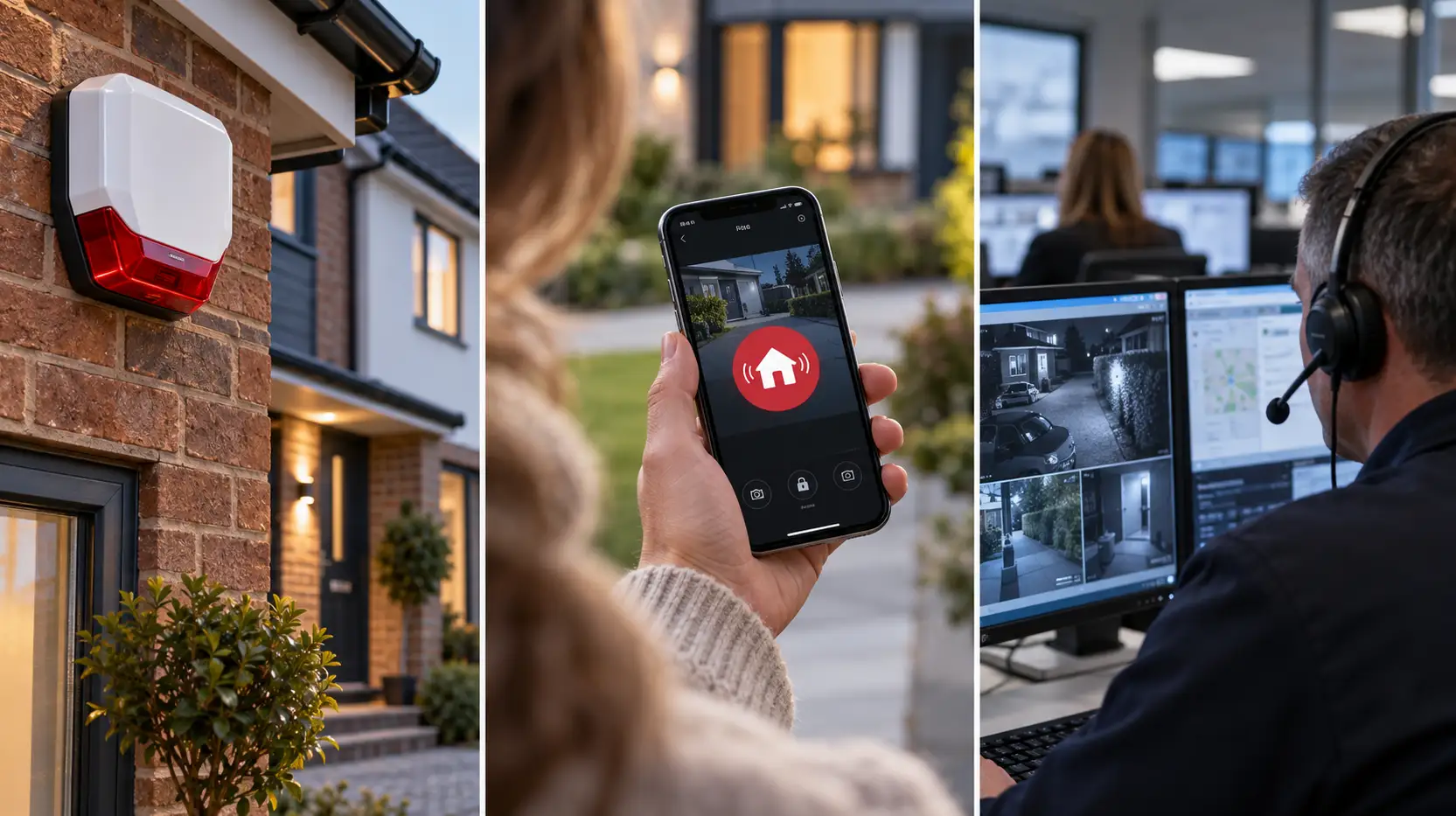
Most people shop for a burglar alarm the way they would shop for almost anything else: by feature list. Number of sensors, app quality, whether it talks to the smart speaker in the kitchen. That is the wrong starting point, because an alarm is not really just a product — it is a decision about what happens next, at 3am, when a sensor trips.
The genuinely useful question is not “which alarm has the most features?” but “who do I actually want to know about this, and what do I expect them to do about it?” That question sorts the market into three fundamentally different response models before a single specification sheet gets involved. There is some overlap between them: a professionally monitored system can still have a good smartphone app, and some smart alarms offer professional monitoring as an optional service. The important distinction is not whether the equipment is clever or connected. It is who receives the alarm and who carries responsibility for acting on it.
Bells-only: the sound is the entire plan
A true bells-only or audible-only alarm does exactly what the name suggests. When a detector triggers, a siren sounds at the property. There is no remote monitoring centre and no automatic police alarm response; somebody nearby has to hear the alarm, decide that something may be wrong and act. The siren is intended to disrupt an intruder and attract attention, while an external alarm box provides a visible deterrent before anybody attempts to enter. Police Crime Prevention Initiatives’ guidance on choosing a home alarm distinguishes audible systems in the same way: they alert people nearby but do not themselves generate an automatic police response.
For a household that is usually occupied, or where neighbours are close enough and likely enough to react to a siren, that can be an entirely rational level of protection. There is no monitoring subscription, although a professionally installed audible system will still need appropriate maintenance. Its limitation becomes much more important when the property is empty. If you are away for a fortnight, at work all day, own a second home or have a rental property sitting between tenancies, the alarm may sound perfectly and still achieve very little if nobody notices. At that point, spending more money on additional detectors does not solve the underlying problem: what you are missing is not detection, but somebody being told.
Smart, self-monitored: you become the response
A self-monitored smart alarm changes the arrangement from “make noise and hope somebody hears it” to “tell me and I will decide what happens next”. Sensors will normally trigger a siren at the property while also sending a notification to your phone, and access can often be shared with a partner, family member or another trusted person. Systems incorporating cameras or linked video devices may also give you useful information about what actually caused the alert.
The trade-off is that you are the monitoring centre. A notification that arrives while you are asleep, driving, on an aircraft, in a meeting or somewhere without usable mobile data may not receive a quick response. It is therefore worth doing more than simply installing the app: decide who receives alerts, test that notifications reach the people you expect them to reach and agree what each person is supposed to do if the alarm activates.
Remote notification also depends on the communication path available to the system. If seeing an activation while you are away is central to why you are buying the alarm, find out what happens when broadband goes down, the mains supply fails or the hub loses its normal internet connection. Some systems have battery and mobile-network backup; others lose part or all of their remote functionality, and some reserve additional communications or recording services for a subscription.
There is also an important difference between receiving a smart-alarm notification and having formal police alarm response. If an alert gives you credible evidence that a burglary is actually under way — through live or recorded images, for example — you can contact the police through the normal route appropriate to the circumstances. But an app notification by itself does not put a DIY alarm into the formal police-response system used by qualifying monitored installations. Police crime-prevention guidance similarly makes clear that an audible alarm alone is not evidence of a crime in progress. For many households, this self-monitored middle ground will be exactly enough; the question is whether you genuinely want to remain the person who has to see the alert, judge what it means and decide what happens next.
Professionally monitored: someone else watches, but with real conditions attached
Professional monitoring moves that responsibility away from your phone and into an Alarm Receiving Centre, or ARC. Alarm signals are transmitted to a continuously staffed facility which follows the response procedure attached to the system. Depending on what you have bought, that may involve contacting nominated keyholders or a commercial response provider, and a qualifying installation can also be configured for formal police response. Professional monitoring and police response are therefore not automatically the same product: an alarm can be monitored professionally without having the police-response arrangements described below.
In England, Wales and Northern Ireland, formal police alarm response operates under the National Police Chiefs’ Council security-system requirements, maintained through Police Crime Prevention Initiatives and most recently updated in June 2026. The current NPCC Security Systems Requirements set out how qualifying systems enter that process. A compliant installation is allocated a police Unique Reference Number, or URN, and the installation, maintenance and monitoring services have to satisfy the relevant requirements through a UKAS-accredited certification route. The certification bodies currently used for this purpose are the National Security Inspectorate, NSI, and the Security Systems and Alarms Inspection Board, SSAIB. A typical DIY smart alarm does not acquire a police URN simply because its hardware is expensive, highly rated or capable of sending video to your phone.
Police-response systems also use confirmation to reduce false calls. This does not mean that two separate movement detectors must always trigger before the police can be contacted. Sequential activation is one method, but current BS 8243 also accommodates other approaches to confirmation, including audio or visual confirmation depending on the way the system is designed. BSI’s current BS 8243:2021 replaced the older version and specifically made sequential confirmation optional rather than universal.
Even a compliant monitored system does not purchase an unconditional promise that officers will arrive every time it activates. Police attendance remains an operational decision, while repeated false activations can also jeopardise police response. That makes sensible system design, proper use and continuing maintenance part of the response chain rather than optional housekeeping. The same is true of the communications path between the property and the ARC: a monitored alarm is only useful if its alarm signals can reach the people being paid to receive them.
It is also worth looking beyond the installation quotation and comparing the ongoing agreement. Monitoring normally means continuing charges and maintenance obligations, and the police requirements themselves expect domestic contracts to set out the services, charges, warranty position and other terms clearly. Police CPI also cautions householders against pressure selling and long-term monitoring arrangements requiring substantial payment in advance. Before signing, establish the contract term, monitoring and maintenance charges, cancellation arrangements and which parts of the service stop if monitoring ends. A cheap installation can be poor value if it ties the property to an unsuitable ongoing agreement.
Scotland should not simply be folded into the NPCC arrangements used elsewhere. Police Scotland has its own policing arrangements, although its current home-security guidance similarly recommends alarm systems meeting the relevant British standards and installers holding NSI or SSAIB certification.
None of these conditions makes professional monitoring pointless. It buys something fundamentally different from a push notification: somebody is receiving and processing the alarm whether or not you happen to notice your phone. For a property that is regularly unoccupied, a second home, a house between tenancies or a home where the consequences of an unnoticed break-in are particularly serious, that may justify the continuing cost. It should simply be understood as a structured response service, with technical and contractual conditions attached, rather than a guarantee that a police car will appear whenever a sensor goes off.
Sensors, standards and the parts underneath all three
Whichever response model you choose, the equipment and the way it is installed still matter. An excellent monitoring contract cannot compensate for poor detector coverage, and an attractive app does not make a badly positioned movement sensor more reliable.
The principal UK framework for professionally specified intruder alarms combines the BS EN 50131 family of standards with PD 6662. The system uses security grades from 1 to 4, with the appropriate grade reflecting the risk rather than acting as a simple consumer quality ranking. Grade 2 is commonly associated with domestic risks, while Grade 3 is generally used where the assessed risk is higher; the correct specification should come from the property, what is being protected and any insurer requirement rather than from assuming that a higher number must always be better. BSI identifies PD 6662:2017 as the current release of the UK scheme.
Door and window contacts, movement detectors, shock or glass-break detection and pet-tolerant sensors can all have a role depending on the house. The more useful question for an installer is why each detector is being proposed, what route or area it is intended to protect and what happens after it activates. If formal police response is part of the quotation, ask how alarm confirmation will actually be achieved rather than simply accepting the phrase “police monitored”. If remote communication is important, ask what happens when one communications route or the mains supply fails. Those questions tell you more about the resilience of the finished system than the raw number of sensors on the quotation.
What your insurer actually requires
There is no universal home-insurance rule requiring every property to have a particular type of burglar alarm. For many ordinary homes an alarm is an additional security measure chosen by the owner. Higher-value properties, unusual risks and policies covering substantial valuables can be different, and where an insurer relies on the alarm as part of the cover, the detail of the policy condition matters.
Requirements can extend beyond simply “having an alarm” to its grade or specification, who installs and maintains it, whether monitoring remains active, whether the system has police-response status and when it must be set. The British Insurance Brokers’ Association’s guidance for purchasers of intruder alarms specifically recommends checking with the insurer before purchasing and describes the kinds of continuing maintenance, monitoring and police-response conditions that may be imposed.
That makes choosing the alarm first and asking the insurer afterwards the wrong way round where your cover depends on it. If an alarm has been specified as a condition of insurance, get the insurer or broker to confirm what is required before committing to an installation. If police response is later withdrawn, monitoring is cancelled or the system is materially changed, check whether the insurer also needs to be informed. The important distinction is between an alarm you have chosen because you want one and an alarm the insurance contract relies upon; in the second case, the policy wording matters more than the sales brochure.
The decision, restated
A bells-only system makes most sense where the aim is visible deterrence and a loud local warning, and there is a realistic prospect that somebody nearby will notice and react. A self-monitored smart alarm adds remote visibility but makes you and anybody sharing the app responsible for seeing the alert, deciding what it means and doing something about it. Professional monitoring adds a staffed response chain and, where the installation satisfies the relevant requirements, can provide access to formal police alarm response — but it also introduces certification, maintenance, monitoring charges, contractual commitments, confirmation requirements and false-alarm rules rather than a guarantee that officers will arrive every time.
So start with the night the alarm actually activates, not the day you buy it. If you are asleep upstairs, at work, abroad or sitting on an aircraft with your phone turned off, who do you want to know that something has happened, and what do you expect them to do next? Answer that first. The sensor count, keypad, app and smart-home integrations come afterwards.
This article provides general information about domestic burglar alarms and security-system response arrangements in the UK. Police-response arrangements differ between Scotland and those operating in England, Wales and Northern Ireland, while insurer requirements depend on the individual policy and property. Standards, products and police procedures can also change. Confirm any insurance requirement and any proposed police-response arrangement with the relevant insurer, appropriately certificated security provider or other suitable professional before purchase.

