

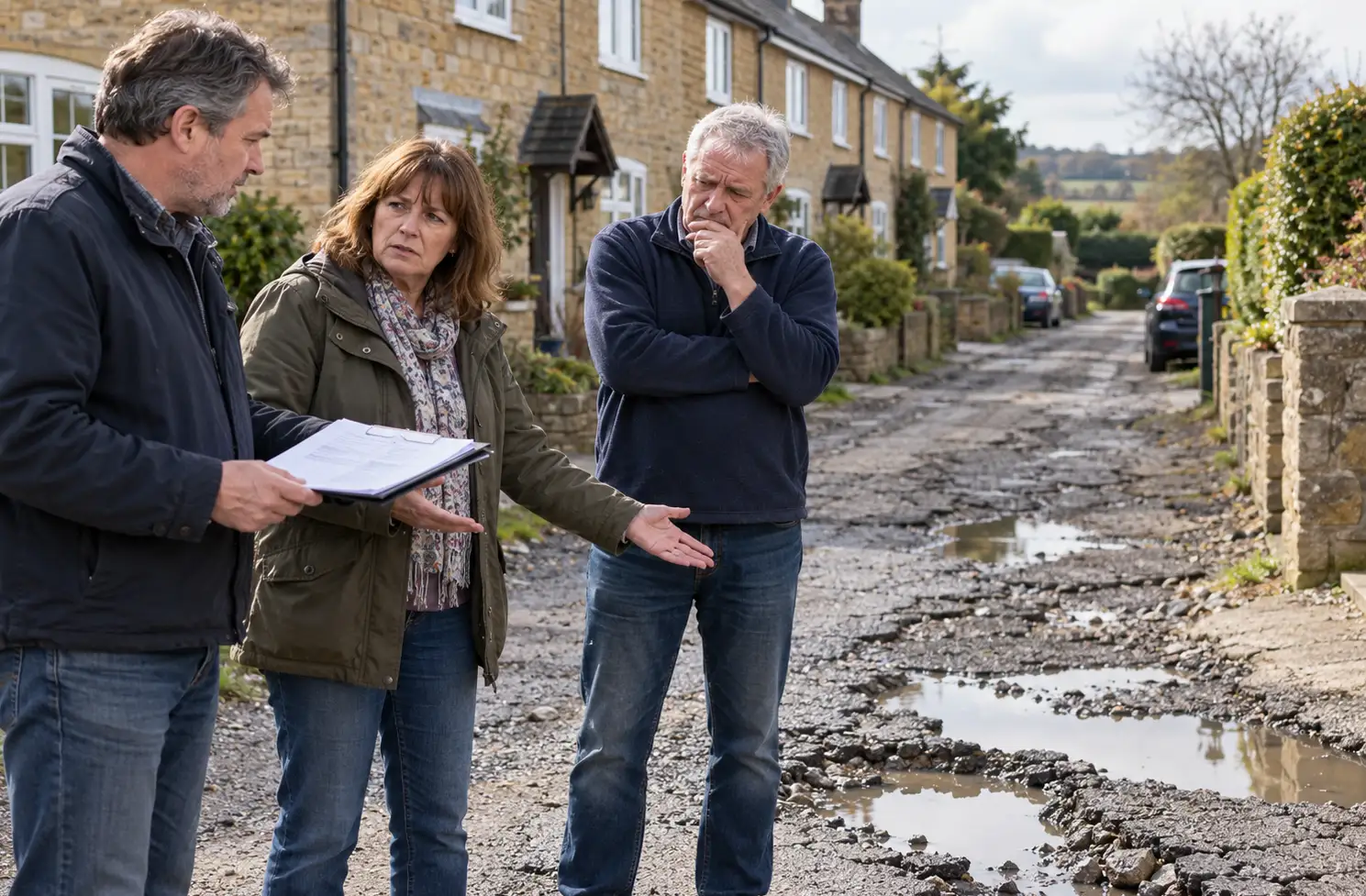
“The council doesn’t maintain unadopted roads” is true, and it’s also the least useful sentence in this entire subject, because it tells you what won’t happen without telling you what will. If you live on a private road that’s starting to crumble, the actual questions are who’s legally on the hook, how much they owe, and what happens to the people who simply refuse to pay their share — and the answers are more structured than most residents realise.
The trouble usually begins with something everybody agrees on. The potholes are getting worse, rainwater is collecting in the broken surface and somebody has obtained a quotation for resurfacing. The road serves six houses, so dividing the bill six ways seems reasonable enough. Until one neighbour points out that they live nearest the entrance and hardly use the rest of it, another says the proposed work is unnecessarily expensive, and somebody else announces that they never agreed to pay for private-road repairs in the first place.
Before long, nobody is talking about the potholes. They’re arguing about the deeds, whose land the road is built on and whether the person who obtained the quotation has any right to demand money from the others.
What makes these disagreements difficult is that several questions are being treated as though they have the same answer. Who owns the road is not necessarily who must maintain it. Having responsibility for maintenance is not automatically the same as owing a particular neighbour money. And agreeing that repairs are needed is not the same as agreeing to a contractor, a specification or a share of the bill.
There are legal mechanisms for resolving some of these problems, including statutory procedures that residents often know nothing about. But the starting point is understanding what kind of road you’re dealing with and where any obligation to contribute actually comes from.
Why “unadopted” doesn’t mean “nobody’s responsible”
An unadopted road is, broadly, a highway that hasn’t been taken over for maintenance at public expense. That’s what the term tells you: the relevant highway authority does not have the ordinary maintenance responsibility it would have for an adopted road. It says surprisingly little about who owns the ground beneath it, who is entitled to use it or how the cost of repairing it should be divided.
“Private road” and “unadopted road” aren’t quite interchangeable descriptions either. A road can be privately maintained while carrying public highway rights, meaning that its legal position is rather different from a private access over which only particular properties have rights. The distinction matters because not every privately used driveway or track necessarily falls within the same statutory street-works procedures.
In England and Wales, the general position under the private-street framework is that maintenance costs can fall upon frontagers, broadly the owners of properties fronting or adjoining the road. The House of Commons Library’s briefing on private or unadopted roads in England and Wales explains the statutory position and why it is considerably more complicated than simply asking the council who owns the road.
The complication is that identifying the frontagers does not, by itself, tell you what each household owes for a particular repair. There may be enforceable obligations in the property deeds, a management arrangement governing expenditure or a statutory procedure through which the cost of qualifying works can be apportioned. Without establishing which of these applies, a resident demanding contributions may be relying on little more than their own understanding of fairness.
Ownership of the road can be equally uncertain. On some developments, a management company or the original developer owns the road. On others, the land may belong to adjoining homeowners, even where nobody has ever thought of the tarmac as part of their individual property.
There is a longstanding presumption known as ad medium filum, under which an owner whose land adjoins a road may, in appropriate circumstances, be presumed to own the adjoining part up to the centre line. HM Land Registry’s guidance on roadway boundaries explains the principle, including the fact that it is only a presumption and can be displaced by the deeds or other evidence.
For a homeowner who discovers that their boundary may extend into the road, this can sound like an unwelcome surprise. But owning some of the ground beneath a road doesn’t necessarily settle responsibility for resurfacing it. Neighbours may have rights of way across that land, a management company may hold maintenance responsibilities, or separate legal arrangements may determine how the expense is recovered.
The useful distinction is between ownership, rights of access and liability for maintenance. A private road can involve all three, with different people or organisations holding different rights and obligations. Until those have been established, nobody should assume that the person whose title includes the roadway is automatically responsible for every repair, or that every household using it must contribute equally.
What the deeds say — and why they may not settle the argument
For an ordinary private-road repair dispute, the property documents should be the first things examined. They may provide a clear answer, although clear wording doesn’t always mean that the answer is what residents expected.
A transfer or conveyance might require the owners of six properties to contribute equally towards maintaining the road. Another might allocate different percentages, while a managed development could give a management company authority to arrange repairs and recover expenditure through estate charges or other contractual arrangements.
Where a valid, enforceable obligation exists, the disagreement may be less about whether residents have to contribute and more about what that obligation actually covers. A requirement to maintain a roadway doesn’t necessarily answer whether somebody can commission a complete reconstruction, replace the existing surface with a more expensive specification or add improvements that were never contemplated when the arrangement was created.
There can also be questions about who is entitled to enforce the obligation. Historic positive covenants affecting freehold land do not always bind later owners in the same straightforward way as other property rights. A maintenance provision that looks simple on paper may therefore require closer examination of the title history, the parties entitled to enforce it and any arrangements designed to make contributions recoverable from successive owners.
This is where a dispute can become expensive even when the documents contain something that appears to be a maintenance clause. One neighbour reads it as an obligation to contribute to any reasonable repairs. Another argues that the clause is not enforceable against them, or that the proposed works go beyond what it requires.
Those aren’t disagreements that can safely be settled by choosing the interpretation that seems fairest. Where substantial expenditure is involved, a solicitor experienced in property covenants and private-road arrangements may need to establish who actually owes what before anyone threatens proceedings.
The absence of a clear maintenance clause creates a different problem. On older roads, the properties may have changed hands repeatedly without anybody paying much attention to the arrangements, particularly where minor repairs have historically been handled by whoever was willing to organise them.
Residents may have contributed informally for decades. That history can be relevant to understanding what has happened, and particular agreements may have legal consequences, but it does not automatically establish a permanent obligation requiring every future owner to contribute whatever amount their neighbours decide upon.
Nor is there a universal rule that costs must reflect the amount of use.
Take a road serving several houses, with one near the entrance and another at the far end. The first household may use only a short stretch, while the second drives the entire length every day. One property may have a single car, another several vehicles and frequent deliveries. It is easy to understand why the residents might think those differences should influence the bill.
They may be perfectly reasonable considerations when negotiating an arrangement, but they don’t automatically override a valid contribution formula in the deeds. Nor does an owner acquire the right to reduce their payment simply by arguing that they personally use the road less.
Where a formal statutory private-street scheme is used in England and Wales, the calculation follows a different set of rules. Part XI of the Highways Act 1980 contains the Private Street Works Code, under which expenses can be apportioned through a formal procedure.
Frontage provides the normal starting point, but the legislation allows other relevant circumstances to be considered. Section 207 permits the authority, where it considers it just, to take account of differences in the benefit particular premises receive and certain work previously undertaken by an owner. Premises that don’t directly front the street but obtain access through it and benefit from the works may also be relevant to the calculation.
That is a more considered approach than simply dividing the quotation by the number of houses. It is also different from allowing the loudest resident to decide that the neighbour with the most vehicles should pay the largest share.
The important thing is to identify which arrangement actually governs the road. The formula residents would prefer is not necessarily the one they can legally enforce.
The neighbour who refuses to pay
This is where the distinction between a legal obligation and a neighbourly expectation becomes particularly important.
Imagine that five households agree the road needs resurfacing. They’ve obtained quotations, chosen a contractor and calculated what each property should contribute. The sixth owner refuses, insisting that they won’t pay for work they never authorised. Everyone else regards the refusal as unreasonable, particularly because the owner will benefit from the repaired road just as much as they will.
Whether that sixth household can be required to contribute depends on something more substantial than the other five owners agreeing that they should.
If an enforceable maintenance obligation exists, the first question is what it actually requires. A neighbour may have little basis for refusing to pay a properly calculated contribution towards authorised work, but that doesn’t mean every invoice presented under a maintenance clause is automatically recoverable.
The proposed work must fall within the relevant obligation, any required procedures must have been followed and the person demanding payment must have a proper legal basis for doing so. A dispute about whether repairs are necessary is different from a dispute about whether the obligation binds the current owner at all. Both may require investigation before legal enforcement becomes appropriate.
Where a management company has authority to arrange and recover maintenance expenditure, the relevant documents may provide an established mechanism for collecting unpaid contributions. That can make the process more straightforward than leaving individual homeowners to pursue one another, although the company’s authority and the charges themselves still need to be considered.
If somebody disputes a bill under an apparently enforceable arrangement, the sensible response is to establish exactly what they are disputing. Are they denying any obligation to contribute, objecting to the contractor’s price, questioning whether the work is necessary or refusing to fund an improvement beyond ordinary maintenance?
Those objections may lead to different answers. A homeowner who is legally required to contribute towards maintaining an access road may still have a legitimate question about the scope or cost of an ambitious reconstruction project. Conversely, a valid contribution obligation doesn’t disappear simply because a resident would prefer to spend the money elsewhere.
Where the legal obligation is clear and a resident continues to refuse payment, formal recovery may be possible through the party entitled to enforce it. Whether proceedings are justified depends on the documentation, the amount involved and the likely cost and risk of enforcement. Sending a solicitor’s letter may be appropriate in some cases; in others, examining the clause reveals that the obligation is not as straightforward as the other residents assumed.
The position is much less comfortable when no enforceable private contribution arrangement can be identified.
A resident who commissions repairs without obtaining agreement cannot necessarily turn the resulting bill into a legally enforceable debt simply because the work was needed and everybody benefited. The contractor may have done an excellent job. The quotation may have been competitive. The road may be substantially better afterwards. None of those facts, by itself, establishes that neighbours who never agreed to the expenditure must reimburse the person who ordered it.
That is the trap for the well-intentioned homeowner who takes charge because nobody else will. They begin by doing everyone a favour and can end up personally responsible for a substantial contractor’s bill while still trying to persuade the neighbours to contribute.
A majority vote is not necessarily the answer either. Five out of six households may favour resurfacing, but their agreement doesn’t automatically create a private maintenance covenant binding the sixth. A majority may have powers under a particular deed, management arrangement or applicable statutory process, but there is no general rule that residents on any private road can compel the minority to pay simply by voting for the work.
Where cooperation is possible, it is much safer to reach a written agreement before commissioning the contractor. That agreement should establish what is being done, who is arranging it, how the cost will be divided and what happens if additional work becomes necessary. If significant sums are involved, residents should understand who will be liable to the contractor and whether promised contributions can actually be enforced.
An owner refusing to contribute may also be more willing to reconsider once the work is properly specified. Some disputes arise because residents have never agreed whether the road needs localised repairs, resurfacing or complete reconstruction. Others begin when a neighbour obtains one expensive quotation without inviting alternatives.
None of this guarantees cooperation. But it helps distinguish somebody who is genuinely disputing liability from somebody who might accept a more proportionate repair scheme.
Where the legal position remains unclear and the work cannot reasonably proceed without everyone contributing, the residents face an awkward decision. They can try to negotiate a workable arrangement, seek advice about whether existing obligations are enforceable or investigate whether a statutory private-street procedure is available. What they should not do is assume that ordering the work first will somehow solve the question of payment afterwards.
When neighbours can’t agree, can the highway authority step in?
The Private Street Works Code exists partly because maintaining a privately funded street cannot always depend on every owner voluntarily agreeing to every detail.
Under the framework in Part XI of the Highways Act, the relevant authority can, where the statutory requirements are satisfied and the procedure is used, arrange for street works to be specified and their expenses apportioned. Affected owners have formal rights to object to matters including the proposed works, estimated costs and division of expenditure, with statutory mechanisms available for resolving objections.
For residents facing a substantial repair problem, that offers something an informal neighbourhood collection cannot: a recognised process for determining works and allocating costs, rather than relying solely on one household’s ability to persuade everyone else to pay.
But there is a qualification that matters enormously in practice. The existence of the Code doesn’t mean that every private-road dispute can be handed to the council for resolution, or that a highway authority is obliged to undertake works whenever one resident asks.
The Act contains particular routes and conditions, and different provisions apply in different circumstances. Section 229, for example, involves qualifying frontager support in situations connected with the Advance Payments Code. It is not a general majority-vote mechanism by which residents of any longstanding private road can force works or adoption.
That means homeowners should establish whether their road and proposed works fall within an available statutory procedure before relying upon it as the solution to a non-paying neighbour.
The relevant highway authority is the sensible place to ask about the road’s status and whether a formal private-street scheme would be applicable or considered. Some residents may discover that there is a statutory route worth investigating. Others may find that their particular access arrangement must principally be dealt with through private title obligations and agreement between the owners.
It is also worth understanding what a formal scheme does and does not achieve. It can provide a lawful framework for works and apportionment where applicable, but it is not necessarily quick, simple or free from dispute. Objections, technical requirements and statutory conditions can affect what happens and when.
For a road needing ordinary maintenance, a properly documented agreement among residents may still be the most practical route. The statutory machinery becomes particularly relevant where informal cooperation has failed and the circumstances justify asking whether a formal process can resolve what individual homeowners cannot.
When the road is dangerous rather than merely worn out
There is a point at which a deteriorating road becomes a different kind of problem. A rough or unattractive surface may be irritating, and potholes can damage vehicles, but serious deterioration can eventually raise questions about danger to traffic.
The fact that a road is unadopted does not transfer its ordinary maintenance costs to the council simply because residents are unhappy with its condition. Nor does the highway authority automatically have to resurface it because several homeowners have complained.
In England and Wales, however, section 230 of the Highways Act provides specific powers where repairs are necessary to remove danger to traffic from a private street.
Where the statutory conditions are met, the relevant authority can serve notice requiring appropriate repairs. If the required work is not completed within the notice period, the authority can carry it out and recover reasonable expenses from the owners in default, subject to the applicable provisions and rights of appeal. The legislation also provides for urgent work in appropriate circumstances where repairs are necessary to prevent or remove danger.
This can matter where a road has deteriorated seriously and residents have reached a complete impasse. There may be a statutory route for addressing the danger without depending on every affected owner first reaching a voluntary agreement.
There is a catch, however, and it is one that homeowners hoping for council intervention should understand. The authority’s involvement does not necessarily mean the public purse will absorb the repair costs. The statutory process can permit those costs to be recovered from the owners liable under its provisions.
Nor is it a means of securing whatever improvements residents would ideally like. The authority’s powers concern the relevant danger and the works necessary to address it, not providing a general publicly funded upgrade to private access roads.
If residents believe the road has become genuinely hazardous, it is worth documenting the condition and contacting the relevant highway authority. Photographs showing the location and seriousness of the defects, along with an explanation of the danger they present, are more useful than a general complaint that the road is in poor condition.
The authority must decide whether its powers apply and whether intervention is justified. A worn surface or inconvenient potholes will not necessarily meet the statutory threshold, however strongly the residents feel that repairs are overdue.
For a road that has become dangerous, though, the distinction between ordinary maintenance and statutory safety intervention is worth knowing. The council may have no general obligation to look after the road, but that does not mean it has no powers in relation to it.
Would adoption put an end to the problem?
For residents who have spent years arguing about potholes, unpaid contributions and the cost of resurfacing, adoption can sound like the obvious long-term answer. If the road becomes maintainable at public expense, the recurring burden of funding ordinary future highway maintenance can pass to the highway authority.
The difficulty is getting there.
A highway authority will ordinarily expect an existing private road to meet the standard required before it assumes responsibility. That may involve considerably more than laying a new surface. Drainage, the underlying road construction, footways, kerbs, lighting, turning arrangements and other features may all need to satisfy the authority’s requirements.
A road that is perfectly adequate for a few households to use every day may still fall short of the standard needed for adoption. Bringing it up to that standard can be expensive, particularly where the construction or drainage has deteriorated over many years.
The Department for Transport’s guidance on adoption of roads by highway authorities explains the principal mechanisms in England. Under section 228 of the Highways Act, an existing private street can potentially become maintainable at public expense following appropriate street works and the relevant statutory procedure. New-development roads are more commonly dealt with through arrangements such as section 38 agreements.
The Advance Payments Code is part of a different mechanism intended, broadly, to secure funding towards future street works where new buildings are erected adjoining private streets. It is one reason why newer developments may have more formal arrangements associated with eventual adoption than some older private roads.
It should not be mistaken for a general scheme allowing any group of residents to pay a contribution and require their road to be adopted. Particular conditions apply to the statutory mechanisms, including those under section 229 where the Advance Payments Code is relevant.
Wales operates under the same principal Highways Act framework but has its own guidance on highways adoption, reflecting the Welsh position for new and existing roads.
For residents of an established private road, the useful question is not simply whether adoption is legally possible. It is whether the authority would contemplate adopting their particular road, what work would be required and how much that work is likely to cost.
Those answers may change the financial calculation considerably. A road that needs moderate repairs to remain serviceable might require substantial reconstruction to meet adoption requirements. Residents who are already struggling to agree on an ordinary resurfacing bill may find the cost of achieving adoption even more difficult to fund.
That doesn’t necessarily make adoption a bad idea. Where a road serves numerous properties and will need maintaining for decades, removing the long-term uncertainty can have real value. But it is a separate project from repairing the present surface, and the two should not be confused.
Before commissioning adoption-standard work, residents should establish the authority’s requirements and whether there is a realistic route to adoption at all. Spending money to achieve a standard that the authority has not agreed to accept would be an expensive way to discover that the original problem remains unresolved.
Scotland and Northern Ireland: similar disagreements, different rules
The same arguments about ownership, repairs and non-paying neighbours arise across the UK, but the legal framework is not identical.
Scotland operates under the Roads (Scotland) Act 1984. Section 13 provides a mechanism through which a local roads authority can require frontagers to make up and maintain a private road to a specified reasonable standard. The statutory notice includes details of the work, an estimate of its cost and an apportionment of the expenses that the authority considers equitable, with procedures available for challenging relevant matters.
Section 16 provides a route by which a qualifying private road meeting the necessary standard can, following the statutory procedure, be added to the authority’s list of public roads. As in England and Wales, adoption is not simply a matter of residents asking the authority to take over an existing surface regardless of its condition.
Scottish title deeds and private obligations remain important in ordinary neighbour disputes, however. A household trying to recover a maintenance contribution cannot assume that the statutory roads framework automatically establishes the particular private debt being claimed. The enforceability of the relevant title obligations and the authority’s statutory powers need to be considered in their proper contexts.
Northern Ireland has a different structure again. The roads-authority role is undertaken by DfI Roads within the Department for Infrastructure, rather than by local councils. The Private Streets (Northern Ireland) Order 1980 provides an important framework for qualifying development roads intended for adoption, and DfI’s private streets determination guidance explains how those roads are determined, constructed to the required standard and ultimately adopted when the applicable conditions have been met.
That development framework does not automatically decide who must contribute to repairs on a longstanding privately maintained road. The relevant Northern Ireland title documents, rights of access and maintenance agreements may still need to be examined, particularly where residents disagree about an existing obligation.
For homeowners elsewhere in the UK, the broad lesson remains useful: establishing the road’s status, the relevant title obligations and the available statutory procedures is more reliable than assuming that every privately maintained road operates under the same rules.
But where the disagreement has reached the point of threatened legal action or substantial expenditure, the advice needs to reflect the property law and roads legislation of the country concerned.
Before the diggers arrive
The expensive mistake in many private-road disputes isn’t choosing the wrong resurfacing contractor. It’s commissioning the work before anybody has properly established who can authorise it, who must pay and what happens if the expected contributions never materialise.
The first question is whether the road actually is unadopted. In England and Wales, highway authorities maintain records of streets maintainable at public expense, so checking the relevant list of streets or adopted-highway records can settle that initial point. If the road is privately maintained, the next task is to establish its ownership, rights of access and maintenance arrangements rather than assuming they all follow from the same document.
Residents should obtain the relevant titles, transfers, conveyances and any management agreements, then establish whether a legally enforceable contribution obligation exists. Where the wording is old or its enforceability uncertain, it is better to resolve that question before presenting neighbours with a substantial demand for money.
Only then does it make sense to decide what job is actually being bought.
A contractor asked to repair failed sections may quote for a very different project from one asked to resurface the entire road. Neither is necessarily pricing the work needed to bring it to an adoptable standard. If residents compare quotations based on different specifications, they may appear to be arguing about price when they have never agreed what the road requires.
For substantial repairs, comparable written quotations against the same specification provide a better basis for agreement. Where drainage or structural deterioration is causing repeated surface failures, appropriate technical advice may also be worthwhile before committing to a treatment that might not address the underlying problem.
Once the work is agreed, the financial arrangements deserve the same attention as the contractor’s specification. Who is signing the contract? Who is collecting the contributions? What happens if unforeseen work becomes necessary, the price increases or one household fails to pay? If residents are relying on a private agreement, they should understand how it will be enforced rather than assuming that a verbal promise will resolve every problem.
Where somebody refuses to contribute, identify the reason before deciding what action to take. An owner disputing the legal obligation raises a different problem from one who accepts responsibility but objects to the price or specification. A resident who simply doesn’t want to pay may still be liable under an enforceable arrangement, while an owner who never agreed to an unauthorised improvement may have a legitimate reason for resisting a demand.
If the documents provide no workable answer and agreement has broken down, consider whether a statutory private-street procedure may be available. Where substantial sums are involved, a property solicitor can advise on the enforceability of the obligations and the risk of proceeding before liability is settled.
It is also worth remembering that the disagreement may outlive the present owners. A private road with unclear maintenance responsibilities, substantial repair needs and a history of unpaid contributions can become an awkward issue when properties are sold. Buyers may want to know what they are legally required to pay, whether expensive work is anticipated and whether the neighbours have an effective arrangement for looking after the access.
A road with a clear maintenance agreement and a history of sensible cooperation is a much easier proposition to explain. That doesn’t mean every private road needs an elaborate management company or formal organisation. Plenty are maintained perfectly well by neighbours who communicate, agree necessary work and share the cost without difficulty.
But goodwill is not a substitute for an enforceable obligation when somebody decides they won’t pay. And a general responsibility for private-road maintenance is not permission for one resident to choose a contractor, order the work and expect everyone else to reimburse them.
The council not maintaining an unadopted road is only the beginning of the answer. The questions that actually resolve a dispute are who has responsibility, what legal arrangement makes each owner contribute, whether the proposed work falls within it and what formal options exist if cooperation fails.
A surprising number of costly, bitter private-road disputes begin with everyone agreeing that something needs doing and nobody checking what they’re agreeing to pay for.
Work that out before the diggers arrive, not after the invoices have been delivered.
This article provides general property information and does not constitute legal, conveyancing, surveying, engineering or other professional advice. Responsibility for maintaining private and unadopted roads depends on their legal status, title documents, enforceable obligations and applicable statutory procedures. Different rules apply in England and Wales, Scotland and Northern Ireland. Before commissioning substantial work, agreeing to significant contributions or attempting to recover money from another owner, obtain appropriate professional advice where the position is uncertain or disputed.

