

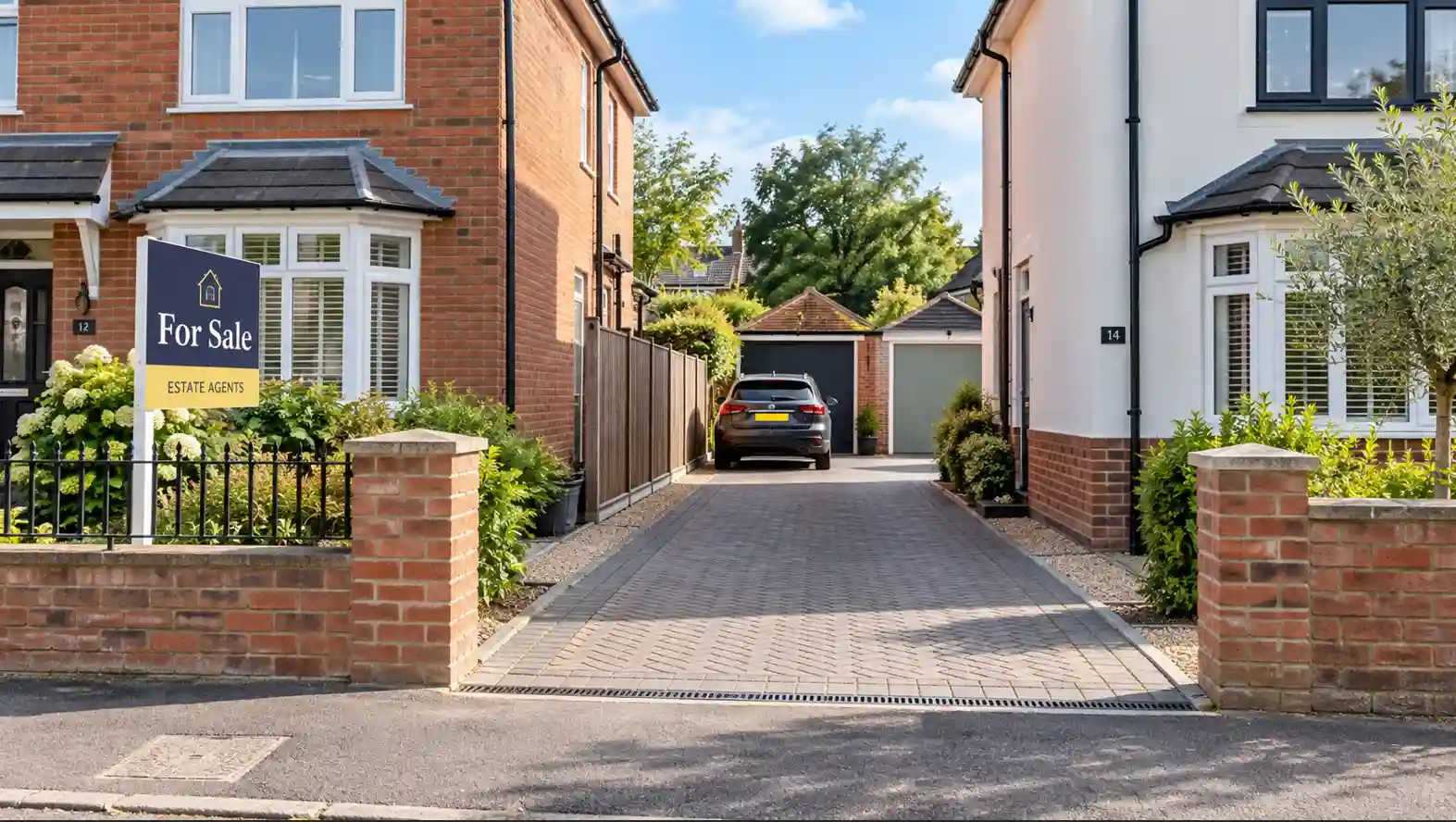
A shared driveway or a right of way over someone else’s land isn’t, on its own, a reason to walk away from a property. Plenty of perfectly ordinary homes are accessed this way, and many of those arrangements work for decades without anyone giving them a second thought. The risk isn’t the arrangement itself — it’s exchanging contracts without actually knowing what it is, because by then the questions that were relatively cheap and easy to ask before you committed can become expensive and difficult to resolve afterwards.
The difficulty is that “shared driveway” describes how a piece of land looks, not necessarily what anybody’s legal rights over it are. Two houses might use the same entrance, but one could own the entire driveway while the other has a right to cross it. Both could own different sections with reciprocal rights of access. The land might belong jointly to the properties, or a management company might own it and control its use.
From the pavement, those arrangements can look almost identical. They can also produce very different answers about where you’re allowed to park, who can use the access, whether a neighbour can install a gate and who is expected to pay when the surface needs replacing.
This is particularly important when the driveway is part of what attracted you to the house. Perhaps you’ve been told there is off-road parking for two vehicles, or the estate agent has pointed out a garage at the rear. You can see how you would reach it, and the seller has apparently been doing so for years. It is easy to assume that the legal right to use the route must therefore be straightforward.
Sometimes it is. But a driveway that works perfectly well during a viewing can conceal an arrangement that is poorly documented, dependent on somebody else’s goodwill or rather narrower than the access you thought you were buying.
The following considerations apply principally to residential purchases in England and Wales, where exchange of contracts normally creates a binding commitment to buy. Scotland and Northern Ireland have different conveyancing arrangements, although many of the practical questions about shared access remain relevant.
The driveway you see isn’t necessarily the driveway you’re buying
The title register and title plan are the starting point, not the finishing point. They help establish what land belongs to the property and what rights may exist over neighbouring land, but they need to be read together with any relevant deeds, transfers or conveyances.
There is a distinction here that buyers often overlook. Your prospective property might benefit from a right of way across somebody else’s land, giving you legal access to a garage, garden or entrance. Alternatively, you might be buying land that is burdened by a neighbour’s right of way, meaning that somebody else will have an established entitlement to cross part of your property. It is also possible for both arrangements to apply, particularly where neighbouring households own different sections of a shared driveway.
Those are not interchangeable positions.
If the house you are buying benefits from the access, your concern is whether that right will allow you to reach and use the property as intended. If you are buying land subject to somebody else’s right, the concern is what that neighbour is entitled to do on land you will own, and whether it affects your intended parking, landscaping or other plans.
Imagine viewing a house with a generous paved area beside it. The agent describes it as a shared driveway, but there appears to be ample room for two cars. You might reasonably picture parking one car near the house and leaving the other towards the entrance. What you haven’t yet established is whether a neighbouring property has a right to cross the precise area where you intend to park.
The fact that the seller has been parking there does not necessarily mean that the arrangement is legally secure. A neighbour may have tolerated it, or the existing households may simply have found a workable way of sharing the space. That can be perfectly satisfactory in practice, but it is different from having a legal entitlement that you can rely upon after the seller moves out.
The title plan itself should not be treated as an exact survey of every boundary or access route. HM Land Registry generally uses what are known as general boundaries, meaning that the plan identifies the general extent of the property without necessarily fixing the precise legal boundary on the ground. Its guidance on title plans and general boundaries explains that there is no standard measurement or tolerance that can simply be applied to establish the exact position.
This matters when a driveway is narrow or when parking depends on the precise extent of the access. A coloured strip on a plan can help identify the land involved, but it will not necessarily answer whether a particular parking position, gate or turning area is legally available to you.
The wording of the underlying deeds is often more important than the drawing. HM Land Registry’s practice guide on easements explains how legal rights over neighbouring land can benefit one property while burdening another. Where the title register refers to an older conveyance or transfer, that document may contain the precise wording that determines what can be done.
Your conveyancer should therefore establish more than the fact that a right of way exists. They should identify the land involved, the properties benefiting from and burdened by it, and the terms of the right itself. If the register refers to a filed deed, the relevant wording needs to be obtained and considered rather than leaving the matter at a brief reference in the title.
It sounds like a technical distinction until you discover that the apparently generous driveway has a right of access running through the space where you intended to park your second car. By that point, the difference between what you saw and what you’re legally buying becomes considerably more important.
Access, parking and the rights you actually need
A right of way is not automatically a right to park. This is probably the single most useful distinction for anybody buying a property with shared access, particularly where the driveway appears to provide more parking than the house itself.
A right to pass and repass over land generally concerns travelling across it. It does not, simply by existing, establish an unrestricted entitlement to leave a vehicle standing there. Parking can be the subject of a separate legal right, but that needs to have an appropriate basis rather than being assumed from the presence of vehicular access.
Suppose you’re buying a house with one garage and a driveway that appears large enough to accommodate another car. The right of way may allow you to drive across the neighbour’s land to reach the garage without granting any right to leave your second vehicle on that land. If your household needs two parking spaces, that difference could fundamentally alter how suitable the property is.
The question is not whether the seller currently parks there. It is whether you will have the legal right to do the same.
It is equally important to distinguish pedestrian access from vehicular access. Some deeds expressly grant rights on foot, others mention vehicles, and some use older or less specific wording that needs interpretation in context. A property reached by an established footpath presents a different proposition from one with a legal right to drive to a rear garage, even if somebody has occasionally managed to take a vehicle along the route.
Older documents can introduce awkward questions about modern use. A right drafted many decades ago may not specifically mention delivery vans, removal vehicles or the larger cars that households commonly own today. The absence of modern terminology does not necessarily mean those uses are prohibited, but neither should a buyer assume that every conceivable vehicle and activity is automatically covered.
Ordinary visitors, tradespeople and deliveries may fall within a residential access right, depending on its wording and purpose. That does not necessarily extend to unrestricted traffic associated with any future commercial activity, nor does an access right benefiting the house automatically authorise its use for separately acquired adjoining land.
For a buyer, the useful question is whether the legal arrangement supports the ordinary way you expect to live in the property. Can you drive to the garage? Can visitors and deliveries reach the house as intended? If parking on the shared section is important, is that parking actually authorised? If there is a gate, can everyone entitled to use the access operate it without relying on the neighbour being available?
It is also worth considering how any existing arrangements could change. A shared entrance that is always open during viewings may be subject to rights allowing the landowner to install a gate, provided the legal access is not substantially interfered with. You may be comfortable opening an ordinary gate each time you leave, but less enthusiastic about electronic access that requires codes or remotes to be shared between several households.
Where a right appears unclear or incomplete, it does not automatically follow that the purchase is impossible. Easements can sometimes arise through implication or long use even where no express grant is obvious in the register. Evidence of historical use, including statutory declarations and supporting documents, may become relevant to establishing the position.
That is not, however, something a buyer should casually accept on the basis that everybody has used the driveway for years. Historic use does not automatically create a legal right simply because it has continued for a long time, and an informal permission from a previous landowner may be very different from an enforceable easement.
If the title does not clearly establish access that is essential to your intended use of the property, your conveyancer needs to explain what legal basis is being relied upon, what evidence supports it and whether anything further is required before exchange.
A missing or uncertain right may sometimes be addressed through formal documentation, agreement with the relevant landowner or another solution acceptable to the conveyancer and lender. In other cases, the uncertainty may remain significant. Title insurance, where proposed, should not simply be treated as equivalent to obtaining the legal right itself; your conveyancer should explain what it would and would not protect.
The important thing is not that every shared driveway must have a perfectly modern deed. It is that you understand the legal basis of the access you are relying upon before committing yourself to the purchase.
The maintenance question — and the bill nobody mentioned
Shared access can work harmoniously for years until the surface begins to fail. Potholes appear, drainage becomes a problem or somebody decides the entire driveway needs resurfacing. Suddenly, an arrangement that has never caused an argument becomes a disagreement about who owes several thousand pounds.
There is no universal rule that two households using one driveway must split every repair bill equally. A right to use an access and a legal obligation to pay towards its maintenance are separate matters.
The original transfer or another enforceable agreement may require each property to contribute a defined proportion of the cost. Some arrangements allocate responsibility according to particular sections of the route, while others involve management companies or wider estate-maintenance provisions. Where an ordinary right of way exists without a specific maintenance arrangement, it should not automatically be assumed that either household can demand an equal contribution from the other.
This is worth asking your conveyancer about directly, but the legal obligation is only half the story. The other half is what maintaining the driveway has actually cost, and what it is likely to cost in the foreseeable future.
A document requiring three properties to contribute towards maintenance may sound reassuring. It tells you very little, however, about whether the access has recently been repaired, whether the drainage is adequate or whether the surface is approaching the end of its useful life.
Consider a long private driveway serving four houses. All four owners may have clear rights of access and a perfectly respectable arrangement for sharing maintenance. But if the drive now needs major resurfacing, your new property might come with an expensive contribution shortly after completion. That does not necessarily make it a bad purchase, but it is something you would probably rather know while you can still consider the price and your budget.
Ask when the surface was last substantially repaired, who arranged the work and how much it cost. If the seller has records of invoices, previous contributions or correspondence about planned repairs, those can give a more useful picture than a general assurance that maintenance is shared.
The history of payments matters too. A maintenance clause may be reasonably clear while the existing neighbours disagree about what work is necessary, whether an improvement goes beyond ordinary repair or how the costs should be divided. Conversely, the households may have an informal arrangement that has worked smoothly for years without any major expenditure, leaving its enforceability and durability uncertain.
On newer developments, estate or management-company arrangements may control maintenance, parking and the use of shared areas. A property may also be subject to estate charges or other obligations associated with privately maintained access. These should be understood as part of the overall cost of ownership, not treated as an insignificant detail simply because the entrance looks like an ordinary residential driveway.
The same consideration arises with longer private or unadopted roads. A right to use the road does not necessarily resolve responsibility for maintaining its surface, verges, lighting or drainage. The longer and more heavily used the access, the more important it can be to establish who organises repairs and how contributions are recovered.
A well-documented maintenance arrangement can be a positive feature, not a warning sign. What deserves attention is the uncertainty: a deteriorating surface, no clear responsibility for repairs and neighbours who have already demonstrated that they cannot agree about paying for them.
It is much easier to decide whether you’re comfortable with that position before exchange than after receiving the first invoice.
The neighbour disputes that don’t appear in the photographs
A shared driveway can be legally sound and physically convenient while still creating an unpleasant living arrangement. That is why the history between the current owners deserves attention alongside the legal documents.
Perhaps the seller has a perfectly valid right to reach the garage, but the neighbour regularly leaves their visitors’ vehicles across the entrance. Perhaps there has been an argument about whether gates should remain locked, or one household has repeatedly refused to contribute to repairs. The underlying legal rights might be clear, yet exercising them could still be a source of continuing friction.
These are not necessarily reasons to reject the property. They are reasons to understand what you may be inheriting.
The Law Society’s TA6 Property Information Form is one of the principal ways relevant matters are raised during the conveyancing process in England and Wales. The sixth edition is the current form for new Conveyancing Quality Scheme instructions from 30 March 2026, and the Law Society’s explanatory notes for the TA6 address matters including disputes, rights and arrangements involving neighbouring land.
Sellers are expected to answer relevant enquiries accurately and honestly based on their knowledge. Their answers may identify disputes, informal access arrangements or issues involving jointly used areas that would not be apparent from the title documents alone. But the form is not a guarantee that every potential problem has been uncovered, and an answer such as “not known” may be legitimate.
It is worth asking specifically whether disagreements have arisen over parking, gates, blocked access, repairs or the boundaries of the shared area. If there have been complaints, what happened and how were they resolved? Is there an agreement in writing, or has everybody simply resumed using the driveway without settling the underlying issue?
A seller who says there has never been a problem may be describing their own experience accurately. Their household may have been content with arrangements that you would find unsuitable, particularly if you have more vehicles, work different hours or intend to use the property differently.
That is one reason to distinguish between whether an access arrangement has caused problems for the seller and whether it is appropriate for you.
A driveway shared by two households with one car each might work effortlessly. The same physical space could become more challenging when one property has several drivers, frequent visitors or regular deliveries. The rights need to support the use you expect, but the practical living arrangements matter too.
It is sensible to raise concerns through your conveyancer rather than relying solely on reassurances given during a viewing. Where something appears inconsistent with the paperwork or the seller’s replies, clear written enquiries give the matter a better chance of being properly investigated before exchange.
The aim is not to search for reasons to mistrust everybody involved. It is to avoid buying into an unresolved problem without knowing that one exists.
A legal right is one thing. Using the driveway every day is another.
Paper rights and physical reality do not always match. An easement can be perfectly valid while the route it protects is narrow, awkwardly designed, poorly surfaced or simply unsuitable for the way you intend to use the property.
This is why the driveway deserves its own careful inspection, not just a glance as you arrive for a viewing.
Walk the whole access where you are permitted to do so, and consider how it would work with the vehicles and everyday activities your household actually has. If you expect to drive along it, establish whether there is sufficient width and manoeuvring space. A route that seems generous when empty may become less convenient once neighbours’ cars, wheelie bins and visitors are taken into account.
A rear garage might be legally accessible but awkward to use if reaching it requires reversing a considerable distance along a narrow track. A gated entrance might seem secure and attractive on the first viewing but less appealing after several journeys each day. A driveway shared with a working farm entrance or commercial activity may have a different character from the quiet residential access you imagined.
Consider deliveries and moving day as well. Can a removal vehicle reasonably approach the house, or will your belongings have to be carried from the road? Is there room for visitors to stop without obstructing other properties? If you depend on convenient access because of mobility requirements, will the arrangement genuinely meet those needs?
Physical suitability and legal entitlement are not identical, so the ability of a large vehicle to reach the house does not necessarily mean it has a legal right to use every part of the route. Nevertheless, understanding how the access works on the ground can reveal questions that need to be put to the conveyancer before you commit.
It is also worth comparing the actual route with the one described in the deeds. Sometimes households have gradually begun using a slightly different area because it is more convenient, without anyone considering whether the documented access still corresponds to what happens on the ground. That might never have caused a dispute, but a buyer should not assume that longstanding practice has automatically resolved the legal position.
Photographs taken during viewings can be surprisingly useful. They give you something to compare against the plans and a clear way of showing your conveyancer any apparent difference between the documented route and the access being used.
If the arrangement is particularly important to your decision, a further visit before exchange may be worthwhile. A driveway can look very different when several households are home, bins are out or the spaces that appeared empty during the first viewing are being used.
The point is not to expect the convenience of a private driveway from an arrangement that is genuinely shared. It is to understand the compromise you’re buying, and decide whether it is one you’re comfortable living with.
What your mortgage lender — and your future buyer — will think
The presence of a shared driveway is not usually the central mortgage issue. What matters more is whether the property has the legally enforceable access it needs, whether the rights are properly established and whether the arrangements satisfy the lender’s requirements.
The UK Finance Mortgage Lenders’ Handbook requires conveyancers acting for lenders to consider whether a property has the easements necessary for its full use and enjoyment, including pedestrian and vehicular rights of way where required, and whether those rights are enforceable by the borrower and future owners. The relevant provisions can be found in the UK Finance Mortgage Lenders’ Handbook for England and Wales.
That makes a house with clearly documented vehicular access over its neighbour’s driveway a rather different proposition from one that physically depends on crossing neighbouring land but has no established legal right to do so.
The first may present little difficulty. The second could require additional evidence, documentation or investigation before the lender is satisfied. A solicitor acting for the mortgage lender may need to report a problem and obtain instructions rather than simply proceeding on the assumption that access has always worked.
Privately maintained roads and shared arrangements can also prompt questions about responsibility for upkeep. A lender may want to be satisfied that the necessary rights and arrangements are adequate for the property’s continued use and value, particularly where future owners will depend on them.
For that reason, it is worth raising any unusual access arrangement early in the transaction. Your conveyancer is responsible for investigating and reporting title matters within the lender’s requirements, while your broker can help you understand whether there may be lender-specific concerns. Discovering a significant access defect shortly before exchange is an avoidable source of stress.
There may be ways to resolve uncertainty, but they need to be assessed rather than assumed. Sometimes an appropriate deed or additional evidence can establish the position. In other circumstances, an indemnity insurance policy may be suggested as protection against a particular legal risk. Such a policy should not be mistaken for creating a missing right of access or guaranteeing the practical use of the driveway. Your conveyancer should explain the limitation and whether the proposed solution satisfies both you and the lender.
This is also a reason to think beyond your own purchase. One day, you may be the seller answering exactly the same questions for another buyer, another conveyancer and another mortgage lender.
A clear, enforceable right of way, supported by accessible documents and workable maintenance arrangements, is comparatively straightforward to explain. An access whose legal basis remains uncertain, whose route differs from the deed or whose use has generated years of disputes may be considerably harder to present with confidence.
You might personally be willing to live with an awkward entrance or an informal arrangement. Your future buyer may not be, and their mortgage lender may have requirements that leave less room for flexibility.
An access arrangement you are comfortable with today therefore deserves consideration as part of the property’s future saleability, not merely its present convenience.
What needs settling before you exchange contracts?
The purpose of investigating a shared driveway is not to eliminate every conceivable inconvenience. It is to establish which rights and responsibilities will come with the property, identify any material uncertainty and decide whether the arrangement still represents the purchase you thought you were making.
By the time exchange approaches, you should understand who owns the access, whether the property benefits from rights over neighbouring land or is burdened by rights belonging to others, and what those rights actually permit. The relevant deeds should have been obtained and considered where necessary, rather than relying on a general assurance that the house has always had access.
You should also know whether the arrangement provides the parking and vehicular access you genuinely need, whether the physical route corresponds with the documented right, and what obligations exist for maintenance. The seller’s replies should have been considered for previous disagreements, while any significant repairs, unusual access arrangements or questions raised by the lender should have been addressed.
If something remains uncertain, ask your conveyancer to explain its significance in plain English. There is a considerable difference between a minor documentary ambiguity that does not materially affect the property’s use and an unresolved question over whether you have any enforceable right to drive to your garage.
A useful question is not simply whether the solicitor is satisfied with the title, but whether the access legally supports the particular use you intend to make of the property and whether any remaining concerns are acceptable to your mortgage lender.
Where a significant problem is identified, there may be scope to seek clarification, obtain additional documents, agree corrective steps with the seller or reconsider the purchase price in light of the actual arrangement. In some cases, delaying exchange until an essential right is established will be more sensible than proceeding on the expectation that everything can be sorted out afterwards.
And occasionally, a material uncertainty may change whether the property is right for you at all. If the house was attractive largely because it appeared to offer two parking spaces, discovering that one of them depends entirely on a neighbour’s permission is not a minor legal technicality. It changes what you’re buying.
The same applies to essential access. A home that depends on an unresolved right across somebody else’s land carries a different kind of risk from one with clear, enforceable access, however similar they might look during a viewing.
Most shared driveways will not present difficulties of that kind. The rights are established, the maintenance arrangements are workable and the households use the space without constant disagreement. There is no reason to treat the existence of shared access as an automatic warning sign.
But buying a house is a substantial commitment, and exchange is the wrong moment to discover that an important part of the property doesn’t work legally in the way it appeared to work physically.
You don’t need every shared driveway to be perfect. You need its limitations, responsibilities and rights to be understood before they become yours.
The risk isn’t sharing the access. It’s buying before anybody has properly established what “shared” actually means.
This article provides general property information and does not constitute legal, conveyancing, mortgage or other professional advice. It focuses principally on residential purchases in England and Wales. Shared-driveway arrangements, rights of way, parking entitlements and maintenance obligations depend on the relevant title documents, deeds, historic rights and individual circumstances. Your conveyancer should investigate any material access or title issues, explain their implications and confirm that relevant lender requirements have been addressed before exchange.

