

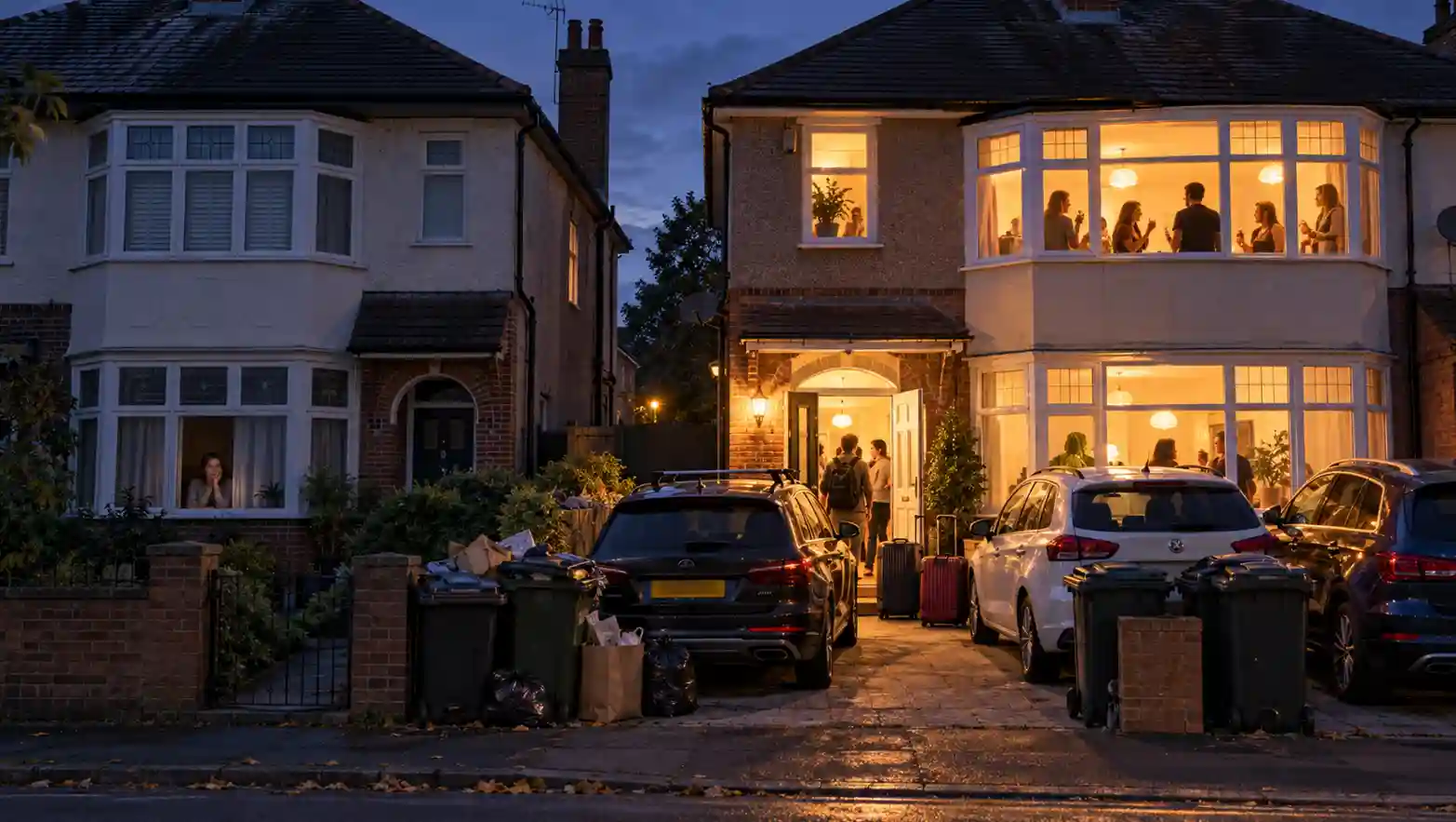
Most of what’s written about short-term letting is aimed at the person doing the letting: can I do this, what will it earn me, do I need permission. Almost none of it is written for the person who already lives next door and didn’t choose any of it — the resident who now has a rotating cast of strangers on the other side of a party wall, wheelie bins that never seem to go out on the right day, cars parked across a shared drive at 2am, and a management structure that seems designed to make it unclear who’s actually meant to deal with any of it.
The honest starting point is that “it’s an Airbnb” isn’t itself the problem, legally speaking, in most of the UK. What matters is what the use is actually doing to you, and that’s also the key to working out who can do something about it.
A short-term let can be operating lawfully while causing a genuine noise nuisance. Equally, a property might be in breach of planning rules, licensing requirements or a lease even if its guests are relatively quiet. Those aren’t contradictions. They’re different legal questions, and treating them as one is often what sends residents from department to department without anybody taking responsibility.
Work out what kind of problem you actually have
A single noisy weekend from one particularly boisterous group of guests is a different problem from a pattern of disturbance that repeats with every new booking. The first is, frustrating as it is, closer to the kind of one-off nuisance any neighbour might occasionally cause. A genuinely useful first step is contacting the host or property manager directly, since a responsible operator has a commercial reason to deal with complaints before they affect future bookings.
If the property is advertised on Airbnb, the platform has a dedicated Neighbourhood Support service through which nearby residents can report parties, noise and other neighbourhood concerns. Airbnb can investigate reports and may take action against listings or users where its policies have been breached. Other booking platforms may have their own reporting arrangements. This isn’t a guaranteed solution, and the platform doesn’t replace the council’s legal powers, but it’s often a more direct route for a disturbance happening during a particular guest’s stay.
A recurring pattern is different, and it’s worth being precise about what’s recurring. Noise at unsociable hours from a stream of different guests is still noise from the premises. In England and Wales, the statutory nuisance provisions of the Environmental Protection Act 1990 can apply where that disturbance unreasonably and substantially interferes with the use and enjoyment of a home, or injures health or is likely to do so. The council can investigate persistent noise regardless of whether the people responsible change every weekend. The Government’s guidance on neighbour noise complaints explains that route, while Property Front Page’s separate article on neighbour noise covers the practical escalation process in greater detail.
The fact that several different bookings have each produced a noisy evening may be important evidence. A host who claims every complaint concerns an isolated guest can overlook the possibility that the property has developed a recurring pattern of disturbance. For the resident next door, it’s the cumulative experience that matters: how often sleep is interrupted, how long the noise continues and how substantially it interferes with ordinary life at home.
Parking, rubbish and shared access raise different questions. Cars obstructing a shared private driveway may involve rights of access or property covenants. Guests leaving rubbish in communal corridors or repeatedly misusing a shared bin store may be a matter for the managing agent or freeholder. Parking illegally on a public highway brings different enforcement responsibilities into play. None of those issues is automatically resolved by making a statutory noise complaint, even if they arise from the same short-term let.
Threatening behaviour, violence, criminal damage or an immediate danger is different again. Those are matters for the police and, where necessary, emergency services, regardless of whether the people involved are holiday guests, long-term tenants or owner-occupiers.
If the problems continue, keep a record that separates them rather than simply describing the property as troublesome. Note when guests arrive, when disturbances occur, what happens in shared areas and how the incidents affect your home. Keep relevant photographs, correspondence with the operator and complaint reference numbers. A record showing late-night parties across six different bookings is much more useful than an allegation that the property has become a nightmare because it’s on Airbnb.
Who’s actually meant to deal with it — and where that breaks down
The host or operator is, in theory, the first point of contact and the person with the most direct control over bookings, house rules and guest behaviour. In practice, an absent owner may have handed day-to-day management to an agency, a cleaning contractor may be the only person regularly visiting the building, and the platform may have no immediate means of resolving a problem with access or parking. It’s quite possible for every organisation involved to refer a resident to somebody else.
That is why identifying the responsible party matters. If the owner or operator is willing to engage, ask for a reliable contact for problems occurring during a guest’s stay, not merely an email address that receives a reply three days later. A simple arrangement covering noise, rubbish collection and guest parking may solve much of the problem without formal action. If the operator refuses to engage, the next step depends on which responsibility has actually been neglected.
Environmental health is interested in nuisance, not the business model next door. The council can investigate qualifying noise from a short-term let just as it can investigate noise from another home, but it doesn’t acquire broader powers simply because guests paid to stay there. Where sufficient evidence establishes statutory nuisance, formal enforcement may follow. Where it doesn’t, the council may have limited scope to intervene even if the situation remains frustrating.
Planning enforcement asks a different question: has the way the property is being used changed sufficiently to require planning permission, and is that use lawful? A property advertised occasionally to guests isn’t necessarily in the same planning position as one operating continuously as visitor accommodation, with frequent arrivals, departures and disturbance. Outside areas with specific controls, whether a material change of use has occurred can be a matter of fact and degree. The listing itself may be useful evidence, but it doesn’t automatically prove a planning breach.
In a block of flats, however, there may be another route entirely: the lease.
Many residential leases restrict how a flat can be used. Some require occupation as a private residence, some prohibit business use, and others contain restrictions on subletting or minimum letting periods. The Leasehold Advisory Service’s guidance on subletting and short-term lets explains why a lease that permits ordinary long-term renting may nevertheless restrict holiday-style occupation.
That doesn’t mean every lease bans Airbnb. The actual wording matters, and so does who has the legal ability or obligation to enforce it. But where short-term guests repeatedly enter secure communal areas, leave luggage in corridors, disturb neighbouring flats or misuse shared facilities, raising the issue with the freeholder or managing agent may be more effective than expecting environmental health to enforce a private lease. If you are a leaseholder yourself, check the covenants and ask the managing agent what steps can be taken if the neighbouring flat is being used contrary to them.
The best complaint is therefore specific about both the conduct and the person or organisation being asked to deal with it. “Flat 8 is an Airbnb” tells a managing agent very little. Repeated incidents involving strangers entering secure common parts, supported by dates and the relevant lease provisions, give them something much more substantial to consider.
Why the planning and licensing picture differs sharply across the UK
This is genuinely one of the more varied corners of UK property regulation, and it’s worth not assuming something you’ve read about another part of the country applies where you live. The same complaint can lead to different legal remedies depending on which nation the property is in, and some of the rules are changing quickly.
England does not currently have a nationwide rule requiring every short-term let to obtain planning permission simply because it’s advertised for holiday accommodation. Outside Greater London, the local planning authority generally assesses whether the actual pattern and intensity of letting amounts to a material change of use. That may involve looking at how frequently the property is occupied by guests, the nature of the activity and the effect on neighbouring properties.
A national registration system is on the way, but timing matters. As at October 2026, the Government’s guidance on self-catering holiday accommodation in England confirms that the mandatory registration scheme is not yet in force, with commencement expected in March 2027. The previously proposed dedicated planning changes should not be treated as though they are already operating. For someone complaining today, existing planning and nuisance powers remain the immediate routes.
Greater London has an additional, long-established restriction. Residential premises can generally be used for short-term sleeping accommodation without specific planning permission only where the relevant statutory conditions are met, including a limit of 90 nights in a calendar year and a requirement concerning council tax liability. London’s official guidance on short-term and holiday lets explains that planning permission is required where the 90-night limit is exceeded. It’s a potentially useful rule for neighbours of a property being let throughout the year, but it isn’t an England-wide limit, and a listing remaining online all year doesn’t prove how many nights it has actually been occupied.
Scotland has the most immediately useful dedicated licensing system for a neighbour trying to establish whether a short-term let is operating lawfully. Short-term-let licensing became mandatory for existing operators from October 2023, following the earlier introduction of the scheme for new hosts. Councils maintain public registers of licensed properties, and mygov.scot’s guidance on reporting short-term-let problems explains how residents can report concerns about nuisance, antisocial behaviour or apparently unlicensed accommodation.
This creates a route distinct from an ordinary noise complaint. A resident can check the council’s licence register and, where appropriate, raise licensing concerns even if the most recent guests have been quiet. Neighbours may also object or make representations during relevant licensing applications, giving them an opportunity to raise substantiated concerns before a decision is made.
Planning control remains separate. Scotland allows local authorities to designate short-term-let control areas, and Edinburgh’s city-wide control area is a prominent example. In a designated area, a new change of use of a dwellinghouse to secondary short-term letting will generally require planning permission, subject to the applicable exceptions and transitional position. A licence doesn’t automatically establish that planning permission has been obtained, just as planning permission doesn’t remove the need for a licence.
Wales already distinguishes between main residences, second homes and commercial short-term letting in its planning system. The Welsh Government’s guidance on planning use classes identifies Class C3 for main residences, C5 for certain dwellings used otherwise than as a sole or main residence, and C6 for commercial short-term lets involving stays of no more than 31 days.
Changes between those classes can ordinarily benefit from permitted-development rights, but councils can remove those rights through Article 4 directions. For a resident, that means checking the particular local planning position rather than assuming every conversion to holiday accommodation requires permission or that none does.
Wales has also reached an important new stage in regulation. Visitor-accommodation registration opened on 1 October 2026, and existing providers generally have until 31 March 2027 to register with the Welsh Revenue Authority. A public register of visitor accommodation is now available, allowing people to search for registered premises. An absence from the register in October 2026 should not automatically be treated as evidence of unlawful operation, however, because the registration deadline has not yet passed.
A separate licensing scheme has been legislated for under the Development of Tourism and Regulation of Visitor Accommodation (Wales) Act 2026, with implementation anticipated from around 2029. That is not a licensing regime already operating in October 2026. The distinction matters if you’re living next to a troublesome holiday let: registration is becoming available now, but planning enforcement and ordinary nuisance powers remain more immediately relevant than making a complaint under a future licensing system.
Northern Ireland takes another approach. Self-catering visitor accommodation generally requires certification from Tourism Northern Ireland, which inspects properties against the applicable accommodation requirements. Tourism NI’s guidance for self-catering accommodation explains the certification process, with certificates normally valid for four years.
That provides a specific regulatory question if a neighbouring property appears to be operating as uncertified visitor accommodation. Certification is not, however, a substitute for planning permission where required, nor does it resolve an ongoing noise complaint or dispute over shared access. Those remain separate matters.
The difference running through all four nations is the important part. Planning enforcement asks whether a particular use is lawful. Environmental health investigates statutory nuisance. A freeholder or managing agent may enforce private lease obligations. A licensing or certification authority deals with its own regulatory requirements. The police deal with criminal behaviour and immediate safety.
None of them is a universal short-term-let complaints department, and no single organisation is necessarily able to deal with every problem a property creates.
For the resident next door, that can feel unnecessarily complicated. But understanding the distinction also provides a way forward. If the real problem is music and shouting at 1am every weekend, a dated record of those disturbances may be more useful to environmental health than screenshots showing that the house is advertised for guests. If the problem is short-term occupation of a leasehold flat where the lease restricts that use, the managing agent may be the more important contact. And if the property appears to be operating as a full-time visitor business without the planning, licensing or certification permissions required locally, that raises a specific regulatory question rather than simply a complaint that the guests are inconsiderate.
What this doesn’t answer
This article deliberately hasn’t covered whether short-term letting is a good investment, how to become a host, what holiday accommodation can earn, or the tax and mortgage implications of running one. That’s a different article, for a different reader, elsewhere.
The question here is narrower and, for anyone already living beside a disruptive short-term let, more useful: what is actually happening, and which of several different routes — host, platform, freeholder, environmental health, planning enforcement, licensing authority or police — is the one equipped to deal with it?
It also isn’t necessarily the case that every problem requires legal enforcement. A responsible host who gives neighbours a reliable contact number, manages guest arrivals, sets sensible house rules and ensures bins are collected may resolve most of the friction without the council becoming involved. The problem tends to become more serious when the property is run remotely, complaints go unanswered and the same behaviour returns with every new booking.
That’s when evidence matters. Not simply evidence that strangers are staying next door, but a clear account of the disturbance, how often it recurs, what effect it has and which attempts to resolve it have failed.
The name of the booking platform tells you how the accommodation is being marketed. What is actually happening at the property tells you where the complaint belongs — and, ultimately, gives you the best chance of getting something done about it.
Important: This article provides general property information, not legal or other professional advice for individual circumstances. Short-term-let planning, licensing, registration and nuisance rules differ across England, Wales, Scotland and Northern Ireland and are changing. The position may also depend on the particular planning history, lease, council area and type of accommodation. Check current guidance from the relevant authority and obtain professional advice where significant rights or costs are involved.

