

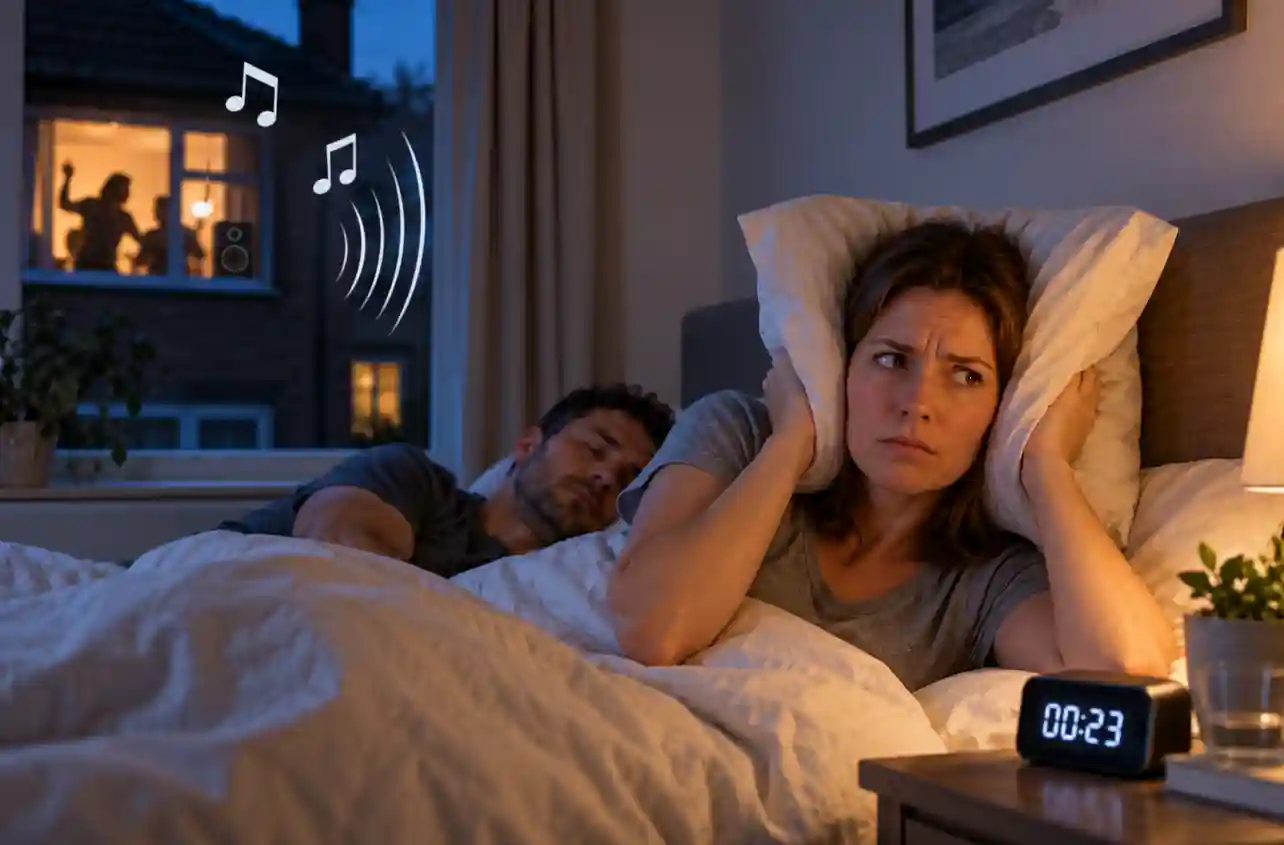
Three nights this week, music has come through the wall after midnight. It’s not loud enough to make out the words, just loud enough to notice, every time, right as you’re falling asleep. Is that something the council can do anything about, or is it just what living next to other people sounds like?
The answer is: it depends on more than the clock. A huge amount of confusion around neighbour noise comes from one persistent myth — that there’s a national cut-off time after which any audible noise becomes illegal. There isn’t. What actually decides whether noise is something the council can act on is a combination of how intrusive it is, how long it goes on, how often it happens, and how much it genuinely interferes with your ability to live normally in your own home.
There’s another distinction worth understanding from the outset. The council has a duty to take reasonably practicable steps to investigate complaints that could amount to a statutory nuisance. That doesn’t mean every complaint will result in enforcement action, but neither does it mean you have to endure months of noise before you’re entitled to report it.
There’s no single “11pm law” — but there is something close to it
Here’s where the myth comes from, and where it’s partly true. In England and Wales, the Noise Act 1996 provides specific powers aimed at excessive night-time noise, covering the period between 11pm and 7am. Under this regime, council officers can investigate noise from neighbouring homes and issue warning notices where it exceeds, or may exceed, prescribed permitted levels. Continuing to make excessive noise after a warning can result in enforcement action, including a fixed penalty or, in appropriate circumstances, the seizure of noise-making equipment.
It’s a genuinely useful tool, but narrower than people assume. The mere fact that you can hear somebody’s television at 11.15pm doesn’t establish an offence. The regime concerns noise above specified levels, assessed under the relevant procedures, and enforcement depends on the council obtaining the necessary evidence. The Government’s guidance on how councils deal with noise complaints explains the warning-notice process used in England.
There’s also a practical difference between having the legal power to intervene and having an officer available to attend your home at midnight. Some councils operate dedicated out-of-hours noise services, while others rely on diaries, recordings, monitoring equipment or investigations during normal working hours. The powers may exist nationally, but the service available on a particular night depends on the local authority. That’s worth checking before assuming someone will be dispatched to measure the music while it’s happening.
Outside that night-time window — and for noise that doesn’t meet the Noise Act’s specific criteria — the relevant legislation in England and Wales is principally the Environmental Protection Act 1990. This allows councils to investigate statutory noise nuisance at any time of day or night. An ongoing problem at three in the afternoon can therefore be actionable even though it’s nowhere near the supposed 11pm cut-off.
Scotland also has statutory nuisance controls, together with a separate noise regime under Part 5 of the Antisocial Behaviour etc. (Scotland) Act 2004, which gives local authorities additional powers over domestic noise where adopted and operated. Northern Ireland has its own statutory nuisance framework and night-noise arrangements, including Noise Act provisions as applied there. The broad principles are familiar across the UK, but the procedures aren’t identical, so the correct reporting route is the one operated by your local council.
What actually counts as noise the council can act on
Under Part III of the Environmental Protection Act 1990, noise emitted from premises can amount to a statutory nuisance where it unreasonably and substantially interferes with the use or enjoyment of a home or other premises, or injures health or is likely to do so. There’s no single decibel figure that establishes statutory nuisance in every situation, and no fixed list of household activities that automatically qualify.
Councils assess the circumstances. How loud or intrusive is the noise? Does it last for ten minutes or continue for hours? Is it happening once, every weekend or most nights? What time does it occur, and what would an ordinary, reasonable person consider unacceptable in that particular setting? A flat above a busy city-centre venue has a different background environment from a quiet residential cul-de-sac, although living in a lively neighbourhood doesn’t mean having to tolerate unlimited disturbance.
This is also where homeowners are most often disappointed by the outcome. Being able to hear your neighbour isn’t the same as being subjected to a statutory nuisance. Footsteps, doors closing, ordinary conversation, children moving around and household appliances can all be clearly audible through poorly insulated walls or floors without necessarily amounting to unreasonable noise-making. It’s a particularly difficult distinction in converted flats, where normal activity can travel surprisingly far through the building.
If poor sound insulation is the underlying problem, environmental health may have limited scope to act against a neighbour who isn’t doing anything unreasonable. In rented or leasehold accommodation, defects in floors, walls or unauthorised alterations might instead need to be raised with a landlord, freeholder or managing agent. A neighbour shouldn’t automatically be blamed for the fact that an ordinary conversation can be heard through a poorly constructed partition.
Loud music, repeated late-night parties, prolonged shouting or persistent banging sit much more clearly within the sort of behaviour councils can investigate, especially where it repeatedly interrupts sleep or substantially interferes with ordinary life at home. But frequency isn’t an absolute requirement. A single exceptionally serious incident can warrant investigation, just as noise that happens repeatedly may still fall short of the legal threshold if it’s ordinary domestic activity.
Once a council receives a complaint about something that could be a statutory nuisance, it must take reasonably practicable steps to investigate. That may involve asking for a diary, arranging a visit, using recording equipment or attempting to witness the disturbance. Where the authority is satisfied that a statutory nuisance exists, or is likely to occur or recur, it generally has a duty to serve an abatement notice requiring the responsible person to stop or restrict it. The Government’s statutory nuisance guidance explains how that process works in England. Breaching an abatement notice without a valid defence is a criminal offence.
The important distinction is between the council’s duty to investigate a potentially valid complaint and its duty to take formal enforcement action once the statutory test is met. The first doesn’t guarantee the second. A council can take your complaint seriously, investigate properly and still conclude that the available evidence doesn’t establish statutory nuisance.
The escalation ladder: what to actually do, in order
1. Work out what you’re actually dealing with. Is this one unusually noisy evening, an ongoing pattern of late-night music or ordinary household sound travelling through thin walls? Understanding the character of the problem helps determine whether a conversation, a complaint to the building’s management or council involvement is the sensible next step. You don’t have to wait for noise to become a nightly occurrence before reporting it, particularly where the interference is serious, but a recurring pattern is often easier to demonstrate.
2. Keep a record. A simple noise diary — date, start and finish time, what you heard, where you heard it and how it affected you — becomes the evidence that everything downstream depends on. An entry saying that amplified music was audible in your bedroom between 12.20am and 1.05am and prevented you from sleeping is more useful than simply recording that next door was unbearable again. Keep the descriptions factual, even when the situation is frustrating.
Phone recordings can help illustrate what a disturbance sounds like, particularly with music, shouting or banging, but they’re not a reliable substitute for professional measurement. Mobile phones adjust sound automatically, and a recording may make something seem louder or quieter than it was in the room. Where the council offers its own recording app or monitoring system, use that process rather than assuming a collection of short clips will settle the question.
3. Approach the neighbour directly, if it feels safe to do so. A surprising number of noise problems arise because somebody genuinely doesn’t realise how far sound travels through a shared wall or floor. A polite conversation about the particular times and sounds causing difficulty can resolve matters more quickly than formal enforcement, especially where the neighbour is willing to move speakers, lower the volume or change the timing of a regular activity. This isn’t a compulsory step, however. If previous contact has been hostile, or you feel threatened or intimidated, there’s no reason to put yourself in an unsafe situation simply to demonstrate that you tried speaking first.
4. If housing arrangements are relevant, contact the landlord or housing provider. Where the noise comes from a rented property, the landlord or housing association may have grounds to investigate behaviour that breaches tenancy conditions. If both properties form part of the same managed building, the freeholder or managing agent may also have a role, particularly where the problem involves communal areas, alterations to flooring or defective sound insulation. This route can sometimes resolve matters without a formal statutory nuisance finding, although a landlord isn’t automatically responsible for every disturbance caused by a tenant.
5. Report it to the council’s environmental health or noise service. You don’t normally need to complete weeks of diary entries before making initial contact. Explain what is happening, how frequently it occurs and how it affects your home, then follow the council’s evidence procedure. Officers may contact the alleged noise-maker informally, ask you to keep further records or arrange monitoring. If the problem happens at night, check whether the authority has an out-of-hours service, since reporting the noise while it’s actually occurring can sometimes make investigation much easier.
If sufficient evidence establishes a statutory nuisance, an abatement notice may follow. If it doesn’t, ask the council what prevented a finding and whether further recordings, a visit at a different time or additional evidence would assist. An unsuccessful initial investigation doesn’t necessarily mean the noise isn’t real, only that the available evidence hasn’t justified enforcement. Keeping a reliable record remains useful if the disturbance continues.
6. Consider mediation. Sometimes the real problem has become a breakdown in relations rather than a neighbour who is deliberately ignoring everybody around them. Different working hours, expectations about quiet, children or the way sound travels through a shared building can create genuine frustration on both sides. An independent mediator may help the neighbours reach a workable arrangement that a legal notice couldn’t easily achieve. Mediation is less appropriate where threats, harassment or intimidation are involved.
7. As a last resort, consider taking your own legal action. In England and Wales, Section 82 of the Environmental Protection Act 1990 allows a person affected by a statutory nuisance to bring proceedings directly in the magistrates’ court, without needing the council to prosecute first. For noise, the person responsible must receive at least three days’ written notice of the intention to bring proceedings. The court must then be satisfied that the relevant statutory nuisance test is met.
This isn’t simply an appeal against a council officer’s opinion, and it shouldn’t be treated as an inexpensive way of forcing a neighbour to be quieter. You’ll need evidence, there may be legal costs and the outcome isn’t guaranteed. But where a serious disturbance continues and the council has been unable to secure a resolution, it’s an option worth discussing with Citizens Advice or a solicitor before pursuing.
Will your neighbour know you complained?
Councils don’t generally need to reveal the identity of every complainant simply to make an initial enquiry about noise, but that shouldn’t be mistaken for a guarantee of anonymity. In a terraced house, a converted building containing two flats or a dispute that’s already been discussed face to face, a neighbour may have a fairly good idea where the complaint came from even if the council never mentions your name.
Your identity and evidence may also become relevant if a formal enforcement case or court proceedings follow. Councils can have confidentiality arrangements for the initial investigation, but an officer’s ability to protect a complainant’s identity may be limited if witness evidence is needed later. If you’re concerned about retaliation, say so when reporting the disturbance and ask specifically how your council handles confidentiality.
There’s also an important distinction between a noise nuisance and a pattern of behaviour intended to threaten or intimidate somebody. Persistent deliberate banging directed at a particular neighbour, threats, harassment or criminal damage may require a different response from an ordinary environmental health investigation. Where you’re being threatened or feel unsafe, the police may be the appropriate service to contact rather than relying solely on the council’s noise team.
If it’s affecting a future sale
A history of noise complaints doesn’t automatically make a property unsaleable, but it’s something to think about if the disagreement becomes prolonged. In England and Wales, the Law Society’s TA6 Property Information Form asks sellers about disputes involving neighbours or nearby properties. The Law Society’s explanatory notes for the sixth-edition TA6 form make clear that this includes past and current disputes and concerns about noise or other disturbances.
That doesn’t mean making one telephone call to environmental health automatically creates a major conveyancing problem. There is a difference between a single complaint about a party and a longstanding dispute involving repeated complaints, formal warnings or enforcement action. The important thing is to answer the questions actually asked during the sale accurately, rather than deciding that a dispute isn’t worth mentioning simply because you’re the person who made the complaint or because the neighbour has temporarily gone quiet.
If a problem has been resolved, keeping the correspondence and any written agreement can help explain the position to a future buyer. An agreement about music being turned down after a certain hour, for example, may demonstrate that an issue was addressed rather than allowed to develop into an ongoing feud. If the problem remains unresolved, trying to conceal it can create a separate and potentially expensive difficulty if misleading information is given during conveyancing.
None of this is a reason to avoid reporting genuine noise nuisance out of fear that a complaint might affect the value or saleability of your home. It’s a reason to deal with the problem proportionately, keep accurate records and make a genuine effort to resolve it before neighbour relations deteriorate beyond repair.
The original question — whether three nights of music after midnight are something the council can do anything about — therefore has a more useful answer than a simple yes or no. The fact that the noise starts after 11pm doesn’t automatically make it unlawful, but neither does its being less than deafening prevent it from amounting to a nuisance. What matters is the character of the disturbance, its timing and frequency, its effect on ordinary life and whether the evidence supports the legal threshold for action.
For most homeowners, the sensible starting point is to record what is actually happening and contact the council if the problem persists or seriously interferes with living at home. You don’t need to know the precise decibel level, and you don’t need to wait until the neighbour has been noisy for months. You do need to give the council something more substantial to assess than the understandable feeling that enough is enough.
Important: This article provides general property information, not legal or other professional advice for individual circumstances. Noise complaints and statutory nuisance proceedings depend on the nature, frequency and duration of the noise, the evidence available and the applicable law. Scotland and Northern Ireland have different procedures from England and Wales. If the situation involves threats, harassment, intimidation or immediate danger, contact the police or seek appropriate professional advice.

