

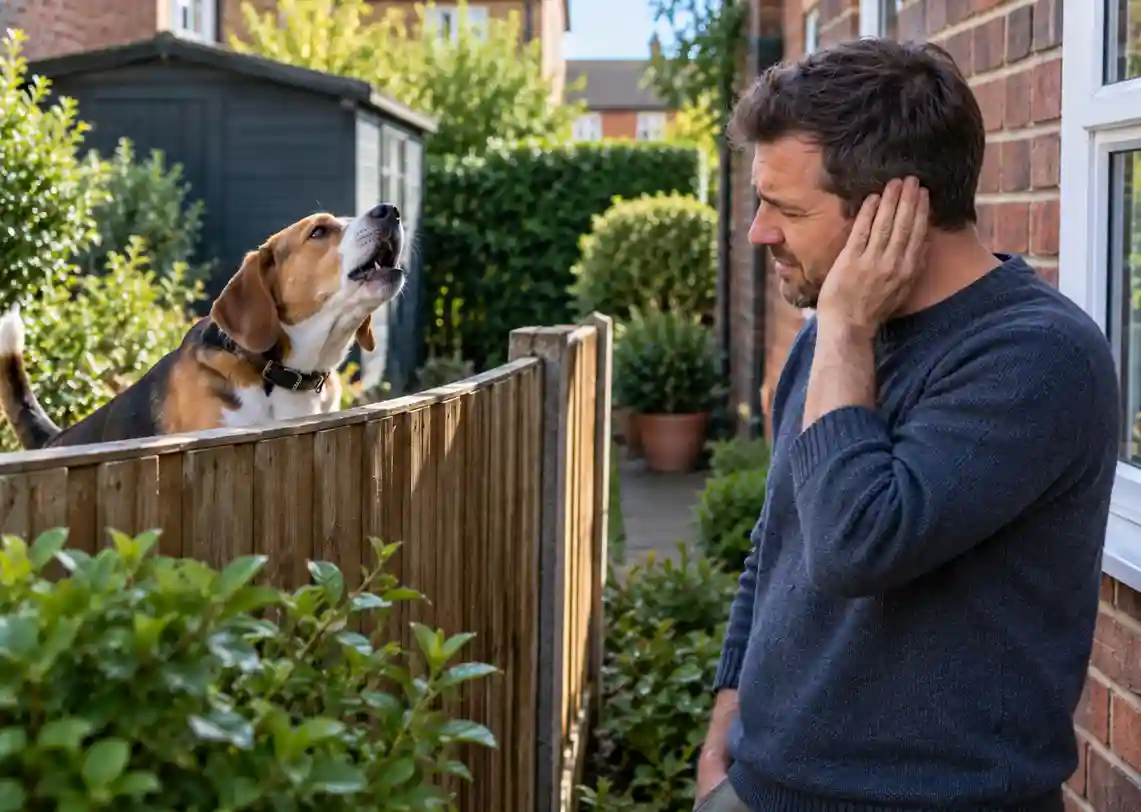
A dog barking for thirty seconds when someone walks past the gate is a dog being a dog. A dog barking on and off for six hours a day, every day, because it’s left alone in a garden, is a different problem entirely — and the gap between those two situations is exactly where most barking complaints get stuck, because everyone involved genuinely disagrees about which one they’re dealing with.
The law recognises that distinction, although there’s no national stopwatch determining how much barking is acceptable. What matters is the pattern, the circumstances and the effect on the people living nearby. A homeowner who can hear the occasional bark isn’t necessarily experiencing a legal nuisance, but somebody whose sleep or ordinary use of their home is repeatedly interrupted may have grounds to ask the council to intervene.
Barking itself isn’t the problem — the pattern is
There’s no rule anywhere in UK law that says a dog is allowed to bark for a specific number of minutes, or that a certain number of barks per hour crosses a legal line. Anyone who tells you otherwise is guessing. What actually matters, under the statutory nuisance framework covering neighbour noise in England and Wales, is whether the barking is sufficiently persistent, prolonged or frequently recurring to unreasonably and substantially interfere with the use and enjoyment of your home, or to injure health or be likely to do so.
Under Part III of the Environmental Protection Act 1990, noise from neighbouring premises can amount to a statutory nuisance, and barking dogs are among the sources councils can investigate. The test isn’t whether the sound irritates you personally, but whether its nature, duration, frequency and impact make it legally unreasonable in the circumstances. Time of day matters too: barking at three in the afternoon may be assessed differently from the same disturbance repeatedly waking somebody at three in the morning.
Councils are consistent on the underlying distinction. An occasional bark at the postman is unlikely to amount to a statutory nuisance, however irritating it might be at that moment. Sustained barking for long periods, repeated howling while an owner is at work or barking that regularly interrupts sleep presents a different picture. But these are examples of potentially actionable patterns, not fixed legal thresholds. A dog doesn’t become a statutory nuisance automatically after an hour, and shorter episodes can still matter where their frequency and impact are sufficiently serious.
There’s also an important difference between being able to hear a dog and being unreasonably disturbed by it. In terraced housing, converted flats and buildings with poor sound insulation, ordinary sounds can travel much further than people expect. That doesn’t mean persistent barking should simply be tolerated, but it does mean a council needs to assess the actual interference rather than assume that every audible animal noise requires enforcement.
Who deals with it — and what they’ll ask you to do first
For an ordinary barking complaint in England and Wales, the starting point is usually the council’s environmental health or noise service, rather than the police. Government guidance on complaining about neighbour noise specifically identifies barking dogs as a potential statutory nuisance. Councils have a duty to take reasonably practicable steps to investigate complaints about matters that could meet that threshold, although an investigation doesn’t guarantee formal action.
The process typically runs in a fairly predictable order:
- Raise it with the owner, if it feels safe and reasonable. A significant number of barking complaints come as a genuine surprise to the person who owns the dog, particularly where it barks mainly while they’re out. A calm explanation of when the problem occurs can be more productive than an accusation that the animal is constantly making noise. This isn’t compulsory, however. If relations are already hostile or you feel uncomfortable approaching the owner, going directly to the council is entirely reasonable.
- Keep a diary. Councils commonly ask for dated records showing when the barking begins, how long it continues, whether it is constant or intermittent and what effect it has on your home. An entry explaining that a dog barked and howled repeatedly between 1pm and 3pm, clearly audible inside your living room, is far more useful than simply writing that next door’s dog was unbearable again. Phone recordings can help demonstrate what happened, although they aren’t necessarily a reliable measurement of the true noise level.
- Report the pattern to environmental health. The council may initially contact the dog owner informally, asking them to investigate the complaint and take steps to reduce the disturbance. You may be asked to continue the diary, submit recordings or use a council-approved monitoring system. The purpose is to establish what is actually happening, rather than immediately treating the owner as having committed an offence.
- Allow the council to investigate if the problem continues. An officer may try to witness the barking directly, arrange monitoring equipment or use other evidence to establish whether the statutory nuisance threshold is met. The barking doesn’t necessarily need to happen while an officer is standing outside your home, but the council needs sufficient reliable evidence to support its conclusion.
- Formal enforcement may follow. Where the council is satisfied that a statutory nuisance exists, or is likely to occur or recur, it generally must serve an abatement notice requiring the nuisance to stop or be restricted. Failure to comply without a valid defence is a criminal offence and can result in prosecution. Depending on the circumstances, an abatement notice may require changes to how the dog is managed, rather than prescribing one particular training method.
There is also a separate enforcement power worth knowing about. In England and Wales, Community Protection Notices under the Anti-social Behaviour, Crime and Policing Act 2014 can address persistent or continuing unreasonable behaviour that damages the quality of life of people in the locality. The Government’s guidance on controlling dogs confirms that these notices can be used in appropriate dog-related cases, with a written warning required before one is issued. They’re not the routine outcome of every barking complaint, and ordinary statutory nuisance enforcement remains the natural starting point where the problem is simply noise from a neighbouring home.
The normal objective is to control the nuisance, not automatically to remove the dog. That may involve changing the animal’s routine, bringing it indoors, preventing access to triggers in the garden or obtaining behavioural assistance. More serious dog-control and animal-welfare legislation can have different consequences in exceptional circumstances, but a neighbour complaining about barking doesn’t, by itself, mean the owner will be forced to give up the animal.
What if the dog is left alone all day?
This is one of the most common underlying causes of persistent barking, and it sits in an interesting overlap between a noise complaint and, potentially, an animal-welfare concern. A dog that barks or howls for hours after its owner leaves may be experiencing separation-related distress, boredom, fear or frustration. The RSPCA’s guidance on excessive barking explains that barking can have several causes, and that understanding why it happens is essential to addressing the behaviour effectively.
That doesn’t mean prolonged barking automatically proves neglect. Some otherwise well-cared-for dogs struggle when left alone, and an owner may be completely unaware of the problem because the animal settles as soon as they return. This is one reason a factual conversation between neighbours can be so valuable: the owner may never have heard the behaviour that’s been disrupting the adjoining household for weeks.
For the dog owner, finding out what happens in their absence is a sensible first step. A camera or suitable recording device can reveal whether the animal is barking occasionally at passing activity or becoming distressed for long periods. A veterinary assessment may be worthwhile where the behaviour is new, while recurring separation-related problems may benefit from advice from a vet or appropriately qualified animal behaviourist. Punishment or devices intended simply to suppress barking can make an underlying anxiety problem worse rather than resolve it.
For the neighbour affected by the noise, the important distinction is between reporting the disturbance and alleging mistreatment. The council’s noise service can investigate whether the barking constitutes a statutory nuisance regardless of whether the dog is otherwise well cared for. If there are additional, genuine welfare concerns — such as obvious injury, lack of adequate shelter or water, or other signs of prolonged suffering — those can be reported separately to an appropriate animal-welfare organisation or enforcement body.
In England and Wales, that may include the RSPCA; in Scotland, the Scottish SPCA; and in Northern Ireland, the USPCA or the relevant statutory animal-welfare authority. Keep the report factual and explain what you have actually observed. A dog barking for several hours is evidence of a possible noise problem and perhaps a reason to investigate its welfare, not proof on its own that the owner is mistreating it.
Flats, multiple dogs, and rented properties
In flats and converted buildings, barking can travel much further than a garden fence — through floors, stairwells, ventilation spaces and thin party walls. The same underlying nuisance principles apply, but it can be surprisingly difficult to establish which property the barking comes from. Before identifying a particular neighbour in a formal complaint, make sure you’re reasonably confident of the source. Where defective sound insulation is significantly amplifying ordinary domestic noise, the building’s construction or management may also be part of the problem.
Where several dogs are kept at one property, the cumulative disturbance is what matters for a nuisance assessment, rather than proving which dog produced each bark. If three dogs regularly bark together, describe what you hear, when it happens and how it affects your home. There’s little value in trying to distinguish individual animals by sound if the problem is the combined noise from the premises.
If the barking is coming from a rented property, you can raise it with the landlord or housing association as well as the council. Tenancy agreements may contain conditions concerning pets, nuisance or antisocial behaviour, giving the housing provider a separate opportunity to intervene. That doesn’t mean a landlord must automatically evict a tenant or can resolve every animal-noise complaint immediately. But an early conversation about the dog’s behaviour may achieve something before formal environmental health enforcement becomes necessary.
If you’re the dog owner facing a complaint, it’s worth taking it seriously even if you believe the allegation is exaggerated. Ask for details of when the barking occurs and how long it lasts, and investigate what your dog does when you’re out. A complaint based on an unusually difficult week may be very different from one describing a problem that’s continued for months. Equally, the fact that your dog is quiet whenever you’re home doesn’t prove your neighbour is mistaken. A recording of what actually happens can be more useful to both households than either side insisting their version must be right.
The position also changes depending on where in the UK the property is located. The Environmental Protection Act’s statutory nuisance framework applies in Scotland as well as England and Wales, but Scotland has an additional route under Section 49(2) of the Civic Government (Scotland) Act 1982. This enables a person experiencing reasonable annoyance from an animal kept near their home to apply to a court for an order requiring the keeper to take steps to prevent the annoyance continuing. The Scottish Government’s guidance on reducing barking also explains the practical measures available to dog owners and the potential legal consequences of persistent noise.
Northern Ireland has its own statutory nuisance legislation and council procedures. nidirect’s guidance on dog barking explains how owners and neighbours can approach the problem and when local authorities may become involved. The practical principles are familiar — establish the pattern, discuss it where appropriate and report a continuing nuisance — but homeowners shouldn’t assume that the precise English enforcement procedure applies unchanged throughout the UK.
Setting realistic expectations
Councils receive barking complaints that range from genuinely serious disturbance to understandable irritation at ordinary animal behaviour. Not all of them meet the legal threshold for enforcement, and a council deciding that occasional barking isn’t a statutory nuisance doesn’t necessarily mean it has failed to investigate properly. Equally, being unable to gather sufficient evidence doesn’t mean the complainant imagined the noise or should simply stop raising concerns if the disturbance continues.
A credible diary showing a genuine, repeated pattern is often what makes the difference. It helps the council distinguish between a dog that reacts briefly to visitors and one that barks or howls for much of the day, and it gives the owner something specific to investigate rather than a vague accusation that their pet is always noisy.
The most useful outcome is usually one that deals with the reason the barking happens. A dog that is distressed when left alone may need changes to its care and routine; one that barks at every passer-by may need a different arrangement in the garden. Those solutions can benefit the animal, its owner and the neighbouring household without anybody needing a formal notice or a court hearing.
The aim isn’t to prove that the dog barks. Most dogs do. It’s to establish whether this particular pattern has crossed from ordinary animal noise into a substantial and unreasonable interference with life next door — and, wherever possible, to resolve that problem before it becomes a lasting dispute between neighbours.
This article provides general property information, not legal, veterinary or other professional advice for individual circumstances. Barking complaints depend on their duration, frequency, timing, impact and the applicable jurisdiction. If the situation also involves threats, a dangerously out-of-control dog or genuine concerns about animal suffering, contact the appropriate police, dog-control or animal-welfare authority rather than treating it solely as a noise complaint.

