

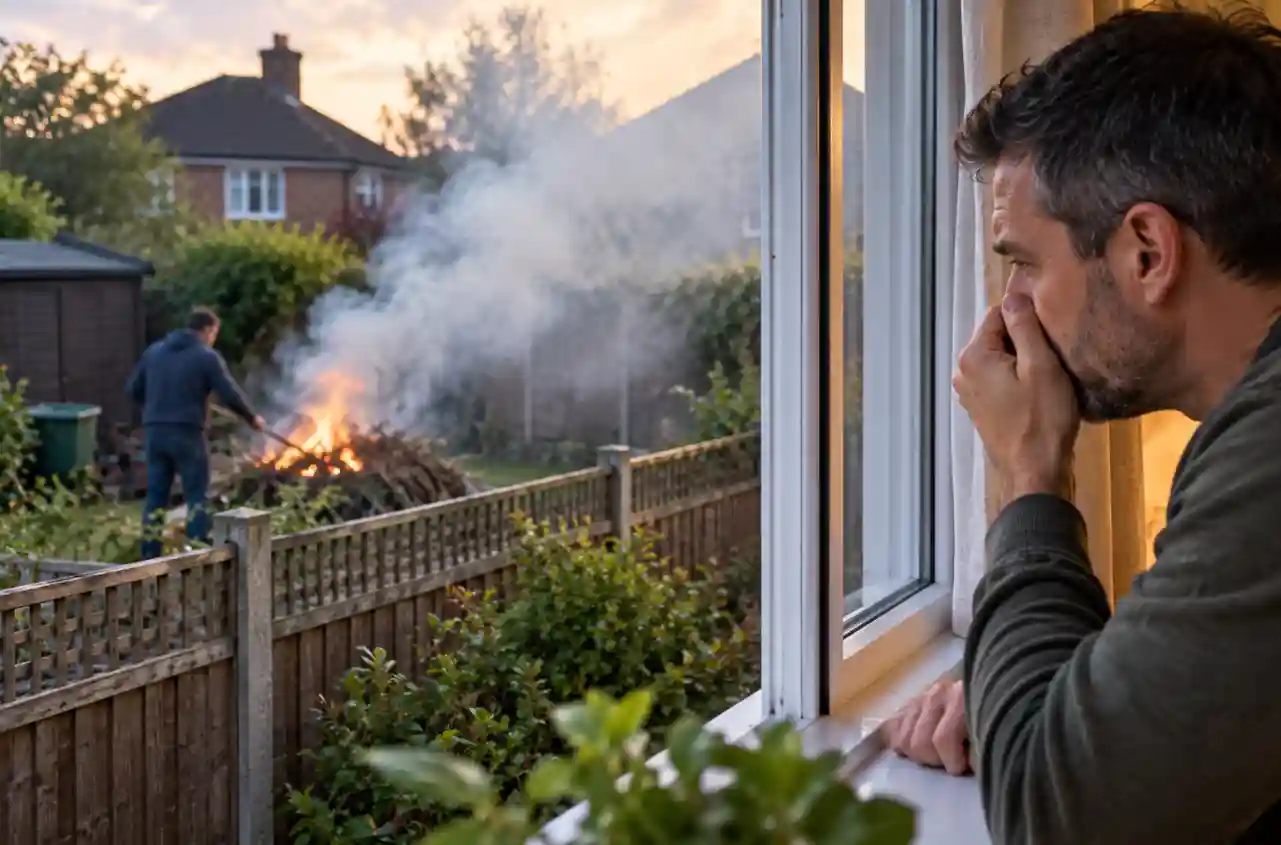
Washing brought in smelling of smoke, windows shut on a warm evening because the alternative is worse, a chest condition that makes every bonfire next door feel like more than an inconvenience. Bonfire smoke is one of the few neighbour nuisances that can genuinely affect health as well as comfort — and one of the most misunderstood, because most people are fairly sure there must be a law about when bonfires are and aren’t allowed. There largely isn’t.
What the law does regulate is the effect of the smoke, what someone is burning and, in certain circumstances, the danger a fire creates beyond the garden itself. A neighbour who lights an occasional, responsibly managed bonfire is in a different position from someone whose fires repeatedly fill the house next door with smoke, and understanding that distinction is the starting point for getting something done about it.
There’s no ban, and mostly no fixed times either
Garden bonfires are generally legal in England and Wales. There’s no national law restricting them to particular times of day, no rule against having one on a Sunday, and no blanket prohibition simply because the property is in a built-up residential area. Multiple councils make this clear, precisely because it’s such a common assumption to the contrary. The official GOV.UK guidance on garden bonfires explains that the rules principally concern nuisance, burning certain kinds of waste and smoke that creates a hazard to traffic.
That doesn’t mean someone can burn whatever they like whenever they choose and disregard the consequences. An allotment agreement, tenancy condition or other restriction applying to particular land may limit fires even where the general law doesn’t. More importantly, the absence of a national bonfire curfew doesn’t give a homeowner an unrestricted right to fill neighbouring rooms with smoke. A fire lit at four in the afternoon can create a legal nuisance just as a fire lit late in the evening can, depending on what happens once the smoke starts travelling.
The legal test: smoke as statutory nuisance
Under Part III of the Environmental Protection Act 1990, smoke emitted from premises can amount to a statutory nuisance if it’s prejudicial to health or amounts to a nuisance. In practical terms, that means smoke which injures health or is likely to do so, or which unreasonably and substantially interferes with someone’s use and enjoyment of their home. There isn’t a fixed number of bonfires that makes the activity unlawful, and there isn’t a national rule saying smoke becomes actionable after a particular number of minutes.
An environmental health officer will consider the circumstances: how often the fires occur, how much smoke they produce, how long it lingers, what appears to be burning and whether the smoke is actually affecting neighbouring properties. A small fire that burns briefly and causes little interference is unlikely to be treated the same way as repeated fires that leave somebody unable to open their windows or comfortably use parts of their home.
This means two things that are worth being clear-eyed about. First, a single bonfire — even an unpleasantly smoky one — will often be difficult to establish as a statutory nuisance, particularly once the fire has gone out and there’s little evidence of its effect. Repeated incidents usually provide a stronger basis for investigation, although an exceptionally serious single incident isn’t automatically excluded from nuisance law. Second, simply being able to see or smell smoke doesn’t necessarily mean a nuisance is occurring. It has to cross the relevant legal threshold, not merely be noticeable.
The important distinction is between an occasional inconvenience that comes with living near other people and smoke that unreasonably interferes with ordinary life at home. It’s not always an easy line to draw, but it’s the one the council has to assess.
What actually strengthens a complaint
A general description that your neighbour is always having smoky bonfires may explain why you’re frustrated, but it gives an environmental health officer relatively little to investigate. The stronger complaints tend to have evidence showing a repeated problem and what the smoke actually does to the neighbouring property.
- Frequency and duration. Regular bonfires, perhaps every weekend or several evenings a week, create a clearer picture than an isolated fire. Record when they start, approximately how long they last and whether the smoke continues drifting towards your property throughout that period.
- What’s being burned. Dry garden material will generally produce less smoke than damp or unsuitable waste. Household rubbish, plastics, foam, tyres, painted or treated timber and similar materials can produce particularly unpleasant or harmful emissions. Burning household waste in a way that causes pollution or harm to health is subject to separate legal restrictions, so the question of what is being burned can matter independently of whether the smoke constitutes a statutory nuisance.
- Direct, demonstrable effects. Smoke entering bedrooms through open windows, repeatedly making a garden unusable, leaving ash on washing or materially worsening a respiratory condition is more useful evidence than a general complaint that the neighbourhood sometimes smells smoky. Photograph visible smoke or ash where possible, and record what you had to do because of it.
- Conditions at the time. Wind direction, still weather and damp material can make a considerable difference to where smoke travels and how long it lingers. A simple diary showing that the same house repeatedly fills with smoke when fires are lit under particular conditions helps establish the connection.
Be accurate about what you’ve actually observed. Dark or acrid smoke may give you reason to suspect inappropriate waste is being burned, but suspicion isn’t the same as witnessing it. Don’t enter the neighbour’s property or put yourself at risk trying to inspect the fire. Describe what you can see, smell and experience from your own home, rather than making allegations you can’t substantiate.
And if you have a respiratory condition that’s genuinely being made worse, mention that specifically when you report the problem. The statutory nuisance framework recognises prejudice to health as a separate consideration, although having a medical condition doesn’t automatically establish that every smoky bonfire is unlawful. The council still has to investigate the circumstances and reach a properly supported conclusion.
Smoke control areas
Many towns and parts of cities are designated smoke control areas under the Clean Air Act 1993. This is where another common misunderstanding arises: people assume that because an area has restrictions on smoke from domestic chimneys, outdoor garden bonfires must also be prohibited.
They aren’t automatically prohibited. The Government’s guidance on smoke control areas expressly confirms that garden bonfires are allowed within smoke control areas, provided the ordinary bonfire rules are followed. Outdoor barbecues, chimineas and pizza ovens are also generally permitted under those rules. Smoke-control restrictions are principally concerned with smoke from chimneys and the fuels or appliances used in them, rather than creating a blanket prohibition on outdoor fires.
That doesn’t make a garden bonfire immune from enforcement. If smoke repeatedly enters neighbouring homes and meets the statutory nuisance threshold, the council can still act. Burning unsuitable waste may raise a separate issue as well. It’s worth checking whether your property is in a smoke control area if you’re concerned about smoke from a chimney or an outdoor appliance connected to a building, but the designation alone doesn’t prove that your neighbour’s ordinary garden bonfire is illegal.
Smoke that reaches a road
If bonfire smoke drifts across a public road and creates a genuine danger to traffic, that’s a separate matter from nuisance law. Reduced visibility can put drivers, cyclists and other road users at risk, even if nobody living nearby has complained about smoke entering their home.
In England and Wales, Section 161A of the Highways Act 1980 addresses danger to highway users caused by fires lit on land away from the road, including the effect of smoke. This isn’t simply a question of whether a neighbour finds the fire unpleasant; it’s whether road users are being injured, interrupted or endangered.
If dense smoke is genuinely making a nearby road hazardous, report the danger to the police rather than waiting for an environmental health investigation. Where visibility is severely affected and there’s an immediate danger to life, treat it as an emergency. Likewise, if the fire itself is spreading towards buildings, fences or people, contact the fire and rescue service. An uncontrolled fire is a safety emergency, not something that should wait for a bonfire nuisance diary to be completed.
What to actually do
1. Talk to the neighbour first, if you feel comfortable doing so. A large number of bonfire disputes come down to someone not realising how their fires affect a particular house nearby. They may not appreciate that the prevailing wind carries smoke directly into your bedroom, that your washing repeatedly needs cleaning again or that somebody in your household has a respiratory condition. A polite, specific conversation can resolve the problem before anybody needs to involve the council. If there’s already hostility or you feel unsafe approaching them, however, there’s no obligation to confront the neighbour yourself.
2. Keep a simple record if the problem continues. Note the date, approximate duration, weather conditions, where the smoke travelled and what effect it had. Record whether you had to shut windows, abandon using the garden or bring washing indoors. Photographs and short videos can support the diary, particularly if they show smoke entering or lingering around your property. The objective isn’t to produce the longest possible complaint; it’s to give the council a reliable account of what has actually been happening.
3. Report it to your council’s environmental health team. Where bonfires repeatedly interfere with your home, the council is the appropriate starting point. Government guidance on nuisance smoke explains that councils in England must investigate complaints about smoke from premises that could amount to a statutory nuisance. You may be asked to continue keeping a diary while officers contact the neighbour informally, arrange a visit or otherwise assess the problem.
If sufficient evidence establishes that a statutory nuisance exists, or has occurred and is likely to recur, the authority generally must serve an abatement notice requiring the nuisance to stop or be restricted. That doesn’t necessarily mean every future bonfire is permanently banned. It means the person responsible must comply with the requirements imposed to prevent the nuisance continuing. Breaching an abatement notice without a valid defence can lead to prosecution.
4. Make the health implications clear. If repeated smoke exposure is worsening an existing condition, tell the council what happens rather than simply saying the smoke is unpleasant. Keep factual notes of symptoms and their timing, and seek medical advice where appropriate. Environmental health can investigate the smoke nuisance, but it isn’t a substitute for healthcare, particularly where breathing difficulties are significant.
5. Report smoke creating a road hazard to the police. A genuine traffic danger needs a more immediate response than an ordinary nuisance complaint, and a fire spreading out of control needs the fire and rescue service. Keeping those situations separate helps ensure the right people deal with the right risk.
If the council investigates but doesn’t establish a statutory nuisance, that doesn’t necessarily mean you have no further options. In England and Wales, Section 82 of the Environmental Protection Act 1990 provides a route for an affected person to bring a statutory nuisance complaint directly before the magistrates’ court. For smoke, the usual requirement is to give the person responsible at least 21 days’ written notice of the intended proceedings. This involves presenting your own evidence and carries potential costs, so it’s worth obtaining advice before treating court action as the next automatic step.
BBQs, fire pits and chimineas
The same underlying principle — genuine, unreasonable interference rather than the mere presence of smoke — applies to barbecues, fire pits, chimineas and outdoor pizza ovens. Their use isn’t automatically unlawful because a neighbour can smell cooking or wood smoke, and an occasional evening around a fire pit is unlikely to present the same circumstances as someone regularly burning large amounts of damp garden waste.
But using a manufactured outdoor appliance doesn’t give someone immunity from nuisance law either. If smoke repeatedly enters the adjoining home or substantially interferes with its ordinary use, environmental health may investigate regardless of whether it comes from a bonfire, a fire pit or something designed specifically for outdoor cooking. It’s the effect of the smoke, not simply the name of the appliance, that matters.
Rented properties
If the bonfires are coming from a rented property, the same council nuisance process applies regardless of whether the person lighting them owns the house. But there may be an additional practical route through the landlord, housing association or letting agent, particularly where the tenancy contains conditions about garden fires, nuisance or antisocial behaviour.
That doesn’t mean a landlord is automatically liable for every fire a tenant lights, or that a tenant can be immediately required to leave because a neighbour has complained. It does mean the person managing the property may be able to address the behaviour informally or remind the tenant of relevant conditions before the dispute reaches formal enforcement.
Tenants affected by smoke have the same reason to keep evidence and report a continuing nuisance to the council. Equally, a tenant considering lighting a bonfire should check the tenancy agreement rather than assuming that the absence of a national ban means the landlord permits garden burning.
Beyond bonfires: garden waste disposal
If the underlying issue is simply how to get rid of garden waste, there are usually easier alternatives to burning it. Many councils offer garden waste collection schemes, while composting, shredding suitable material for mulch or taking waste to a household recycling centre can avoid the smoke problem altogether. Those alternatives may be worth suggesting if the neighbour is willing to discuss the issue but believes burning is the only practical way of clearing their garden.
For homeowners outside England and Wales, the underlying problem is familiar but the legal procedures aren’t identical. In Scotland, smoke from premises can fall within the statutory nuisance framework, and the Scottish Government’s guidance on statutory nuisance explains how smoke can constitute a nuisance or prejudice to health. Northern Ireland has its own environmental legislation and council procedures; nidirect’s guidance on burning rubbish explains the risks of smoke pollution and the role of local councils in investigating complaints. In either jurisdiction, the local authority’s environmental health service is the sensible starting point for a recurring domestic smoke problem.
The law doesn’t give everyone a universal right to a completely smoke-free neighbourhood, but neither does it allow somebody to repeatedly fill the house next door with smoke simply because there is no national bonfire curfew. An occasional garden fire and a recurring problem that prevents someone opening their windows, using their garden or comfortably living in their home are different things.
The sensible response is to establish which one you’re dealing with, explain the problem where it’s safe to do so, and give the council credible evidence if it continues. The question isn’t whether your neighbour is allowed to light a bonfire at all. It’s whether what happens afterwards has crossed the line from an ordinary neighbourhood inconvenience into something the law can properly address.
This article provides general property and environmental information, not legal, medical or other professional advice for individual circumstances. Smoke-nuisance complaints depend on the source, frequency, duration, health effects, applicable law and evidence available. If smoke is affecting a medical condition, seek appropriate healthcare advice. If a fire or smoke creates an immediate danger to people, buildings or road users, contact the relevant emergency service.environmental-health investigation.

