

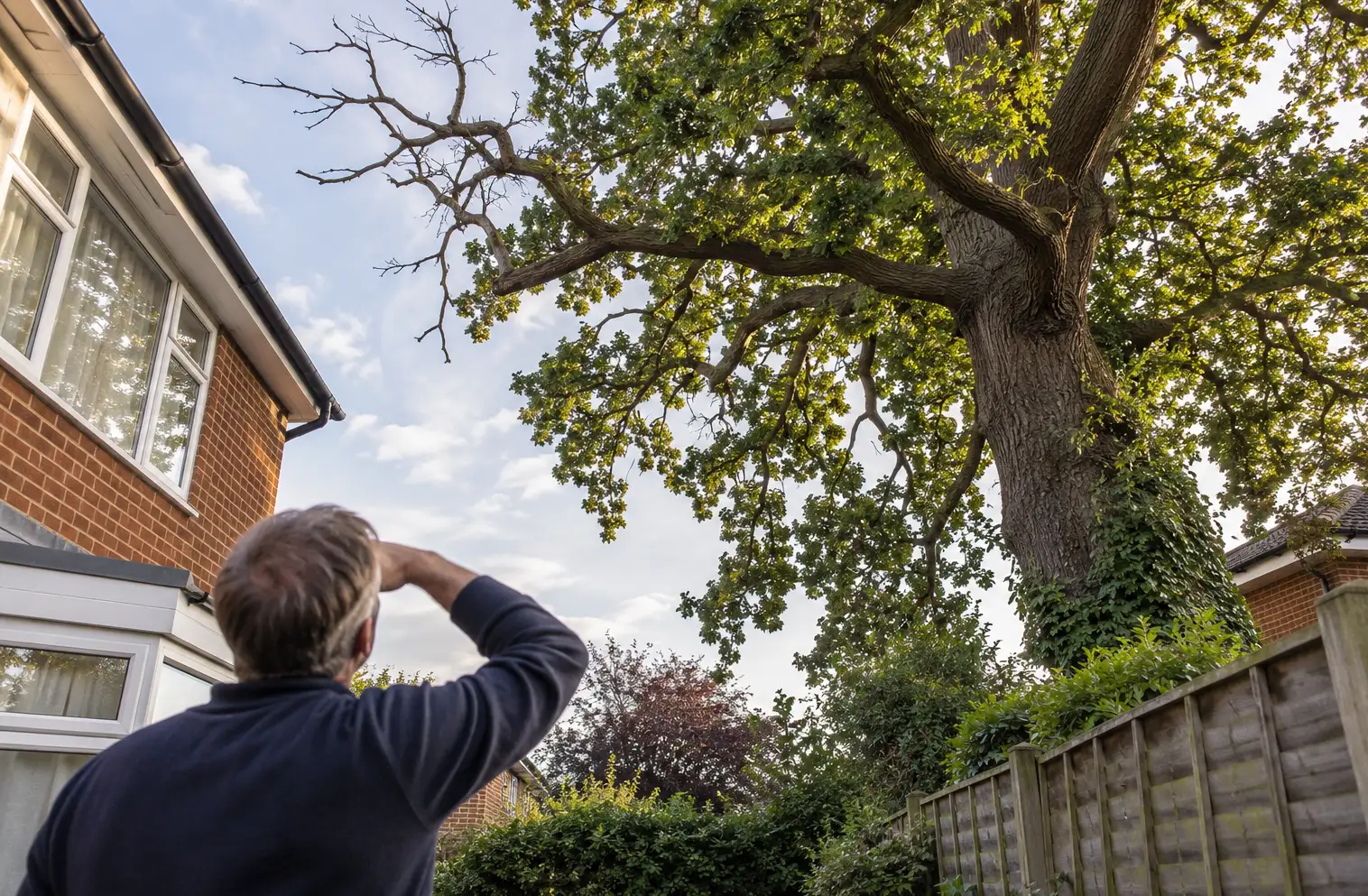
A big tree leaning slightly, or a crown full of branches that look dead from ground level, can be genuinely alarming to live next to — and genuinely difficult to judge from a garden fence. The instinct to demand it comes down immediately is understandable. It’s also not quite how the law, or the practical process for dealing with it, actually works.
A neighbour isn’t automatically obliged to remove a tree because somebody living next door is worried about it. Equally, owning a tree brings responsibilities, and ignoring credible evidence that it could fall or cause serious harm may have consequences.
The difficulty is establishing whether the danger is real. A homeowner might look across the fence and see a heavy crown hanging over their conservatory, while the tree’s owner sees a perfectly healthy specimen that has stood in the same position for decades. Neither perspective tells you much about its structural condition.
The law is concerned with reasonable care and foreseeable danger, not simply whether a tree makes somebody uncomfortable. Even where a genuine defect is identified, making it safe doesn’t necessarily mean cutting it down.
This article concentrates on England and Wales. Scotland addresses comparable issues through its own law of delict, while Northern Ireland has separate legislation and legal principles governing responsibility for dangerous conditions. The particular English and Welsh authorities discussed below shouldn’t be assumed to apply unchanged elsewhere in the UK.
A tree can look frightening without being dangerous
Mature trees aren’t necessarily upright, symmetrical or free from deadwood. Some have leaned naturally for most of their lives, developed cavities or survived decades of storms without presenting an unusual risk.
Others look entirely healthy from the garden while concealing structural weaknesses that an experienced arboriculturist would recognise.
One particularly important distinction is between a longstanding lean and a recent change in the tree’s position.
A tree that has grown at an angle for forty years may simply be adapted to that position. A tree that has noticeably changed angle following a storm, particularly where the surrounding ground has lifted or cracked, presents a different concern. Movement around the root plate can indicate that the tree’s anchorage has been disturbed.
The same distinction applies to branches. A modest amount of deadwood is common in mature trees, whereas a substantial limb that has recently split and remains suspended above an occupied garden deserves prompt attention.
Fungal growth, cavities, exposed decay and damage around major branch unions may also warrant investigation. Their significance depends on the species, location and extent of the defect, which is why photographs taken from a kitchen window rarely settle the question.
There is another consideration that homeowners sometimes overlook: what lies beneath the tree.
A defect in a branch above an unused corner of a large garden presents a different risk from the same defect above a bedroom, children’s play area or busy pavement. The likelihood of something failing matters, but so do the consequences if it does.
The National Tree Safety Group’s Common sense risk management of trees, updated in 2024, advocates a proportionate approach that balances the benefits of trees against the risks they present.
That matters because trees are living structures. Branches occasionally fail, and no reasonable inspection regime can eliminate every possibility of an accident. Treating every mature tree as an emergency would achieve little beyond unnecessary expense and the loss of otherwise healthy trees.
A sudden lean, newly fractured limb or substantial change following nearby excavation is different. Those are the kinds of observations that can justify further investigation rather than relying on the fact that the tree has always been there.
What the law expects from the tree’s owner
Owning a tree doesn’t make somebody automatically liable if a branch falls during a storm.
In England and Wales, the relevant legal principles concern reasonable care and foreseeable danger. A tree owner may be responsible where they knew, or reasonably ought to have known, about a hazard and failed to take appropriate steps to address it.
An important foundation for this approach is Leakey v National Trust (1980), which concerned an unstable hillside rather than a garden tree. The case established a measured duty to respond reasonably to natural hazards on land, taking account of the circumstances and what could fairly be expected of the owner.
For ordinary homeowners, a particularly useful tree case is Stagecoach South Western Trains Ltd v Hind [2014] EWHC 1891 (TCC).
A large ash tree fell from a private garden onto a railway line, where it was struck by a train. The railway company brought proceedings against the homeowner and a tree surgeon who had previously undertaken work at the property.
The tree had concealed defects, but the court found that the homeowner had acted reasonably. She wasn’t expected to arrange regular specialist inspections of an apparently healthy tree when there was no warning that should reasonably have prompted one.
This is an important distinction for anyone who owns a mature tree near neighbouring property. The law doesn’t ordinarily require a householder to employ an arboricultural consultant every year simply because a tree is large.
Reasonable informal observation may be sufficient where there are no apparent problems. But once something emerges that should prompt further investigation — a major structural split, recent storm damage or credible professional advice — the owner may need to do more.
The response still needs to fit the circumstances. A qualified arboriculturist might recommend removing one damaged branch, reducing part of the crown or monitoring a particular defect. Complete removal may be necessary in some cases, but it isn’t automatically the correct remedy.
This is also why a written complaint from next door doesn’t itself establish that a homeowner has been negligent. The concern may turn out to be unfounded after inspection.
The legal position is stronger where there is a recognisable danger that a reasonable owner should have investigated, rather than a hidden weakness that nobody could reasonably have been expected to discover.
There are related duties under occupiers’ liability legislation towards people visiting the land, but those provisions aren’t a general route for neighbours to demand that an otherwise healthy tree be removed. Where the concern is damage or injury beyond the boundary, nuisance and negligence principles may be particularly relevant.
For both households, the practical message is much the same: the tree’s condition needs to be assessed, and the owner needs to respond reasonably to any credible risk.
What to do when your neighbour doesn’t share your concern
A conversation about a potentially dangerous tree can become confrontational surprisingly quickly.
If you tell somebody that their tree is dangerous and must come down immediately, they may assume you simply dislike the tree or want more sunlight in your garden. Even where your concern is genuine, that opening can make cooperation less likely.
It is better to explain what you’ve actually noticed.
Perhaps a large limb appears to have split since the last storm, or the tree seems to have changed angle and the ground around its base is visibly disturbed. These are observations the owner can investigate rather than a demand they must accept without question.
If the danger isn’t immediate, approach the neighbour calmly and suggest that the tree be assessed by a suitably qualified, insured arboricultural professional. Photographs can help explain the concern where they clearly show the suspected defect and can be taken safely.
For significant concerns, put the request in writing.
That doesn’t mean beginning with a solicitor’s letter. A straightforward message identifying the problem and asking whether the owner would arrange an inspection may be enough.
The written record becomes important if the risk is later ignored, but its value depends on what it establishes. A general statement that a tree looks frightening is different from a warning describing a substantial crack, recent movement or professional findings suggesting a serious risk of failure.
An arboricultural assessment can change the discussion entirely. The professional can consider the tree’s structural condition, visible defects, surrounding property and likely consequences of failure, then recommend what work, if any, is necessary.
Sometimes the result will be reassuring. A tree which appears alarming from the neighbouring garden may be structurally sound. In other cases, the assessment may identify work that should be carried out promptly.
If the neighbour refuses an inspection and the concern remains serious, you can consider obtaining your own professional opinion based on what can lawfully be examined from your property or other accessible land. A limited external view may not establish the full condition of the tree, particularly where the suspected defect requires close examination, but it can help determine whether further action is justified.
A professional assessment is generally a much stronger basis for approaching the neighbour again than continued disagreement over how dangerous the tree looks.
Can the council or a court make them act?
Sometimes, although council involvement is more limited than many homeowners expect.
Under section 23 of the Local Government (Miscellaneous Provisions) Act 1976, councils in England and Wales have discretionary powers concerning dangerous trees, including certain situations where a privately owned tree threatens neighbouring land.
Where the statutory conditions are satisfied, an authority may be able to serve notice requiring appropriate safety work. If the owner fails to comply, the council can have powers to undertake the specified work and recover relevant costs.
The important qualification is that the council isn’t obliged to intervene simply because a neighbour complains.
The legislation sets conditions for using those powers, and the authority must consider the tree’s condition and the risk involved. A disagreement about the height, appearance or general desirability of a tree isn’t enough.
That is why evidence matters when approaching the council.
A report that a tree is enormous and worrying is quite different from photographs of a partially failed limb, supported by an arboricultural assessment identifying a substantial danger and correspondence showing that the owner has declined to take reasonable action.
Councils vary in how they investigate dangerous-tree reports and exercise their powers. Some may offer initial advice or direct the parties towards private resolution, particularly where there is no immediate danger. The availability of statutory powers doesn’t turn the council into a general tree-dispute service.
The position is different if a tree threatens a public road or footpath.
Section 154 of the Highways Act 1980 gives relevant authorities powers concerning trees and vegetation that endanger or obstruct public highways and other roads or footpaths to which the public has access. The legislation includes powers to require appropriate work where the statutory conditions are met.
If a damaged tree or unstable branch could fall across a public road or pavement, reporting it to the relevant highway authority may be more appropriate than approaching the council as an ordinary private neighbour dispute.
A court can also potentially intervene where convincing evidence establishes a genuine danger and the owner refuses reasonable measures.
In suitable circumstances, an injunction may require action to address the problem. But obtaining one involves legal expense and uncertainty, and the court won’t necessarily order a tree to be felled simply because removal is the outcome the neighbour prefers.
If appropriate pruning would make the tree reasonably safe, demanding complete removal may be difficult to justify.
For a serious private dispute, an arboricultural report followed by a clear written request will usually be a more productive starting point than immediately threatening proceedings. If the owner continues to ignore credible evidence of danger, specialist legal advice can help establish whether further action is realistic.
The aim is to secure a proportionate response to an established risk, not to obtain legal authority to remove a tree merely because its presence is unwelcome.
A protected tree can still be made safe
Tree Preservation Orders can create another source of misunderstanding.
Some homeowners assume that a protected tree cannot be touched, even if it becomes dangerous. Others assume that declaring a tree unsafe allows them to remove it without involving the local planning authority.
Neither position is correct.
In England, ordinary pruning, substantial reduction or felling of a tree protected by a Tree Preservation Order will generally require consent from the local planning authority. Conservation-area status may also impose notice requirements.
There is an exception where work is urgently necessary because a tree presents an immediate risk of serious harm. The Government’s guidance on Tree Preservation Orders and trees in conservation areas explains that only the work necessary to remove that immediate risk is permitted under the exception.
The tree owner or their agent must give written notice to the authority as soon as practicable after the urgent work becomes necessary.
A tree which may conceivably fail one day doesn’t automatically qualify. The danger must be sufficiently immediate and serious to justify urgent work rather than the ordinary consent process.
Where time permits, obtaining an arboricultural assessment and making the appropriate application is the safer course. If emergency work is genuinely necessary, photographs and professional evidence can help establish why immediate action was justified and why the work was limited to what was needed.
The detailed position differs in Wales, which operates its own tree-preservation procedures. The Welsh Government’s guidance on protected trees provides the relevant starting point, alongside advice from the local planning authority.
Wildlife protection is a separate consideration. A mature or damaged tree may contain an active bird nest or a legally protected bat roost, and the fact that safety work is proposed doesn’t automatically remove those protections.
Where there is time to plan substantial pruning or felling, the arboricultural assessment should consider relevant wildlife risks. Active bird nests and bat roosts can restrict work or require specialist advice and appropriate authorisation under the legislation applying in that part of the UK.
An urgent danger still needs to be made safe. But the work should be proportionate to the emergency, with professional input where practicable, rather than using the description dangerous tree to justify unnecessary additional removal.
When a tree looks ready to fall now
A general worry about a mature tree can wait long enough for a proper assessment. A tree that has become visibly unstable after a storm may not.
A substantial limb hanging partly detached over an occupied area, a tree that has suddenly shifted at its base or obvious fresh movement around its roots can call for immediate precautions.
Keep people and animals away from the potential fall area. Move vehicles only if it is safe, and don’t stand beneath a damaged tree to obtain better photographs or attempt to cut down a large unstable branch yourself.
An emergency arboricultural contractor may be needed to assess the danger and make the tree safe. If a public road or footpath is threatened, alert the relevant authority. Where there is an immediate danger to life, contact the emergency services.
Inform the owner as soon as it is safe and practical. A genuine emergency may require urgent professional intervention, but it doesn’t provide unrestricted permission to enter somebody else’s land or undertake work beyond what is necessary.
For a concern that isn’t immediate, the better approach remains a competent inspection before irreversible decisions are made.
What if you warned the owner and the tree falls anyway?
A previous written warning can become important evidence if a tree subsequently causes damage, but it doesn’t automatically establish liability.
Suppose you complained that a large, apparently healthy tree looked frightening. Several months later, a previously undetectable defect causes a branch to fail during severe weather. The existence of your letter doesn’t necessarily mean the owner should have anticipated or prevented the failure.
Now consider a professional assessment identifying a seriously weakened limb hanging over your property. The report recommends prompt work, the findings are supplied to the tree owner, and no reasonable action follows.
If that identified defect subsequently causes the damage the report warned about, the question of foreseeability and the adequacy of the owner’s response becomes much more significant.
The precise circumstances still matter. A court or insurer would need to consider the nature of the defect, what the owner knew or should reasonably have known, and what preventative action would have been appropriate.
If a tree or branch damages your property, record the incident and notify your buildings insurer promptly. Earlier photographs, correspondence and arboricultural reports may help establish what happened and whether another party may be legally responsible.
For the tree owner, responding properly to a credible warning can protect both properties and demonstrate that reasonable care was taken. For the concerned neighbour, obtaining sound evidence is far more useful than repeatedly insisting that the tree must come down.
You cannot normally require somebody to fell a tree just because its size or position worries you. Where a serious risk is established and the owner refuses reasonable action, council powers or legal remedies may become relevant.
But the solution still depends on what is wrong with the tree.
Sometimes felling will be necessary. Sometimes a defective limb can be removed or another limited measure will reduce the risk sufficiently. And sometimes a proper inspection will establish that the tree which looked so alarming from your garden is structurally sound.
The objective is to make the tree safe, not necessarily to make it disappear.
This article provides general property, tree-safety and legal information and does not constitute legal, arboricultural, ecological, insurance or other professional advice. Responsibility for trees and potential liability depend on their condition, location, foreseeable risks, the information available to the owner and the reasonableness of their response. Tree-preservation and wildlife procedures differ across the UK. If a tree presents an apparent immediate danger, keep clear of the potential fall area and seek appropriate professional or emergency assistance.

