

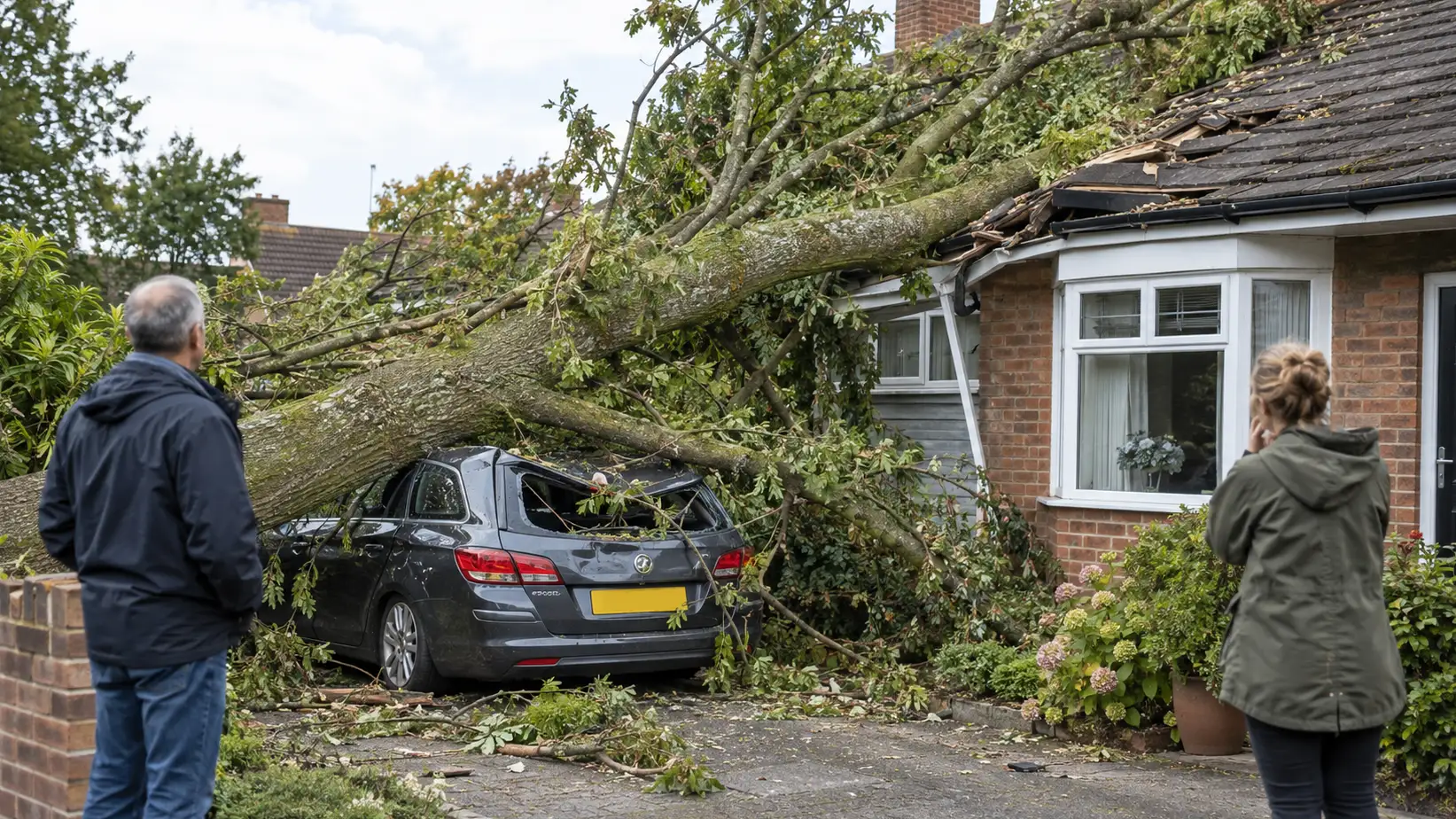
The tree is down, there’s real damage, and the obvious assumption is that whoever owned the tree now owes you a repair bill. It’s the single biggest misconception in this area of neighbour law, and it isn’t a small technicality — it genuinely determines whether you’re waiting on a negligence claim against someone else or simply calling your own insurer today.
A tree can fall from your neighbour’s garden, smash through your roof and leave you facing thousands of pounds in repairs without your neighbour necessarily being legally responsible for any of it. Equally, a storm doesn’t automatically excuse someone who ignored clear signs that their tree was dangerous.
For the household dealing with the damage, though, there’s a more immediate problem than establishing blame. Somebody needs to make the property safe, protect what’s left of the building and work out which insurer to contact. Those decisions shouldn’t wait until the two households have agreed whose fault it was.
The liability principles below reflect the law of England and Wales. Scotland and Northern Ireland reach broadly similar outcomes through their own legal systems, although the precise rules and procedures differ.
The first call usually isn’t to your neighbour
If a tree has come through your roof, damaged a wall or crushed a car, the first priority is to keep everyone away from anything that could still fall or move. Partially uprooted trees can be unstable, and branches that appear firmly lodged against a building may shift without warning. Fallen electricity cables should be treated as live, with the emergency services or electricity network operator contacted as appropriate.
Once there’s no immediate danger, photograph what has happened from somewhere safe and contact the relevant insurer. For damage to the house, that will usually be your buildings insurer. If the tree has landed on your car, it will generally be your motor insurer, assuming your policy covers that type of damage. Personal belongings damaged inside the house may fall under contents insurance.
The Association of British Insurers’ guidance on storm damage advises policyholders to contact their insurer promptly and arrange necessary temporary repairs to prevent further damage. If rain is entering through the roof, for example, emergency weatherproofing may be needed before the insurer can send somebody to assess the full repair. Keep receipts, photographs and details of any contractor involved.
What you shouldn’t do, unless there is a genuine safety need, is rush into extensive permanent repairs or have the tree removed before the insurer has had a reasonable opportunity to advise. The condition of the fallen tree may become important evidence, particularly if there were previous warnings about it.
Most standard buildings insurance policies provide cover for storm damage and certain damage caused by falling trees, subject to their terms. Comprehensive motor insurance will normally cover storm damage to a car, while third-party or third-party, fire and theft policies generally won’t cover that damage to your own vehicle. Outdoor structures, fences and garden features are less predictable, with exclusions that can make a substantial difference to the eventual settlement.
The insurer will also consider whether the circumstances meet the policy’s definition of an insured event. Not every period of strong wind qualifies as a storm under every policy, and the cause of the damage can matter just as much as the weather at the time.
Where the house is badly damaged, buildings insurance may also cover alternative accommodation while essential repairs are carried out. That can be important if a fallen tree has made the property unsafe or uninhabitable, although the available cover and financial limits vary.
The practical advantage of starting with your own insurer is that the damage can be dealt with while responsibility is investigated separately. If it later emerges that your neighbour was legally at fault, your insurer may pursue recovery from them or their liability insurer. You don’t ordinarily have to conduct that recovery yourself, although you should ask how your policy excess and any other uninsured losses might be dealt with.
Ownership is not the same as liability
This is the point on which many neighbour disputes begin badly.
Suppose a mature tree has stood in the garden next door for decades. It appears healthy, there have been no obvious signs of decay or instability, and its owner has taken the reasonable care expected of them. A severe storm then brings it down onto your property.
The fact that the tree belonged to your neighbour doesn’t, by itself, make them responsible for the damage. The law doesn’t require ordinary landowners to guarantee that every tree on their property will remain standing whatever the weather. Where a sound tree fails unexpectedly despite reasonable care, there may be no negligence to pursue.
But reasonable care isn’t the same as simply waiting until a tree looks dangerous. The size and position of a tree, how it is managed and the consequences if it fails can all affect what precautions its owner ought to take.
An important illustration is Witley Parish Council v Cavanagh [2018] EWCA Civ 2232, a Court of Appeal case involving a mature lime tree that fell across a Surrey road and crushed a passing bus, seriously injuring its driver.
The tree had appeared healthy, and the parish council operated a three-year inspection programme. But it was a very large, mature tree beside a busy road, near a bus stop and other places where people or property could be harmed if it fell. The court upheld a finding that the council had been negligent because the inspection arrangements were insufficient for that particular risk. More frequent inspection should have identified the developing problem before the accident.
The judgment is significant because it shows that the absence of an obvious defect isn’t always enough to establish that an owner has acted reasonably. The potential consequences of failure can make closer attention necessary, even where a tree appears sound.
That doesn’t mean every homeowner must arrange professional inspections every two years. The council was responsible for a particularly large tree in a high-risk roadside position, and the court assessed the precautions appropriate to those circumstances. An ordinary garden tree presents a different situation, with the owner’s knowledge, resources and ability to recognise possible defects relevant to what reasonable care requires.
What the case establishes is a principle that matters well beyond roadside trees: the law expects a reasonable response to a foreseeable risk, not a guarantee against every natural accident.
What actually turns a fallen tree into negligence?
The clearest cases are often those where the danger was apparent before the tree came down.
A tree that was visibly dead, significantly decayed or showing clear signs of instability may present a very different position from one that appeared sound. A split in the trunk, substantial root movement, a recent unexplained change in the tree’s position or repeated failures of major branches could all give an owner reason to investigate. Whether those signs were genuinely apparent, and what they indicated, may still require professional assessment.
Previous complaints and warnings can be particularly important. There is a considerable difference between telling a neighbour that their tree is enormous and makes you nervous, and sending them an arboricultural report identifying serious decay and recommending urgent work.
The first expresses understandable concern, but doesn’t necessarily establish that a dangerous defect existed. The second identifies a specific problem that a reasonable owner could be expected to consider and address.
Imagine that a neighbour received a professional warning about a severely decayed trunk but chose to do nothing, and the tree subsequently failed at that same point during ordinary windy weather. There may be a strong argument that reasonable action could have prevented the damage. But if the tree failed for an entirely different, unforeseeable reason, the earlier warning would not automatically establish liability.
That distinction matters because negligence isn’t proved simply by showing that a tree was dangerous in hindsight. The question is what the owner knew or reasonably should have recognised beforehand, whether their response was reasonable and whether any failure to take proper care actually caused the loss.
It also explains why the familiar claim that a storm was an act of God rarely settles an argument by itself. Exceptionally violent weather may bring down a healthy tree that no reasonable precaution would have saved. More moderate weather may simply be the final event that causes an already defective tree to fail.
The condition of the tree and the weather have to be considered together. Neither the presence of a storm nor the fact that the tree belonged to a neighbour provides a complete answer on its own.
When the tree is down but the insurance won’t pay
A tree through the roof is one thing. A fallen trunk lying across an otherwise undamaged garden can produce a very different financial problem.
Some home insurance policies cover the reasonable cost of removing a tree that has damaged an insured building or another qualifying structure. But where a tree has fallen without causing covered damage, clearance may be excluded, even if the work is expensive and the garden is unusable until it’s completed.
This isn’t merely a theoretical distinction. In a Financial Ombudsman decision involving a neighbour’s fallen tree, a homeowner obtained a quotation of £1,800 to remove a tree that had fallen across a brook and into his garden. His buildings insurer initially refused the claim because it said the tree hadn’t damaged any insured buildings.
The disagreement centred on whether concrete edging alongside the brook counted as part of an insured boundary wall. The Ombudsman questioned whether the insurer had fairly considered that evidence and proposed further assessment. The insurer subsequently agreed to meet the removal cost, and the final decision required it to reimburse the homeowner.
It’s a useful illustration of how much can turn on the exact policy wording and the definition of what has been damaged. The decision doesn’t establish that insurers must pay to remove every fallen tree. It shows why an initial refusal deserves closer examination if the policy might cover a damaged wall, path, fence or other structure.
Fences can be especially troublesome. A policy may exclude fences damaged directly by a storm while treating impact damage from a falling tree differently. Other policies exclude particular outdoor features altogether. What matters is the wording of the cover, the cause of the damage and any applicable exclusions.
Where the fallen tree has caused no insured damage and its owner wasn’t negligent, the cost of removal may end up falling on the affected homeowner. There is no blanket rule requiring a neighbour to clear and pay for every section of their tree that lands across the boundary.
If negligence can be established, reasonable removal costs may form part of the resulting claim, along with repairs and other losses caused by the failure. But that is a question of legal responsibility rather than automatic tree ownership.
This is why it is worth speaking to the insurer before commissioning expensive clearance unless urgent work is needed for safety or essential access. If the insurer declines a claim, ask for the relevant policy wording and a written explanation. Where the response appears inconsistent with the cover, the insurer’s complaints procedure and ultimately the Financial Ombudsman Service may provide a route to challenge it.
The evidence can disappear with the tree
There’s an awkward practical problem with fallen-tree disputes: the work needed to clear the damage can remove the very evidence that might establish why it happened.
Once a tree surgeon has cut up the trunk, chipped the branches and ground out the stump, identifying the original point of failure can become difficult. A decayed root system or rotten section of timber that would have explained the collapse may no longer be available for examination.
If negligence is likely to be disputed, photographs of the broken trunk, exposed roots, visible decay and the relationship between the tree and the damaged property can be valuable. So can older images showing how the tree looked before it fell, particularly where they reveal changes in its condition or position.
Keep copies of previous correspondence with the owner and any professional reports. Messages warning of a specific defect, especially where the owner acknowledged them, may be relevant to whether the risk was foreseeable. The owner, meanwhile, may have records of inspections or work that help demonstrate reasonable care.
None of this should interfere with making the site safe. Damaged trees can contain enormous forces even when lying on the ground, and a partially uprooted root plate can move unexpectedly as weight is removed. If the trunk is resting against a roof or lies across both properties, cutting the wrong section could cause further damage or injury.
Where practical, tell the insurer or contractor that responsibility may be disputed and ask whether the failed sections should be photographed or retained before removal. A competent arboricultural professional may be able to assess the likely cause of failure, although the usefulness of that evidence will depend on how much of the tree remains.
If the fallen tree extends across both gardens, coordinating clearance is generally more sensible than arranging separate contractors to cut whichever parts happen to be on each side. Ownership and liability may still need resolving, but neither should become an excuse for leaving an immediate hazard unaddressed.
What if the tree was protected?
A Tree Preservation Order doesn’t automatically cease to matter because a tree has been damaged in a storm. This is particularly relevant when a tree is only partly down, or contractors are proposing to remove substantial remaining sections after the immediate danger has passed.
In England, work on protected trees normally requires consent from the local planning authority unless an applicable exception applies. Work urgently necessary to remove an immediate risk of serious harm can fall within an exception, but it should be limited to what is needed to remove that risk. Written notice must be given to the authority as soon as practicable after the need for the emergency work arises.
There are different arrangements for dead protected trees where there is no immediate emergency. Such work can generally proceed without ordinary TPO consent, but five working days’ written notice is normally required. Work on trees in conservation areas can involve additional notification requirements, and separate wildlife protections may also apply.
The government’s guidance on Tree Preservation Orders and trees in conservation areas explains the exceptions, notification requirements and circumstances in which replacement planting may be necessary.
For someone whose roof has just been damaged, the important distinction is between dealing with an immediate danger and deciding what should happen to the remaining tree afterwards. Safety work shouldn’t be delayed where there is a genuine emergency, but the storm isn’t an unrestricted permission to fell whatever remains.
Wales, Scotland and Northern Ireland have their own tree-protection arrangements, so the correct procedure should be checked with the relevant local authority before non-emergency work begins.
If the property is rented
When a fallen tree damages a rented house, the tenant should report the incident promptly to the landlord or managing agent. Structural repairs and the buildings insurance arrangements will normally be matters for the property owner, although responsibility for particular work depends on the tenancy and the applicable legal obligations.
That doesn’t mean every loss caused by the tree belongs to the landlord. A tenant’s damaged furniture or other possessions may fall under their own contents insurance, while a damaged vehicle will usually involve motor insurance. Personal injury raises a separate question of legal liability.
Tenants should also avoid arranging substantial permanent repairs or negotiating responsibility for structural damage on the landlord’s behalf without authority. Where immediate protective action is necessary, however, safety comes first, and clear records of the damage, expenditure and communications will help establish what happened.
So who pays?
For most people, the question has two answers: who is responsible for dealing with the damage now, and who might ultimately be legally liable for the cost.
If a neighbour’s apparently healthy tree falls unexpectedly despite reasonable care, the neighbour won’t ordinarily be responsible simply because the tree belonged to them. Buildings, motor or contents insurance is likely to be the practical route for whatever damage is covered, while uninsured clearance or repairs may leave the affected household facing a bill.
If the tree presented a foreseeable danger that the owner knew or reasonably ought to have known about, and they failed to take appropriate precautions, there may be grounds for a negligence claim. That can potentially include repair costs, clearance and other resulting losses, but responsibility must be established from the evidence rather than assumed from where the tree was growing.
The distinction can feel unfair when you’re looking at a hole in the roof or a car buried beneath branches. But a tree falling onto your property doesn’t automatically mean that somebody has been careless, just as the presence of a storm doesn’t automatically prove that nobody was.
The most useful approach is therefore to deal with the damage through the appropriate insurer, preserve whatever evidence can safely be obtained and investigate responsibility separately. If there were credible warnings before the tree fell, they may be decisive. If there weren’t, the case may depend on what a reasonable inspection should have revealed and whether different action would have prevented the accident.
The repair bill may be obvious the moment the tree comes down. Who ultimately has to pay it can take rather longer to establish.
Important: This article provides general property information, not legal, financial, insurance, surveying, arboricultural or other professional advice. Liability for a fallen tree depends on the circumstances, its previous condition, what the person responsible knew or reasonably ought to have known, causation and applicable law. Insurance cover depends on individual policy terms. Where significant property damage, personal injury, a protected tree or disputed negligence is involved, contact the appropriate insurer promptly and seek suitably qualified professional advice.

