

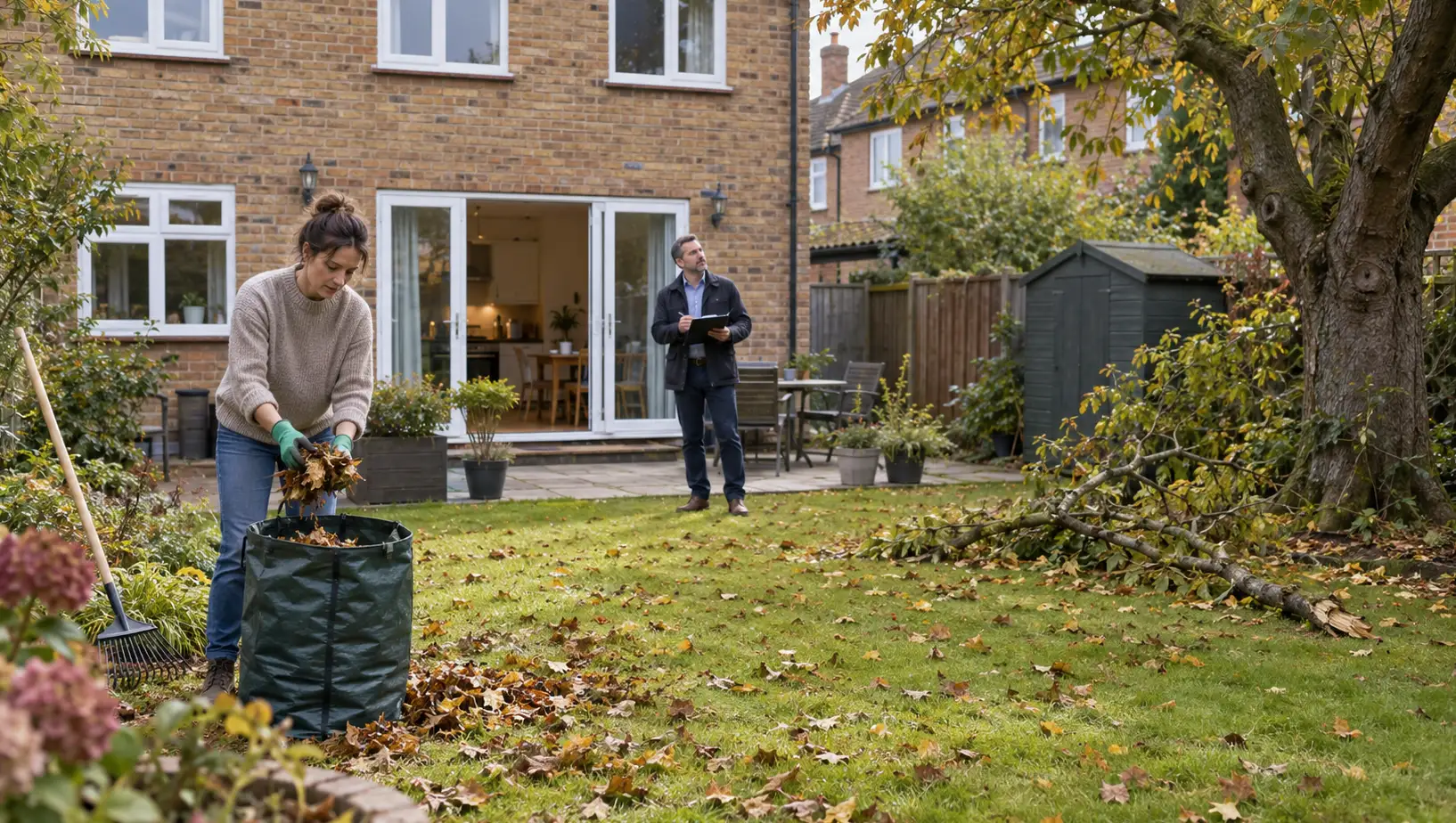
A tenant moves into a rented house in April. The lawn is tidy, the borders are weeded, and a mature apple tree leans over the fence at the end of the garden. By October, the grass has grown out, a storm has brought down a large branch from the apple tree, and the landlord is asking why neither has been dealt with. Who was actually supposed to do what?
Gardens sit in an odd position in a tenancy. They’re outside the four walls that most people think of as “the property,” yet they’re still part of what’s being let — and they’re surprisingly good at creating arguments over money. The grass was too long, the hedge hadn’t been cut, the flowerbeds were full of weeds. What began as an ordinary patch of rented garden can end with a contractor’s bill and two people insisting the other was responsible.
According to the Tenancy Deposit Scheme’s 2025 statistical briefing, gardening featured in 14% of deposit adjudications in England and Wales during 2024/25, making it one of the five most common issues. That’s not 14% of all tenancies — only around 1% of protected deposits reached formal adjudication — but it shows how regularly garden condition becomes contentious once a dispute gets that far.
The difficulty is that “maintaining the garden” can mean very different things to a tenant and a landlord. One imagines mowing the lawn and pulling out the weeds. The other may expect hedge trimming, tree care and repairs to whatever happens to be outside the back door. The law doesn’t settle every one of those disagreements with a neat tenant-versus-landlord rule.
The basic split: upkeep versus repairs
There’s no single law declaring that every private tenant must mow the lawn. Routine garden responsibilities usually come from the tenancy agreement, alongside the tenant’s general duty to take reasonable care of the property. What the agreement requires, and what the tenant could reasonably be expected to do, are both important.
Mowing an established lawn, weeding beds and paths, clearing ordinary garden waste and keeping small shrubs under control are the sorts of everyday jobs commonly allocated to tenants. They don’t ordinarily require specialist expertise, and the person living in the property is usually best placed to keep on top of them.
A landlord’s responsibilities become more complicated when the problem involves repairs, substantial tree work or something potentially dangerous. In England, the landlord has statutory obligations concerning specified parts of the property, including the structure and exterior of the dwelling, drains, gutters and external pipes. The government’s guidance on repairs in privately rented homes explains those obligations, which cannot simply be transferred to a tenant through a tenancy clause.
The trouble starts when those two sorts of work overlap. A tenant may have agreed to keep the garden tidy, but that doesn’t necessarily mean they’re expected to rebuild a damaged retaining wall or climb a mature tree to remove a dangerous branch. Equally, a landlord doesn’t automatically become responsible for every neglected shrub or every fence panel simply because they own the house.
Freestanding fences, sheds and garden walls can be particularly difficult. Responsibility may depend on what was provided with the tenancy, the terms of the agreement, the cause of the damage and whether the feature falls within a relevant repairing or safety obligation. A rotten fence that has deteriorated over several years isn’t the same problem as one damaged by a tenant, and neither should be treated automatically as ordinary gardening.
This is why vague wording causes trouble. A requirement to keep the garden “well maintained” might reasonably cover mowing and weeding, but what does it say about an established hedge that’s already too tall to trim safely, or an ornamental garden that requires specialist attention?
If a landlord expects more than ordinary upkeep, that expectation needs to be made clear before the tenancy begins. Even a detailed clause, however, won’t override a statutory duty that legally belongs to the landlord.
The apple tree is not the same problem as the lawn
Return to the garden in April. By October the grass has grown out of control, and a large branch from the apple tree is lying across the lawn. The landlord sees two neglected jobs. Legally and practically, they may be quite different.
If the tenancy requires the tenant to maintain the lawn, and the grass has been left unchecked for months, the landlord may have grounds to complain. That’s particularly true if the garden was handed over in good condition and the work required was ordinary domestic maintenance.
The apple tree is another matter. A large branch brought down in a storm may leave other branches unstable, damage surrounding structures or require equipment that an ordinary tenant neither owns nor knows how to use. The fact that the tree stands in the rented garden doesn’t automatically turn that into a missed household chore.
A tenant who discovers significant tree damage should report it promptly to the landlord or managing agent, preferably in writing, and explain any immediate risk. Neither side should assume that a general gardening clause settles who must arrange and pay for specialist work. The answer may depend on the tenancy, the condition of the tree, the circumstances of the damage and any relevant legal duty.
The same caution applies to an unstable garden wall, damaged access steps or a fence threatening to fall into a public footpath. These are problems to report and assess, not matters a tenant should necessarily tackle with ordinary gardening tools.
Safety also cuts across the usual division of responsibilities. A landlord cannot avoid an applicable duty to deal with a serious hazard simply by describing it as garden maintenance. Equally, a tenant who notices a dangerous condition shouldn’t ignore it because they believe the landlord will eventually discover it. Prompt reporting gives the person responsible an opportunity to act and provides a useful record if there is later disagreement about when the problem arose.
What does “leave it as you found it” actually mean?
This is where the argument often moves from the garden into the tenancy deposit.
The usual starting point is that a tenant should return the garden in a condition consistent with the agreement and its condition when the tenancy began, allowing for normal seasonal change, fair wear and tear and the ordinary growth of plants.
A garden handed over in May and returned in November will look different regardless of how attentive the tenant has been. Leaves fall, perennials die back, grass grows at different rates and beds that looked full of colour in summer may appear almost empty by winter. None of that, by itself, means the garden has been neglected.
But seasonal change isn’t a blanket excuse either. A tenant cannot necessarily leave brambles to take over established borders, abandon agreed lawn maintenance for months or leave piles of rubbish behind and argue that gardens naturally become untidy.
The difficulty for a landlord is proving the difference between ordinary change and a failure to maintain the garden properly. For a tenant, it’s demonstrating that a deduction is being sought for something that wasn’t their responsibility or wasn’t in better condition when they moved in.
The original inventory often decides which argument is more convincing. A description such as “garden tidy” tells an adjudicator relatively little about the lawn, hedges or planting. Dated photographs showing the condition of individual areas are much more useful, particularly when compared with photographs taken at the end of the tenancy.
The Tenancy Deposit Scheme has illustrated this problem in an unusually memorable garden-dispute adjudication. The check-out report recorded an overgrown garden and a stuffed gorilla ornament that hadn’t been there originally. But the garden had already been overgrown at check-in, so the adjudicator awarded the landlord £10 for removing the gorilla rather than treating the existing overgrowth as the tenant’s responsibility.
It’s an unusual example, but the principle is an everyday one: a landlord cannot fairly charge a tenant for putting right a condition that was already present when the tenancy began.
Nor does a deposit deduction automatically become reasonable because the landlord has paid a gardener. If the lawn was patchy at check-in, for instance, the landlord cannot ordinarily expect the departing tenant to fund a completely new lawn merely because some maintenance was neglected. Any claim should reflect the actual deterioration for which the tenant is responsible, rather than leave the landlord with something better than they originally provided.
Tenants who disagree with a garden-related deduction should ask for the photographs, inventory evidence and invoices supporting it, and compare them with their own records. Where agreement cannot be reached, the relevant tenancy deposit protection scheme may offer independent dispute resolution. In England, the government’s deposit-dispute guidance explains that the approved schemes offer a free resolution service, with both sides asked to provide evidence if they agree to use it.
The lesson for both parties is straightforward. The time to establish what a garden looks like isn’t after someone has received a disputed bill for restoring it.
When the garden becomes more than ordinary maintenance
Not every disagreement arises because a tenant has done too little. Sometimes the problem is that they’ve done rather more than the landlord expected.
A tenant might replace a gravelled area with lawn, build raised beds, remove shrubs or decide that a neglected-looking hedge would be better taken out altogether. From their point of view, they’re improving the property. From the landlord’s, they may be removing features that were part of what was originally let.
Maintaining a garden and redesigning it are not the same thing. Substantial alterations will usually require the landlord’s consent, particularly where the tenancy restricts changes to the property. Even an improvement made with good intentions can create a dispute over restoration when the tenancy ends.
Getting permission in writing before beginning the work avoids much of that uncertainty. It should also establish what happens afterwards: whether the raised beds can remain, who maintains new planting and whether the original layout must be restored when the tenant leaves. A verbal agreement that something “looks fine” is a poor substitute for a clear record if the property changes hands or the relationship deteriorates.
There are also circumstances where a tenant wants to fulfil the agreement but genuinely struggles to manage the garden. A substantial plot may require more work than someone anticipated, or illness, disability or changed circumstances may make routine upkeep difficult.
That doesn’t automatically transfer every gardening obligation to the landlord. But allowing the garden to deteriorate without discussing the problem is unlikely to produce a good outcome. The parties might agree to employ a gardener, reduce the tenant’s responsibilities or arrange for particular tasks to be handled professionally, with the cost and arrangements agreed in advance.
Where a disability is involved, the position may also raise questions about applicable equality duties and individual circumstances. It should not be assumed either that the landlord must automatically provide free gardening services or that every existing gardening requirement can be applied without considering the circumstances. Specialist housing advice may be appropriate if agreement cannot be reached.
The common thread is that responsibilities can be clarified or changed by agreement. A garden that is manageable for one tenant, or at one stage of a tenancy, may require a different arrangement later. What matters is dealing with that openly rather than allowing uncertainty to develop into a dispute over damage or deposits.
Does it matter where in the UK you rent?
The distinction between everyday upkeep and more substantial repair or safety work is useful throughout the UK. The legal framework behind it, however, is not identical.
In England, the Renters’ Rights Act reforms introduced on 1 May 2026 moved most private assured tenancies onto a periodic basis, including the conversion of existing assured shorthold tenancies. That changed the structure of those tenancies, but it didn’t create a new rule about who cuts the grass. Existing lawful garden obligations must still be considered alongside the tenancy terms and applicable repair law. The government’s guidance on assured periodic tenancies explains the current tenancy framework.
Wales uses occupation contracts under the Renting Homes (Wales) Act 2016. Private renters are generally known as contract-holders, and their written statements set out the relevant terms alongside statutory obligations concerning the home. The Welsh Government’s guidance on standard occupation contracts explains that framework. As in England, a general gardening obligation should not be confused with the landlord’s separate repairing responsibilities.
Scotland offers a more direct reference to gardens. The Scottish Government’s model private residential tenancy guidance provides for reasonable garden maintenance by the tenant where a private garden forms part of the let property. It also recognises arrangements where the landlord provides gardening services through the rent, leaving the tenant responsible for keeping the area tidy. These are provisions of the model agreement, rather than a guarantee that every individual Scottish tenancy contains identical wording.
Scotland also has its own repairing standard, covering certain external features, so it would be misleading to assume that a fence or boundary structure is treated identically under English and Scottish law.
Northern Ireland operates under separate private-tenancy legislation. The nidirect guidance on repairs for private tenants explains how agreed tenancy responsibilities interact with obligations that may remain with the landlord, particularly where the documentation is unclear.
For anyone renting outside England, the practical answer is therefore to examine the actual contract and the rules applicable where the property stands. A generic tenancy clause copied from elsewhere in the UK may not tell the full legal story.
Keeping the garden out of a dispute
Most garden disagreements are easier to prevent than to settle. A landlord who wants a tenant to maintain an ordinary lawn and flowerbeds should have little difficulty explaining that expectation clearly. But where a property has mature trees, formal hedges, specialist planting or substantial outdoor structures, the division of work deserves more thought.
The same applies from the tenant’s side. Before accepting responsibility for a garden, it’s worth looking beyond how attractive it appears at the viewing. A large hedge may need professional cutting; a mature tree may require inspection; an existing fence may already be in poor condition. What looks like a pleasant outdoor space can carry obligations that neither party has properly considered.
A clear agreement, accompanied by an accurate inventory and photographs, gives both households something more useful than their recollection of a conversation months earlier. It also distinguishes work the tenant is expected to undertake from defects they should report rather than attempt to repair themselves.
Which brings us back to the April garden. The landlord may have a perfectly reasonable complaint about a lawn that the tenant agreed to maintain and then allowed to become badly overgrown. But the broken branch from the mature apple tree is not automatically another neglected gardening chore. It needs to be considered separately, particularly if the remaining tree is dangerous or specialist work is required.
That is ultimately where most rented-garden disputes go wrong. “Look after the garden” sounds clear enough when everything is tidy and nothing has broken. It’s only when the grass gets out of hand, a tree comes down or the deposit is being returned that both sides discover how much they left unsaid.
Important: This article provides general information about garden responsibilities in rented homes and is not legal, surveying or other professional advice. Responsibilities depend on the agreement, type of tenancy, condition of the property and the law applicable in England, Wales, Scotland or Northern Ireland. Where a dispute involves significant deposit deductions, dangerous trees or structures, disability-related requirements or statutory repairing duties, seek appropriate housing or legal advice before taking action.

