

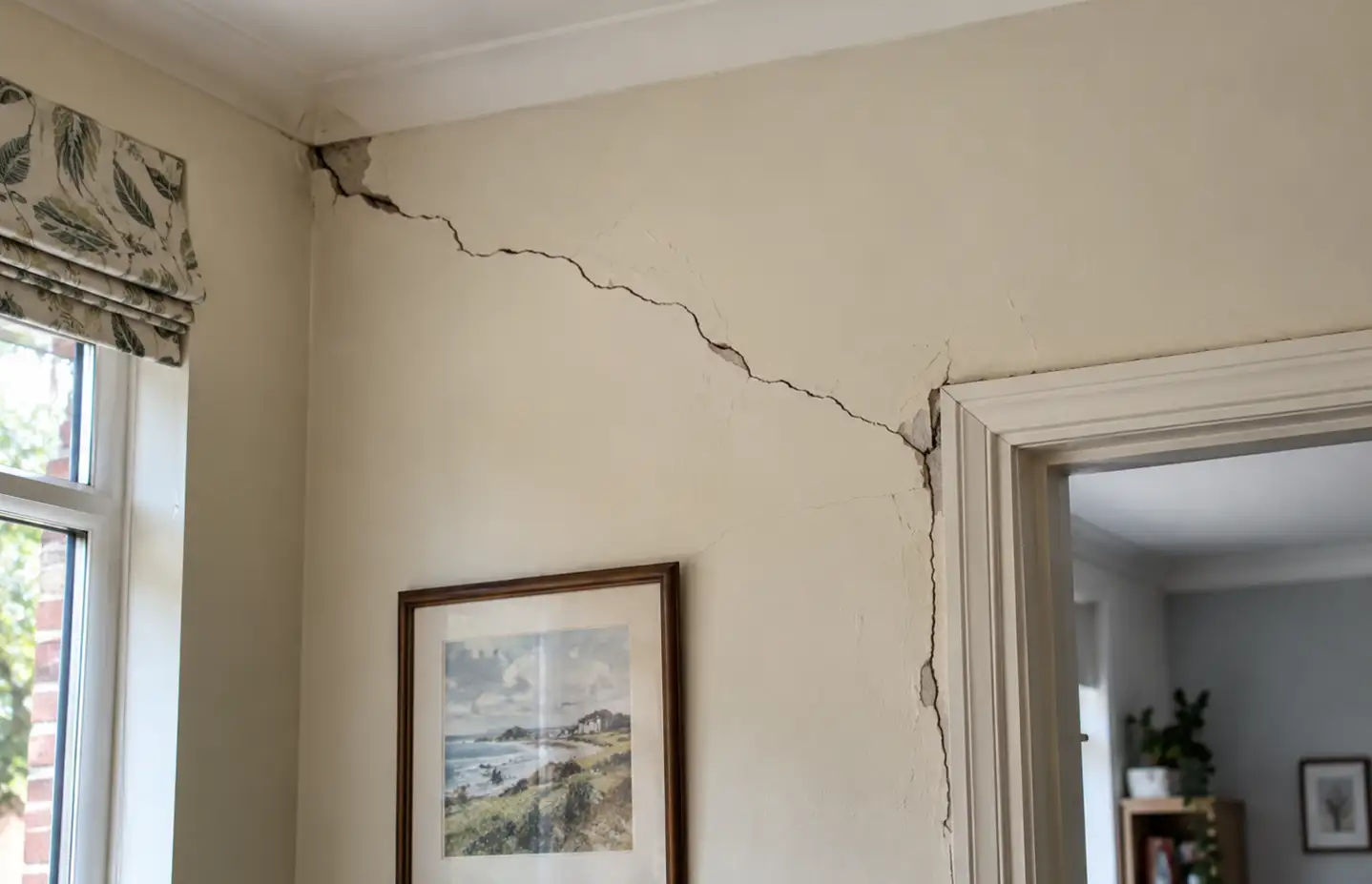
Almost every house develops cracks somewhere over its life. Plaster shrinks, different materials expand and contract, and newer or recently altered buildings can show minor drying and settlement movement — none of it is unusual, and very little of it means anything is structurally wrong. The genuine skill isn’t spotting a crack. It’s working out which of the cracks in your home, if any, actually deserve a closer look.
Look at the whole picture, not just the width
It’s tempting to want a single number — “under this many millimetres, don’t worry; over it, panic” — and it’s worth being upfront that no such rule reliably exists. Width is one piece of information, not a verdict. A hairline crack that’s been sitting quietly in the same spot for a decade tells you something different from a crack half that width that’s appeared in the last fortnight and is visibly getting wider.
As one useful point of reference, the RICS consumer guide to subsidence says there is rarely cause for real concern unless cracks appear suddenly and are more than around 3mm wide. But RICS also makes clear that new or expanding cracks, sticking doors and windows and newly sloping floors all matter to the assessment.
So 3mm isn’t a magic dividing line between “safe” and “structural”. What actually matters is a combination of factors: how the crack looks, when it appeared, whether it’s changing, where it is and what else is happening around it.
The patterns worth recognising
Hairline plaster cracking, often fine lines across a ceiling or wall surface, is extremely common and is very often associated with plaster drying and shrinking — particularly in newer homes, recently plastered rooms or recently completed building work.
Diagonal cracking, running at an angle rather than straight up/down or across, often starting from the corner of a window or door opening, is a pattern worth paying more attention to, especially if it appears on both the inside and outside of the same wall in roughly the same place.
Stepped cracking, following the zig-zag line of mortar joints between bricks or blocks rather than cutting straight through them, can indicate movement in masonry — though “movement” covers everything from minor, historic movement that has long stabilised to something actively progressing, so this pattern alone doesn’t tell you which.
Horizontal cracking, running broadly along a bed joint or across a wall, deserves context rather than an instant diagnosis. Depending on the construction, location and accompanying distortion, it can be associated with restraint, movement, corrosion or loading issues. A significant or progressing horizontal crack is therefore one to assess rather than diagnose from appearance alone.
Cracks around window and door openings are worth noting particularly if the door or window itself has also started sticking, twisting or no longer closing properly — a purely superficial plaster crack is less likely to come with a new functional symptom.
Cracks at wall-to-ceiling junctions are frequently associated with small differences in movement between timber, plaster and masonry and are often benign when fine and stable.
None of these patterns, on its own, gives you a diagnosis. What they do is tell you where to look more carefully and what questions to ask next.
Crack patterns at a glance
| What you’re seeing | Often less concerning when… | Worth investigating when… |
|---|---|---|
| Fine plaster crack | It’s hairline, confined to the finish and remains unchanged | It keeps widening, repeatedly reopens or corresponds with cracking in the structure behind |
| Diagonal crack from a door/window corner | It’s fine, old and stable | It’s new, widening, present through masonry or accompanied by a sticking opening |
| Stepped masonry crack | Evidence suggests old movement that has stabilised | It’s new, expanding or accompanied by distortion elsewhere |
| Horizontal crack | It’s minor, superficial and demonstrably stable | It’s substantial, progressing or associated with bulging, bowing or other wall movement |
| Matching crack inside and outside | Both are old and unchanged | Both have appeared or progressed together |
| Wall/ceiling junction crack | It’s fine and associated with normal differential movement | It’s widening materially or accompanied by sagging or wider structural distortion |
This isn’t a diagnostic chart. Its purpose is to show why change over time and accompanying symptoms matter at least as much as the shape of the crack itself.
The clues that matter more than appearance
A single static photograph of a crack tells you comparatively little. What tends to matter more:
Is it new, or has it always been there? A crack a previous owner mentioned that’s stayed exactly the same for years is a fundamentally different proposition from one that’s appeared since you moved in.
Is it actually widening? Not “does it look big” but “is it getting bigger over time” — this needs tracking, not a single glance.
Does it appear to change with the seasons? On shrinkable clay soils, long dry periods can reduce soil moisture and contribute to foundation movement, particularly where trees and other vegetation are also drawing moisture from the ground. A recurring seasonal pattern is useful evidence rather than something to dismiss.
Have doors or windows started sticking for no obvious reason, alongside the cracking? Movement around an opening can sometimes affect how the frame operates.
Do floors feel noticeably uneven or sloped, particularly if this is new rather than a long-standing quirk of an older property?
Does the crack appear at corresponding points inside and outside the same wall? Matching internal and external cracking, lining up at the same location, generally deserves more attention than an isolated surface crack visible only in plaster.
Is there anything nearby that could help explain it — recent excavation or building work, a mature tree on shrinkable clay, a leaking drain or water main, or an unusually long dry spell?
Any one of these in isolation is rarely conclusive. Several of them together is when it’s worth taking more seriously.
How to monitor a crack sensibly
For a crack that doesn’t show obvious red flags but that you’d rather keep an eye on than ignore, a simple monitoring routine can provide genuinely useful information:
- Photograph it clearly, with a ruler or crack-width scale held in the same plane as the crack.
- Record the date and exact location.
- Measure the width at a consistent marked point where possible.
- Photograph and measure it again at regular intervals using roughly the same position and scale.
- Note other changes at the same time — sticking doors, floor movement, new external cracking or unusually dry weather.
- Avoid repeatedly filling and redecorating over a crack you’re actively trying to monitor, because that can obscure the evidence you’re looking for.
Simple homeowner monitoring can show whether something appears stable or is visibly changing, but meaningful structural movement is sometimes monitored professionally for many months. RICS notes that suspected subsidence cracking may need measuring for up to 12 months and sometimes longer before the pattern becomes clear.
Professional monitoring can also use tell-tales, precise crack gauges and level measurements rather than relying on photographs alone.
The goal isn’t to prove a structural diagnosis yourself. It’s to establish whether “there is a crack” has become “there is a crack that is measurably changing”.
Monitor it or get advice now?
| Situation | Sensible next step |
|---|---|
| Fine internal plaster crack, unchanged for years and no other symptoms | Usually reasonable to monitor or repair cosmetically |
| New crack but very fine, with no distortion or other signs | Record and monitor carefully |
| Crack is visibly widening or extending | Arrange professional assessment |
| Sudden crack approaching or exceeding roughly 3mm, especially with other symptoms | Seek professional advice rather than relying on DIY monitoring |
| Crack appears internally and externally in the same area | Professional assessment is sensible, particularly if new or changing |
| Doors/windows suddenly stick or floors newly slope alongside cracking | Investigate the building rather than the crack alone |
| Wall is visibly bowing, bulging or otherwise distorted | Obtain prompt professional advice |
| Cracking follows nearby excavation, drainage failure or other significant event | Investigate the potential cause as well as monitoring the crack |
If something looks immediately unstable or unsafe, monitoring it for several months plainly isn’t the right response.
The everyday, usually harmless explanations
A great deal of cracking in ordinary homes comes down to unremarkable causes: plaster shrinking as it dries, general drying-out in a newly built or recently renovated property, small thermal movements as materials expand and contract, and minor initial settlement as new construction beds in.
NHBC’s guidance for new homeowners specifically notes that minor wall cracks and gaps in joinery are common consequences of materials drying out and are extremely unlikely, on their own, to be structurally significant.
Cracks also frequently appear at junctions between different materials simply because those materials don’t expand, contract or dry at exactly the same rate.
It’s worth resisting the opposite temptation too, though: age alone doesn’t make a crack safe. A long-standing house can develop new structural movement, just as a new home can occasionally develop a genuine structural defect. Don’t assume either “it’s an old house, that’s normal” or “it’s a new house, it must be fine” without looking at how the crack is behaving.
Settlement and subsidence aren’t the same thing
These words are often used interchangeably in ordinary conversation, but they’re not quite the same thing.
Settlement generally describes movement associated with a building or its foundations adjusting under load, particularly during or after construction.
Subsidence is downward movement caused by changes in the ground supporting the building. RICS identifies causes including shrinkable clay drying during prolonged dry conditions, tree and vegetation influence on susceptible soils, and leaking drains or water mains affecting the supporting ground.
That distinction matters because seeing a crack doesn’t automatically mean “subsidence”, and using the word before the cause has been established can make an already worrying situation sound much more certain than it really is.
When it might be something more than cosmetic
Cracking can, in some cases, be an early sign of more significant structural movement — subsidence, unusual settlement, heave, a failing structural element or instability in part of a wall.
None of these can be reliably diagnosed from a description or a photograph alone, and this article isn’t the place to try to identify which one you might have — that’s covered in more depth in our companion article on the different types of building movement.
What’s worth flagging here is simply when it becomes sensible to get a professional opinion rather than continuing to monitor alone: a crack that’s clearly widening, cracking that’s appeared alongside sticking doors, newly sloping floors or other symptoms, substantial or widespread cracking, corresponding internal and external cracks, or visible distortion in the building itself.
A chartered building surveyor can often be a useful first point of assessment where the cause is unclear. Where the issue appears specifically structural or calculations and engineering advice are required, a structural engineer may be appropriate.
And if the evidence genuinely starts to suggest subsidence, check your buildings-insurance policy before commissioning major investigations or repair work independently. Insurers commonly have their own claims and investigation process and may appoint the professionals involved.
The takeaway
Most homes carry some cracking, and most of it is genuinely nothing to worry about. What changes a crack from a cosmetic nuisance into something worth investigating is rarely its width in isolation — it’s the pattern, whether it’s actively progressing, and whether it’s accompanied by other signs that the building itself, not just its plaster, is on the move.
This article provides general property information and cannot diagnose your specific crack or property. If a crack is new, progressing, accompanied by distortion or other movement, or you are uncertain about its significance, get advice from a suitably experienced building professional rather than relying on appearance alone.

