

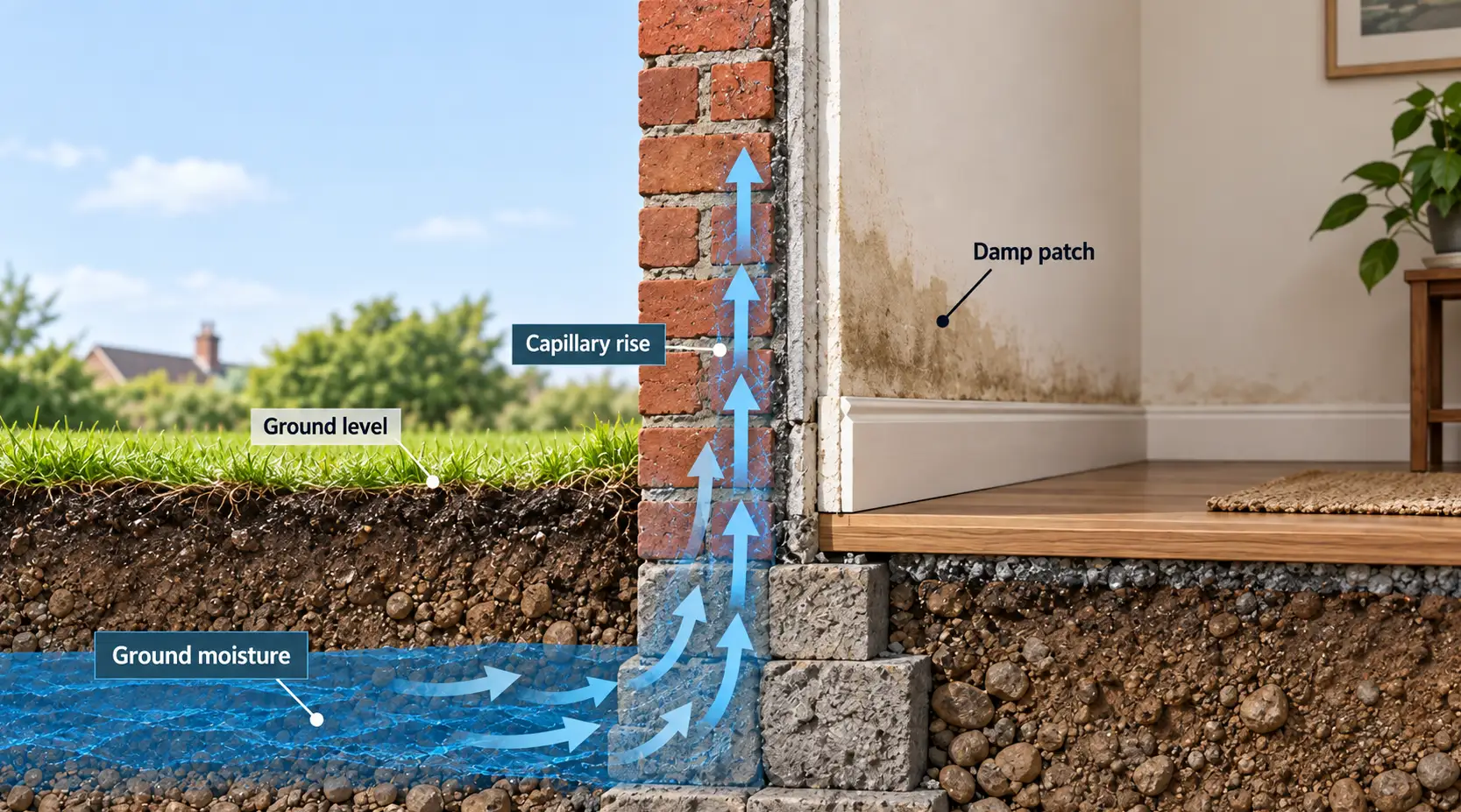
“You’ve got rising damp” can be one of the more expensive sentences in UK homeownership, and it’s said far more often than the condition it describes actually occurs. Before agreeing to an injected damp-proof course, hacked-off plaster, waterproof render or another potentially substantial treatment, it’s worth understanding what rising damp genuinely is, how commonly it’s actually the cause, and what else routinely gets mistaken for it.
What rising damp actually means
Rising damp is a specific physical process: moisture from the ground drawn upward through porous masonry by capillary action, moving through interconnected pores much the way a paper towel draws water up from a shallow dish. It’s a real phenomenon, and it’s not a myth — but genuine cases are considerably rarer than the frequency with which the diagnosis gets handed out.
Historic England’s 2026 guidance on assessing damp in historic buildings cites Building Research Establishment analysis of 1,500 damp investigations, in which rising damp accounted for only 4% of cases.
Historic England describes groundwater-related rising damp as fairly uncommon. In that same guidance, more common explanations for damp at the base of a wall include drainage faults, leaking water-supply pipes, inadequate surface-water disposal, splashback from hard surfaces and external ground levels built up against the wall.
That 4% is worth understanding properly. It’s a finding from that particular BRE investigation dataset, not a claim that precisely 4% of every modern UK damp problem is rising damp. But it is strong evidence for a much more useful point: low-level damp should be investigated, not automatically labelled rising damp because of where it appears.
Where damp-proof courses fit in
A damp-proof course (DPC) is a barrier incorporated near the base of a wall to resist moisture travelling upwards through the masonry. Modern masonry construction normally includes damp protection as part of the building’s moisture-control design. Older buildings vary considerably: some have physical DPCs made from materials such as slate or bituminous products, while some traditional buildings may have been constructed without a modern-style DPC at all.
Where genuine rising damp has been properly established and an additional DPC is an appropriate remedy for that particular construction, retrofit systems can include chemical injection or physical methods.
But that sequence matters: diagnosis first, treatment second.
The current RICS damp and mould consumer guide specifically warns that rising damp is often misdiagnosed and states that failure of an original damp-proof course is extremely rare. A recommendation for a new injected DPC therefore needs more supporting evidence than a damp patch at skirting-board level and a high handheld meter reading.
What commonly gets mistaken for rising damp
A long list of things produce a similar-looking symptom — a damp patch or tidemark low down on an internal wall — without involving rising damp at all:
- ground levels outside that have been raised over the years by new paving, decking or flowerbeds, allowing moisture to affect the wall above or around its original damp protection
- a bridged DPC, where render, debris, a path or another material provides moisture a route around the barrier
- leaking underground drains or a defective water-supply pipe
- rainwater penetrating from outside and travelling through the construction before appearing near floor level
- condensation, particularly at a cold wall/floor junction, in a poorly ventilated corner or behind furniture
- hygroscopic salts left behind in plaster by an earlier damp problem, which can continue to attract moisture from humid air after the original source has gone
- inappropriate impermeable finishes on traditional construction, changing how the wall absorbs and releases moisture
- problems at the junction between a floor and a wall, including defects around suspended timber floors and ventilation beneath them
Low-level damp: what else should be checked?
| What you find | What it may indicate | Useful next check |
|---|---|---|
| Damp corresponds with high paving or a raised flowerbed outside | Lateral moisture penetration or bridging | Compare internal floor/DPC level with external ground level |
| Patch worsens after heavy rain | Rain penetration or defective rainwater disposal | Gutters, downpipes, render, pointing, splashback and roof details |
| Damp is close to a drain or incoming water pipe | Drainage or plumbing leak | Drain condition, water supply and nearby pipe routes |
| Mould rather than obvious staining dominates a cold corner | Condensation or thermal bridging | Surface temperature, ventilation, heating and furniture position |
| Old wall remains apparently damp after a previous leak was repaired | Residual moisture or hygroscopic salts may be involved | Establish whether free water is still present rather than relying on one meter reading |
| Traditional solid wall has dense cement or impermeable finishes | Altered drying behaviour may be contributing | Understand the original construction and existing finishes before specifying treatment |
None of these proves the answer either. Their value is that they provide alternative explanations that should be considered before invasive treatment is specified.
Why older buildings need particular care here
Traditional properties need to be understood according to their actual construction rather than their age alone. Homes built before the 1920s are more likely to have solid external walls, but there are exceptions, including timber-framed buildings and early cavity construction.
Traditional masonry commonly incorporates permeable or semi-permeable materials such as brick, stone and lime-based mortar or plaster. These materials can absorb, temporarily store and release moisture as conditions change.
That is more precise than simply saying an old house “needs to breathe”, but the practical implication is important: altering that moisture behaviour with inappropriate impermeable materials can cause problems.
Hard cement render, dense impermeable coatings and some unsuitable internal finishes can restrict drying or concentrate moisture elsewhere. Likewise, an injected damp-proof treatment applied to a traditional wall simply because low-level damp has been observed may be unnecessary if the actual source is a leaking drain, raised external ground or rain penetration.
This doesn’t mean older buildings should never have damp treatment, or that every modern material is automatically wrong. It means the construction and moisture source need to be understood before the remedy is selected. Historic England’s guidance is particularly valuable for this reason.
Why a moisture meter reading isn’t proof
A handheld moisture meter can contribute useful evidence. It cannot, by itself, prove rising damp.
Resistance-type meters work by measuring electrical resistance or conductivity in the material being tested. They are particularly useful with timber, where readings can be related to moisture content within appropriate limits.
Masonry and plaster are more complicated. Salts, different materials and other conductive substances can affect readings, so an elevated number does not necessarily mean the instrument has measured a corresponding quantity of water.
Historic England’s current guidance goes considerably further than the simple warning about one type of meter: different moisture-measurement techniques measure different physical properties, and all have limitations that need interpreting in the context of the building.
A high reading therefore tells an investigator where to ask another question. It does not answer the question “why is this wall damp?”
Professional guidance is explicit on this point: be wary of anyone diagnosing the source of dampness from meter readings alone, particularly on hard walls and solid floors.
The conflict of interest worth knowing about
Here’s the structural issue that makes this subject genuinely high-stakes: some damp surveys are carried out free of charge or at low cost by the same company that would then be paid to carry out whatever treatment the survey recommends.
That doesn’t mean every commercial damp firm is dishonest — it doesn’t, and many provide competent investigation and repair. But it does mean the diagnosis and the sale of the remedy can sit within the same commercial relationship.
Where the diagnosis is uncertain, the proposed work is extensive, the cost is significant, or the property is older or architecturally unusual, paying separately for an independent assessment from someone with no commercial stake in selling a particular damp-proofing treatment can be genuinely worthwhile.
RICS recommends asking for an inspection compliant with the Joint Position Statement 2022, produced with Historic England and the Property Care Association. The RICS Joint Position Statement guidance promotes a whole-building approach: identify the source of excessive moisture, understand the building and don’t base conclusions on potentially misleading data.
The statement is specifically concerned with traditional buildings, rather than being a statutory inspection standard applying identically to every modern property, but its diagnostic principles are particularly relevant where expensive damp treatment is being proposed.
What a genuinely good diagnosis should include
Before agreeing to any significant damp treatment, a properly reasoned report should be able to answer several questions clearly: what is the actual source of the moisture, and what evidence supports that conclusion specifically rather than simply indicating that a wall is damp? What alternative causes were considered and ruled out, and how? Were relevant external defects checked — rainwater goods, drainage, ground levels, plumbing? Does the report account for the property’s particular construction? And critically: does the proposed treatment actually address the identified cause?
Before agreeing to an injected damp-proof course
| Ask | Why the answer matters |
|---|---|
| What evidence demonstrates moisture is genuinely rising from the ground? | Low-level damp and meter readings alone aren’t enough |
| What other causes have been investigated? | Drainage, rainwater, plumbing, bridging and condensation can mimic the same symptom |
| Where is the existing DPC, if there is one? | Its presence, position and whether anything bridges it materially affect the diagnosis |
| Why is a new DPC the appropriate remedy for this wall construction? | Traditional and modern walls don’t necessarily need the same treatment |
| What plaster or finishes are being removed, and why? | Replastering can be a major part of the disruption and cost and should have a stated technical reason |
| What happens if the wall remains damp after treatment? | The answer reveals how confidently the proposed work has been tied to the actual moisture source |
If a report jumps straight from “we found elevated moisture-meter readings” to “you need an injected damp-proof course”, without answering those questions, that’s a reasonable reason to stop and ask for a more complete diagnosis before signing anything.
What treatment tends to cost
There isn’t a single national per-metre figure that usefully tells a homeowner what a correctly diagnosed damp problem will cost to resolve.
Even where an injected DPC genuinely is appropriate, the injection itself may be only one part of the job. A quotation can also include removing contaminated or damaged plaster, disposing of waste, preparing the wall, replastering, refitting skirting, moving radiators or sockets, decorating and making good.
More importantly, the right diagnosis may lead to a completely different repair: lowering external ground, repairing a drain, fixing a leaking downpipe or changing inappropriate wall finishes rather than installing a DPC at all.
That makes the scope of the quotation more useful than a generic price per metre.
When comparing proposals, separate the cost of investigation, the damp treatment itself, plaster removal and reinstatement, ancillary building work, decoration, VAT and any guarantee or insurance-backed element. Otherwise two supposedly competing “damp-proofing quotes” may not actually include the same work.
This is also why paying for a genuinely independent diagnosis can sometimes save substantially more than it costs: the cheapest unnecessary treatment is still unnecessary treatment.
If you’re buying, not selling
A buyer who receives a survey flagging damp, with a recommendation for “further investigation”, is in a genuinely different position from one who’s been told the house definitely needs extensive damp-proofing.
A general home survey is intended to identify visible concerns within the scope of that inspection; it doesn’t automatically establish the moisture mechanism hidden inside a wall. Treating cautious survey language as though it were already a specialist damp diagnosis can therefore create unnecessary anxiety — or prompt a buyer to obtain quotations for a remedy before anyone has established what actually needs repairing.
How to interpret damp findings during a purchase belongs in more depth in Property Front Page’s Buying & Selling section, under Surveys & Valuations.
The point worth remembering
Treatment that doesn’t match the actual cause of a problem rarely fixes it, however confidently it’s sold. If raised external ground levels, a leaking drain or defective rainwater goods are driving moisture into a wall, an injected damp-proof course addresses none of those defects.
Before paying for treatment, the question worth insisting on an answer to is simple: why is moisture actually entering or remaining in this wall, what evidence demonstrates that, and does what’s being proposed genuinely address that cause?
This article provides general property information, not a survey of your specific property or a substitute for professional advice. Damp diagnosis can depend heavily on individual building construction and history. Where significant expenditure is being proposed, an independent, suitably experienced assessment before committing to treatment is a reasonable and often cost-effective precaution.

