

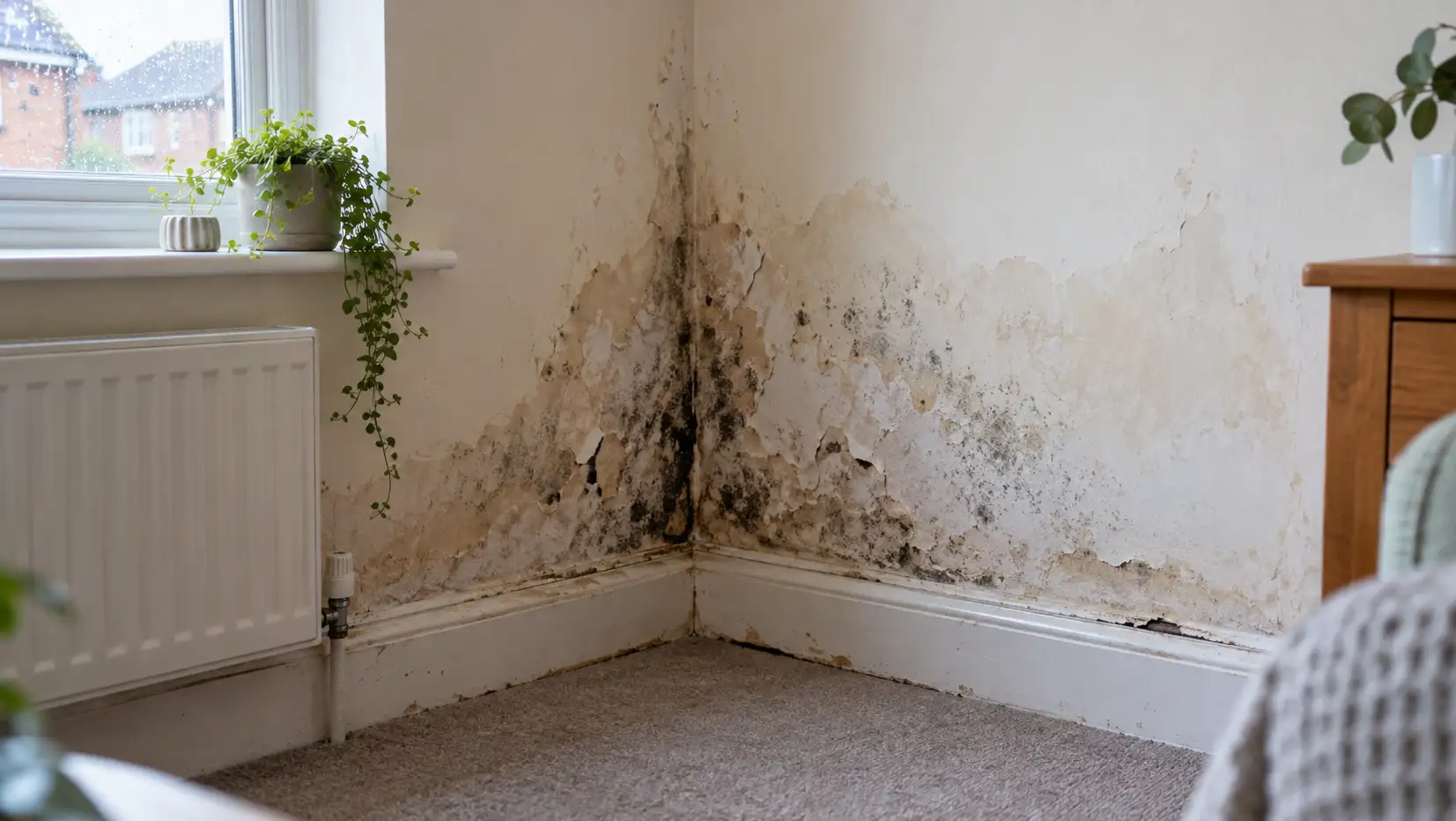
A damp patch doesn’t come with a label. It’s a stain, a smell, a patch of crumbling plaster or a corner of black mould — and the temptation is to name it something (“that’ll be rising damp”) and move straight to a solution. That habit is exactly what causes UK homeowners to spend money on the wrong repair.
The Royal Institution of Chartered Surveyors makes an important distinction in its 2025 damp and mould consumer guide: penetrating damp, rising damp and condensation aren’t causes of a problem in themselves. They’re different ways in which moisture arrives at, or moves through or onto, a wall, floor or ceiling. None of them explains, on its own, where the water is actually coming from. That distinction — between how moisture is moving and why it’s there — is the single most useful thing to understand before spending a penny on treatment.
Start with what you can actually see
Before assigning a category, look properly. Is the affected area not dry to the touch? Is there mould growth or a musty smell anywhere in the property? Any one of those is reason enough to investigate further, regardless of what the mark looks like on the surface.
Then start narrowing things down using pattern, timing and location, not appearance alone. Visual signs are clues. They are not proof.
Damp clues at a glance — not a diagnosis
| What you’re noticing | What it might point towards | What to check next |
|---|---|---|
| Wet windows, mould on cold external corners or behind furniture, worse in winter | Condensation, inadequate ventilation, cold surfaces or thermal bridging | Extract fans, ventilation, heating patterns, indoor humidity and cold areas |
| A localised patch that worsens during or after rain | Rain penetration | Roof coverings, flashing, gutters, downpipes, pointing, render and window seals |
| Low-level damp on a ground-floor wall | Several possibilities: raised ground, bridged DPC, drainage or plumbing defects, splashback, condensation at a cold junction, or genuine ground moisture | External ground levels, drains, rainwater goods, nearby plumbing and the wall’s construction before assuming rising damp |
| A patch below a bathroom, shower, radiator or known pipe route | Plumbing or seal failure | Pipework, bath/shower seals, wastes and nearby fittings |
The point of that table isn’t to diagnose the problem yourself. It’s to stop one visible symptom being mistaken for one inevitable cause.
Condensation: the everyday culprit
Condensation happens when water vapour in the air meets a surface cold enough for liquid water to form — when the surface temperature reaches or falls below the dew point for the surrounding air. It’s why a cold glass sweats on a warm day, and why bathroom mirrors fog after a shower.
Typical clues include wet windows first thing in the morning, mould gathering in room corners or behind furniture, and problems that are noticeably worse in winter. Bathrooms and bedrooms are frequent trouble spots, because moisture from washing, cooking, breathing and drying clothes can increase indoor humidity while colder external walls and glazing provide surfaces where condensation can form.
None of these clues proves condensation on its own. A cold external wall with recurring mould could also have another source of moisture affecting it. The pattern is suggestive, not conclusive.
And condensation shouldn’t automatically be reduced to “the occupants aren’t opening the windows enough”. RICS specifically warns against that sort of oversimplification: ventilation, heating, building defects, construction changes, insulation and the way the property itself performs can all contribute.
Penetrating damp: water finding a way in from outside
Penetrating damp is water moving through a wall, roof, ceiling or floor from one side to the other — commonly from outside to in. A broken roof tile letting rain through, or failed sealant around a window frame, are straightforward everyday examples.
The tell-tale clues are localised patches that worsen noticeably after rain, staining near chimney breasts or roof lines, and damp associated with windows, defective gutters or downpipes. One point catches out a lot of homeowners: the external defect causing the problem can be some distance from where the damp becomes visible inside. Water can follow joints, cavities and other parts of the construction before finally showing itself on an internal surface.
It’s worth working through the external suspects methodically: leaking or blocked gutters and downpipes, ill-fitting doors and windows, defective roof flashings or dislodged tiles, open or poorly protected chimney pots where rain can enter, deteriorated pointing, cracked render and defective seals around openings.
A simple and genuinely useful first step is to observe the outside of the property during rain from a safe position. Overflowing gutters, a downpipe discharging badly or rainwater repeatedly splashing from hard paving against a wall can sometimes provide a far more useful lead than immediately attaching a meter to the internal plaster.
‘Rising damp’: the most misunderstood term in the whole subject
Genuine rising damp is moisture drawn upward from the ground through porous masonry by capillary action. It is a real physical phenomenon. It is also considerably less common than its reputation suggests.
RICS is blunt about the potential for misdiagnosis: the term is often misused to describe general low-level moisture, and cases labelled “rising damp” can have quite different underlying causes.
Historic England’s 2026 Assessing Damp in Historic Buildings guidance provides unusually useful evidence here. It cites Building Research Establishment analysis of 1,500 damp investigations, in which rising damp accounted for 4% of cases. Historic England describes groundwater-related rising damp as fairly uncommon and points instead to causes such as defective drainage, leaking water-supply pipes, poor surface-water disposal, splashback and raised external ground levels as common explanations for moisture at the base of walls.
That 4% figure should be understood for what it is: the result of that BRE investigation dataset, not a claim that exactly 4% of every damp problem in Britain today is rising damp.
Crucially, calling something “rising damp” still isn’t a complete diagnosis, because it doesn’t identify why excess moisture is reaching the wall or whether another source better explains the evidence. RICS also states that failure of an original damp-proof course is extremely rare.
So neither extreme position holds up. Rising damp is not a myth, but a low-level damp patch is not automatically rising damp either — and automatically specifying a replacement or injected damp-proof course before investigating drainage, ground levels, rainwater and plumbing is precisely the sort of shortcut current professional guidance warns against.
Other sources worth ruling in or out
Not every damp problem fits neatly into the three headline categories, and forcing one on doesn’t help. Worth checking alongside the above:
- plumbing leaks, including hidden pipework under baths or behind showers
- roof leaks and defective flashing
- blocked or damaged guttering and downpipes
- external ground levels that have crept up over the years and bridge or bypass the intended damp protection
- defective drains or leaking water-supply pipes
- chimney breasts affected by rain penetration, salts, condensation or changes to how a redundant flue is ventilated
- bridged cavity walls, including debris or inappropriate material allowing moisture across
- construction defects and inappropriate later alterations, particularly where the way an older wall manages moisture has been changed
Timing and location tell you more than the stain itself
A methodical homeowner can learn a great deal by noticing patterns over time. Does the mark appear or worsen after rain? Is it predominantly a winter problem? Is plumbing nearby — a bathroom above, a kitchen next door, a radiator or pipe run close to the affected area? Does the pattern correspond with an external defect?
If a damp patch appears on an upper floor, moisture rising from the ground cannot by itself explain that particular patch in the ordinary meaning of rising damp — although a property can, of course, have more than one moisture problem at the same time.
Low-level ground-floor moisture needs more care. Its position alone doesn’t distinguish between ground moisture, bridging, leaking services, rain splashback, drainage faults, salts or condensation around a cold floor/wall junction.
None of these clues answers the question alone. Together, they build a case.
Why a moisture meter alone won’t settle it
Handheld moisture meters are widely used and widely over-relied on.
The problem isn’t that moisture meters are useless. It’s that the number they produce has to be understood in context.
Resistance-type meters were originally developed for timber, where electrical resistance can be related to moisture content within useful limits. On masonry and plaster, handheld meters generally provide indirect or comparative information rather than a definitive measurement of how much water a wall contains. Salts, material composition, surface contamination and other factors can influence readings.
Historic England’s 2026 technical guidance makes the limitation clear: instruments commonly described as moisture meters often measure another property influenced by moisture — such as electrical resistance or dielectric behaviour — and can give misleading readings when something other than water affects that property.
RICS therefore warns against anyone diagnosing the source of dampness from a meter alone, particularly on hard walls and solid floors.
A meter can contribute evidence. It doesn’t explain where the moisture came from.
When to bring in a professional — and which one
For anything beyond a straightforward, obvious maintenance defect, a suitably experienced professional opinion is worth considering before committing to expensive remedial work.
The Joint Position Statement 2022, developed by RICS, Historic England and the Property Care Association, sets out best-practice principles and competencies for investigating moisture in traditional buildings. It calls for a whole-building approach, identification of the source of excess moisture and avoidance of conclusions based on potentially misleading data. The RICS Joint Position Statement guidance explains the framework.
RICS’s broader 2025 consumer guidance also recommends asking for a JPS 2022-compliant inspection where significant damp and mould problems require professional investigation.
Not every chartered surveyor is the right person to ask. Membership of RICS alone doesn’t guarantee experience in damp and mould — plenty of members specialise in valuation or quantity surveying rather than building pathology. Look specifically for someone with genuine, demonstrable experience in this area, and ask about their track record with buildings and moisture problems like yours before instructing them.
Neither an independent building surveyor nor a commercial damp-proofing contractor is automatically right or wrong in every situation. But where the person diagnosing the problem also makes money from selling a particular treatment, that commercial relationship is worth understanding — especially where the proposed remedy is expensive or invasive.
A useful report should explain the evidence, the likely moisture source, reasonable alternative explanations and why the recommended repair addresses the cause rather than merely the visible symptom.
Older and traditionally built homes need a different lens
Solid-walled Victorian, Georgian and earlier properties can behave very differently from a modern cavity-wall house.
Traditional construction commonly uses materials such as brick, stone, earth, timber and lime-based mortars and plasters that can absorb, store and release moisture. The way these materials and assemblies dry is therefore an important part of diagnosing problems correctly.
That is more precise than simply saying that old houses “need to breathe”, but it leads to an important practical conclusion: inappropriate impermeable materials can interfere with how some traditional walls dry.
Hard cement renders, dense plasters and impermeable coatings can, in some circumstances, restrict evaporation or concentrate moisture elsewhere in traditional construction.
That doesn’t mean every Victorian wall needs lime everywhere, or that every modern material is automatically wrong. It means the construction needs to be understood before a standard damp-proofing specification designed for a different type of building is applied to it.
The diagnosis comes before the spending
The practical lesson from all of this is straightforward, even if the diagnosis itself often isn’t: the correct treatment depends entirely on where the moisture is coming from, so working that out has to come before buying damp-proofing, ventilation equipment or mould treatment — not after.
A convincing-sounding label attached to a damp patch is not the same thing as an explanation for it.
This article provides general property information, not a diagnosis for your individual property. Damp problems can depend on the specific building, its construction and its history. Where a significant repair bill or an older or unusual property is involved, get an independent, suitably experienced opinion before committing to treatment.

