

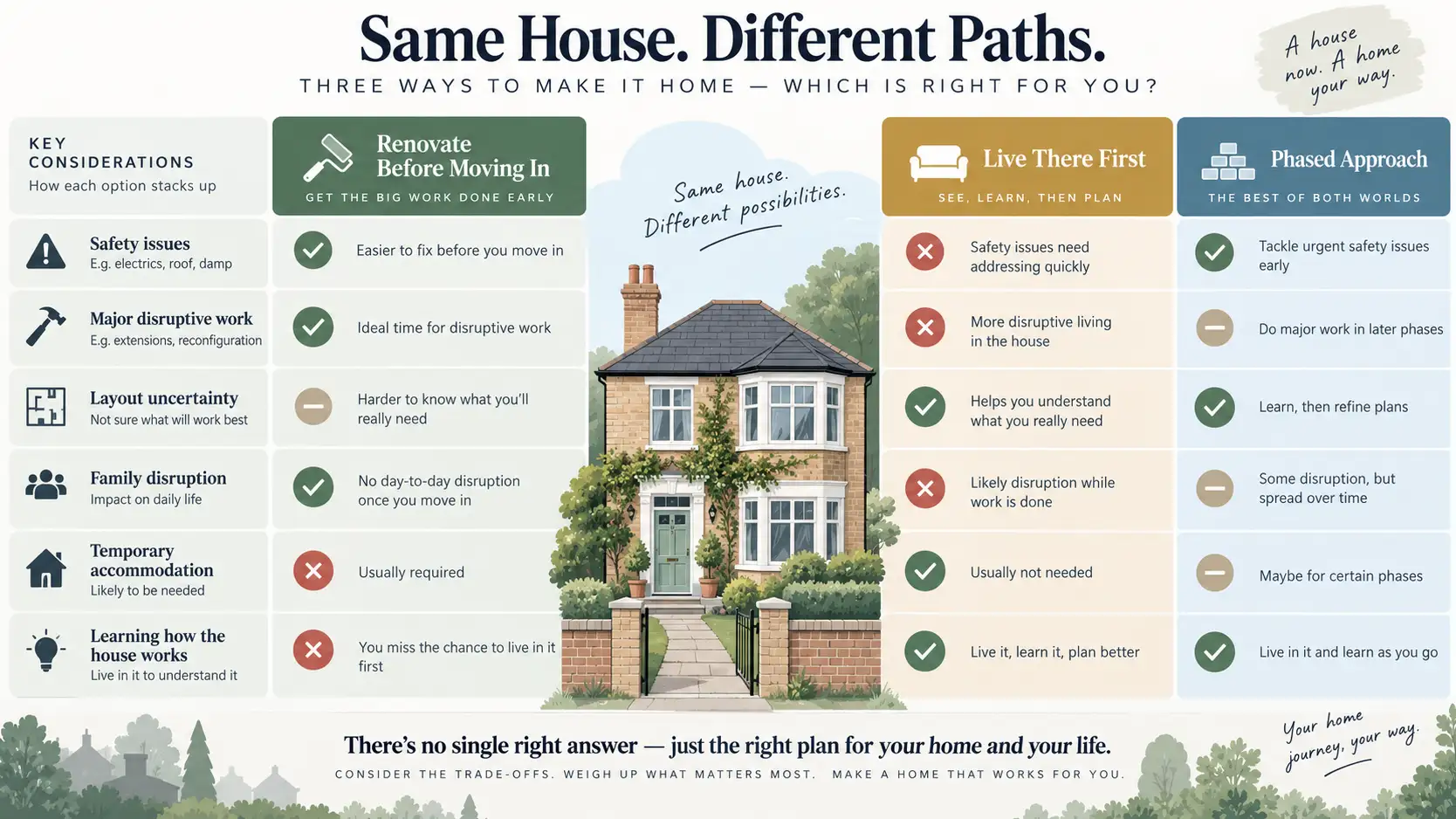
Buy a house that needs work, and almost everyone offers the same confident opinion: get it all done before you move in, while it’s empty, and you’ll never have to live through the dust. It’s sensible advice for a real subset of situations — and it quietly ignores the fact that some of the best renovation decisions only become obvious once you’ve actually lived somewhere for a while. Neither approach is universally right. The interesting part of this decision is understanding what each one genuinely buys you, and being honest about which matters more for a specific household and a specific property.
The case for renovating first
Certain kinds of work are genuinely, substantially easier to do in an empty property: a full rewire, major plumbing alterations, replacing flooring throughout, extensive plastering, structural alterations, major kitchen or bathroom strip-out, or heavy demolition. In an empty house, none of this has to be worked around, protected against, or paused for daily life — no furniture to shield from dust, no need to maintain a working kitchen or bathroom for anyone actually living there, and generally much easier access for contractors and materials. Doing this kind of work before moving in can also mean less overall disruption in the long run, since it avoids the awkward, drawn-out experience of major building work happening around a household that’s simultaneously trying to live normal daily life.
Intrusive work in an older property also needs the right hazards considered before anyone starts breaking into the building fabric. HSE advises that asbestos can be present in domestic buildings built or refurbished before 2000. Where refurbishment work could disturb suspect materials, the people carrying out the work need sufficient information to manage that risk properly rather than discovering it halfway through demolition. The Health and Safety Executive’s asbestos guidance is the appropriate starting point.
It’s worth being realistic, though, that “we’ll get it all done before we move in” is a plan that can run later than expected, and building in a genuine allowance for that — rather than assuming the original schedule will hold exactly — avoids a stressful collision between a fixed moving date and an unfinished house.
The case for living there first — genuinely underrated
This is the more editorially interesting half of the decision, and it’s worth taking seriously rather than treating as the fallback option for people who simply couldn’t afford to renovate first. Living in a property, even for a few months, reveals things that drawings, viewings and even a thorough survey simply can’t: which rooms are actually too dark to use comfortably, where morning and evening sun genuinely falls through the day and across the seasons, where storage is quietly missing once daily life is actually happening in the space, which routes through the house feel awkward in practice rather than on paper, whether a wall that looked like an obvious knock-through candidate actually needs to come out at all, whether the kitchen layout that seemed fine on a viewing genuinely bothers you once you’re cooking in it every evening, how sound travels between rooms, and which rooms the household naturally gravitates toward and which sit unused.
This matters because a huge number of expensive renovation decisions are, in effect, solutions to problems that only become real once someone has actually lived with them — and plenty of confidently planned changes turn out, after a few months of actual living, to have been solving an imagined problem rather than a real one. Renovating immediately, based entirely on assumptions formed during a 45-minute viewing, risks spending serious money solving the wrong problem, or solving a problem that wouldn’t have felt like a problem at all once daily routines settled in.
Not all work is equally postponable
It’s worth drawing a genuine distinction between work that may need dealing with before occupation — because of safety, basic habitability or active deterioration — and work that can reasonably wait while the household lives with the property and learns what it actually needs.
Unsafe electrics, significant water ingress, a serious structural safety concern, failed drainage or a heating problem that makes the property impractical or unsafe to occupy may belong in the first category, depending on their severity. A kitchen that’s dated but functional, a layout that feels slightly awkward but liveable, or bathrooms that aren’t to taste but work perfectly well sit far more comfortably in the second category — postponable, precisely because living with them for a while is likely to sharpen exactly what should change, rather than leaving anyone worse off in the meantime.
Which way does your project lean?
| What you’re dealing with | Usually favours renovating first | Usually favours living there first |
|---|---|---|
| Safety issue or active deterioration | ✓ | |
| Whole-house rewire, plumbing or extensive strip-out | ✓ | |
| Major structural layout already firmly decided | ✓ | |
| Perfectly usable but dated kitchen or bathroom | ✓ | |
| Uncertainty about how the rooms will actually be used | ✓ | |
| Storage, lighting or circulation questions | ✓ | |
| Young children, pets or intensive home working during major works | ✓ | |
| Household wants time to refine design and specification | ✓ | |
| Some urgent work but major layout decisions remain uncertain | Often suits a phased approach | Often suits a phased approach |
The useful question isn’t simply whether an empty house is easier to work on — it almost always is. It’s whether the benefit of that easier construction outweighs the information you would gain by living in the house before committing to the expensive decisions.
The trap of expensive temporary fixes
It’s worth watching for a specific, easy-to-fall-into trap: spending real money on decorating, flooring or a kitchen refresh that will simply be ripped out again once the main renovation eventually happens. Where a full renovation is genuinely being planned for the near future, it’s rarely worth investing heavily in finishes that won’t survive that project.
That said, this isn’t an argument for enduring genuine unpleasantness needlessly — inexpensive, low-commitment improvements that make a home comfortable to live in while plans develop, such as basic decoration, second-hand furniture and functional repairs, are a different, entirely sensible category, distinct from a premium spend on something about to be demolished.
A useful test is to ask: if the full renovation starts in twelve months, will I resent having paid for this twice?
Household circumstances change the calculation considerably
The tolerance for living through building work varies enormously by household, and it’s worth being honest about this rather than assuming everyone can simply push through. Young children and pets can make dust, noise, open work areas and a temporarily unusable kitchen or bathroom considerably harder to manage than the same disruption would be for a couple without either. Working from home changes the calculation too — noisy structural work happening metres from a video call is a genuinely different daily experience from the same work happening in an empty house nobody’s occupying.
None of this dictates a single right answer, but it’s a legitimate, significant factor in deciding how much disruption a specific household can reasonably absorb while still living there.
There’s also a difference between living in a house that’s being renovated and living in a house where major construction can be properly separated from the occupied part. A large property where one floor or wing can remain genuinely usable is a different proposition from a small terrace where demolition, dust and services work affect almost every room.
Weighing temporary accommodation against staying on site
Where renovating first is the chosen route, it’s worth genuinely comparing the cost and inconvenience of temporary accommodation — renting elsewhere, staying with family, or another temporary arrangement — against the cost and disruption of staying in the property throughout.
The calculation should go beyond the headline rent. Depending on the circumstances it may include storage, overlapping council tax or utility commitments, additional travelling, removal costs, and the financial effect of the project running beyond the expected temporary-accommodation period.
There’s no reliable average figure worth quoting here; it needs working out against the actual project and actual local options rather than assumed from a generic number.
Don’t forget the insurance question
An empty house undergoing major renovation can also be an insurance issue rather than merely a logistical one. Home-insurance policies can restrict cover when a property is left unoccupied for a specified period, and insurers may need to be told about significant building work.
MoneyHelper advises policyholders to tell their insurer when circumstances change, including when building work is being carried out. The Association of British Insurers also notes that prolonged unoccupancy can result in restricted cover under standard home-insurance policies.
Before assuming you can simply leave the property empty for several months while work proceeds, check the existing policy and tell the insurer what is planned. Specialist renovation or unoccupied-property cover may be necessary depending on the work and policy terms.
The MoneyHelper home-insurance guidance provides a useful starting point.
Living in first can also buy planning time
Choosing to live in a property before undertaking a major renovation can create valuable time to develop drawings properly, secure any necessary approvals, and select the right builder carefully, rather than rushing these decisions to hit a fixed pre-move-in deadline.
That can matter particularly where the intended renovation includes structural alterations, extensions, changes to heating, windows, electrical work or other elements that may bring Building Regulations into play. Planning permission and Building Regulations are separate systems, and not needing planning permission does not necessarily mean no Building Regulations process is required.
For projects in England, the current GOV.UK Building Regulations guidance explains the types of work that may require approval.
The trade-off, honestly stated, is that this also means living with whatever’s imperfect about the property for longer in the meantime — which loops back to the point above about household tolerance for that kind of ongoing compromise.
A middle path worth genuine consideration
For a meaningful number of households, the most sensible approach isn’t a binary choice at all: essential work first — the safety, weatherproofing and basic-habitability items that can’t reasonably wait — followed by moving in, followed by a period of genuinely living in and learning the property, followed later by a larger, more confidently informed discretionary renovation once the real priorities have become clear through actual daily use.
For example:
Phase one: stop leaks, deal with genuine safety concerns, establish reliable heating, electrics and basic facilities.
Phase two: move in and learn how the house actually works — light, storage, circulation, noise, garden connections and how rooms are genuinely used.
Phase three: finalise the major design and undertake the structural, layout and finish changes once those decisions are based on experience rather than assumptions.
This phased approach won’t suit every situation — some renovations are disruptive enough, or involve enough structural work, that doing them in stages around daily life is genuinely impractical — but it’s worth considering seriously rather than assuming the only options are “fully renovate before moving in” or “renovate immediately after.”
For buyers specifically
It’s worth resisting the reflex to assume every dated-looking property needs an immediate, wholesale redesign. Some features that look unfashionable in listing photos turn out, once actually lived with, to be genuinely practical, well built, or straightforward to update later without a full renovation — a dated but perfectly functional kitchen layout, for instance, or bathroom fittings that aren’t to current taste but work perfectly well.
Treating every original feature as an automatic renovation target, before actually spending time in the space, risks spending money changing things that never needed to change at all.
There’s also a financial benefit to allowing the first few months to separate things you dislike because they’re unfamiliar from things that genuinely interfere with how the household lives. The two can feel remarkably similar on moving day.
The decision, honestly stated
Renovating an empty property can genuinely reduce disruption and simplify access for major, disruptive work. Living in a property first can reveal, with real accuracy, what actually needs to change — information that drawings, viewings and even a careful survey simply can’t provide in the same way.
Neither instinct is wrong on its own; the right answer depends on weighing the condition of the specific property, the urgency of any genuine safety or habitability issues, the scale and interconnectedness of the planned work, and the household’s realistic tolerance for living through construction, against the value of the insight that comes only from actually living somewhere before deciding what to change.

