

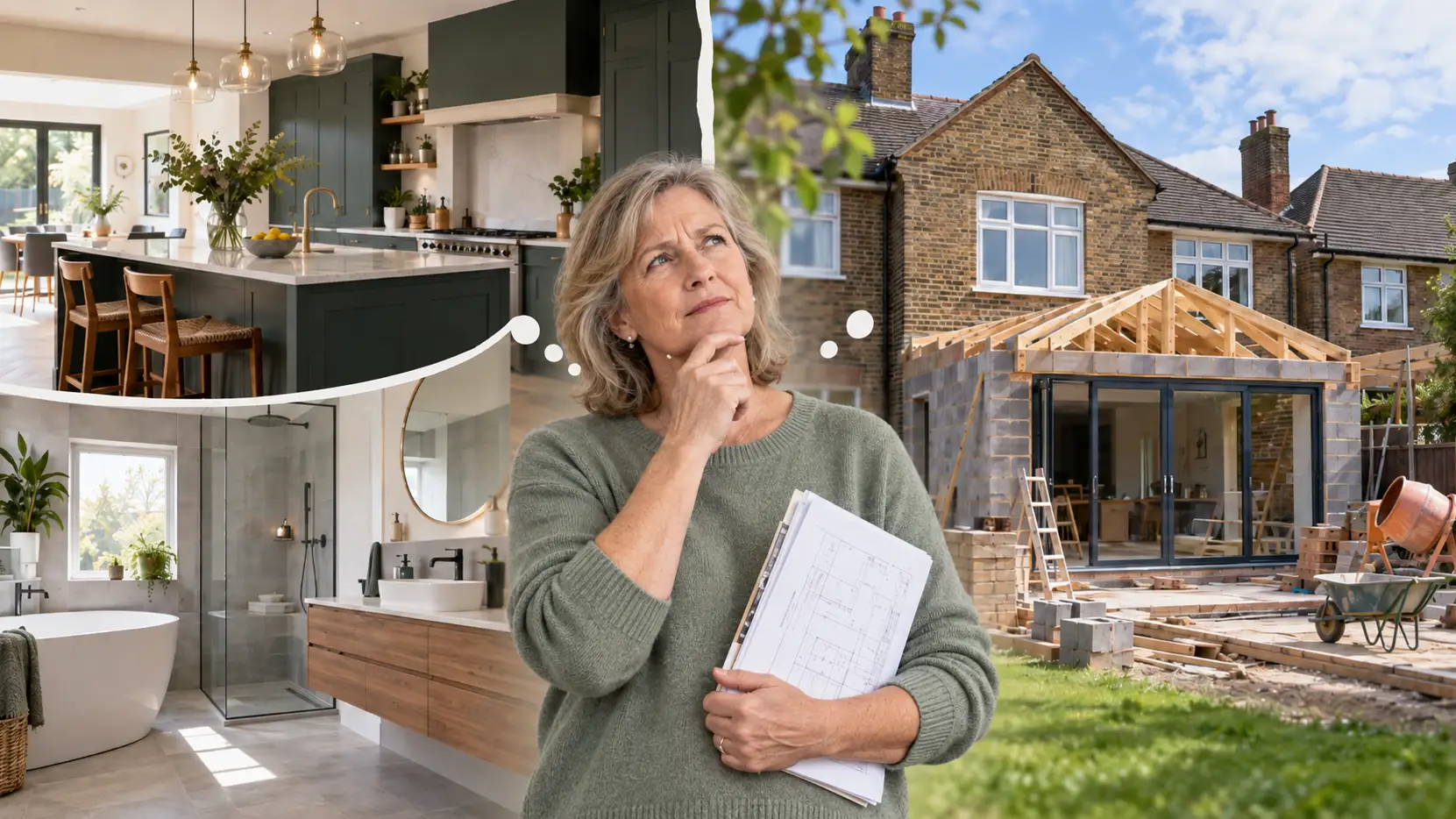
Search for “which home improvements add the most value” and the results contradict each other almost entirely. One source insists kitchens and bathrooms deliver the strongest returns of any improvement; another, drawing on different data, ranks them among the weakest. One claims a specific renovation adds a precise five-figure sum to a specific market; another quotes a wildly different figure for what sounds like the same job. None of this is a coincidence, and it’s not really anyone’s fault — it’s what happens when a genuinely local, genuinely property-specific question gets flattened into a single national headline. The honest starting point for this decision is admitting that a confident, universal percentage almost never holds up, and building a better framework in its place.
Three different kinds of return, not one
It helps to separate what an improvement is actually buying, because “worth it” means different things depending on which of these you’re actually after:
Financial return — does the work affect what the property is worth, how many buyers want it, and how easily it sells when the time comes?
Practical return — does the home function better day to day: easier to maintain, more comfortable to live in, better suited to how the household actually uses the space?
Enjoyment return — will the people living there genuinely benefit from it, for years, regardless of what a future buyer thinks?
These frequently overlap, but not always, and treating them as interchangeable is where a lot of disappointment comes from. A home cinema room might deliver enormous enjoyment return but little predictable financial return. A replacement heating system may deliver important practical benefits without producing an equally obvious pound-for-pound increase in sale price. Knowing which kind of return a specific improvement is actually chasing helps set realistic expectations before the money’s spent.
A six-question test before spending
Before committing a substantial part of a renovation budget, ask:
| Question | Why it matters |
|---|---|
| Is this fixing a genuine defect? | Stopping deterioration can prevent a larger future bill even if the work isn’t visually exciting |
| How often will we actually benefit from it? | Daily-use improvements can justify themselves through comfort and convenience over many years |
| How long are we likely to stay? | The longer you remain, the more relevant practical and enjoyment returns become |
| Would buyers locally expect this feature? | Market expectations vary dramatically between streets, property types and price brackets |
| What do comparable renovated homes actually sell for? | This provides a reality check on how much financial headroom the local market may support |
| Am I doing this for resale, or because I genuinely want it? | Either reason is legitimate — problems arise when an enjoyment purchase is justified using an assumed financial return |
An improvement doesn’t have to score highly on all six. The point is to know why you’re spending the money before trying to decide whether it was “worth it”.
How long you’re staying changes almost everything
This is arguably the single biggest variable in the whole decision, and it’s worth being explicit about it before anything else. A household planning to stay six months faces a very different calculation from one settling in for fifteen years. A high-specification kitchen fitted immediately before marketing a property is essentially a financial and presentational decision, judged largely against likely buyer appeal and sale price. The same kitchen, fitted by a family expecting to cook in it daily for the next decade, is primarily an enjoyment and practical decision, where resale value is a welcome side effect rather than the main point. The right choice of improvement, and the right specification level, genuinely differs between these two situations — there isn’t one correct answer independent of how long you expect to be living there.
Repairs first, upgrades second
Before any discussion of kitchens, bathrooms or kerb appeal, it’s worth being clear that fixing genuine problems — a leaking roof, persistent water ingress, dangerous electrics, structural issues — will usually deserve priority over a discretionary cosmetic improvement where the budget cannot comfortably cover both. An attractive new kitchen sitting below an unresolved roof leak is not a good trade, financially or practically, and a buyer’s survey is unlikely to make the underlying defect disappear simply because the kitchen looks good.
Where a budget is limited, resolving genuine defects generally deserves priority over cosmetic upgrades, not because it’s more exciting, but because active deterioration can become more expensive the longer it’s allowed to continue.
Kitchens and bathrooms, without the fabricated percentages
Kitchens and bathrooms are highly visible, heavily used and comparatively disruptive for a future owner to replace, which gives sensible reasons for paying attention to them. A dated or poorly functioning version of either can also influence how a buyer perceives the amount of work a property still needs.
But resist any claim that a kitchen or bathroom renovation adds a specific, predictable percentage or pound figure to a property’s value — the genuinely credible evidence doesn’t support that level of precision across every property and market.
What matters far more than a headline percentage is condition and functionality relative to what buyers in that specific market currently expect, and — critically — not over-specifying relative to the property and area, covered below.
There’s also a difference between replacing something that’s actively putting buyers off and replacing something perfectly serviceable merely because it isn’t to your own taste. The financial argument for those two decisions is not necessarily the same.
Additional space, briefly
Extra usable space — through an extension, loft conversion or garage conversion — can improve both daily life and eventual value, but an increase in floor area doesn’t guarantee that the project cost will be recovered pound for pound.
The detailed feasibility, design and cost analysis for that kind of project belongs in our Extensions & Conversions coverage rather than here. The point worth making in this context is simply that “more space” and “better space” are different goals, and a smaller, better-organised home can sometimes serve a household better than a larger, more expensively extended version of the same layout.
Kerb appeal and the exterior, honestly
The state of a property’s exterior — the front elevation, the entrance, general maintenance, garden condition — genuinely shapes a buyer’s first impression, and first impressions are real even if they’re hard to price precisely. This is worth taking seriously without reaching for the kind of confident, specific claims that circulate about exactly how many percentage points a well-maintained front garden adds.
What can be said with more confidence: obvious neglect on the exterior can make buyers wonder what else has been neglected, which is a genuine reason to address visible maintenance issues even on a limited budget.
That doesn’t mean an expensive landscaping scheme automatically pays for itself. Tidying, repairing, cleaning and dealing with obvious deterioration are different financial decisions from redesigning an entire frontage to somebody else’s taste.
Parking is genuinely local, not universal
Off-street parking can matter enormously to buyers in one area and barely register in another, depending entirely on local parking pressure, public transport availability, and what’s typical for similar properties nearby. There’s no honest, universal claim to make here about how much a parking space is “worth” — it depends on the specific street and area far more than on any national average.
This is exactly the kind of improvement where looking at nearby sold properties is more useful than reading a national list. In England and Wales, HM Land Registry’s sold-property-price service provides an official starting point for checking actual transaction prices.
Energy improvements, briefly
Better insulation, appropriate heating improvements and better overall energy performance can deliver practical returns through comfort and potentially lower energy use. Energy performance is also visible during the sale process: where an Energy Performance Certificate is required, prospective buyers can see the property’s rating and recommended improvement measures.
The government’s Energy Performance Certificate guidance explains the current position for sellers.
The detailed case for specific energy upgrades, and how to prioritise between them, is covered properly in our Energy Efficiency & Retrofit coverage. The relevant point here is simply that comfort, running costs and improving the building itself are legitimate reasons to prioritise this kind of work even where the resale uplift cannot honestly be reduced to a simple percentage.
Every improvement sits under a local ceiling
No improvement can be judged sensibly in isolation from the street, area and property type it sits within. There is usually a range the local market currently supports for broadly comparable homes, and spending £100,000 on improvements does not reliably produce £100,000 of additional value once a property’s specification moves meaningfully ahead of what similar homes nearby actually achieve.
This is what’s usually meant by overcapitalising or over-improving: spending more on the property than the local market is likely to recognise in additional value. That doesn’t automatically make the work a mistake — you may be buying years of personal enjoyment — but it changes the financial justification for doing it.
Professional residential valuation relies heavily on relevant comparable evidence rather than generic national uplift percentages. RICS guidance on comparable evidence in property valuation emphasises recent, relevant and genuinely comparable market transactions.
HM Land Registry sold-price data can help a homeowner establish the basic local evidence, but raw sale prices still need interpreting. Two houses on the same street may differ substantially in extension size, condition, plot, parking, orientation and specification. Where a large investment decision depends on the answer, a good local estate agent or chartered surveyor can help interpret those differences rather than simply quoting the highest nearby sale.
What overcapitalising can look like
Consider a purely illustrative example.
Suppose broadly comparable homes in their current condition have recently been selling around £330,000, while genuinely comparable renovated examples appear to achieve around £360,000.
That suggests roughly £30,000 of apparent market headroom before allowing for all the differences between those properties.
It does not mean a £30,000 renovation will automatically generate a £30,000 return. And spending £60,000 purely because you expect the property’s value to rise by the same amount would be a very different proposition.
The household might still quite reasonably spend £60,000 because it intends to live there for another ten years and values the resulting home highly. The important distinction is that part of that spending is then being justified by use and enjoyment, not by pretending the entire cost is an investment that the resale market is certain to repay.
If you’re selling relatively soon
Where a sale is reasonably imminent, it’s worth genuinely questioning whether a major renovation is the right move at all, versus a more modest set of actions: addressing obvious defects, a general tidy-up and repair pass, fresh decoration where genuinely needed, decluttering, and making sure nothing about the property’s presentation actively puts buyers off.
A major renovation undertaken purely to sell carries real risk — cost overruns, delays that push back the sale, and a specification chosen by the current owner that doesn’t necessarily match what the eventual buyer would have chosen for themselves.
For many sellers, the more modest, lower-risk route may be more sensible than an ambitious pre-sale renovation, though this depends heavily on the property’s actual condition and how it compares with similar homes currently competing for buyers nearby.
The question to actually ask
Not “does this improvement add value,” treated as a single, universal, easily answered question — it isn’t. The more useful question is: what kind of return am I actually buying with this specific spend, on this specific property, given how long I expect to be here and what the local market will realistically support?
A repair that stops ongoing deterioration, a functional upgrade the household will use daily, and a discretionary indulgence bought purely for enjoyment are all legitimate reasons to spend money on a home — but they’re different decisions, made for different reasons, and conflating them under a single vague idea of “adding value” is exactly how renovation budgets end up in the wrong place.

