

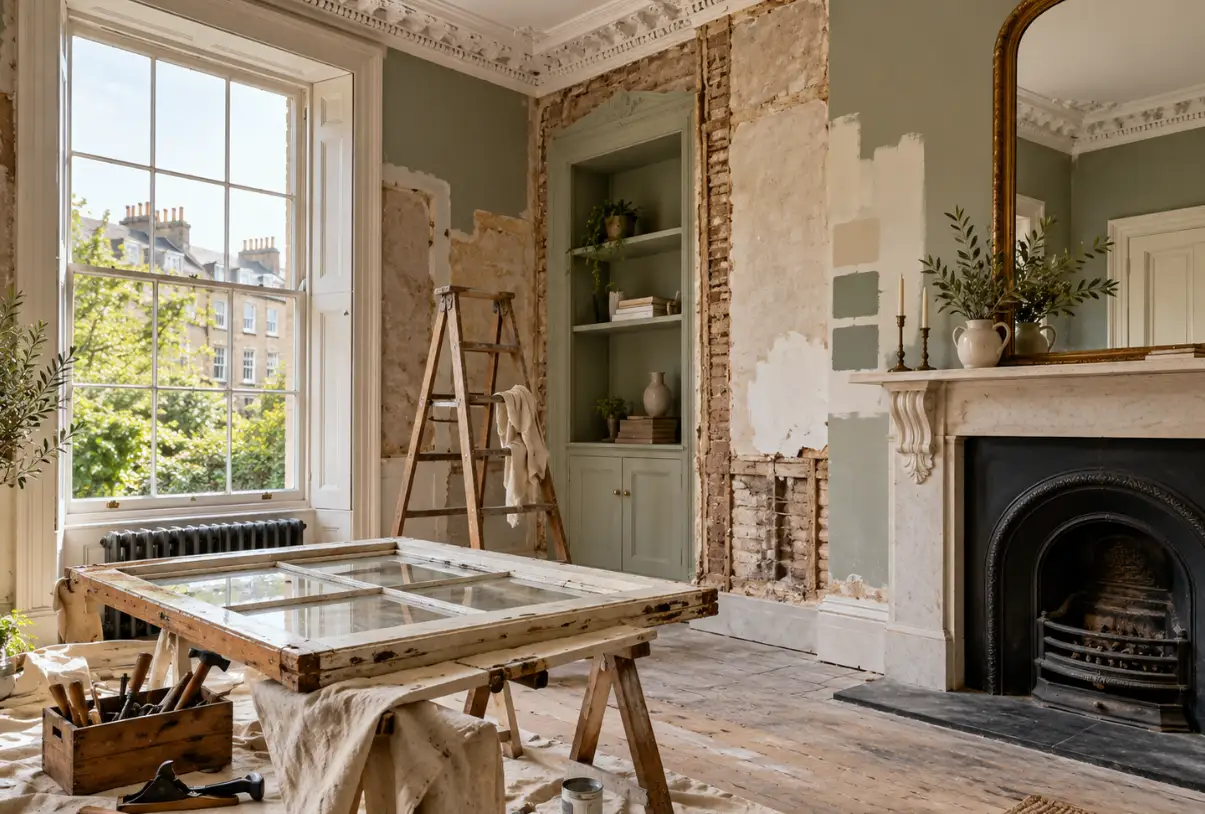
There are two instincts that both go wrong in a period property, and they go wrong for opposite reasons. One says everything old is sacred and must be preserved regardless of condition, which can mean nursing along a genuinely failed feature at real cost and inconvenience purely because it has survived for a long time. The other says original features are simply obstacles to modernising the house properly, which can mean stripping out joinery, plasterwork, floors and detailing that was well made, repairable and integral to the character of the building, only to replace it with something less durable and less convincing.
Neither instinct is a particularly useful way to renovate a house.
The better approach is feature by feature: what does this actually contribute, what condition is it really in, what has caused any deterioration, can it be repaired properly, and what would replacing it genuinely improve? There is also a fourth possibility renovation projects easily forget — that a sound feature may simply need maintaining and leaving alone. A house does not become better because everything in it has been intervened with.
It is worth distinguishing restoration from repair too. Repair means dealing with defects while keeping as much useful existing material as possible. Restoration means taking something back towards a known earlier state, which is a rather different exercise and should be based on evidence rather than an assumption about what a house of that age ought to look like. Historic England’s guidance on restoration makes that distinction important: period houses usually contain several phases of alteration, and later work is not automatically disposable simply because it isn’t original.
Condition tells you more than age does
Age is almost never the right test on its own. A century-old timber sash window with sound primary joinery can have a very long useful life ahead of it, and local decay, failed cords, loose joints or draughts do not necessarily mean the whole window has failed. Skilled joinery repairs, overhaul and draught-proofing can retain most of the existing window while making it work substantially better.
Historic England’s guidance on traditional windows recommends repair wherever practicable and notes the exceptionally long service life well-maintained timber windows can achieve. Thermal comfort can often be improved without removing them either: draught-proofing, shutters, curtains, secondary glazing and, where appropriate, sensitive glazing improvements can all make a real difference.
A window with serious decay through its main structural members, severe distortion or repeated failed repairs is another matter. The point isn’t that an original sash must survive whatever its condition. It is that replacement should follow a proper diagnosis rather than precede one.
The same principle applies throughout an older house. If floorboards are decaying, find the moisture source before replacing them. If plaster repeatedly fails, understand what is happening behind it before covering the wall with another system. If roof timbers are damp, establish whether failed coverings, gutters, flashings, condensation or another defect are responsible before concluding that the timber itself is the problem. Replacing damaged material while leaving the cause untouched merely gives the same problem something new to damage.
And sometimes there is no meaningful defect at all. Historic England’s maintenance guidance puts regular inspection and small, timely repairs at the centre of looking after older buildings for good reason. A sound floor does not need sanding back simply because the room is being renovated, and a serviceable window may need paint and maintenance rather than a restoration project.
What replacement quality actually buys you
Replacement is not automatically an upgrade.
Some original joinery, plasterwork, flooring and decorative features are difficult and expensive to reproduce to the same quality, and a standard modern replacement can look perfectly convincing in a catalogue while feeling obviously wrong once it sits beside the proportions and detailing of the original building.
That does not make replacement a failure. There are features which are genuinely beyond sensible repair, and there are modern replacements which offer worthwhile improvements in security, operation, accessibility, maintenance or performance. Safety can also override a preference for retention: hazardous materials, unsafe services or structurally failed elements need to be dealt with according to the actual risk, not kept in unsafe use simply because they are old.
The useful comparison is therefore not “old versus new”. It is the existing feature after a realistic repair or upgrade compared with the actual replacement being proposed.
A neglected sash, for example, should not be compared with a pristine new unit as though neglect represents the best the original can ever be. Compare the repaired, draught-proofed existing window with the specification, detailing and likely life of the replacement and then ask what the additional intervention really buys.
The same applies to cost. Replacement can bring removal, making good, plastering, decoration and damage to adjacent material which do not necessarily appear in the headline price of the new item. A specialist repair can look expensive until both options are compared as complete jobs rather than individual line items.
None of that means repair must win. It means replacement should win for a reason beyond simply being new.
Reading the individual elements
Doors, skirting, architraves, staircases and panelling are often strong candidates for retention where they survive in useful condition because their dimensions, mouldings and workmanship contribute to how the rooms around them feel. Missing or badly damaged sections can often be repaired or replicated without throwing the rest away.
Old timber floors require similar judgement. Original boards can often be locally repaired and refinished, but lifting them is not automatically harmless. Boards split, concealed fixings cause damage and significant old floors may be better disturbed as little as possible. Wear, slight unevenness and gaps are not the same thing as failure.
Decorative plasterwork, cornices, ceiling roses, shutters, fireplaces and original ironmongery can matter disproportionately to the character of a room. They are also the sort of features whose contribution is easy to underestimate until they have gone: removal may take very little time, while convincing reinstatement can require specialist work and far more disruption.
That does not mean every feature which looks old is important. A relatively recent reproduction fireplace does not become significant merely because it imitates an earlier style, while a well-designed later alteration should not automatically be removed simply because it came after the original house. Period properties are often made up of several architectural layers; the useful distinction is whether a later change contributes something, works well and belongs convincingly to the building, not merely when it was fitted.
Roofs sit somewhere between character and necessity. Keeping water out is non-negotiable, but an older roof can also be an important part of the building: clay tiles, stone or Welsh slate, ridges, flashings, laying patterns and surviving structures can all contribute to its appearance and history. Historic England’s guidance on older roofs recommends considering whether coverings and historic roof structures can be repaired or reused before wholesale renewal. That is not an argument for tolerating a leaking roof; it is an argument for solving the failure without automatically discarding material which is still capable of doing its job.
Services tend to sit at the more practical end of the decision. Obsolete wiring, an inefficient later heating arrangement or a poor modern bathroom is not owed preservation simply because it has acquired some age. Sensitive modernisation often works best when it improves the things that genuinely benefit from contemporary technology while leaving alone the parts of the house whose value lies precisely in having survived.
Where traditional building fabric changes the calculation
Solid-walled and other traditionally constructed buildings can behave differently from modern cavity-wall houses, particularly around moisture, ventilation and insulation. That isn’t sentiment dressed up as building science; it changes what constitutes a sensible repair.
Many older buildings use solid masonry, timber, earth, lime mortars and lime plasters which can absorb, redistribute and release moisture in ways quite different from many modern construction systems. Altering one part of that balance without understanding the rest can move moisture somewhere it was never causing trouble before.
Historic England’s guidance on traditional buildings and energy efficiency stresses the interaction between moisture, heat and air when older buildings are altered. Poorly conceived insulation, impermeable materials or changes to ventilation can contribute to moisture accumulation, mould and decay rather than solving the problem they were intended to address.
The useful principle is compatibility, not simply buying something marketed as “breathable”. An unsuitable render, floor build-up or internal insulation system can cause problems, but an old wall does not become healthy merely because traditional materials are specified either. Failed gutters, leaking pipes, damaged pointing and inadequate ventilation still need to be fixed.
This is where repair-versus-replace decisions stop being purely visual. Once work touches the actual building fabric, the person specifying it needs to understand how that particular building is constructed and why the defect has occurred.
Where the building itself sets the rules
For a listed building, some of these choices are not solely aesthetic or financial.
In England, listed building consent can be required for work which affects a listed building’s special architectural or historic character, and that can include internal as well as external alterations. Staircases, plasterwork, panelling, fireplaces, historic room arrangements and other features may therefore have a legal significance as well as an architectural one. Historic England’s guidance on permissions for older homes explains the distinction.
A conservation area is different. Simply living in one does not place the interior of an unlisted house under the same blanket control as a listed building. Conservation-area controls are principally planning controls concerned with the character and appearance of the area, while Article 4 directions can remove specified permitted development rights, often affecting visible external changes such as windows and doors.
That distinction is worth understanding before an original feature is either ripped out unnecessarily or preserved because someone has incorrectly said the law requires it.
With a listed building especially, the sensible time to check is before removal. Whether something is physically easy to take out and whether you are legally free to take it out are different questions.
The better question, feature by feature
By the end of walking through a period house room by room, the useful question to have settled on isn’t “is this old?” and it isn’t “can we replace it?”
It is whether the feature actually needs work at all; what it contributes to the house; what condition it is genuinely in; whether deterioration has an underlying cause; whether a skilled repair can retain what is still good; and what replacing it would materially improve beyond simply giving you something new.
Sometimes the answer will be to maintain it and leave it alone. Sometimes repair will preserve something worth keeping for many more years. Restoration can make sense where there is good evidence for what has been lost and a genuine reason to reinstate it. And sometimes replacement is plainly the better decision because the existing feature has failed or the modern alternative solves a problem that repair cannot reasonably solve.
That is a much more useful way to renovate an older home than deciding in advance that everything original is precious or everything old is obsolete.
A successful period renovation does not preserve everything and it does not modernise everything. It keeps what is genuinely worth keeping, repairs what can sensibly be repaired, replaces what genuinely needs replacing and leaves sound parts of the house alone when doing more would achieve very little.
That usually produces a home which works better without erasing the things that made it worth renovating in the first place.
Important: This article provides general property and renovation information, not a condition assessment, conservation appraisal or specification for a particular building. Traditional construction varies considerably between properties, and potentially hazardous materials or unsafe building elements require appropriate professional assessment. Where original or potentially significant features are involved, seek advice from professionals and tradespeople experienced in older buildings. The heritage-consent discussion above describes the position in England; listed-building and conservation-area controls differ elsewhere in the UK. Check the appropriate consent position before altering protected features.

