

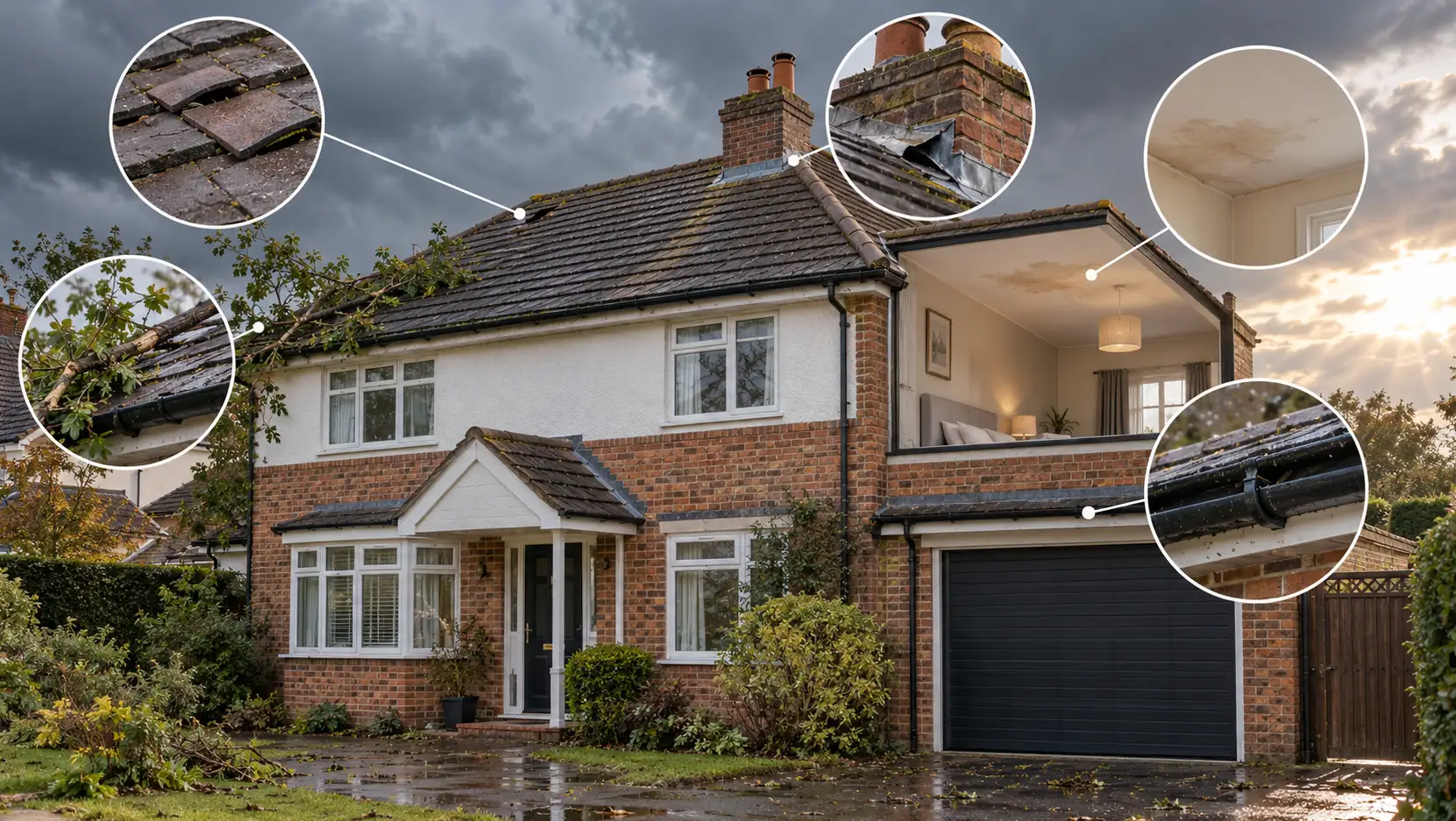
Nothing has fallen down. There are no roof tiles in the garden, no cracked glass and no fence panel lying across the lawn. It would be reasonable to conclude that the property came through the storm unscathed. It can also be wrong, because some of the damage worth finding does not announce itself immediately: a tile may have shifted rather than fallen, flashing may have moved just enough to admit rain from one direction, a gutter bracket may have loosened, or a branch may have split without coming down.
Most properties genuinely do come through most storms without serious damage, so this is not an argument for treating every spell of high wind as a structural emergency. It is about knowing what “looks fine” can and cannot tell you. The useful question after genuinely severe weather is whether anything has changed that needs watching, repairing or inspecting before the next spell of rain or wind turns a small disturbance into a more expensive problem.
Why intact and undamaged aren’t the same thing
Storm damage does not require something to become completely detached. A slate can move and remain on the roof; ridge, verge or flashing details can loosen without becoming obvious from the garden; rainwater goods can shift just enough to leak at the next downpour. A storm can create a defect, worsen one that was already developing or simply expose a component that was near the end of its serviceable life.
That distinction matters because finding a problem immediately after a storm does not automatically prove that the weather created all of it. The Association of British Insurers notes that severe weather can reveal existing weaknesses such as deteriorated pointing, corroded roof fixings and ageing flat-roof coverings, while insurance generally distinguishes sudden storm damage from normal wear and tear. Association of British Insurers — storms and storm damage
The most useful comparison is often not “before the storm versus after the storm”, but “what has genuinely changed?” Old estate-agent photographs, survey photographs or ordinary phone pictures can sometimes answer that surprisingly well. A crack, leaning fence post or imperfect roofline first noticed after a storm may be new, may have worsened, or may simply be something nobody happened to look at closely before.
What to check from safe ground
Wait until the weather has genuinely settled before going outside. The Met Office warns that buildings, boundary walls, fences and trees may have been weakened by high winds and advises keeping clear of anything that could be unstable. Met Office — staying safe in a storm The first inspection should therefore be from the ground, from safe windows and from normal accessible parts of the property rather than from a ladder or roof.
Look along the roof rather than merely looking for something missing. A slate or tile sitting at a different angle, a new gap, a ridge line that no longer looks even, disturbed flashing around a chimney or roof junction, or debris beneath a stack can all justify a closer professional look. Work down the building too: gutters and downpipes can pull away at brackets or joints, fascias and soffits can loosen, and render, cladding, windows and doors may show a new crack, displaced trim or evidence of wind-driven rain. In the garden, look for a boundary wall, fence, gate, shed or canopy that now leans, moves differently or has loosened fixings, but do not stand on the side towards which a weakened wall or fence could fall.
Some of the parts most worth checking are also the least visible. A flat-roofed extension, hidden valley, parapet, dormer junction or roof partly obscured by solar panels can contain precisely the details that are hardest to judge from below. That does not mean commissioning a roof survey after every gale. It becomes more reasonable where the property took unusually severe exposure, the roof already has known weaknesses or previous repairs, something looks different from the ground, or the construction simply prevents the vulnerable areas being seen.
Trees need the same emphasis on change rather than anxiety. The National Tree Safety Group’s householder guidance supports owners making ordinary visual observations and seeking specialist advice where an obvious defect causes concern. National Tree Safety Group — householder guidance A broken or hanging major limb, partial uprooting, newly altered lean or other obvious new defect is a reason to keep clear and obtain competent advice, not to stand underneath investigating it.
Checking inside, without climbing anywhere
Inside, start at the top of the property and look for what the exterior cannot show you. Ceilings and upper walls may develop fresh staining, damp patches or peeling finishes, particularly beneath roof junctions, valleys, chimneys and exposed elevations. Water around a window does not necessarily mean the window itself has failed; wind-driven rain can find routes that ordinary rainfall does not.
If there is a normally accessible loft, start by looking from the hatch. Only move into an area that is normally boarded or safely accessible if nothing suggests that entering it would be unsafe. Fresh water staining, damp insulation, dripping or obviously displaced roofing material all matter, but daylight has to be interpreted carefully: some roofs deliberately admit light at ventilated eaves and other openings, while the absence of visible daylight does not prove the outer covering is undamaged.
Particular caution is needed where water has reached electrics. If water is present around a light fitting, socket or other electrical equipment, do not touch it or test it by switching it on. Electrical Safety First advises switching off the electricity only where it is safe to do so and having water-affected electrical installations assessed by a registered electrician. Its guidance is written for flood damage, but the electrical principle is relevant whenever water has reached wiring or electrical equipment. Electrical Safety First — water-damaged electrics
A markedly sagging ceiling or roofline, obvious structural movement, a damaged chimney or anything that makes an area appear unsafe takes the situation beyond a routine homeowner inspection. Keep people clear rather than trying to diagnose it more closely.
Why the first check isn’t the only check
An inspection immediately after a storm is good at finding things that have already fallen, moved or begun leaking. It is much less capable of finding a defect that only becomes apparent when rain reaches it from the right direction.
The next ordinary spell of rain may reveal a defect that the first dry inspection simply could not. From inside, check previously vulnerable ceilings, roof spaces and windows while or shortly after normal rainfall where it is safe to do so; once the weather has passed, look again from outside for overflowing gutters, new staining or anything else that now behaves differently. Where water is already entering, something is loose or unstable, or electricity may be involved, there is nothing useful to be gained by waiting for another test.
Keeping a simple record makes this much more useful. Photograph anything that looks different from the same position and note when a stain, drip or odour first appeared. If there is obvious insured damage, take photographs before substantial temporary work where that is safe, contact the insurer promptly if a claim may be involved, and keep receipts for emergency repairs. ABI advises policyholders to contact insurers as soon as possible, take sensible steps to prevent further damage and retain evidence and receipts.
Reading what you find
| What you find | What it suggests | Sensible response |
|---|---|---|
| Nothing visibly changed, no water entry and no unusual movement | Reassuring, but not absolute proof | Check again after ordinary subsequent rain and remain alert to anything that changes |
| Something looks newly displaced, cracked, loose or different | Possible local storm damage or a pre-existing weakness exposed by the storm | Photograph and compare with earlier images; obtain inspection where the area is inaccessible or the change cannot be safely understood |
| Fresh staining, dripping or damp appears indoors | Water has found a route into the building | Investigate and repair the source rather than simply treating the internal mark |
| Apparent structural instability, water affecting electrics, or a seriously damaged tree | Potential safety risk | Keep clear and obtain the appropriate professional assessment rather than continuing the inspection yourself |
The table is deliberately not a DIY diagnostic chart. Its purpose is to separate something that can reasonably be watched from something that already justifies action.
Commercial buildings need the same discipline, often at greater scale
The same principle applies to commercial property, although inaccessible roof areas and external systems can make visual checks less informative. Flat roofs, membranes, parapets, cladding, signs, rooflights, drainage and rooftop plant can all suffer local disturbance without anything obvious being visible from the car park. A professional inspection becomes more defensible after unusually severe exposure where these elements are inaccessible, where water has appeared internally, or where failure could create a significant safety or business-interruption problem. For landlords and facilities managers, keeping photographs and contractor findings also helps distinguish a new storm event from a maintenance issue that was already developing.
The building tells you what happened, if you keep checking
A storm passing without anything visibly falling from the property is genuinely good news, but it is not quite the same as proving that every exposed component is unchanged. The defects worth catching early are usually modest: a tile sitting slightly differently, a gutter joint beginning to leak, water appearing only in wind-driven rain, or a branch damaged but still attached.
The aim is not to keep searching until you find a problem. It is to establish whether anything has genuinely changed, understand which parts of the property cannot be judged from a quick look and pay attention when subsequent weather tests those areas again. A safe inspection after severe weather, sensible comparison with how the property looked before and a second look after ordinary rain will catch many of the defects that otherwise remain quiet until they become larger, wetter and considerably more expensive.
This article provides general property information, not legal, financial, surveying, arboricultural, electrical or other professional advice for individual circumstances. Do not access roofs or unsafe areas, use ladders to investigate storm damage, approach unstable trees or structures, or touch electrical equipment affected by water. Where there is apparent structural instability, significant water entry, electrical involvement or an obviously damaged tree capable of causing harm, keep people clear and obtain appropriate professional advice.

