

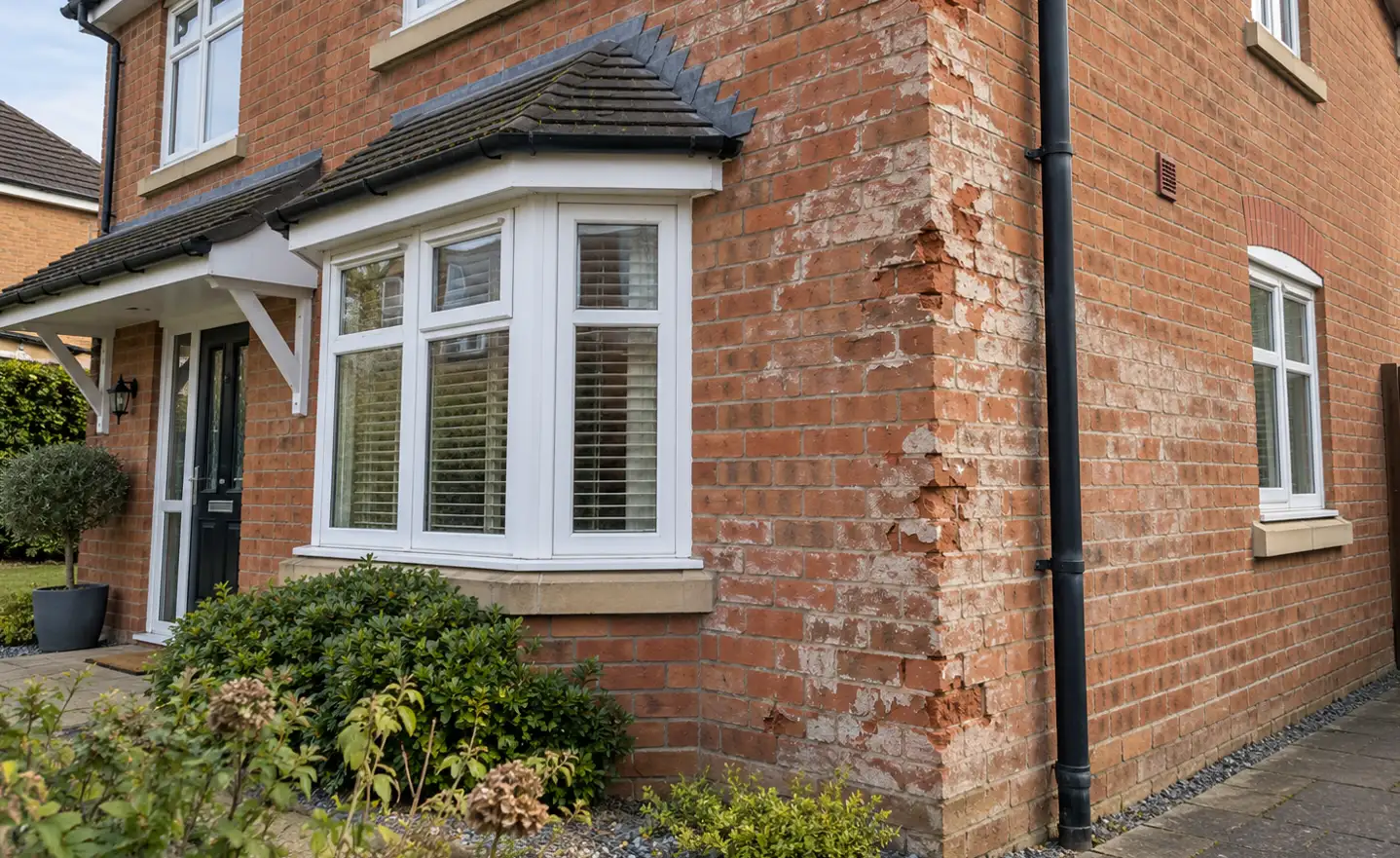
The mortar looks fine. It’s the bricks themselves that are the problem — faces flaking away, corners crumbling, or a surface that has become friable where there used to be a solid fired face.
That is a different question from repointing, and the distinction matters because the two problems do not automatically have the same cause or the same repair. Repointing can replace deteriorated mortar between bricks; it cannot put missing material back onto a brick whose face has broken away. But mortar cannot be ignored altogether, because on some walls an unsuitable mortar can actually contribute to deterioration of the bricks beside it.
The most useful starting point is therefore not simply how bad does the brick look? It is where the deterioration is occurring and what pattern it follows. Two failed bricks in an otherwise sound elevation, a band of damage close to ground level, a patch beneath a leaking gutter and widespread decay across an exposed parapet may all be described as spalling, but they can be telling you quite different things.
Two different parts of the wall, two different problems
A brick wall is made from the masonry units themselves and the mortar joints between them, and either can deteriorate without the other failing in the same way.
Where mortar is becoming loose, deeply eroded or dropping from the joints while the brick faces remain substantially sound, the principal question is whether repointing is needed — something covered separately in our guide to failing mortar joints. Spalling is different: material is being lost from the brick itself. The face may flake away in thin sections, corners can crumble, or deterioration can progress until the softer body of the brick is noticeably exposed.
Usually the distinction is visible if you look closely. Is material disappearing from the joint, or from the brick?
White powder on a wall can confuse the picture. A crystalline or powdery white deposit on otherwise intact masonry is often efflorescence: soluble salts have travelled with moisture towards the surface and crystallised as the water evaporated. It can look alarming, but it is not the same thing as the brick face physically breaking away.
Historic England’s guidance on masonry and moisture explains that surface efflorescence is commonly unsightly rather than harmful in itself; the greater risk arises where salts crystallise within masonry, particularly where moisture or salts are trapped behind relatively impermeable materials.
So a white deposit alone does not prove that a brick is spalling. If it repeatedly returns on established brickwork, however, it is still useful evidence that moisture and soluble salts are moving through that part of the wall — which raises the more important question of why.
The same distinction applies to repointing. Repointing alone cannot reconstruct the face of a damaged brick. If inappropriate mortar is contributing to the deterioration, though, correcting some of the pointing may form part of the wider remedy.
Why bricks actually spall
Freeze–thaw action is one of the best-known causes, but cold weather on its own is not enough to explain why one wall deteriorates while another does not. The amount of moisture in the brick, its frost resistance, how exposed the wall is and how quickly it can dry all influence what happens.
Where susceptible bricks become and remain sufficiently wet during freezing weather, repeated freeze–thaw cycles can progressively damage the material until parts of the face break away. The Brick Development Association’s guide to alteration and repair of brickwork describes extensive frost failure where bricks remain saturated in freezing conditions and also notes that occasional individual bricks can fail within an otherwise sound expanse of masonry.
That latter point is important for homeowners because the pattern can tell you more than the word “spalling”.
One or two deteriorating bricks scattered through an otherwise healthy wall may indicate localised brick failure rather than a problem affecting the whole elevation. A particular brick may be less durable than its neighbours, have suffered earlier damage or simply perform differently because of how it was made.
A cluster of damaged bricks directly beneath a gutter joint or beside a downpipe is a different clue. If the rainwater system repeatedly wets the same patch of wall, repairing the brick without dealing with the water source leaves the reason for the failure untouched.
Low-level deterioration needs reading in context too. Paving, soil, poor local drainage and repeated splashback can leave the bottom of a wall much wetter than the masonry above. If most of the damage follows that same low band, the question should be why that part of the elevation remains exposed to moisture rather than whether every affected brick happened to be defective.
Then there are parts of a property that are inherently more exposed. Chimney stacks, parapets, freestanding garden walls and wall tops can receive rain from several directions and may stay wet for longer, making brick durability and the quality of copings and other weathering details much more significant. Widespread deterioration across one highly exposed area therefore tells a different story from a few random bricks failing on a sheltered elevation.
Salt crystallisation provides another route to damage. Moisture can carry soluble salts through porous masonry; where those salts crystallise within the pore structure rather than harmlessly appearing on the surface, they can contribute to breakdown of the brick face. Relatively impermeable coatings can make this worse in some porous masonry by restricting drying and trapping moisture and salts beneath the surface.
The practical point is more useful than the chemistry: ask why these particular bricks, in this particular location, keep becoming wet or vulnerable when the surrounding masonry may not.
The brick and mortar relationship matters — particularly on older walls
The relationship between brick and mortar matters on any wall, but it becomes especially important on traditionally constructed buildings.
Many older solid-wall properties were built with relatively soft, permeable bricks and lime-based mortar. In that type of construction, the mortar is intended to weather and accommodate moisture preferentially rather than leaving the brick to take the brunt of the deterioration.
Problems can arise when softer historic brickwork has later been repointed with dense, strong cement-rich mortar. SPAB’s guidance on inappropriate cement pointing explains that on old walls this can cause the bricks to become the more permeable element and suffer greater frost and salt action. One characteristic pattern is hard mortar remaining prominently in place while the adjacent brick faces gradually recede.
That does not mean cement-containing mortar is inherently wrong for all brickwork or that every wall should be repointed in lime. Modern bricks, wall construction, exposure and mortar specifications differ considerably from traditional masonry. The important question is whether the mortar is compatible with the bricks and with the way that particular wall is intended to deal with moisture.
Nor should finding hard cement pointing on an old wall automatically trigger wholesale removal. Strong mortar can adhere so firmly to softer bricks that cutting it out damages their edges and faces. SPAB specifically recommends trial removal and a pragmatic approach where removing the mortar risks causing greater damage than leaving sound sections temporarily in place.
The same caution applies to waterproofing. If bricks are visibly deteriorating because they are repeatedly wet, coating the whole elevation can sound like an obvious cure. But relatively impermeable paints, coatings or sealants can interfere with drying and may worsen salt-related deterioration in porous masonry.
That does not mean every specialist water-repellent treatment is unsuitable in every situation. It means “seal the wall” is not a diagnosis. A leaking gutter needs repairing; defective coping needs addressing; poor drainage needs understanding; incompatible pointing may need carefully targeted work. The visible brick face should not be treated in isolation from the reason it became wet.
What repair actually involves
The first part of a durable repair is often somewhere other than the damaged brick.
If a gutter or downpipe is leaking, repair it. If a parapet or garden-wall coping is allowing the wall beneath to remain saturated, deal with the weathering detail. If low-level brickwork remains persistently wet, investigate drainage, external levels and splashback. If inappropriate mortar is demonstrably contributing to deterioration of traditional masonry, decide what can safely be changed rather than assuming the entire elevation needs repointing.
Only then does it make sense to decide how much brickwork actually needs repairing.
Not every weathered brick needs removing. Where surface loss is shallow, stable and no longer progressing after the underlying moisture problem has been corrected, leaving sound remaining fabric in place can sometimes be the better intervention — particularly on older buildings where unnecessary replacement sacrifices original material.
On some traditional brickwork, a skilled conservation mason may use a compatible coloured mortar repair where enough sound brick remains to support it. This is specialist work rather than simply smearing ordinary mortar over a damaged face. Where deterioration is deep, the brick is substantially friable or there is too little sound material for a local repair to remain durable, selective brick replacement becomes the more appropriate option.
The replacement should match more than colour. Size and texture matter visually, but durability and suitability for the exposure matter technically. A replacement that looks convincing on the day it is laid but is unsuitable for a permanently exposed parapet or garden-wall coping has not really been matched at all.
That is where a quotation should explain more than the number of bricks being replaced. If a contractor proposes replacing a substantial area, the homeowner should be able to understand why those bricks failed, what is being done about the cause, why the proposed replacement is suitable for that location and whether any work to the surrounding mortar is actually necessary.
A quotation for forty replacement bricks that says nothing about why the original forty deteriorated has answered only half the question.
It is also worth resisting the temptation to “clean the wall up” aggressively before deciding what to repair. Brick Development Association guidance on cleaning clay brickwork warns that excessive pressure can permanently damage brick faces, particularly older, handmade, sand-faced or heavily textured bricks. Wire brushes and indiscriminate abrasive cleaning can be equally unhelpful where the surface is already failing.
If the face is crumbling, blasting more of it away does not reveal the defect more clearly — it changes the defect.
The right professional depends on what the wall is telling you. A few localised damaged bricks in an otherwise stable modern wall, with an obvious water source that has already been corrected, may be straightforward work for an experienced bricklayer. Traditional masonry showing potentially incompatible pointing is better suited to someone experienced with historic brickwork and compatible mortars. Widespread unexplained deterioration may justify an independent building surveyor or other building-pathology expertise before dozens of bricks are removed. Where spalling appears alongside movement, the structural question comes first.
When it stops being a cosmetic question
A handful of shallow spalled bricks in an otherwise straight, stable elevation is usually a very different problem from a wall that is deforming. Surface deterioration may need attention without meaning that the wall itself is structurally unstable.
The situation changes where brick loss is widespread and deep, substantial portions of individual units are disappearing, cracks continue through both bricks and mortar, openings are distorting, or the wall is visibly bulging or leaning. Those signs can indicate movement, failing restraint, lintel problems or another wider defect that cannot sensibly be diagnosed from the spalling alone.
That boundary matters because the repair sequence changes. If the wall itself is moving, replacing its damaged faces first risks making good a symptom while the more important defect remains active. Our companion coverage on bowing, bulging and leaning walls deals with that structural territory in more detail.
There is also a separate form of urgency that has little to do with whether the whole wall is unstable. Loose masonry falling from a chimney stack, parapet or high elevation can be a safety hazard below even where the wall remains broadly sound. The same amount of superficial loss near ground level on a garden wall may therefore deserve a very different timescale from loose material several storeys above a pavement, entrance or neighbouring property.
Spalling describes deterioration of the masonry material. It does not, by itself, diagnose the structural condition of the wall.
Working out which question you’re actually asking
| What you’re seeing | What it may point towards | What to investigate next |
|---|---|---|
| Mortar joints eroding while brick faces remain substantially sound | Mortar deterioration | Whether repointing is needed and which mortar is compatible |
| One or two bricks failing in an otherwise sound wall | Localised brick failure | The individual units, previous damage and a suitable replacement if needed |
| Spalling concentrated beneath a gutter, downpipe or other repeatedly wet area | Localised saturation | Correct the water source before repairing the brick |
| Low-level deterioration concentrated near paving or ground | Persistent wetting, drainage or splashback | Why the lower wall remains wetter than the masonry above |
| Brick faces receding while hard mortar joints stand proud | Possible mortar incompatibility, particularly on older soft brickwork | Assess mortar and moisture behaviour before commissioning wholesale repointing |
| White crystalline or powdery deposits on otherwise intact brick | Likely efflorescence rather than spalling itself | Why moisture and salts are moving through the wall, especially if deposits keep returning |
| Deep brick loss accompanied by significant cracking, bulging or leaning | Potentially wider wall defect | Broader building or structural assessment before cosmetic repair |
The table is not intended to diagnose a wall from appearance alone. Its purpose is to stop visibly different problems being sold the same repair.
Treat the cause, not just the face
Spalling brickwork becomes much easier to understand when the wall is read as a pattern rather than as a collection of damaged bricks.
Two isolated failures in an otherwise healthy elevation can justify a very different response from twenty deteriorating bricks below a leaking rainwater fitting. A parapet exposed to repeated saturation raises different questions from old brickwork receding around dense cement joints. White efflorescence without actual material loss is different again from a brick whose fired face is physically breaking away.
The mistake is repairing what is easiest to see before understanding what produced it.
That is how replacement bricks get installed beneath the same leaking gutter, traditional masonry gets subjected to unnecessary wholesale repointing, a wet wall gets coated before the source of the moisture has been established, or aggressive cleaning removes more of an already weakened brick face.
A durable repair starts one step earlier: establish why those particular bricks, in that particular part of the property, are deteriorating, correct or reduce that cause where reasonably possible, and then repair only as much masonry as actually needs repairing.
That is not merely a conservation principle for old buildings. It is better property maintenance on almost any brick wall — and usually a better use of the owner’s money.
This article provides general property information, not legal, financial, surveying, structural-engineering or conservation advice for individual circumstances. Appropriate repair depends on the brick, mortar, wall construction, exposure and cause of deterioration. Older and traditionally constructed buildings may require specialist masonry or conservation expertise. Seek professional assessment where deterioration is widespread or unexplained, masonry is becoming loose at height, or cracking, bulging, leaning or other signs of structural movement are present.

