

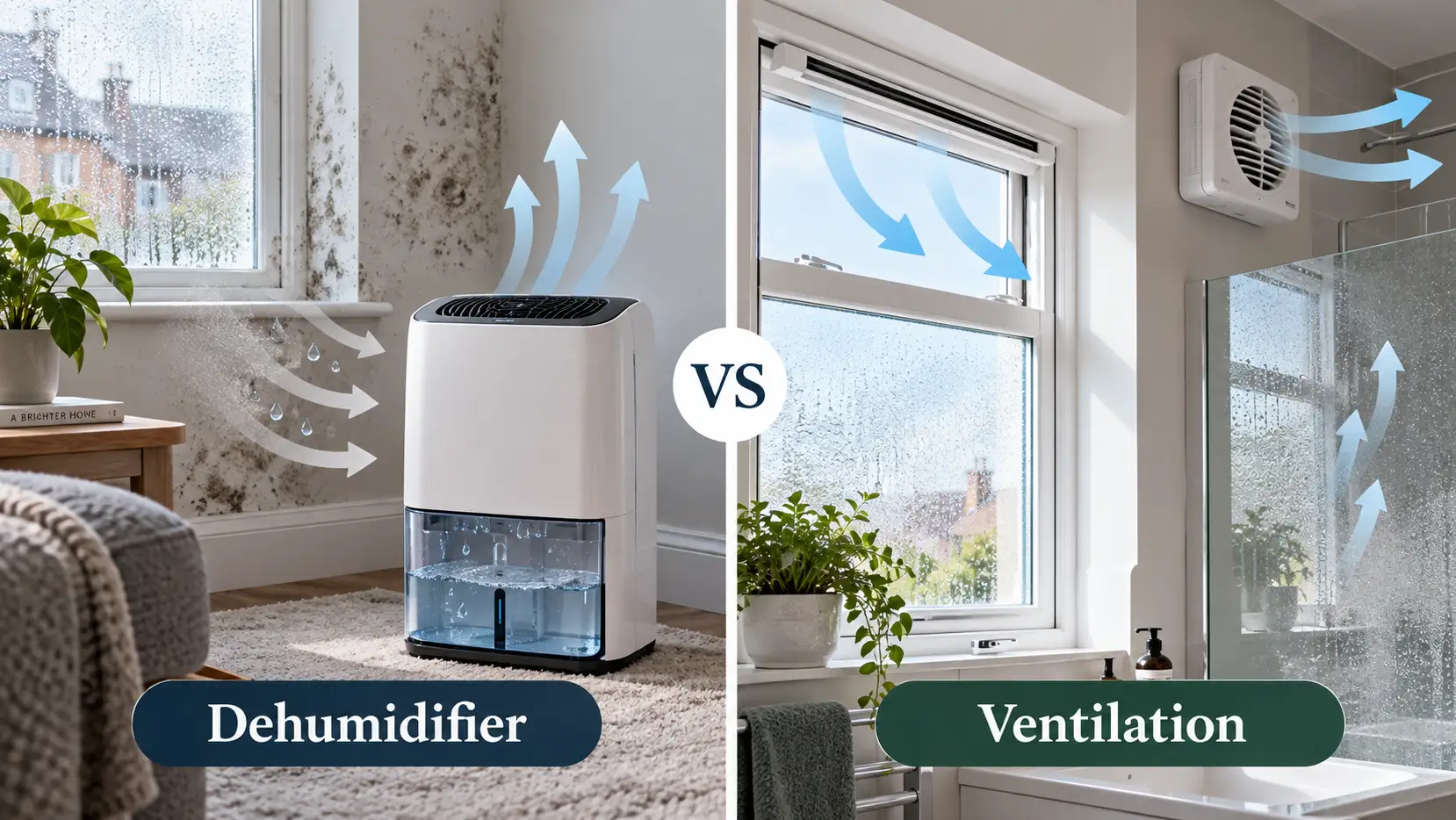
Faced with a condensation or mould problem, most people reach for one of a handful of options: a dehumidifier from the local hardware shop, an extractor fan, opening the windows more, or simply turning the heating up. It’s rarely framed as a genuine choice between fundamentally different tools — but it should be, because a dehumidifier and a ventilation system don’t do the same job, and buying one when you needed the other is a common and avoidable waste of money.
They solve different problems
A dehumidifier removes moisture that’s already in the air inside a room. It doesn’t change how much moisture is being produced, and it doesn’t bring in fresh outdoor air — it recirculates the air already in the space and removes some of its water vapour.
Ventilation works differently: it exchanges indoor air for outdoor air, removing moisture and other indoor pollutants in the process. During much of the UK heating season, cold outdoor air can contain less actual water vapour than warmer indoor air even when the outdoor relative humidity looks high; once that incoming air is warmed indoors, it can absorb additional moisture.
Neither is a universal fix. The right choice — and it’s very often a combination rather than a single product — depends on where the moisture is coming from, how the house is ventilated, how cold its surfaces become and what’s already happening in the room.
Dehumidifier, ventilation or heating: what each one actually does
| Tool | Particularly useful for | What it doesn’t fix |
|---|---|---|
| Dehumidifier | Removing excess airborne moisture; indoor laundry; short-term moisture management | Poor fresh-air provision, leaks, penetrating damp or cold bridges |
| Bathroom/kitchen extractor | Removing a large moisture load at source | Condensation caused elsewhere by wider ventilation or cold-surface problems |
| Trickle/background ventilation | Continuous low-level air exchange across the home | A major moisture burst on its own, or water entering through the building |
| PIV / whole-house ventilation | Persistent house-wide airborne humidity where the system is suitable for the dwelling | Roof leaks, plumbing defects, rising/penetrating moisture or serious fabric defects |
| Heating | Raising surface temperatures and reducing the chance of reaching dew point | Excess moisture production or inadequate ventilation |
| Insulation / fabric improvement | Raising cold surface temperatures where the construction and detail are suitable | Excess indoor humidity on its own |
That table is deliberately about function rather than products. A property can easily need more than one row at the same time.
Dehumidifiers: what they’re good at, and where they fall short
A dehumidifier can be effective at managing a known, contained moisture load — drying laundry indoors in a spare room, for instance, or controlling excess humidity in a space where natural ventilation alone isn’t practical.
There are two main types sold for home use. Refrigerant or compressor models draw moist air over a cold surface, condensing water into a tank or drain. They generally perform best in heated rooms and become less effective as conditions get colder.
Desiccant models use an absorbent material to capture moisture. They tend to perform better in colder or unheated spaces, such as garages and some conservatories, but generally use more electricity in operation.
Electrical Safety First’s dehumidifier guidance explains the distinction and also covers safe positioning, ventilation around the appliance, filters and unattended use.
The important point is not to buy on extraction capacity alone. Room temperature, the size of the space, noise, water-tank capacity, drainage options, humidistat control and electricity consumption all matter.
What does a dehumidifier cost to run?
The calculation is straightforward:
Power in kilowatts × hours actually running × your electricity unit price
For scale, Ofgem has confirmed an average capped Direct Debit electricity unit rate of 26.32p per kWh from 1 October to 31 December 2026 across England, Scotland and Wales.
At that rate, a hypothetical 200-watt machine drawing its full rated power for four hours would use:
0.2 kW × 4 hours = 0.8 kWh
That would cost about 21p for those four hours, or roughly £6.32 over 30 days if repeated every day.
Real usage can differ substantially. Many dehumidifiers use a humidistat and cycle their dehumidification on and off once the selected humidity level is reached; different fan modes and technologies also change consumption. Your own tariff may be higher or lower than the Ofgem average.
The current rates are published on Ofgem’s energy price cap page.
What a dehumidifier won’t do is stop the moisture being produced in the first place, bring fresh air into the home, remove indoor pollutants in the way ventilation does, or address why a particular wall or window is cold enough to attract condensation.
If the underlying cause is a badly ventilated bathroom or a cold bridge in one corner, a dehumidifier running elsewhere may reduce the overall humidity while leaving the underlying problem untouched.
Ventilation: several different things, not one
“Ventilation” covers a range of approaches that work quite differently from each other.
Opening windows provides purge ventilation — a rapid exchange of indoor and outdoor air. It can be useful after a moisture-producing activity or where a room needs a quick air change, but leaving windows open for long periods during cold weather can obviously increase heat loss.
One point is worth clearing up: high outdoor relative humidity doesn’t automatically mean opening a window is pointless. Cold outdoor air can have a high percentage relative humidity while still containing less water vapour than warmer indoor air. Once brought inside and heated, its relative humidity falls and it can help carry moisture away.
Trickle vents — the small slotted vents built into many window frames — provide background ventilation without requiring the whole window to be opened. Where they’re part of the home’s ventilation provision, permanently blocking or taping them shut can undermine that system.
For homes in England, the government’s current existing home ventilation guide specifically advises leaving trickle vents open and unobstructed, keeping extractor fans clean and maintaining whole-house ventilation systems according to their instructions.
Extractor fans target moisture at the point it’s produced — particularly bathrooms and kitchens. That’s an important distinction: removing humid air before it spreads through the dwelling is usually preferable to allowing the moisture to circulate through colder rooms and then trying to remove it afterwards.
Their effectiveness depends on the fan and ductwork actually performing properly, being clean and maintained, having a route for replacement air to enter, and operating for long enough to deal with the moisture load.
Whole-house mechanical ventilation systems are another category entirely. Some continuously extract air from wet rooms; balanced systems such as Mechanical Ventilation with Heat Recovery (MVHR) both extract stale air and supply fresh air while recovering some heat from the outgoing air. These systems need to be properly designed, installed and maintained rather than treated as oversized extractor fans.
Positive Input Ventilation: a specific tool for a specific situation
Positive Input Ventilation (PIV) is a whole-house approach that introduces a continuous supply of filtered replacement air, commonly from a ventilated loft space in a house or through a purpose-designed external intake in other installations. Air is normally introduced through a central diffuser, often on a landing or hallway.
The incoming air dilutes humid indoor air and creates a slight positive pressure that encourages existing air to leave through intended ventilation paths and normal leakage routes.
PIV can be a useful retrofit option for some existing homes suffering from widespread condensation because installation can be much less disruptive than running a complete system of supply and extract ductwork through an occupied house.
But PIV isn’t simply a stronger dehumidifier and it isn’t automatically the right whole-house answer. Suitability depends on the dwelling’s construction, airtightness, existing extract fans, available air paths, loft or intake conditions and the way the property is occupied.
A very airtight dwelling needs a properly designed ventilation strategy; simply relying on uncontrolled leakage as an exhaust route is not an appropriate assumption. Conversely, a leaky home may have other fabric and comfort problems that adding PIV alone won’t solve.
PIV also doesn’t repair the source of building moisture. It won’t fix a leaking gutter, damaged roof, plumbing leak or penetrating damp.
For significant whole-house ventilation changes, proper assessment is substantially safer than choosing a system purely because it is marketed for condensation.
What role does heating actually play?
Warmer surfaces are less likely to fall below dew point, so adequate heating genuinely reduces condensation risk.
But “turn the heating up” is easy advice to give and, for a lot of households, genuinely difficult advice to follow given energy costs. It’s worth being honest about that trade-off rather than repeating it as though affordability weren’t a factor.
Heating also isn’t a substitute for moisture removal. A very warm but poorly ventilated bathroom can still contain a great deal of water vapour; heating changes the temperatures at which condensation occurs, while ventilation or dehumidification changes how much moisture remains in the air.
Where heating has to be limited, reducing avoidable moisture and maintaining effective ventilation become particularly important.
Insulation interacts with this too: raising the surface temperature of a cold wall through appropriate insulation can reduce condensation risk in that location, but badly designed or poorly detailed insulation can leave or create cold bridges elsewhere. Detailed retrofit and insulation guidance belongs in our Energy Efficiency & Retrofit coverage.
Should I worry about losing heat if I ventilate?
Yes — ventilation inevitably carries some heat away during the heating season. The goal isn’t zero heat loss; it’s enough controlled ventilation to protect indoor air quality and remove moisture without relying on permanent uncontrolled draughts.
A badly fitting door or window can leak heated air continuously whether ventilation is needed at that moment or not. Deliberate ventilation is different because it can be provided at an appropriate rate and location.
Brief purge ventilation — opening windows to exchange air relatively quickly — can be more purposeful than leaving windows slightly open for hours, but there isn’t a universal “five-minute rule”: the amount of air exchanged and the heat lost depend on wind, temperature, window size, room layout and how widely the openings are used.
Background ventilation through trickle vents and mechanical systems is intended to provide the lower, ongoing airflow needed between those larger moisture events.
The useful distinction is therefore controlled ventilation versus uncontrolled leakage, rather than “ventilation good, heat loss bad”.
A simple way to know what you’re dealing with
An inexpensive hygrometer — a relative-humidity meter — can be genuinely useful for understanding patterns in a specific room over time rather than guessing.
It won’t diagnose a cause on its own, and humidity shouldn’t be treated as a pass/fail number independent of temperature. A room can develop condensation at an apparently moderate relative humidity if part of the wall or window is cold enough.
What a hygrometer is particularly good at is showing patterns:
- does humidity jump sharply after showering?
- how long does it stay elevated afterwards?
- does a bathroom extractor bring it back down?
- does indoor laundry keep one room humid for hours?
- is one room consistently more humid than the rest of the house?
That turns it from a gadget displaying a percentage into something much more useful: evidence about how moisture behaves in the home.
Matching the tool to the actual problem
Bathroom mould that reappears on the ceiling after showers should prompt a check of extraction at source before defaulting to a dehumidifier somewhere else in the house — the first question is whether the moisture can be removed effectively where it’s produced.
Laundry regularly dried indoors in a spare room is a predictable, contained moisture load, and a dehumidifier running in that room with windows closed can be a sensible way of managing the water released while the clothes dry.
Morning condensation across several rooms points towards a wider humidity, ventilation and surface-temperature question. This is where background ventilation, heating patterns and — where appropriate after assessment — a whole-house ventilation approach may deserve attention.
Persistent mould on one wall that gets noticeably worse after rain is unlikely to be solved by either ventilation or a dehumidifier, because the moisture may not be coming primarily from indoor air at all. It needs checking for penetrating damp, a leak or another building defect.
One consistently cold corner growing mould while the rest of the house is relatively dry may need investigation of insulation or thermal bridging rather than simply increasing whole-house ventilation indefinitely.
The underlying principle is the same throughout: dehumidifiers remove moisture already in the air, ventilation dilutes and removes moist indoor air while supplying replacement air, heating changes surface temperatures, and insulation can change how cold the building fabric becomes.
Working out which part of that system is failing — rather than reaching for whichever product is cheapest or most heavily advertised — is what actually solves the problem.
This article provides general property information. The running-cost calculation is an illustrative example using Ofgem’s published average capped Direct Debit electricity rate for 1 October to 31 December 2026; your tariff, appliance and usage will differ. Where persistent damp or mould doesn’t respond to reasonable ventilation and moisture control, or where a building defect may be involved, seek advice from a suitably experienced building professional.

