

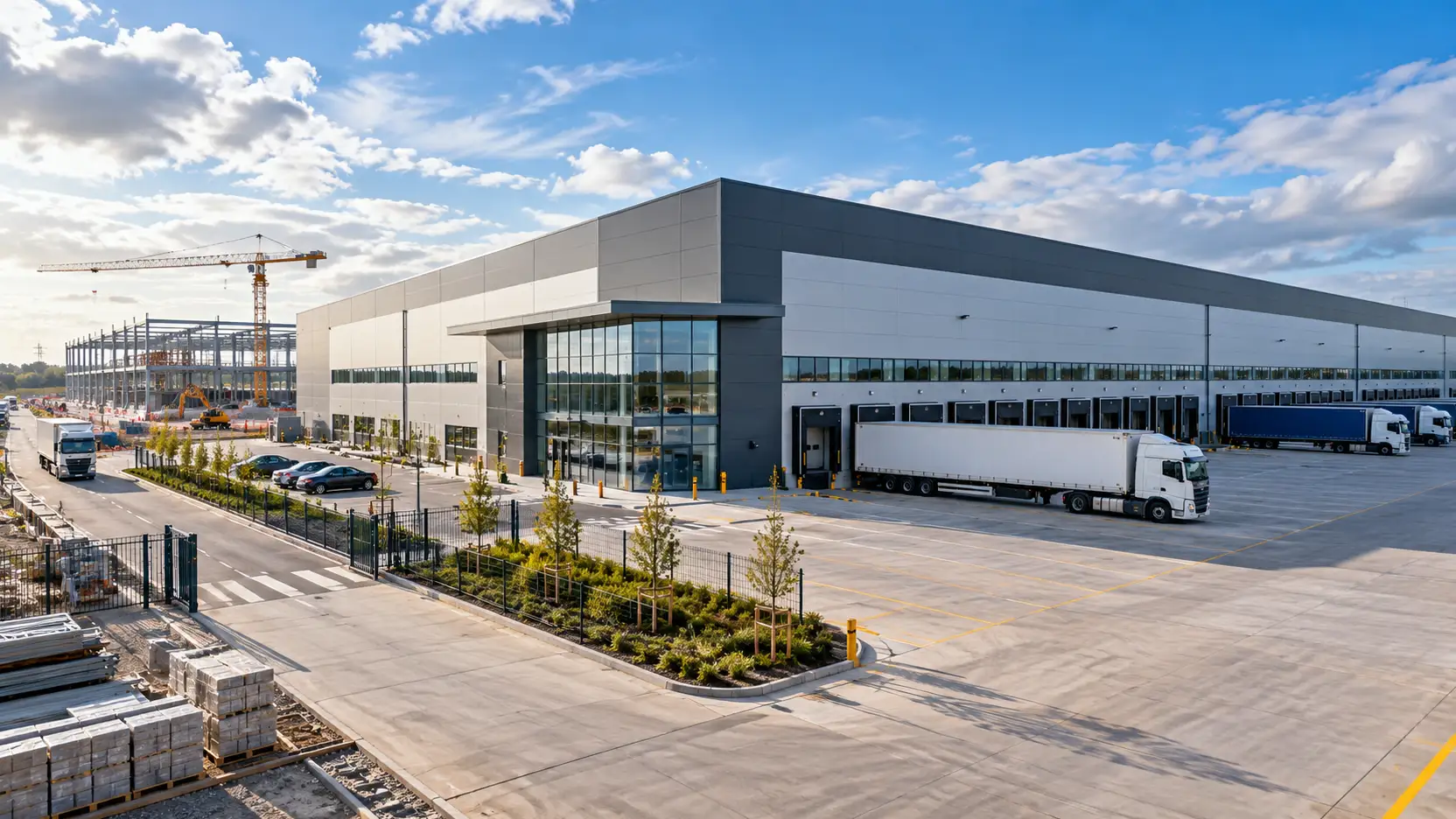
Look at the construction figures for UK logistics property and the market appears to be building its way through the shortage of modern, large warehouses. Look at who those buildings are intended for and the picture changes. A growing share of the pipeline is committed to named occupiers before completion, leaving comparatively little new speculative space for businesses that want to secure a building without commissioning one themselves. The speculative shed — developed on the expectation that a tenant will arrive before or shortly after completion — has not disappeared, but it is no longer the default response to demand at the largest end of the market.
The scale of the shift is measurable. CBRE’s mid-year 2026 logistics review put UK logistics space under construction at 19.9 million sq ft, with build-to-suit accounting for 66% of it. DTRE’s first-half big-box report found just under 6 million sq ft of speculative completions expected over the following 12 months, against a long-run rolling annual average of about 10.9 million sq ft. Those figures measure different things — total space under construction in one case and forthcoming speculative completions in the other — but point to the same constraint: relatively little uncommitted new stock is coming through the development process.
That changes more than the developer’s willingness to gamble on a letting. It influences which sites attract funding, how far ahead occupiers must commit to premises, and what investors will be left owning when an occupier eventually moves out. It also raises an awkward question: if speculative development has become scarce, has avoiding that risk itself created an opportunity for someone prepared to take it?
Why speculative development became a harder bet
Building a 500,000 sq ft warehouse without a tenant has always been a bet: that the eventual rent, investment value and pace of letting will justify the cost of the site, construction and borrowed capital. The bet becomes harder when the specification is expensive, the borrowing period is uncertain and there is no occupier committed to take the building. Higher construction and financing costs have narrowed the room for error, while prospective tenants increasingly want more than a standard shell with sufficient loading doors. Power capacity, automation, floor loading and yard configuration can materially change which businesses a warehouse will suit.
Cost risk is real, although it needs describing accurately. The government’s steel trade measure introduced in July 2026 applies a 50% tariff to specified steel imports above the applicable tariff-free quotas; it is not a 50% surcharge on every tonne of structural steel used in a warehouse. Contractors also face uncertainty over energy, labour and infrastructure costs, and securing enough grid capacity can be as important to the viability of an automated distribution centre as constructing the building itself. For a speculative developer, the difficulty is pricing all of that before knowing the tenant’s final requirements or the rent the market will support.
A pre-let can make the funding case more convincing because there is an identifiable income stream behind the project. Build-to-suit goes further: the premises are planned around an occupier whose operational needs are known before construction. The two are not interchangeable — a largely standard speculative scheme can be pre-let before completion without becoming a bespoke development — and neither removes construction or tenant risk. Investors and lenders still have to assess the occupier’s covenant, the conditions attached to its commitment, delivery obligations and the likelihood of cost overruns. A rent agreed well before completion can also limit the developer’s share of later rental growth while leaving it exposed to construction-cost escalation. What changes is the balance of risks the parties are being asked to carry.
There is an important qualification to the idea that speculative development no longer works. In July 2026, Colliers argued that the thin pipeline had created an opportunity for selective speculative funding, particularly where land pricing, demand and expected development returns justified the letting risk. By October, CBRE was reporting a pickup in speculative construction in its big-box market. Neither finding overturns the dominance of pre-committed space in the broader mid-year pipeline. Both show why calling the shift permanent, or treating all speculative development as unfinanceable, would be a mistake. What has changed is the level of conviction a developer and its funder need about a particular location and size band.
What this means for occupiers, and why some are choosing it deliberately
It would be wrong to treat build-to-suit purely as something developers have been pushed towards. A business with a genuinely specific operational requirement — substantial power for automation, a particular racking or mezzanine arrangement, or an unusual yard-to-building ratio for cross-docking — may struggle to find the right space in existing stock however much nominal availability there is. A tailored facility can reduce operational compromises and make a network more efficient over the length of a lease. Knight Frank’s 2026 industrial outlook recorded a 13% rise in UK take-up during 2025, to 40.8 million sq ft for units above 50,000 sq ft, with the strongest growth in the 250,000–400,000 sq ft bracket. Larger, more demanding requirements are part of the reason occupiers are prepared to become involved earlier in development.
The trade-off is time and commitment. A ready-to-occupy warehouse can offer a business flexibility that a project still going through design, approvals, construction and fit-out cannot. A build-to-suit occupier may have to decide on its network footprint well before it knows what future contracts, customers or automation systems will require, and its lease commitment will often need to support the landlord’s investment in that specification. That creates a different risk for a retailer, manufacturer or third-party logistics provider whose operating strategy changes, whose customer contract expires or whose growth fails to arrive as expected. A building that fits perfectly on day one can become an expensive obligation if the business needs to leave before its lease ends.
The practical negotiation is therefore as much about delivery and adaptability as headline rent. How much power is available and when will it actually be connected? Who pays if automation or fit-out requirements change after the building design is fixed? What happens if practical completion is delayed, and how much of the bespoke installation belongs to the landlord rather than the occupier? Those points determine whether the building can support the operation it was commissioned for, and who carries the cost when expectations change. Knight Frank’s July 2026 occupier review also reported growing demand for fitted or partly fitted premises that reduce upfront spending and speed up occupation — a reminder that not every occupier can afford, or wants, to wait for a purpose-built solution.
The pipeline looks bigger than the available choice
The distinction between nominal vacancy and genuinely suitable space is already familiar in the logistics market. A related distortion sits in the development figures. Space classified as under construction is not necessarily space available for the next occupier to lease. Where a building is already committed to a tenant, its completion increases the country’s warehouse stock but does not add another choice to the open market. A business looking for a modern unit of 400,000 or 500,000 sq ft cannot treat a crane on a pre-let site as evidence that its search is about to become easier.
DTRE’s first-half 2026 figures show why that distinction matters. The firm’s overall big-box vacancy rate was 7.55%, yet its Grade A availability measure was only 2.6%; those are different segments of the same survey, not competing estimates of a single vacancy rate. DTRE also identified very few newly built, ready-to-occupy options above 300,000 sq ft and a speculative completions pipeline running substantially below its long-run average. An occupier unable to wait for a bespoke development may have to consider a second-hand facility, change the location of its search or accept substantial alteration costs. None of those responses is captured by a national headline showing how much floor area is being built.
There is a complication in the other direction too. A new pre-let building can release an older warehouse when its occupier relocates, so the market may gain second-hand availability even though the new development itself was never offered openly. That is one reason the share of the pipeline already committed cannot be read directly as a forecast of vacancy or rental growth. The location, age, specification and timing of the released space still determine whether it helps the occupiers who are searching. It is possible for total availability to rise while the choice of immediately occupiable, modern large units remains narrow.
What happens when a bespoke occupier leaves
There is a longer-term question in the move towards build-to-suit, and it will matter most when the present generation of pre-let warehouses reaches its first major lease events. A building engineered around one operation — a particular dock configuration, highly specific automation infrastructure or an unusual distribution layout — is not automatically the building the next tenant wants. Investors who fund such developments are underwriting more than the covenant of the first occupier. They are also making a judgement about how readily the property could be re-let, at what rent, and after how much alteration if that occupier leaves.
This is where the apparently opposing aims of the first occupier and the long-term owner meet. The occupier wants a facility precisely suited to its business; the owner wants the building to remain useful to a broad enough market after that business has changed or departed. Power capacity, clear height, yard provision and energy performance can have enduring appeal, while unusually specialised fit-out may be expensive to remove or replace. The important distinction is often between the adaptable building itself and the operational equipment installed within it, including who owns that equipment, who maintains it and whether reinstatement is required at the end of the lease. The design and leasing decisions made before construction can determine the cost and length of a future void. Secure income from a pre-let may justify committing capital that a speculative development could not attract, but it does not make the resulting property immune to obsolescence. A long lease reduces near-term letting exposure; it does not guarantee an equally strong tenant, or an equally valuable building, when that lease expires.
The strategic consequence
The shift towards pre-committed logistics development is neither a straightforward supply solution nor evidence that speculative building has ceased to have a role. It is a redistribution of risk. Developers and funders can reduce uncertainty about the first letting by securing an occupier early, but may take on demanding delivery obligations and longer-term exposure to a building designed for one business. Occupiers gain a closer fit with their operations but surrender some freedom to move or change course. Investors receive greater visibility of initial income while still having to judge the future market for the physical asset.
For the wider logistics market, the more revealing question is not simply how many square feet are being built. It is how much of that construction will genuinely be available, where it is located, what specification it offers and whether somebody is prepared to fund an uncommitted building to fill the gap. If the selective return of speculative capital continues, the pre-let-heavy market of 2026 may prove to be a phase in the development cycle rather than its final destination. For the occupier searching for a suitable warehouse now, however, the immediate problem is unchanged: a pipeline that looks reassuring on paper can still consist largely of someone else’s buildings.
This article provides general information and market analysis only and does not constitute property, investment, legal or financial advice. Market conditions, figures and development circumstances can change. Consider appropriate professional advice before making significant commercial property or investment decisions.

