

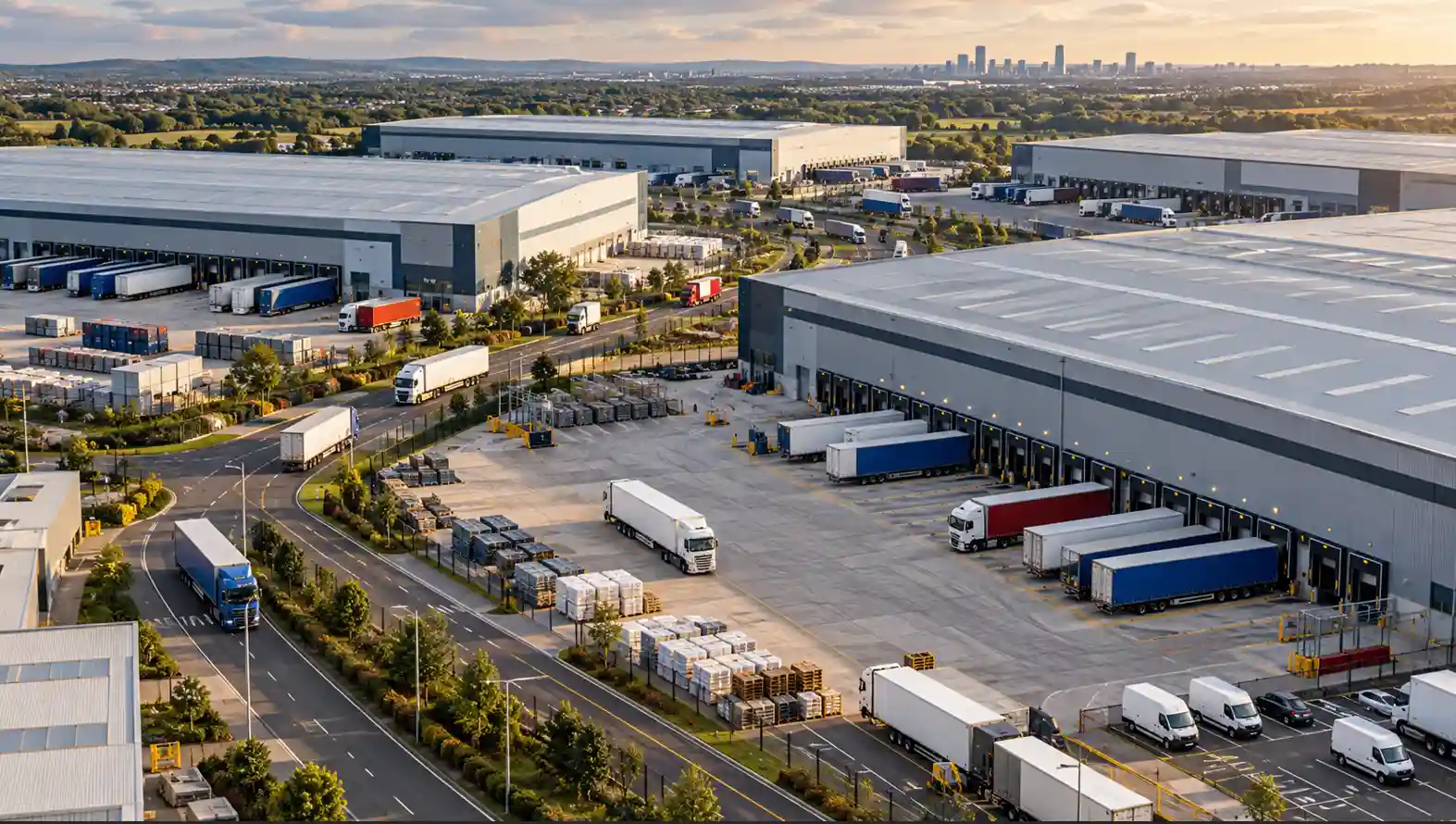
For most of the past decade, one sentence did most of the explanatory work in UK industrial property: online retail needs more space than shops did, and that is why warehouses kept filling up. It was true, and it was a genuinely useful piece of shorthand while it lasted. It is no longer sufficient, and developers, investors and agents who are still underwriting the next logistics cycle primarily on that basis are working from an increasingly out-of-date model of who actually wants the space.
The clearest early signal sits in Knight Frank’s 2026 industrial and logistics outlook. Manufacturing accounted for 32% of space taken in UK transactions above 50,000 sq ft during 2025. Total take-up rose 13% year-on-year to 40.8 million sq ft, average transaction size rose 8%, and the fastest growth came in the 250,000–400,000 sq ft size band, up 48%. None of that is a story about parcels. Yet manufacturing had not permanently displaced retailers: Knight Frank’s second-quarter 2026 figures show retail occupiers accounting for 44% of take-up in that quarter, with online retail once again prominent. The lesson is not that one sector has replaced another, but that the occupier market is more complicated than the shorthand that explained its previous cycle.
E-commerce did not disappear. It stopped being the whole explanation
It is worth being precise about what has and has not changed, because the lazy version of this argument — that online retail is somehow over — is simply wrong, and any developer who believed it would be making a different and equally costly error. Online retail continues to depend on extensive fulfilment and distribution networks, and major platforms are expanding their UK logistics footprints. What has changed is that manufacturing, food distribution and businesses reorganising their supply chains are also generating substantial requirements, while e-commerce demand itself increasingly arrives through logistics contractors or overseas platforms building domestic operations. The single-sector narrative made sense when online fulfilment appeared to explain almost every major deal. It makes less sense when the name on the lease, the use of the building and the business generating the demand can be three different things.
Manufacturing, and why it is not simply “back”
Manufacturing’s 32% share is the headline figure worth sitting with, because it is easy to misread. This is not a story of Britain suddenly making more of everything it used to make. Some manufacturers are restructuring supply chains to bring certain operations closer to customers or protect themselves against overseas disruption, while others are taking space to consolidate, modernise or distribute products rather than expand output. That does not mean full-scale reshoring of mass manufacturing — the cost structure for most high-volume, low-margin production has not changed enough to make that broadly viable. It means a narrower range of manufacturing and assembly requirements, often linked to activities where proximity, security of supply or control over the production process matters more than the lowest possible unit cost, can be important sources of industrial-property demand without representing an equivalent rise in national manufacturing output.
Defence and engineering-linked manufacturing sit inside that picture and appear to be strengthening it, according to Knight Frank’s outlook. But the wider manufacturing economy is not enjoying an uncomplicated boom. Make UK’s September 2026 manufacturing outlook found improved orders and confidence alongside continuing pressure from energy, employment and input costs, with businesses still cautious about investment and recruitment. For an industrial landlord, the implication is that manufacturing-related take-up cannot be read as a guarantee of lasting expansion by every occupier in that category. A firm replacing several older premises with one modern facility may appear in take-up figures as a substantial transaction without adding an equivalent amount of occupied space across the market.
Food, grocery and the return of a steadier occupier base
Food and grocery distribution has quietly become one of the more dependable sources of demand, less dramatic than the e-commerce growth curve of 2020 and 2021 but generally less exposed to discretionary spending. Grocery logistics does not track consumer confidence in quite the way general retail does, even though costs and competition can affect individual operators. The scale of some requirements is visible in Savills’ July 2026 occupier research, which records Farmfoods taking around 800,000 sq ft at Logicor Park, Daventry. Food distribution also overlaps with temperature-controlled logistics — a distinct specialist property requirement rather than a specification every grocery operator needs. For a landlord considering the next lease event, a highly specialised building may be less readily adapted to another occupier than its size and location suggest.
Third-party logistics: still central, differently positioned
Third-party logistics operators remain among the largest and most consistent occupiers in the market, but their role makes sector take-up statistics harder to interpret. Savills recorded 3PL businesses accounting for 38% of big-shed take-up during the first half of 2026 in its market for units above 100,000 sq ft. A substantial part of that activity was connected to e-commerce, including Amazon-backed requirements fulfilled through Bleckmann at Lutterworth and ID Logistics at Rugby. The tenant signing the lease may be a logistics contractor, but the trade supporting the building can still be online retail. Equally, a manufacturer may outsource its distribution to a 3PL, with the customer’s sector disappearing from the headline transaction category altogether. It would be a mistake to infer from the growth of 3PL lettings alone which end markets are expanding.
This matters for landlords assessing covenant and renewal risk: a 3PL’s requirement for a particular building can be tied closely to the contracts it operates for customers, and those arrangements do not necessarily run for the same length of time as its property lease. The covenant of the tenant remains important, but so do its ability to replace a lost contract, the alternative customers the location could serve, and the work needed to adapt the premises if the operation changes. A landlord can therefore have a perfectly respectable tenant on paper while remaining exposed to an underlying customer relationship that is considerably less visible than the tenancy agreement.
Trade flows, ports and the domestic fulfilment question
Broader trade patterns are feeding into occupier behaviour in ways that rarely make it into take-up headlines. Businesses importing goods have been reassessing how much inventory to hold, and where, as a hedge against shipping disruption, tariff uncertainty and less predictable transit times. Larger domestic buffers can require more warehouse space than a lean just-in-time model, although consolidation and better use of existing buildings can offset some of that requirement. Port access and customs arrangements may influence the choice of location for particular importers; it would be too broad to conclude that every port-proximate market or bonded facility is enjoying stronger demand for the same reason. The more useful distinction is between a lasting reorganisation of a distribution network and stock being held temporarily against disruption.
A related and increasingly visible strand is direct-to-consumer volume from large overseas e-commerce platforms serving UK customers. Knight Frank’s research published on 2 October 2026 found that Chinese e-commerce operators and the logistics firms working for them took just over 4 million sq ft of UK space in units above 50,000 sq ft during 2025 and the first half of 2026 — about 7% of take-up in that period. Seventy-four per cent of that take-up was in the East and West Midlands, where national distribution links and modern warehouse stock fit the operating model. These businesses are increasingly holding inventory within Britain rather than relying exclusively on individual parcels shipped from overseas, creating demand for substantial fulfilment facilities as well as more local delivery infrastructure. This is still e-commerce demand, but not simply a continuation of the first domestic online-retail boom.
The letting terms are changing alongside the occupiers. In Knight Frank’s sample, Chinese e-commerce occupiers had an average lease term of 9.6 years, compared with 10.9 years across the wider market; excluding 3PL-led transactions, retailer-led Chinese e-commerce deals averaged 7.0 years. It is a specific sample, not a rule for every overseas tenant, but it has an obvious bearing on an investor’s assessment of income duration and the likely date of the next reletting. There is also a regulatory reason to be cautious about projecting this growth indefinitely. HMRC’s July 2026 policy paper on low-value imports provides for the removal of customs-duty relief on qualifying imports worth £135 or less, with the change due to take effect by October 2028 at the latest. The reform is not yet in force and is distinct from the VAT already applying under existing arrangements. It could strengthen the case for holding goods in the UK, but the scale of any additional warehouse requirement will depend on the decisions sellers make in response.
What this means for the people underwriting the next cycle
For developers and investors, the practical question this raises is not whether occupier demand exists, but whether the demand base being assumed for a new development is the diversified one actually visible in the data, or the e-commerce-led one that shaped the last cycle’s underwriting assumptions. A speculative or pre-let scheme designed purely around parcel-sorting logistics, with the loading doors, power, yard configuration and automation that implies, is a different building from one flexible enough to suit a manufacturer or a food distributor. Getting that specification wrong is a longer-term risk than a temporary vacancy; it affects how re-lettable a building is to the next occupier once the first lease event arrives. The pressure is already visible in Knight Frank’s second-quarter figures: overall vacancy stood at 8.0% but Grade A vacancy at 4.4%, while modern space accounted for 57% of first-half take-up against a five-year average of 26%. An older warehouse can be available and still be unsuitable, while a highly specialised new one can satisfy its first tenant without being easy to relet.
For agents, the sectors generating requirements have become more varied, and instructions can come from businesses with less institutional experience of the commercial property leasing process than the retailers and 3PLs who dominated instructions through the last cycle — a manufacturer taking its first purpose-built distribution facility, for instance, is a different client relationship from a national retailer renewing its tenth. It matters to understand whether the business wants to increase capacity or replace an inefficient network, and whether the planned operation would suit another occupier when it ends.
For occupiers already in the market, the more interesting consequence is competitive. A logistics business used to competing against other logistics businesses and retailers for space now finds itself bidding against manufacturers, food distributors and importers who may have different rent tolerances, different lease-length preferences and different views on what makes a building suitable — a genuinely different competitive landscape from the one that shaped occupier expectations five years ago.
Reading take-up data without overreaching
None of this should be read as a single, tidy replacement narrative — “manufacturing is the new e-commerce” would be just as reductive as the story it replaces. Knight Frank’s 32% manufacturing figure describes a full year of transactions above 50,000 sq ft; its 44% retail figure covers a single subsequent quarter; and Savills’ 38% 3PL figure comes from a different size threshold and reporting period. Nor should take-up be mistaken for net growth in occupied floorspace: a large relocation or consolidation contributes to transactions even if older facilities are left empty elsewhere. The safest reading of the data is not that e-commerce has ceded the market to any one new sector, but that the apparent diversity of warehouse occupiers conceals different business models and different exposures behind the rent. Those distinctions, more than any single sector’s latest share, should shape how the next generation of space is designed, financed and let.
This article provides general information and analysis about UK industrial and logistics property, not legal, customs, financial, tax, valuation or investment advice. Research providers use differing transaction thresholds and occupier classifications, while market conditions, lease requirements and legislation can change. Obtain appropriate specialist advice before making property, financing or customs decisions.

