

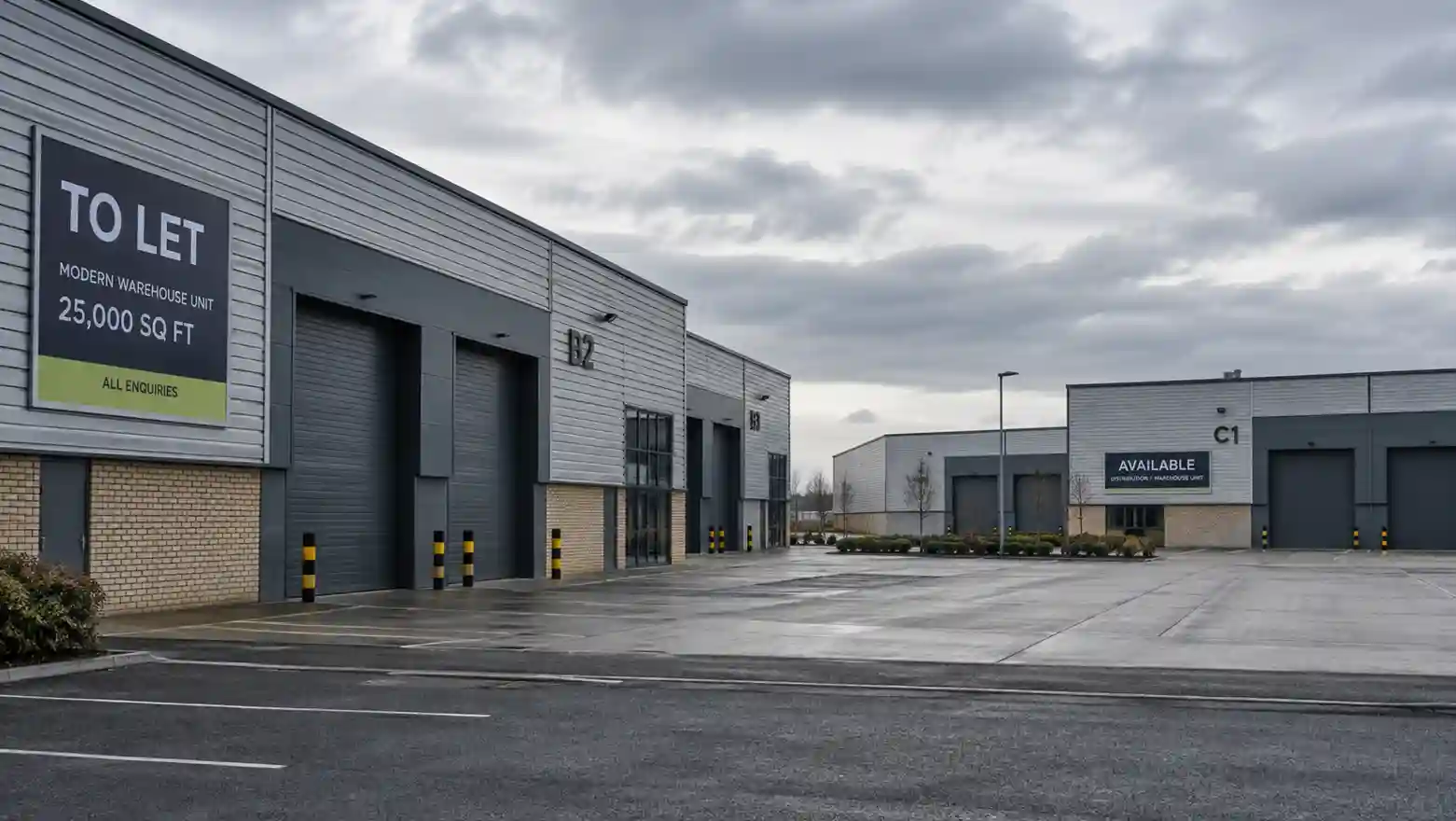
In the larger UK logistics market, headline vacancy has risen noticeably. Knight Frank’s market for logistics units over 50,000 sq ft recorded an overall vacancy rate of 8.0% at the end of the second quarter of 2026, with 97.1 million sq ft available.
At the same time, a business looking for a modern, well-specified unit can still find itself facing a surprisingly thin choice of suitable options. Grade A vacancy in the same dataset was only 4.4%, while second-hand space accounted for 87% of the increase in availability during the first half of 2026.
Read only the headline number, and the larger UK logistics market looks relatively well supplied. Try to find the right building, and parts of it can feel distinctly tight. Both experiences are real, and reconciling them requires abandoning the idea that “industrial space” is one market at all.
There is no single warehouse market
The term covers a genuinely wide range of building types, and lumping them together into one vacancy statistic obscures more than it reveals.
Big-box logistics — generally the very large distribution centres above 100,000 sq ft in much of the industry’s research — sits at one end. Mid-box space broadly occupies the territory between the largest logistics buildings and smaller multi-let estates, although definitions differ between agents and datasets. Multi-let industrial typically consists of smaller units let across estates to a diverse mix of trade businesses, manufacturers, service companies and local distribution operators. Those categories overlap at the edges, and the market does not observe one universal set of size bands.
There is another distinction running through all of them: specification. Modern new-build or refurbished Grade A stock sits alongside older secondary buildings ranging from perfectly serviceable accommodation to property whose power, yard, loading, height, energy performance or configuration no longer suits the occupiers looking in that market.
“Grade A” itself is market shorthand rather than a statutory building classification, and exact definitions can differ between research houses. But the underlying distinction between modern, higher-specification space and older stock is very real.
A national vacancy figure blends all of this together. For an occupier, the more meaningful measure of supply is not simply how much floor space is technically vacant, but how much of that vacancy can actually satisfy the requirement by specification, size, location and timing. That is precisely how overall availability can increase while particular buildings remain difficult to secure.
What the 2026 data actually shows
The change has been developing for some time. Lambert Smith Hampton reported that UK-wide industrial and logistics availability increased from 7.0% to 7.9% during 2025, its highest level in 12 years. Speculative development activity effectively halved during that year, while Grade A stock represented roughly two-thirds of total supply.
Lambert Smith Hampton — Industrial and Logistics Market Report 2026
By Q2 2026, Knight Frank’s logistics market for units over 50,000 sq ft put vacancy at 8.0%. But the composition of that increase is the more revealing number: second-hand space accounted for 87% of the additional availability during the first half, while Grade A vacancy stood at 4.4%.
Occupiers were also disproportionately selecting better-quality stock. Grade A space — including new and refurbished accommodation in Knight Frank’s methodology — accounted for 50% of Q2 take-up and 57% across the first half of 2026, compared with an average of 26% over the preceding five years.
Knight Frank — UK occupier market overview, Q2 2026
The big-box market shows an even sharper version of the same divide. DTRE, whose Big Box dataset covers units of 100,000 sq ft and above, reported an overall vacancy rate of 7.55% at the end of H1 2026, while Grade A availability had tightened to 2.6%.
DTRE — Big Box Logistics Report, H1 2026
That does not mean secondary warehouses have become unwanted. DTRE also recorded second-hand buildings accounting for 46% of H1 big-box take-up, demonstrating that the right existing building in the right location can still compete very effectively.
These figures describe different parts of the industrial and logistics market and should not be treated as directly interchangeable vacancy measures. Knight Frank’s larger logistics market, DTRE’s 100,000 sq ft-plus Big Box market and the multi-let evidence discussed later all answer slightly different questions. That methodological difference reinforces rather than weakens the central point: there is no single vacancy rate that adequately describes the choices facing every industrial occupier.
Why so much available stock isn’t actually usable
The gap between “vacant” and “genuinely suitable” often comes down to specification, condition and location — and it is worth being specific about what that means rather than treating “obsolete” as a catch-all description for every older warehouse. Plenty of second-hand industrial space remains commercially useful; the problem arises where a building carries characteristics that cannot economically support the operation looking at it.
Electrical capacity may be inadequate for automation, refrigeration, machinery or fleet charging. Eaves height can restrict usable cubic capacity regardless of the floor area quoted in the particulars. Loading doors and yards may have been designed around different vehicles and operational patterns. Column spacing or internal configuration can frustrate modern racking and materials handling. Poor insulation or ageing building services can increase operating cost. A location that once worked well may no longer fit the workforce, carrier or transport network on which the occupier now depends.
Some of those deficiencies can be remedied relatively straightforwardly; others require substantial capital, while some are effectively inherent in the site or building. That distinction matters because a technically vacant warehouse is not automatically useful supply for the business currently searching for space.
Power has become a genuine constraint on which buildings actually work
Power capacity is not new to industrial property, but its importance has increased as more operations introduce automation, refrigeration, electrically intensive machinery, data infrastructure and EV charging. For businesses with modest electrical requirements it may remain a secondary issue; for a power-intensive occupier it can eliminate an otherwise excellent building from consideration.
This is particularly relevant in Great Britain because electricity-connection demand has risen sharply. Ofgem said in June 2026 that the demand-connections queue was large and growing and that some well-progressed projects were unable to connect quickly because of the time required for network or generation build, alongside congestion caused by projects unlikely to proceed.
Ofgem — Demand connections reform update
That does not mean industrial property across Great Britain is universally power constrained, and connection conditions can vary substantially between individual sites. But for an occupier requiring significant capacity, the building’s existing supply, the availability of additional capacity, any reinforcement required, the cost and the realistic delivery programme can now be decisive. A warehouse can therefore appear in the availability statistics while remaining effectively unavailable to an occupier whose operation requires more power than the site can practically provide.
The flight to Grade A, and why it’s rational rather than fashionable
It would be easy to read occupiers’ increasing preference for Grade A space as simply chasing prestige, in the way “flight to quality” is sometimes described in other commercial-property sectors. In industrial property, the reasons are frequently more operational.
A modern building is generally more likely to offer better energy performance, useful clear height, efficient loading and yard arrangements, modern building services and infrastructure capable of supporting more sophisticated warehouse operations. Occupiers can also reduce the amount of capital and time required to adapt the property before trading begins. Knight Frank’s Q2 2026 research specifically identifies power availability, clear heights, floor loading capacity, automation-ready specifications and speed to occupation among the factors becoming increasingly important to logistics occupiers.
That does not mean every Grade A building works for every business, nor that an older building cannot outperform a new one. A well-located second-hand warehouse with the right geometry, power and yard can be exactly what an occupier needs, while a new building in the wrong location or with the wrong operational characteristics can still fail the brief.
The meaningful trend is not simply “new is better”. It is that occupiers are increasingly willing to distinguish between nominal floor area and usable operational capability.
The shortage most coverage of this market misses entirely
Industrial-market commentary naturally gives substantial attention to big-box logistics because the largest transactions involve extraordinary amounts of space. But the smaller multi-let end matters to a very different group of occupiers: trades businesses, SMEs, light manufacturers, local distributors, service companies and growing businesses that may need a few thousand or a few tens of thousands of square feet rather than several hundred thousand.
New supply in this part of the market remains limited. Newmark’s Multi-Let Winter Bulletin put the UK multi-let development pipeline at 11.9 million sq ft in late 2025 — less than 1% of existing multi-let floorspace — with only 29% of that pipeline actually under construction. The amount being built equated to only a little over one month’s national multi-let take-up.
Newmark — Multi-Let Winter Bulletin 2025
That does not prove every small-unit market in Britain is undersupplied. Industrial property remains intensely local, and availability can differ considerably between estates and towns. But it does explain why a rising vacancy rate in the larger logistics market can be of little comfort to a smaller business searching within a tight radius for a modern unit of the right size. The market can simultaneously contain millions of square feet of available warehouse space and very few realistic options for that particular occupier.
Energy standards are starting to reshape which buildings stay lettable
Energy regulation adds another layer to the quality divide, but the current position needs to be described carefully.
In June 2026, the government published an interim response on strengthening Minimum Energy Efficiency Standards for the non-domestic private rented sector in England and Wales. The government confirmed its intention to pursue a targeted approach under which, from 2031, privately rented non-domestic buildings over 1,000 square metres would be required to reach EPC B where cost-effective. Buildings below 1,000 square metres are intended to remain subject to the existing minimum EPC E standard, with no set deadline currently proposed for going beyond that level.
Importantly, this is not yet the operative 2031 legal requirement. The government states explicitly that the higher standard will only take effect following the successful passage of secondary legislation, and that further details of the threshold and implementation will follow.
GOV.UK — Non-domestic MEES interim response
That distinction matters for landlords and occupiers alike. It would be premature to treat EPC B by 2031 as though it were already enacted for every large industrial building, but it would be equally unwise for an owner considering substantial investment in older industrial property to ignore the government’s stated direction.
A building that needs major capital expenditure to remain competitive may therefore have to be assessed against both today’s letting market and the regulatory direction likely to affect its investment case over the coming years.
Why landlords of obsolete stock don’t simply cut the rent
Price can solve some property problems, but it cannot solve all of them. A prospective tenant looking at an older building, even at a materially lower rent, still has to establish whether the electrical capacity supports the operation, whether the loading and yard work, whether the clear height and layout suit the required storage or production process, and whether condition or repairing obligations create costs that overwhelm the apparent rental saving.
For some businesses, enough discount will make an older building attractive. DTRE’s H1 figures showing substantial take-up of second-hand big-box stock are an important reminder of that. But an operational incompatibility does not become compatible simply because the landlord cuts £1 per sq ft from the rent.
Where significant capital works are required, the commercial negotiation may instead turn on landlord works, capital contributions, rent-free periods, lease terms and who carries the risk of delivering the improvement. That is why a widening quality gap cannot be understood through headline rent alone.
What happens to the stock nobody wants
For landlords of genuinely obsolete industrial buildings, the options depend on how fundamental the problem is. Where the basic location and structure remain sound, refurbishment can restore competitiveness through improvements to energy performance, building services, loading facilities, roofs, offices or other elements of the specification. Power may sometimes be capable of upgrading too, although the network and cost position needs to be established rather than assumed.
Where the building’s geometry, condition or site layout makes meaningful refurbishment uneconomic, redevelopment may be the more rational route. In some cases a different use may ultimately produce more value, subject to planning and the wider commercial context.
This deserves fuller treatment in its own right, but the important point here is that vacant industrial space should not be treated as a static pool that will necessarily return to occupation unchanged simply because demand improves. Some buildings need significant capital before they become genuinely competitive supply again.
Regional mismatch: available space and a real shortage, in the same market
The same contradiction can appear within individual regions. DTRE’s H1 2026 big-box data provides a particularly clear example in the Midlands, where the East and West Midlands together accounted for around 36% of total UK big-box availability, apparently suggesting substantial occupier choice.
But of 97 available units across the region, DTRE reported only five new-build units larger than 300,000 sq ft. A region can therefore hold a large amount of available floor area while offering very little of the particular product an occupier wants.
The pattern is not limited to the largest boxes. Earlier in 2026, Knight Frank reported Grade A logistics vacancy at or below 1% in Scotland, Wales and West Yorkshire even while overall vacancy was rising.
Knight Frank — UK Logistics Market Update, May 2026
This is why regional vacancy statistics need the same interrogation as the national figure. How much space is modern, what sizes are available, where is it, what power does it have, when can it actually be occupied, and does it have the yard, height and loading configuration required? Until those questions are answered, the vacancy percentage alone says surprisingly little about the choices facing an individual occupier.
The one description that actually fits
“The UK has too much industrial space” and “the UK doesn’t have enough industrial space” are both too crude to describe the market as a whole.
In the larger logistics market, overall availability has risen, driven heavily by second-hand stock returning to the market. At the same time, modern Grade A availability remains materially tighter than headline vacancy suggests, development remains constrained in important parts of the market, and smaller multi-let supply has its own development problem.
That does not mean every old warehouse is obsolete, every new warehouse is scarce or every small business faces a shortage. It means the UK industrial market is increasingly segmented by quality, specification, size and location.
An occupier can therefore search in a market with millions of vacant square feet and still have very few buildings capable of doing the job. A landlord can own an empty warehouse in a market where competing modern units are attracting strong demand. An investor can look at a rising vacancy rate without that number telling them whether the property they actually own sits on the oversupplied or undersupplied side of the divide.
That is why a single national vacancy statistic can be perfectly accurate and still answer the wrong question.
This article provides general market information for readers with an interest in the UK industrial and logistics property market, not investment, legal, energy or professional advice. Vacancy, availability, take-up, energy policy and development data change over time and should be checked against current sources before being used for a specific occupier, investment, lending or asset-management decision.

