

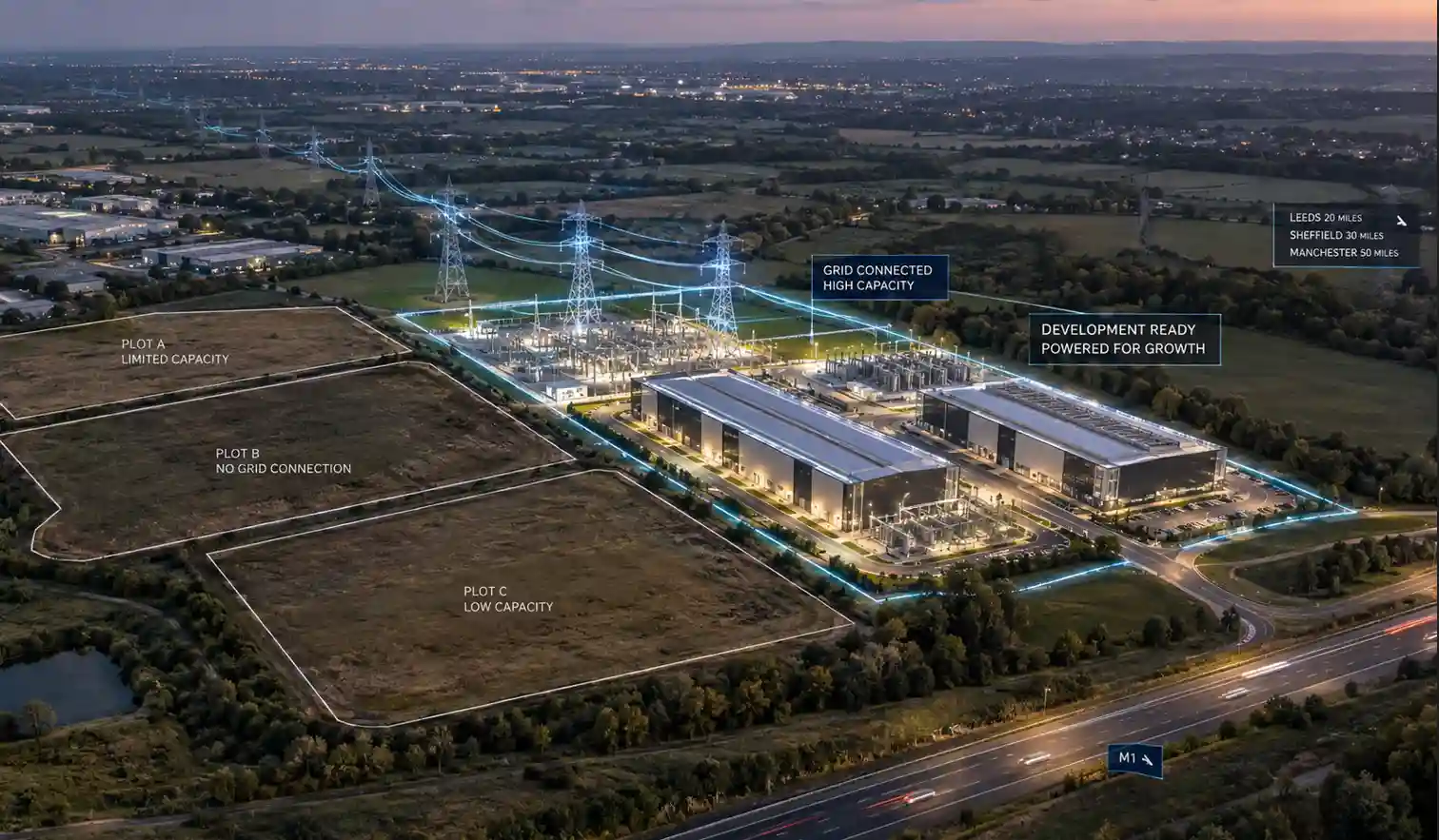
For some of the most power-intensive forms of commercial development, electricity capacity is beginning to influence land value in a way that would have seemed extraordinary only a few years ago.
Reuters reported in April 2026 that conventional London industrial land was selling for around £4.5 million to £6 million an acre, while Savills and other market sources put land suitable for data-centre development at roughly £8 million to £15 million an acre. Those figures are not a UK-wide valuation benchmark, nor are they a like-for-like rule that can be applied to any industrial site sitting near electricity infrastructure. They do, however, illustrate how dramatically a credible power position can change what particular buyers are prepared to pay.
As Reuters’ examination of the emerging “powered land” market showed, the premium is increasingly associated with something that conventional development appraisals once tended to treat as a utility question rather than a primary land characteristic: access to substantial electricity capacity on a timetable the project can actually use.
For data centres that can now be the first site-selection filter. It is increasingly relevant to other electricity-intensive projects too, including parts of advanced manufacturing, electrified industry, large charging infrastructure and some high-load logistics or temperature-controlled operations. That does not mean power has replaced location across commercial development. Motorway access, labour, planning, fibre, water, environmental constraints, land price and proximity to customers can all remain decisive depending on the use.
But where a project depends on tens or hundreds of megawatts, the old assumption that an attractive site can be selected first and adequately powered later is becoming much harder to make.
“Power nearby” is not the same claim as “power available”
This distinction needs to sit near the beginning of any serious acquisition appraisal because physical proximity to electricity infrastructure says surprisingly little on its own about whether the proposed development can actually obtain the supply it needs.
A transmission line, substation or distribution network may be physically close to a site while the relevant part of the network lacks capacity, requires substantial reinforcement or cannot offer an energisation date compatible with the development programme. Even a connection application or offer should not be treated as synonymous with power being immediately deliverable. The conditions attached to it, reinforcement works, milestones, costs and connection programme can be as important as the nominal megawatt figure.
The useful question is therefore not simply whether a site is “powered”, but what contractual and technical position actually sits behind that description. There is a meaningful difference between land being close to electricity infrastructure, an application having entered the connections process, an offer having been made or accepted, and a project having an evidenced route to energisation with the remaining works, conditions, costs and timing properly understood. Those are not formal regulatory categories; they are different levels of commercial certainty that a purchaser needs to distinguish during due diligence.
For a developer whose scheme only works with a particular capacity by a particular date, that distinction can determine whether the land is genuinely development-ready or merely capable of being marketed as though it might become so.
The scale of the grid constraint explains why this now matters
The backdrop is a demand-connections queue that expanded at extraordinary speed. Ofgem reported in July 2026 that contracted demand connection offers had increased from 41GW in November 2024 to 125GW by June 2025, driven heavily by data-centre applications. By the regulator’s July 2026 assessment, data centres accounted for at least 80GW of demand in the connections queue.
Ofgem’s work on speculative data-centre connections is based on a straightforward problem: a queue containing large numbers of projects that never reach development can obstruct viable schemes and give network planners a misleading picture of how much future infrastructure is genuinely required.
A separate government exercise examining strategic demand illustrates the same issue from another angle. Around 142 data-centre projects responding to NESO’s demand-connections work represented approximately 52GW at transmission level alone. That dataset is not directly interchangeable with Ofgem’s wider queue figures — it covers a different part of the connections landscape — but both point to demand substantially exceeding what can realistically be treated as a pipeline of projects all likely to proceed.
This is also why queue capacity should not be read as a forecast of future electricity consumption. Applications can overlap, disappear, change scale or fail to reach construction. For development land, the narrower and more useful conclusion is that holding a connection position is not the same thing as owning a deliverable development, and the market is increasingly recognising the difference.
Queue reform is changing what a credible power position looks like
This is also a moving regulatory environment, and care is needed not to describe proposals as though they were already operative requirements.
As of September 2026, Ofgem has just closed consultation on a package specifically aimed at reducing speculative data-centre projects in the demand queue. Its proposed data-centre connection reforms include a financial commitment mechanism and project-progression milestones under which relevant developments could be required to demonstrate matters such as a credible end user, procurement of long-lead electrical equipment and the financial and technical capability to deliver the project. The consultation closed on 17 September 2026 and is awaiting a final decision.
Government is separately considering how strategically important electricity demand should be prioritised. Its strategic-demand connections proposals cover sectors including data centres and industrial development and are intended to tackle speculative applications while creating routes for projects judged important to economic growth.
For development land, the direction is important even before every element of the eventual regime is settled. A nominal place in a heavily oversubscribed queue is becoming less useful as a proxy for value than evidence that the underlying project is credible, properly controlled, financeable and capable of progressing through whatever readiness requirements ultimately apply. That increasingly links electricity strategy to land strategy: a developer pursuing a power-intensive site needs to understand not only the land it controls and the planning path it expects to follow, but whether the occupier, funding, infrastructure programme and grid position collectively form a project that can survive a more selective connections system.
Why this can create real land value rather than merely a marketing angle
Power does not automatically transform ordinary industrial land into data-centre land. The premium only exists where the capacity is useful to an end market willing to pay for it, and where the rest of the development proposition works. Fibre connectivity, planning prospects, environmental constraints, site scale, access, water requirements where relevant, security and the economics of constructing the facility still matter. A grid position attached to an otherwise unsuitable site is not a substitute for a viable development proposition.
Where those factors align, however, deliverable capacity can materially reorder the value of sites that would once have been judged primarily on conventional industrial-property characteristics.
Wilton International on Teesside is a useful example. The site has long served energy-intensive industry and benefits from established infrastructure, power assets and grid connectivity. In May 2026, Sembcorp announced the first phase of a proposed data-centre development there with Digital Reef, designed for up to 280MW of capacity. Sembcorp describes the Wilton proposition as benefiting from an existing large grid connection, behind-the-meter power assets, utilities and connectivity.
That does not prove that every legacy industrial site with substantial electrical infrastructure has acquired enormous data-centre value. It illustrates why infrastructure that once existed to serve one industrial era can become commercially strategic in another: the land has not moved closer to London, but the market has changed what it is prepared to pay for the ability to power development there.
Data centres are the clearest case, not the only one
Data centres currently provide the most extreme example because modern AI and high-performance-computing campuses can demand electricity at a scale that fundamentally changes how sites are screened.
Knight Frank’s 2026 data-centre research describes site selection as increasingly “power-first”, with investors prioritising land capable of supporting phased delivery in the hundreds of megawatts and noting that constrained parts of the London market can face connection waits approaching a decade. Its analysis of AI infrastructure and powered land reflects a market in which the ability to secure scalable power can outweigh advantages traditionally associated with established locations.
That is a significant change in development logic. Instead of identifying the ideal parcel and then arranging the utilities, the search can begin with where the required electricity can credibly be delivered and work backwards to the land capable of supporting the rest of the development.
Data centres should not obscure the broader point, however. Government’s own strategic-demand work identifies industrial sites and EV charging infrastructure alongside digital infrastructure as areas where connection timing can affect investment. Manufacturing processes are electrifying, fleets are gradually changing and some warehousing or temperature-controlled uses can have materially greater loads than conventional industrial stock was designed to serve.
The intensity differs enormously between sectors and individual occupiers, so it would be wrong to suggest that every warehouse or factory now needs a power-first site strategy. The important change is that developers can no longer infer future suitability simply from the fact that a site has historically supported industrial use.
Planning consent and deliverable power are separate development risks
A site can have an attractive planning position and an inadequate electricity solution. It can equally have exceptional electrical infrastructure and a planning, environmental or commercial problem that prevents the intended development from proceeding. For power-intensive development, those are separate deliverability questions that can progress on different programmes and fail for entirely different reasons.
A developer may spend considerable time creating a planning position only to discover that reinforcement pushes energisation beyond the economic window of the scheme. Another site may have a strong connection proposition but require a planning outcome or environmental mitigation that cannot be assumed simply because the infrastructure is already there. The sensible appraisal therefore treats power and planning as parallel deliverability workstreams, rather than putting planning at the centre of due diligence and leaving electricity to the technical team after the land position has effectively been decided.
That is also where the preceding Land & Development questions about site control become relevant. An option, conditional acquisition or other control structure may be particularly valuable where the planning and grid positions both need to mature before the developer can justify committing the full land capital.
The speculative “powered land” risk deserves serious attention
Whenever one characteristic begins commanding a substantial land premium, there is an obvious incentive for marketing language to run ahead of what has actually been secured.
Reuters’ investigation into the market described speculative sites and connection applications as “zombie projects”, while Ofgem uses the more formal language of speculative or non-viable projects when explaining the case for queue reform. The underlying concern is the same: an application for capacity can exist without a corresponding development being sufficiently advanced, funded or otherwise capable of proceeding.
For a land buyer, the danger is assuming that an infrastructure claim has more certainty than the underlying documentation supports. “Near a substation”, “power available”, “grid connection secured” and “powered land” can describe materially different positions depending on what has actually been agreed with the relevant network company and what remains to happen before energisation.
The answer is not cynicism about every site marketed on its power credentials, because genuine powered-land opportunities plainly exist and can be exceptionally valuable. It is to require the power position to withstand the same level of verification as the other assumptions carrying material weight in the land appraisal.
What proper power due diligence actually needs to establish
A sophisticated purchaser does not need to become an electricity-network engineer, but where the site economics depend on power it needs the grid position investigated with the same seriousness applied to title, planning and abnormal development costs.
The starting point is the capacity actually required by the intended development rather than the largest figure appearing in the selling agent’s material. From there, the buyer needs to understand the status of any connection application or offer, the relevant connection point, the capacity covered, the current programme and the conditions still standing between the project and energisation. If network reinforcement is required, its scope, programme, cost allocation and dependency on other works can materially alter the value attributed to the site.
The headline MW number is only part of that analysis. The connection terms need to establish what kind of capacity will actually be usable by the development and when. Capacity that is phased, flexible, subject to restrictions or otherwise qualified can have a very different commercial value from capacity capable of supporting the operating profile assumed in the development appraisal. For uses where continuity of supply is itself critical, the technical review also needs to establish whether the proposed connection arrangement can support the resilience requirements of the intended operation rather than assuming that sufficient headline capacity answers the entire question.
The contractual position matters just as much as the engineering one. A connection associated with a seller, previous applicant or different development concept should not simply be assumed to pass intact to a purchaser or to support a materially changed use. Appropriate technical and legal advisers need to establish what rights actually exist, whether assignment or project changes require consent, what milestones must be met and what circumstances could alter or terminate the connection position.
Timing then has to feed directly back into the development appraisal. A project needing power in 2029 is not necessarily helped by a theoretically adequate connection in 2036, while a cheap connection is of limited value if obtaining it requires reinforcement expenditure large enough to destroy the land residual. The aim is therefore not merely to verify that electricity exists somewhere nearby, but to establish whether the required capacity, quality of supply, contractual rights, cost and energisation programme collectively support the development being underwritten.
The map has genuinely changed, where power is a binding constraint
Traditional commercial-development site selection has rarely been as simple as motorway access, labour and land price alone, and power has always mattered to genuinely electricity-intensive industry. What has changed is the scale at which electricity demand is now entering sectors such as data centres and the degree to which network congestion can prevent an otherwise attractive site from being delivered on a commercially useful programme.
For most conventional development, grid capacity will not suddenly become the overriding land-value variable. Property markets remain local, development uses have radically different energy profiles and many schemes can still obtain the electricity they require without reorganising the entire acquisition strategy around the network.
But where power is a binding constraint, treating it as a utility enquiry to be resolved after the site has already been selected is becoming increasingly difficult to justify. In those markets, the commercially valuable asset is not a field beside a transmission line or an agent’s claim that a large connection is possible. It is land where the developer can demonstrate a credible route from the capacity and resilience required by the end use to an energisation date, cost and contractual position that the development appraisal can actually support.
That is why, for a particular and growing part of the development market, power is starting to behave less like a service supplied to the location and more like part of the location itself.
This article provides general development-land, market and electricity-infrastructure information, not engineering, planning, legal, valuation, financial or investment advice for individual circumstances. Electricity connections and regulation differ between Great Britain and Northern Ireland; the Ofgem, NESO and demand-connections reforms discussed above relate to Great Britain. Connection capacity, contractual rights, cost, resilience and energisation timescales should be independently verified with the relevant network company and appropriate professional advisers before any land acquisition or development commitment is made.

