

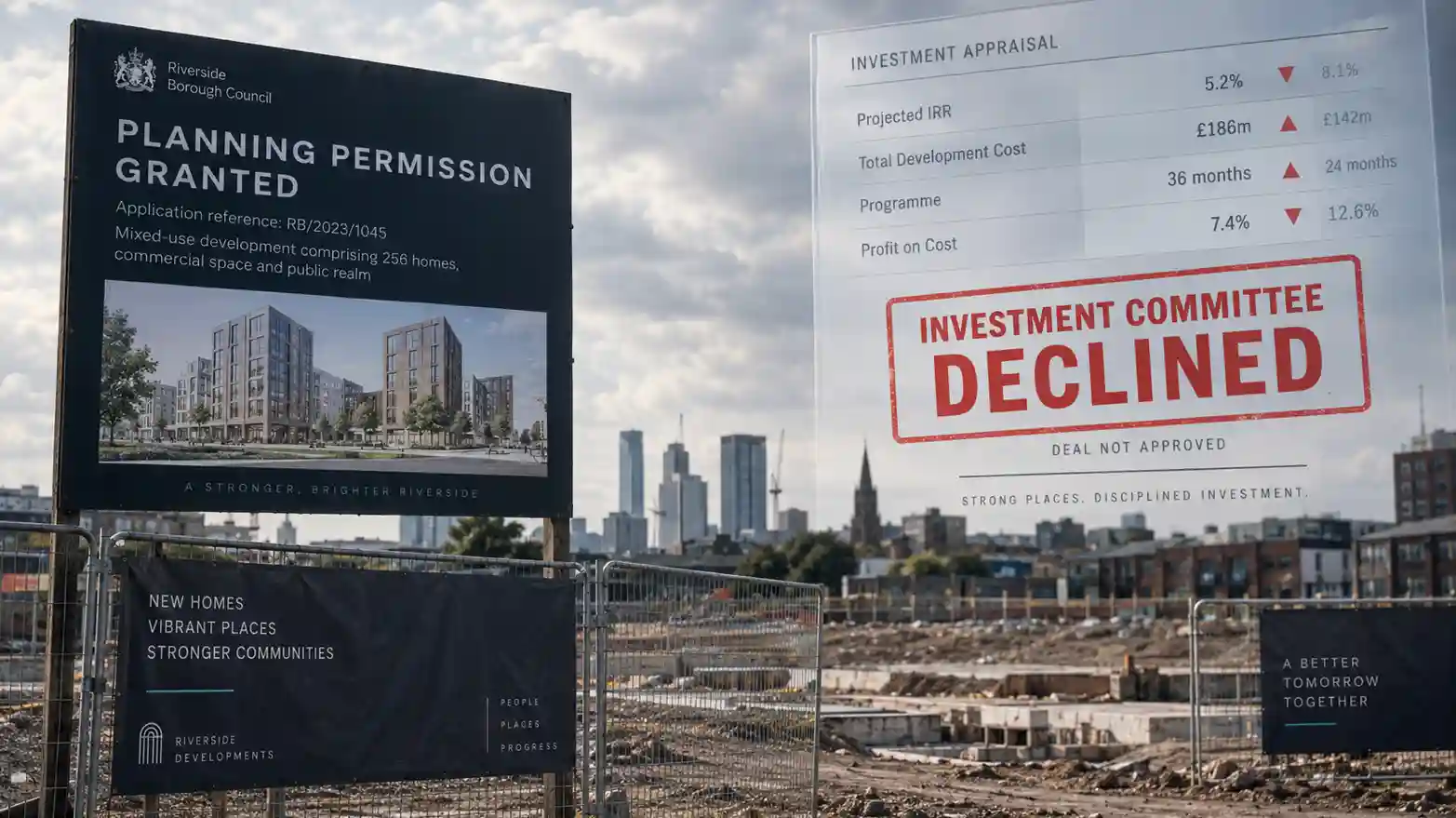
Planning permission in place, the technical position understood and a scheme that can, in principle, be delivered — yet the investment committee still says no. There is nothing contradictory about that outcome. Planning permission creates development opportunity; it does not compel rational capital to pursue it, and it does not certify that the economics still work for the developer considering the site today.
That distinction matters particularly in the current residential land market. Knight Frank’s Q2 2026 research found developers becoming increasingly selective as weaker sales rates, elevated build costs and financing pressures continued to affect viability, while fully consented, shovel-ready sites that can be brought forward quickly remained in demand. The useful conclusion is therefore not that developers have stopped wanting sites with planning permission. It is that permission alone cannot rescue a scheme whose wider investment case has deteriorated.
The same principle extends beyond housing. A commercial or mixed-use development can have an entirely acceptable planning position and still fail because rents, yields, pre-letting assumptions, construction cost, finance, programme or the alternative use of the developer’s capital no longer justify proceeding.
Planning permission and investment approval are two different tests
It is easy to blur planning viability and commercial investability because both use development appraisals, but they answer different questions. In England, government planning viability guidance is principally concerned with whether planning policies and obligations allow development to be delivered while balancing landowner and developer returns against the public benefits sought through the planning system. Not every planning application goes through a site-specific viability assessment, and the grant of permission should not be interpreted as a local authority having certified that the scheme will produce an acceptable commercial return for whichever developer eventually builds it.
An investment committee is asking something narrower and more demanding: should this business, with its own funding, return requirements, pipeline, expertise and alternative opportunities, deploy capital into this scheme now? Those answers can diverge substantially. A consent may remain perfectly valid while the construction market changes, sales or rental assumptions soften, finance becomes more expensive, technical requirements become clearer or the programme stretches. A scheme can therefore remain capable of development without remaining attractive enough to compete successfully for capital inside the developer’s business. That is not planning failure; it is capital allocation.
The appraisal can deteriorate without one dramatic shock
Development schemes rarely become unattractive because a single line suddenly destroys the appraisal. More often, several moderate movements compound. Construction is an obvious example: the BCIS Private Housing Construction Price Index recorded annual housebuilding cost inflation of 2.3% in the first quarter of 2026. That is far below the exceptional inflation seen earlier in the decade, but moderation in the rate of increase does not reverse costs already embedded in specifications, labour, materials and procurement. Nor does one national index describe every project equally; a low-rise scheme on a relatively straightforward site has a very different exposure from a complex apartment building, remediation-led development or project requiring substantial infrastructure.
Revenue assumptions can move just as consequentially. On housing, weaker sales rates can lengthen the period over which units are completed and sold even where headline prices have not collapsed, increasing finance exposure and slowing capital recycling. In commercial development, the equivalent pressure may come from achievable rent, tenant incentives, letting periods, pre-let requirements or exit yield. Because the development return is what remains after substantial fixed and semi-fixed costs have been met, a modest movement in the revenue side of the appraisal can produce a much larger movement in residual value or developer return.
Finance then amplifies those changes rather than sitting neatly beside them. A slower programme means debt is outstanding for longer; delayed sales or lettings postpone receipts; additional technical work can push expenditure earlier relative to income; and equity remains tied to the project instead of becoming available for another acquisition. A scheme that continues to show a positive nominal profit can therefore become unattractive once the timing, risk and opportunity cost of that return are properly recognised.
Policy and regulatory costs do not stop moving when planning permission is granted
Planning obligations form part of the development economics, but their treatment needs care. In England, Section 106 obligations, affordable housing and the Community Infrastructure Levy where applicable can materially affect residual value. Other parts of the UK operate different planning-obligation and infrastructure-funding regimes, so those English mechanisms should not be treated as a universal UK cost structure.
Permission also does not freeze every regulatory cost that will affect delivery. A particularly immediate example is the Building Safety Levy in England, which comes into operation on 1 October 2026. Under current government Building Safety Levy guidance, the levy applies to relevant building control applications and notices submitted on or after that date where the charging conditions are met, including major residential development of 10 or more dwellings or 30 or more purpose-built student accommodation bedspaces, subject to the exemptions in the regime.
The levy is charged by reference to floorspace, with rates varying by local authority and a lower rate applying to previously developed land, so its effect is inherently scheme- and location-specific rather than a flat amount that can safely be inserted into every appraisal. Timing matters as well. Existing building control applications submitted before 1 October 2026 are outside the levy, and government guidance confirms that qualifying variations to those existing applications do not generally bring them into charge; a rejected pre-commencement application that is subsequently resubmitted after 1 October is a different matter and can become liable. For an investment committee considering a residential scheme now, that is not a future policy discussion but a cost whose treatment needs to be explicit where the relevant building control route falls within the new regime.
Scotland is taking a separate route. The Scottish Building Safety Levy is intended to commence on 1 April 2028, subject to the necessary secondary legislation, and indicative rates have already been published. Wales and Northern Ireland should not be assumed to share either England’s or Scotland’s regime.
Gateway 2 matters materially where it applies — but the current position is more nuanced than the headlines suggest
For higher-risk buildings in England, the building-control regime introduces another investment consideration that planning permission does not resolve. New higher-risk buildings cannot simply move from planning permission into construction without the required Building Safety Regulator approval, so Gateway 2 affects programme risk in a particularly important part of the residential development market, especially where time, finance and pre-sales are closely interconnected.
The current evidence needs to be presented fairly, however. Gateway 2 has unquestionably produced long determination periods, but performance has been improving. The Building Safety Regulator’s June-to-August 2026 data showed a 92% approval rate for new higher-risk buildings and conversions, with a median approval time of 22 weeks. Twelve months earlier the comparable median stood at 43 weeks and the approval rate at 39%.
That improvement matters because it would be wrong to write about Gateway 2 as though nothing has changed or to imply that every higher-risk project is indefinitely trapped in the process. Equally, a 22-week median remains a material programme input when the developer cannot lawfully start higher-risk building work before approval. The investment point is therefore specific rather than universal: Gateway 2 remains a meaningful programme and execution risk for schemes within the higher-risk regime, but it should not be presented as a generic viability problem affecting ordinary residential development as a whole.
Infrastructure and site complexity can reopen an appraisal that once looked settled
Consent does not guarantee that every physical cost required to deliver the scheme was fully understood when the land was first priced. Highway works, drainage, utilities, substations, diversions, remediation, demolition, unusual foundations, retaining structures, ecology and off-site infrastructure can all become clearer — and more expensive — as detailed technical work progresses. On power-intensive development, the cost and timing of electricity infrastructure can itself become a major land-value issue, as discussed in this section’s companion article on grid capacity.
Brownfield schemes concentrate many of these risks because they frequently combine demolition, remediation, constrained logistics and existing infrastructure with relatively intensive forms of development. Current market evidence reflects that difficulty without supporting the idea that every brownfield site is failing. Knight Frank’s Q2 2026 Residential Development Land Index recorded urban brownfield residential land values falling 2.5% during the quarter and 5% over the year. Its analysis identified high-rise apartment schemes as particularly difficult, citing weak off-plan sales, elevated build costs, affordable housing requirements and Gateway 2 risk among the pressures affecting viability.
At the same time, the finding that fully consented, shovel-ready sites remain sought after provides an important counterweight. The market is not rejecting consented or brownfield land as categories; it is distinguishing increasingly sharply between sites capable of moving efficiently into delivery and those still carrying significant capital, infrastructure or programme burdens. Planning permission narrows one category of uncertainty, but it does not make the abnormal-cost line disappear.
Time can make an apparently profitable scheme a poor investment
This is where an investment committee can see something that a headline profit margin conceals. A scheme generating an acceptable cash profit over three years and the same nominal profit over seven years are not economically equivalent: the longer project carries more financing exposure, delays capital recycling and consumes management and balance-sheet capacity for longer. If the organisation measures return through IRR, return on capital or another time-sensitive metric, programme extension can move a project below its hurdle even while the simple profit number remains positive.
There is no universal developer hurdle rate that determines whether a consented site should proceed. Different businesses use different measures — profit on cost, profit on GDV, IRR, return on capital or combinations of them — and required returns vary with risk, leverage, programme and corporate strategy. That distinction is particularly important because familiar percentages used in planning viability should not casually be imported into acquisition or investment decisions. Government guidance may use assumptions about developer return when testing planning policies; an individual developer’s investment committee is deciding whether the expected return from a real scheme compensates its own capital for the risks being accepted.
For commercial development the logic is the same even though the variables change. A warehouse, office or mixed-use scheme may still produce a positive development profit but lose investment approval because a pre-let has weakened, the letting period has lengthened, incentives have risen or the exit yield has moved. Planning permission cannot insulate the appraisal from the investment market the finished asset will eventually enter.
Sometimes the real problem is the price or strategy inherited from an earlier market
Many consented sites were acquired, optioned or first appraised under assumptions that no longer describe the market in which the scheme will actually be delivered. That creates an uncomfortable investment-committee problem because proceeding can become psychologically entangled with what the business has already spent: the acquisition price has been agreed, planning and professional fees have been incurred and substantial management time may already sit behind the project.
Economically, however, those historic expenditures are sunk. The investment committee’s job is to judge the next pound of capital against the return still available from today, not to justify the pounds committed under yesterday’s assumptions. Previous expenditure may affect accounting, balance-sheet value or the range of practical choices available to the business, but it does not by itself make further development expenditure rational.
The appraisal therefore has to be refreshed using current evidence rather than defended because the original acquisition thesis once made sense. On an option or conditional contract there may still be scope not to complete, renegotiate or restructure, depending on the legal terms. On owned land, the choices may instead include redesign, rephasing, bringing in a partner, changing tenure or use where planning allows, holding, selling, or accepting that the land requires a different value before development becomes rational again.
Failing today’s investment hurdle does not necessarily mean abandoning the site permanently. It may mean deferring the start, repricing the opportunity, restructuring the capital or development strategy, or exiting altogether, depending on what has changed and whether the underlying problem can realistically be repaired. That is also why the phrase “the site is viable” can be misleading unless it is followed by the questions: viable for whom, using which capital structure, on what programme, at what land basis and against which alternative investment?
Those questions matter more to an investment committee than the fact that permission appears on the planning register.
The final decision is not “can we build it?”
The final decision is whether this business should deploy its capital here now. Planning permission remains enormously valuable because it resolves or reduces one of development’s major uncertainties, and in the current market genuinely deliverable consented sites can command strong demand precisely because so many other opportunities still carry planning, infrastructure, regulatory or viability risk.
What planning permission cannot do is preserve the economics that existed when the application was submitted. It cannot lock construction costs, guarantee sales rates or rents, fix interest expense, shorten an infrastructure programme, remove every regulatory burden or ensure that the scheme still offers the best risk-adjusted return available to the developer. A responsible investment committee can therefore reject, defer or restructure a consented scheme without concluding that the land is worthless or that the planning work was wasted.
Another developer with a lower cost base, different funding, a longer investment horizon, a different exit strategy or a stronger operational advantage may value exactly the same opportunity differently. A development site does not have to become a bad site for the correct answer to become “not now”, “not at this price” or “not for us”. Planning permission establishes the opportunity; capital still has to choose it.
This article provides general development-land, market, planning and regulatory information, not financial, valuation, planning, legal, tax or investment advice for individual circumstances. Development costs, regulatory requirements, programme risk, financing and required returns vary materially by scheme, jurisdiction and developer. Current requirements and appraisal assumptions should be independently verified before any acquisition or investment decision.

