

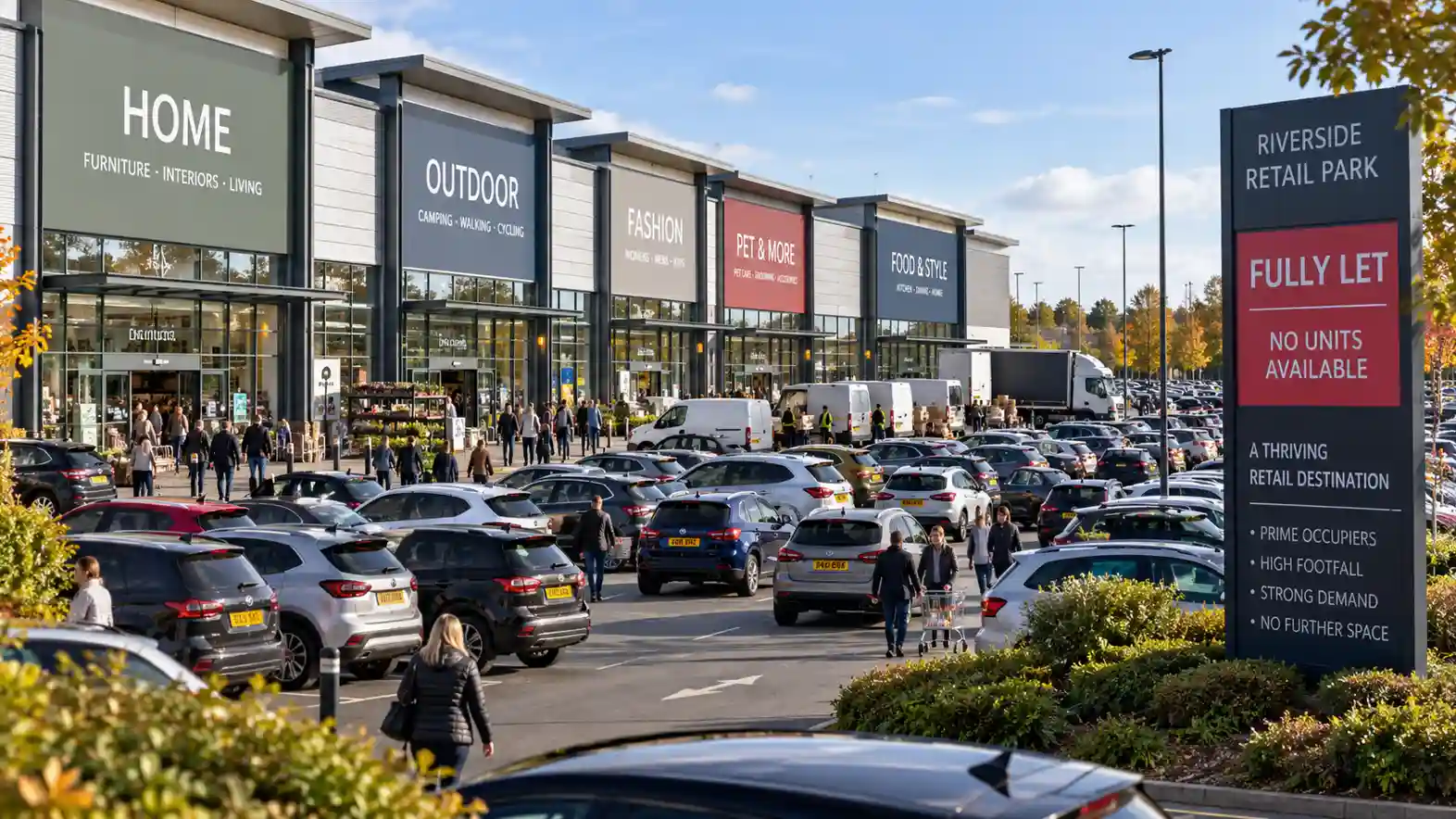
A retailer wants to open on a well-located retail park. Several others want the same thing on the same park, or one very like it. The park is full, trading well, and its landlord has no obvious reason to think demand will soften. And yet almost nothing new is being built to meet it. Trevor Wood Associates recorded UK retail warehouse vacancy at a record-low 4.7% in the second quarter of 2026, with 9.27 million sq ft available and only 0.54 million sq ft of consented space expected to be delivered over the following two years. The figures concern retail warehousing, including accommodation beyond multi-let retail parks, rather than vacancies on retail parks alone.
Separate research from Savills found effective availability of just 1.8% after stripping out units that had been vacant for three years or more, often because they were unsuitable for modern occupiers or difficult to bring back into use. Savills works from a different market dataset and reports a different headline vacancy rate, so its 1.8% figure is not a simple adjustment to Trevor Wood’s 4.7%. Both nevertheless describe a shortage of space retailers can realistically take. A market this tight should, on paper, be building furiously. It is doing almost the opposite, and the reasons matter more to landowners, developers and investors than any further restatement of how strongly existing retail parks are trading.
Strong demand is necessary, but nowhere near sufficient
The instinctive assumption — that developers will simply build wherever tenants clearly want space — misunderstands what triggers new development. A developer does not build because occupiers want space; a developer builds because a particular site can be acquired, consented, serviced and constructed at a cost the achievable rent and eventual investment value will support. Strong demand is necessary for that calculation, but nowhere near sufficient. A retailer eager to take a vacant unit on an established park may be considerably less willing to commit to the rent required to make a new scheme viable, even in the same catchment. The shortage of existing space and the economics of creating new space are related, but they are not the same question.
Where the supply chain breaks down
Suitable land for retail warehousing has always required a particular combination of scale, road access, visibility, catchment and enough room for parking and servicing. In the places where those characteristics are most valuable, the same land may be attractive for housing, industrial or logistics development, and its owner may have little incentive to accept a value that works only for retail. Competing uses will not always win, but their realistic development prospects influence the asking price long before a retail developer gets to its own appraisal. Construction costs, utility connections and highway works then add to the amount that must be committed before the first unit produces any income. An otherwise desirable location can be priced out by the very characteristics that make retailers want to trade there.
Planning compounds that problem rather than merely delaying its solution. In England, the National Planning Policy Framework’s town-centre policies, published in September 2026, apply a sequential test to qualifying proposals for main town-centre uses outside existing centres where they are not supported by an appropriate up-to-date allocation. Suitable town-centre sites must be considered ahead of edge-of-centre and then out-of-centre locations. Depending on the development plan and the proposal, an out-of-centre retail scheme may also require an impact assessment; where no local floorspace threshold is set, the default is 2,500 sq m gross. None of that amounts to a blanket prohibition on new retail parks, and these are England-specific rules, but a scheme’s ability to attract retailers is not sufficient to secure permission.
The financial consequences are less visible than a planning refusal but can be just as decisive. A developer needs enough rental income, once capitalised at a plausible investment yield, to support land, construction, professional fees, finance, infrastructure and a return for taking the development risk. Yet Savills recorded average net effective retail warehouse rental growth of only 0.1% in 2025, after 7.0% in 2024. That does not mean rents have stopped rising in every location — larger units and undersupplied markets performed more strongly — but it shows why low vacancy cannot simply be converted into whatever rental increase a new-build appraisal requires. Retailers still have their own staffing, rates and trading costs to absorb. The gap between a rent that looks achievable on an established park and the rent needed to create another one can remain stubbornly wide.
Why a sitting tenant rarely moves on
A further constraint compounds the shortage without involving the development pipeline at all: very little existing space is coming back to the market. Savills found that across its own deal book of lettings, regears and renewals between 2023 and 2026, only 8% of occupiers vacated and 92% renewed their commitments. That is evidence from Savills’ transactions, not a universal UK lease-renewal rate. Retailers holding a successful location are understandably reluctant to surrender it when a comparable alternative may not become available for years. Many units also serve an omnichannel role through collections, returns and the influence of a physical shop on online sales, making the space harder to replace than its tills alone might suggest.
Savills recorded 721 new lettings in 2025 against a long-run average of 847, followed by just 120 in the first quarter of 2026. Lower transaction volumes could look like weaker demand if viewed in isolation, when the more immediate explanation is that so few suitable units can be offered. Space released through the failures of Homebase and Carpetright was absorbed relatively quickly, briefly opening up opportunities rather than producing a lasting increase in choice. The lack of churn strengthens the position of established owners, but it also deprives developers and agents of recent comparable lettings at the rental levels that a new scheme might need to command.
Distinguishing retail warehousing from the wider retail-property picture
It is worth being precise that this is a shortage of retail warehouse accommodation, not a description of Britain’s retail property market generally. Shopping centres and high streets have their own patterns of vacancy, investment and changing occupier demand, while some retail warehouses remain difficult to let because they are in the wrong catchment, are poorly configured or carry restrictions on the goods that may be sold. A bulky-goods unit cannot necessarily accommodate an expanding food or fashion retailer simply because that business is ready to pay for space. Even within out-of-town retail, a well-located, modern park and a tired freestanding warehouse may have little in common beyond their broad property classification. A national shortage can coexist with local surpluses and buildings whose vacancy will not be cured merely by stronger market demand elsewhere.
Intensification as the more realistic growth route
Where genuinely new development remains constrained, the more realistic route to growth for many existing parks is intensification of what is already there. Larger units can sometimes be subdivided to meet demand from smaller occupiers, extensions may add floorspace without requiring a new site, and changes to circulation, servicing or parking can reveal room for an additional unit or food-and-beverage operator. A shift in tenant mix may also improve rental income without increasing floorspace at all. These opportunities begin with an established location whose trading credentials and customer catchment are already understood, rather than asking an investor to acquire land and underwrite a wholly new park.
None is a permission-free or cost-free shortcut. Subdividing a unit does not itself create additional square footage, and changes to entrances, servicing, permitted retail uses or parking arrangements can require planning permission, landlord and tenant agreement, or other consents depending on the scheme. Losing too many parking spaces to add a drive-through could weaken the existing park; changing a large unit into smaller ones could incur substantial building-services and fit-out costs. Where the extra rent justifies those sacrifices, intensification is a practical way of meeting some of the demand. It cannot, however, solve a national shortage of new retail warehouse floorspace by itself.
What makes a new scheme financeable
For a landowner or developer weighing a new park, the calculation turns on a smaller number of decisive commitments than a national vacancy statistic can capture. A binding pre-let from a financially strong occupier can transform the case for finance by giving the lender or forward purchaser identifiable income from the outset. But a retailer’s expression of interest is not a lease, and even a signed commitment does not remove planning or construction risk. The rent, lease length, incentives, specification and conditions on which that commitment depends all affect the price an investor will pay for the completed park. A scheme can have several eager prospective occupiers and still fail if none is willing to underwrite the rent required at completion.
The limited pipeline is corroborated by separate industry work. Knight Frank’s July 2026 analysis identified just 21 schemes considered likely to proceed before 2033, representing approximately 2.7 million sq ft if delivered as envisaged. That is a different horizon and measure from Trevor Wood’s two-year forecast, not a contradiction to be resolved by adding the figures together. In either case, the small number of prospective schemes is telling. It remains possible to build in locations where land cost, planning prospects, retailer commitments and the eventual investment value align; the difficulty is finding enough such locations to change the market’s overall supply position.
What this means for owners of existing stock
For investors already holding well-let retail parks, the lack of new supply creates a competitive advantage that a wave of construction would normally erode. Retailers have fewer ways to expand into a successful catchment, established locations become harder to replace and lease events can present opportunities to improve income. British Land’s May 2026 results reported its retail parks were around 99% occupied and that retail park lettings in the second half were 6.3% ahead of previous passing rent. That is evidence from a particular owner with a particular portfolio, rather than a national forecast, but it demonstrates why investors have been paying closer attention to established parks while new construction remains scarce.
Scarcity is not immunity from cost or overpayment. Retailers still have limits on the rent they can bear, a park may need expensive work to accommodate the next occupier, and much of the anticipated rental growth may already be reflected in the price an investor pays today. A landlord with a full park can be in a strong negotiating position while still facing substantial roof, servicing or access expenditure. The difference between owning an asset competitors cannot easily reproduce and buying it at a price that leaves room for an adequate investment return is as important here as in any other property sector.
Why tight demand alone will not fix this
The uncomfortable conclusion for anyone hoping strong demand will eventually force enough new retail park supply into the market is that demand cannot, by itself, make land cheaper, alter town-centre planning policy or close a development appraisal that does not work. The shortage looks more persistent than an ordinary pause in construction, although it would be wrong to suggest that no combination of higher rents, lower costs or changes in land values could bring additional sites forward. Existing owners can make better use of some of what they have; developers will continue to find exceptional opportunities where the numbers align. Neither changes the underlying contradiction: plenty of retailers would take suitable space if it existed, but that is not the same as being able to deliver it at a cost those retailers can afford to support.
This article provides general information and analysis about UK commercial property, not legal, planning, valuation, financial, tax or investment advice. Market datasets use differing definitions, and planning policy varies between UK jurisdictions. Obtain appropriate professional advice before buying, developing, financing or altering retail warehouse property.

