

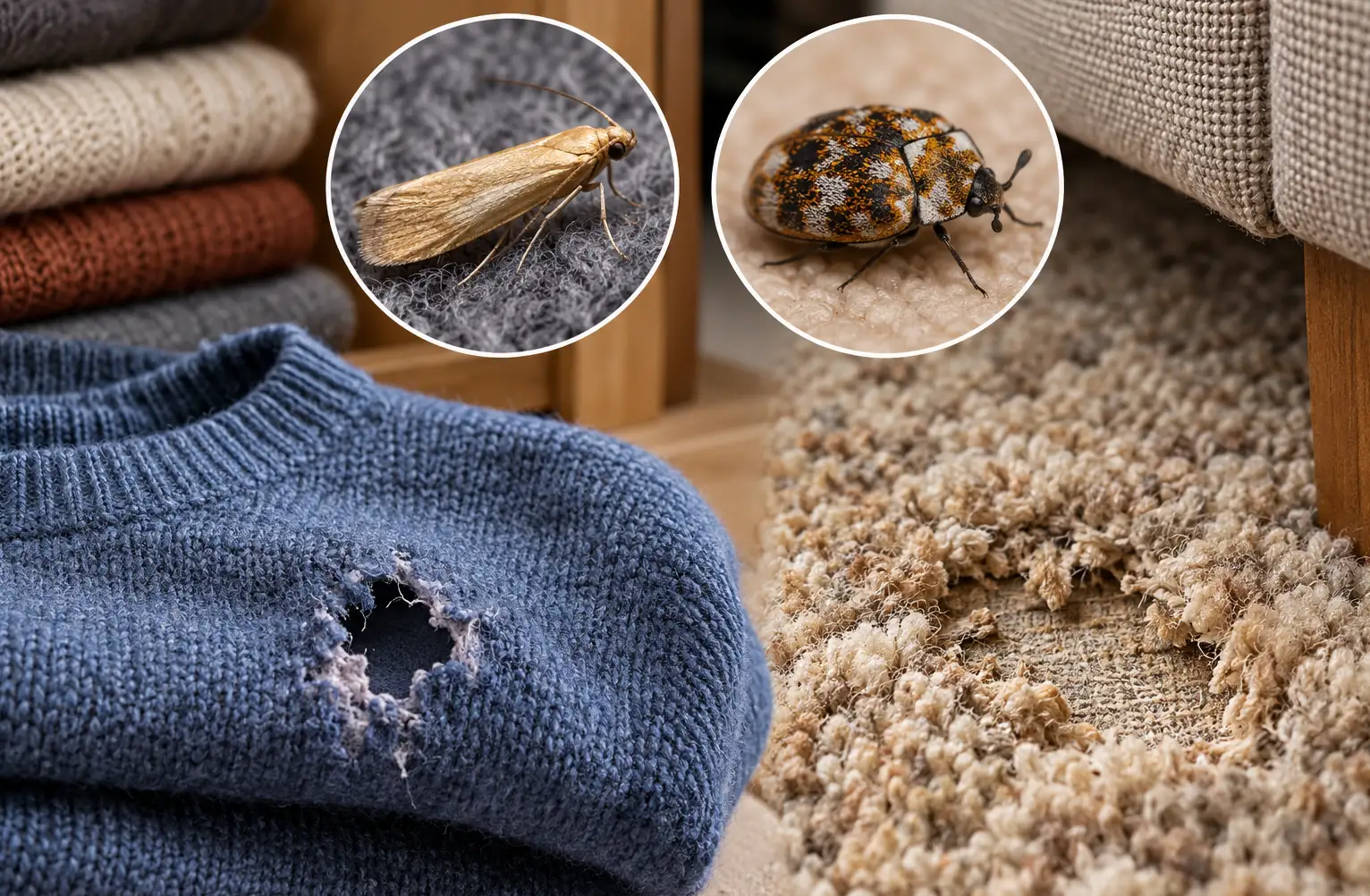
A jumper comes out of storage with a hole in the shoulder. A patch of carpet under the sofa has thinned to the backing. The instinct is to blame “moths” — it is the name most people reach for — but carpet beetles are another important cause of textile damage in British properties, and the evidence left behind by the two pests is different enough to change where you look next.
There are actually two questions to answer before reaching for any treatment. First, is the damage active, or have you simply discovered an old hole? Second, is the damaged material something textile pests would normally feed on at all? Get those questions right and the investigation becomes much more useful than trying to identify an infestation from the shape of a hole.
The insect you can see is rarely the one doing the damage
For both clothes moths and carpet beetles, it is the larvae that damage textiles. The adult moth or beetle you happen to notice is therefore evidence worth investigating, not proof that the garment or carpet beside it is being eaten.
This is particularly important with carpet beetles. Adults are small, rounded or oval beetles, often mottled with pale and darker patches, and naturally feed on pollen and nectar. The Natural History Museum notes that adults commonly turn up on windowsills seeking light or trying to get outside. Natural History Museum — carpet beetles identification guide One beetle on a sunny sill may therefore tell you very little about an old hole in a carpet elsewhere in the room unless larvae, cast skins or fresh feeding evidence can also be found.
Clothes moths behave differently. The common clothes moth is small and golden and tends to favour darker, undisturbed areas; the case-bearing clothes moth is greyer-brown and its larva carries a distinctive silk case. The Natural History Museum confirms that the larvae, rather than the adults, are responsible for damage to clothing, carpets, upholstery and other susceptible materials. Natural History Museum — clothes moths identification guide
Before deciding that either pest is active, look at the damage itself over time. A hole proves that damage happened; it does not, on its own, prove that larvae are still feeding there today. Fresh larvae, new webbing, cast skins, frass, repeated moth activity or damage that can be seen to be increasing are much stronger evidence. Photographing a suspect area and comparing it later can be surprisingly useful where it is unclear whether an old carpet patch is getting worse. National Museums Scotland specifically recommends photographic records and monitoring because they can help distinguish new damage from historic damage. National Museums Scotland — how to monitor pests
The material itself provides another clue. Clothes moth larvae are principally associated with animal-derived fibres such as wool, hair, fur and feathers, while carpet beetle larvae also attack materials including wool, fur, feathers and skins. The Natural History Museum notes that carpet beetle larvae do not feed on entirely synthetic fabrics. If the damaged item is entirely synthetic, textile-pest feeding becomes a less convincing explanation and wear, abrasion, snagging or another cause deserves consideration. Blended fabrics are less straightforward, because a vulnerable natural component may still provide food.
Two pests, two rather different sets of evidence
Clothes moth larvae are pale, caterpillar-like grubs with a darker head. Common clothes moth larvae spin silk into their feeding area, sometimes creating quite obvious webbing mixed with fibres and debris. Case-bearing clothes moth larvae produce a portable silk case camouflaged with material from their surroundings. In a damaged wool jumper or beneath a piece of furniture, finding pale larvae together with silk or cases is far more persuasive evidence than deciding that the holes “look like moth holes”.
Carpet beetle larvae — often called “woolly bears” — are much more obviously hairy or bristly. As they grow they moult, leaving behind light, hollow, bristly skins that can remain after the larva has moved elsewhere. Damage may also be accompanied by powdery or dust-like frass, but there is no moth-like silk webbing. Adult varied carpet beetles look quite different again: tiny, rounded beetles patterned with pale, brownish and darker scales.
Hole shape by itself is a poor discriminator. Carpet beetles can leave quite clean, well-defined holes, while moth feeding can vary according to the weave, pile and condition of the material. The useful distinction is therefore not “clean hole versus ragged hole”, but the combination of evidence around it: silk or cases, bristly cast skins, larvae, frass, vulnerable material and where within the property the damage is appearing.
Telling them apart
| Clue | Clothes moths | Carpet beetles |
|---|---|---|
| Adult | Small moth; common clothes moth usually golden-buff and associated with darker areas | Small rounded or oval beetle; varied carpet beetles are mottled and adults are often seen near windows |
| Larva | Pale caterpillar-like grub with darker head | Brownish, conspicuously hairy or bristly “woolly bear” |
| Silk, cases and shed remains | Common clothes moth may leave silk webbing; case-bearing larvae carry silk cases and pupal material may remain | No silk webbing; conspicuous bristly cast larval skins are an important clue |
| Debris | Frass can occur among webbing, fibres and feeding debris | Powdery/dust-like frass can occur around damaged material |
| Typical places to look | Folds and seams of stored woollens, wardrobes, upholstery creases and wool carpet beneath furniture | Carpet edges, beneath furniture, skirting edges, floor voids, accumulated fluff and other hidden organic material |
| Fibre clue | Principally animal-derived fibres such as wool, fur, hair and feathers | Wool, fur, feathers, skins and other susceptible animal-derived materials; wholly synthetic fibres are not a food source |
| Can the hole alone identify it? | No | No |
No single row should be treated as a laboratory diagnosis. The more clues that point in the same direction, the more useful the identification becomes.
Where the infestation is actually coming from
Once there is reasonable evidence of current activity, start at the damage and work outwards. Check seams, folds, pockets and the reverse of affected clothing rather than simply looking at the visible face. With carpets, concentrate on edges, beneath furniture and around skirtings rather than the open area that is vacuumed every week. Upholstered furniture can hide activity in piping, folds, buttons and the underside.
The question is not merely “where are the insects?” but “where can larvae feed undisturbed?”
For clothes moths, that may be several stored woollens rather than the one damaged jumper that happened to be picked up first, or an area of wool carpet beneath heavy furniture that has not moved for years. Carpet beetles can exploit a wider range of hidden animal-derived material and debris, including hair, feathers, dead insects and accumulated fluff. Their larvae may therefore be found around skirting edges, beneath floors and in other places that initially seem unrelated to the damaged textile.
Old birds’ nests are another recognised source, particularly for carpet beetles, and roof spaces, eaves, chimneys and other voids can matter where infestations keep returning. Clothes moth problems can also be supported by feathers, animal remains and other suitable material in inaccessible areas. An apparent wardrobe problem can therefore actually be a building problem: repeatedly cleaning the same bedroom achieves little if larvae are continuing to emerge from an old nest or debris-filled void elsewhere.
That is why recurring activity after thorough cleaning deserves a wider inspection rather than simply stronger treatment in the same place.
Stopping the damage once you know where it is coming from
Much of the sensible first response is the same whichever pest is involved. Isolate clearly affected removable textiles rather than carrying them through other rooms, inspect neighbouring vulnerable items, and vacuum the harbourage much more thoroughly than an ordinary weekly clean. Carpet edges, beneath furniture, the bottoms and corners of wardrobes, skirting junctions and upholstery crevices matter more than an already-clean stretch of open floor. Dispose of vacuum contents promptly outside the living area.
Do not automatically throw away every damaged item. Clothing and other removable textiles may be treatable, but the method has to suit the material. High heat can ruin some of the wool, cashmere and delicate fabrics most vulnerable to textile pests, so “wash everything as hot as possible” is not responsible advice. For suitable clothes-moth-infested items, English Heritage recommends sealing them in freezer bags and keeping them at -18°C for at least two weeks; valuable, layered or delicate objects may need specialist conservation advice instead. English Heritage — understanding clothes moth infestations
Once cleaned or treated, vulnerable items are better returned to clean, closed storage than put straight back into an untreated wardrobe. Clothes should also be clean before long-term storage, because soiling can make susceptible material more attractive to some textile pests. Periodically moving and inspecting stored woollens removes the long periods of darkness and disturbance-free feeding conditions that clothes moths favour.
Monitoring can tell you whether activity continues. Species-appropriate pheromone traps can help monitor particular clothes moths, but they are not a universal textile-pest detector and do not prove that larvae in fabric have been eliminated. National Museums Scotland notes that pheromone traps are species-specific; ordinary sticky monitoring traps can also help reveal where insects are moving. The trap therefore answers “are we still seeing activity here?” rather than replacing inspection and treatment.
Insecticide can have a role where an identified infestation persists in cracks, carpet edges or other inaccessible harbourage, but indiscriminate spraying is not a substitute for finding the source. Use only products labelled for the pest and surface concerned, exactly as instructed. Repeated fresh damage, larvae emerging from inaccessible areas, several affected rooms or failure after thorough cleaning and treatment are sensible points at which a competent pest-control professional becomes more useful than further trial and error.
Beyond the wardrobe
Textile pests become more difficult where responsibility for the contents and the building is divided. Furnished rental properties, communal carpets, storage rooms, inherited furniture, vacant homes and period interiors all contain places where vulnerable material can sit undisturbed for long periods.
For landlords and managing agents, finding damage during one tenancy does not establish when the infestation began. An old hole may be historic, while larvae beneath supplied furniture, fitted carpet or in a building void may have been present before an occupier noticed the first visible sign. In apartment buildings, recurring activity may also justify looking beyond the individual room or flat where damage was reported, particularly where shared voids or building fabric could provide a route or source.
That distinction matters commercially as well as domestically. Replacing a tenant’s one damaged rug is a different problem from discovering that larvae are established beneath fitted wool carpet throughout a furnished property. In historic interiors, hotels, theatres or other properties containing valuable carpets and upholstery, preserving an insect specimen or taking clear close-up photographs before cleaning everything away can also make subsequent identification considerably easier.
Identify first, treat second
A hole in a jumper or carpet does not automatically mean moths, and it does not automatically mean there is still an active infestation. Start with the material and the evidence around the damage. If the textile is vulnerable and you can find fresh webbing, cases, bristly cast skins, larvae, frass or continuing damage, then work outwards until you understand where those insects are developing.
The distinction between clothes moths and carpet beetles matters because the clues lead the investigation in different directions, not because every control measure is completely different. Isolation, inspection, thorough cleaning, appropriate treatment of affected textiles and removal of hidden food sources all overlap. What changes is where you are most likely to find the source and what evidence tells you the problem is continuing.
That is a much better basis for action than buying whichever product has a moth or beetle pictured on the packaging. Find evidence that the damage is current, identify what is feeding, find where it is living and then choose the least extensive treatment that actually reaches it.
This article provides general property and pest information, not legal, textile-conservation or professional pest-control advice for individual circumstances. Delicate, valuable or heritage textiles can be damaged by unsuitable washing, heat, freezing or chemical treatment, so obtain specialist advice where appropriate. Use pesticides only when necessary and strictly according to their label instructions. Persistent, widespread or repeatedly returning infestations are best assessed by a competent pest-control professional.

