

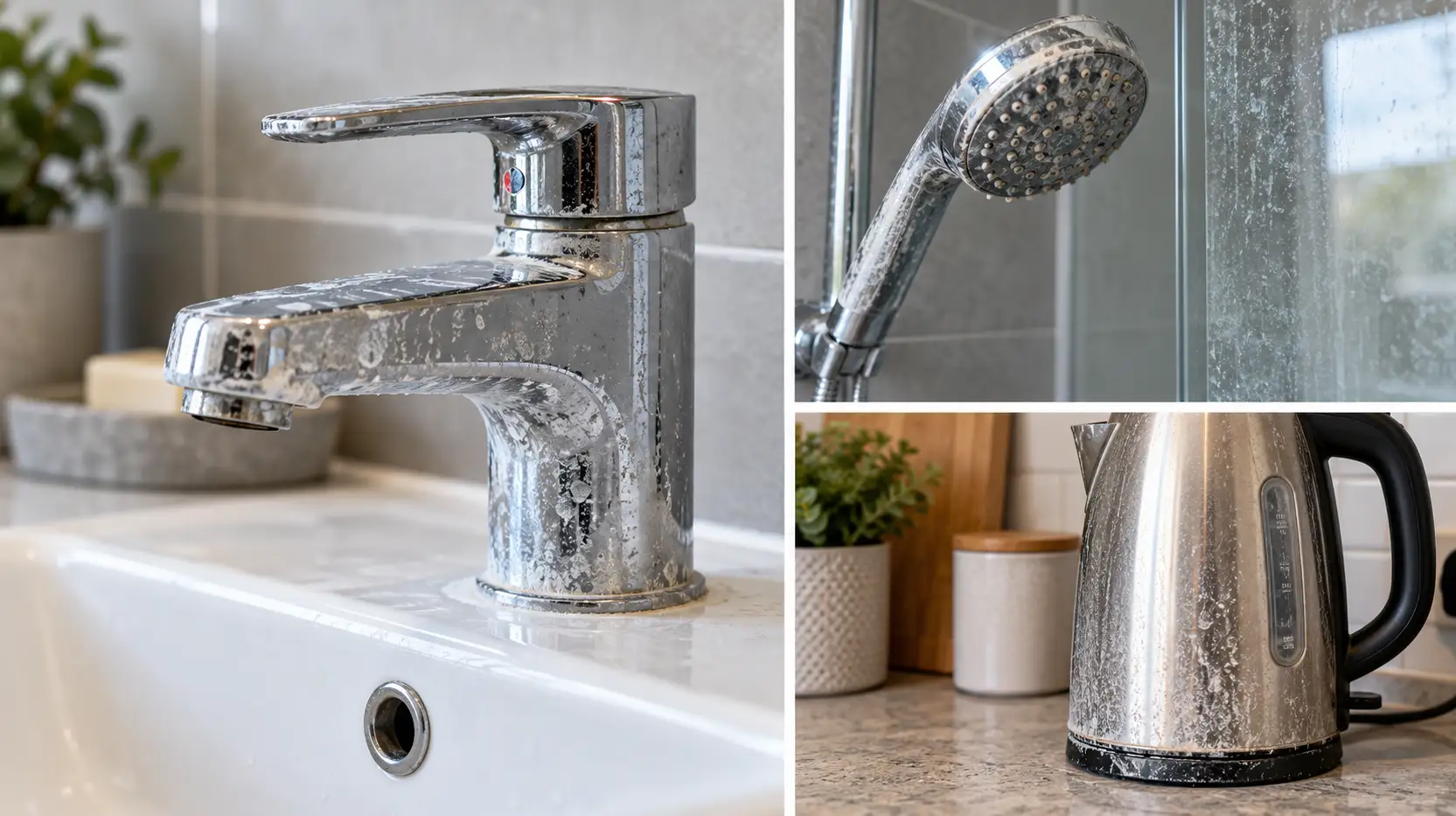
A kettle that scales up within weeks, a shower screen that never quite comes clean and white crust returning around taps almost as soon as it has been removed are familiar problems in many hard-water areas. For a large share of households, particularly across parts of London, the South East and eastern England, some level of limescale is simply a consequence of the local water supply. The useful question is not whether hard water is annoying, but what it is actually costing you, where in the property the scale matters and whether the product being offered solves the same problem you have.
That distinction matters because regular descaling, protecting a particular hot-water appliance and softening most of a home’s water are not different sizes of the same solution. They solve different problems at very different costs. A whole-house softener can be worthwhile, but so can deciding that a bottle of descaler, a correctly set dishwasher or targeted protection of the hot-water system is all the property really needs.
What hard water actually is
Hard water contains relatively high levels of dissolved calcium and magnesium, picked up naturally as water passes through particular rocks and soils. That is why hardness varies sharply by geography and can vary even within the area served by one water company. The figure worth using is therefore the one for your own supply rather than a general map; the Drinking Water Inspectorate recommends obtaining an accurate local measurement from the water company. Drinking Water Inspectorate — Water Hardness / Hard Water
DWI expresses hardness as milligrams per litre of calcium carbonate equivalent — mg/l CaCO₃ — and classifies water up to 100mg/l as soft, 100–150 as slightly hard, 150–200 as moderately hard, 200–300 as hard and more than 300 as very hard. Around 200mg/l is therefore a useful point of context: it is where DWI’s hard-water category begins and where scale becomes a more significant concern, but it is not a point at which every household suddenly needs a water softener. Two properties with the same hardness can have very different amounts of hot-water use, different appliances and very different tolerance for cleaning.
Hardness itself does not mean the mains water is unsafe. The property issue is what happens when those minerals are heated or water evaporates, leaving scale behind. Appliance instructions can sometimes complicate matters by referring to either total hardness or temporary hardness; temporary, or carbonate, hardness is the part readily precipitated by boiling and heating. If an appliance quotes a hardness limit, check which measure and unit it is actually using rather than comparing numbers that may not mean the same thing.
Cosmetic scale and functional scale are different problems
Scale on a shower screen and scale inside hot-water equipment have the same broad origin, but they are not the same property problem. Deposits around taps, showerheads, tiles, sanitaryware and kettles are mainly a maintenance nuisance. They make cleaning harder and can eventually restrict small outlets, but if the main consequences of the local water are a marked shower screen and a kettle that needs descaling, installed whole-house treatment may never repay its cost in purely financial terms.
The calculation changes where fresh hard water is repeatedly heated. Scale on heating surfaces can impair performance and shorten component life, which is why hot-water equipment deserves more attention than cold pipework simply carrying hard water through the building. Current Heating and Hotwater Industry Council guidance says measures to reduce limescale are required for relevant heating and hot-water applications where incoming hardness is above 200ppm, while also stressing the importance of the appliance manufacturer’s instructions. HHIC — Water Treatments guidance
That still does not mean every part of a boiler is exposed to hard mains water in the same way. In a combination boiler, for example, the domestic-hot-water side repeatedly receives fresh water, while the sealed primary heating circuit normally recirculates its existing system water. If a boiler, cylinder or water heater is the reason you are considering treatment, the useful question is what protection that particular appliance requires rather than whether the whole property should be softened.
It is also worth checking whether an appliance already has its own protection. Many dishwashers contain an internal salt-regenerated softening system and need their hardness setting matched to the local supply. If a dishwasher is leaving white residue, checking the hardness setting, dishwasher-salt level and manufacturer instructions is a much cheaper first step than treating every litre of water entering the house.
Water softeners: what they actually do
A conventional domestic water softener normally works by ion exchange. Hard water passes through a resin which exchanges the calcium and magnesium responsible for hardness for sodium. The treated water is genuinely softer, so limescale formation is greatly reduced and soap generally lathers more readily. Unlike a magnetic or electronic conditioner, the softener has actually changed the hardness of the treated water.
The trade-off is that this is an installed appliance with running requirements. The resin must be regenerated using salt, regeneration uses water, the unit needs a suitable drain and enough physical space, and it has to be maintained. It also needs to be sized for the property’s demand: a household with several bathrooms needs sufficient flow as well as sufficient capacity, and a quotation that discusses only how hard the incoming water is has not answered the whole question.
Ion exchange changes the water chemistry too. DWI advises keeping an unsoftened outlet for drinking and cooking because softening adds sodium, and notes that artificially softened water can be more aggressive towards some plumbing materials. In practice, the installation should be designed so that the appropriate drinking supply is retained and the softener is compatible with the plumbing and equipment it serves. Notification requirements also differ around the UK, so before installation it is sensible to ask whether the work needs notifying to the local water undertaker and whether the installer will deal with it. Water Regs UK — Notification
Crucially, softening the whole house is not the only option. DWI specifically notes that treating the feed to a hot-water tank or boiler can be more economical than softening the entire supply. If most of the actual cost is being created by hot-water equipment while cold-water outlets are causing little more than occasional cleaning, targeted treatment may be the more proportionate answer. Whole-house softening becomes easier to justify where scale is widespread and the owner also values genuinely soft water for bathrooms, cleaning and everyday use.
The products that are not actually water softeners
This is where the market becomes confusing, because “water treatment”, “scale control” and “water softening” are often presented as though they mean the same thing. They do not. If the calcium and magnesium remain in the water, the water has not been softened in the chemical sense, even if a device claims to make those minerals less likely to form troublesome deposits.
Magnetic and electromagnetic conditioners are the most obvious example. The Advertising Standards Authority says these devices are not capable of softening water and that there is no generally established evidence showing that the category consistently inhibits scale formation. It also notes that results can depend on the particular system, flow and water conditions, which means broad claims that such a device will simply stop limescale deserve scrutiny. ASA — Water Treatment Devices
That does not mean every non-softening treatment is automatically ineffective; different technologies exist and some may have legitimate appliance-specific applications. It does mean that the product category itself is not proof. If a magnetic, electromagnetic or other low-maintenance treatment is being offered as an alternative to a conventional softener, ask what it measurably changes, what independent evidence exists for that particular product in a comparable domestic system and whether the boiler or appliance manufacturer accepts it as suitable scale protection.
For smaller problems, point-of-use treatment can be entirely rational. Some filter jugs, for example, contain ion-exchange material that reduces temporary hardness in the relatively small quantity of water being filtered, which can reduce kettle scale without doing anything to the shower, washing machine or hot-water system. Matching the scale of the treatment to the scale of the problem is usually more useful than buying the most comprehensive system available.
When does a water softener actually earn its keep?
The best starting point is the recurring cost or inconvenience you are trying to remove. If the problem is mainly descaling a kettle, clearing a showerhead occasionally and removing spotting from glass, whole-house softening is largely a convenience purchase. There is nothing wrong with paying for that convenience, particularly in very hard water, but it is different from spending money to protect equipment that is repeatedly suffering scale-related problems.
The case becomes stronger where scale is affecting hot-water equipment, several heavily used bathrooms or multiple appliances, particularly when the supply sits well into DWI’s hard or very-hard bands. In commercial properties such as hotels, laundries and catering premises, the calculation can move further because much larger volumes of water are heated and the cost of maintenance or equipment downtime can be significant.
A good quotation should help establish whether the system will actually earn its keep. It should identify the hardness figure being used, explain which outlets will receive softened water, confirm how the drinking supply will be retained and show that the unit is compatible with the boiler, cylinder and other equipment. For a whole-house system, ask what peak flow it can deliver and, in plain annual terms, how much salt it is expected to use, how often it will regenerate and how much water those regeneration cycles are likely to consume for a household like yours.
If the costly problem is concentrated in the hot-water system, ask what targeted protection would achieve before paying to soften cold supplies that are causing little trouble. If scale is persistent throughout the property and easier cleaning, reduced widespread deposits and genuinely soft water are themselves valuable to you, the case for whole-house softening becomes much stronger.
Matching the response to the actual problem
| What is actually happening? | First response worth considering | Why |
|---|---|---|
| Kettle, taps and showerhead collect visible scale but equipment is otherwise behaving normally | Regular descaling | Lowest-cost response to a mainly cosmetic or local problem |
| Dishwasher leaves white residue or performs poorly | Check its hardness setting, salt system and instructions | Many machines already contain their own water-softening system |
| Boiler, cylinder or water heater needs scale protection | Follow the appliance requirements and consider targeted protection of the relevant feed | Protects the equipment where repeated heating makes scale costly without automatically treating the whole house |
| Scale is persistent across bathrooms, hot-water equipment and several appliances, and genuinely soft water is itself valued | Price an ion-exchange softener including its running costs | This is where whole-house treatment has the clearest practical case |
| A magnetic or electromagnetic device is offered as an easy alternative | Ask for robust product-specific evidence from a comparable domestic system | It does not soften the water, and effectiveness cannot be assumed from the technology name |
The point of the comparison is not to identify the most sophisticated treatment. It is to identify the least extensive treatment that reliably deals with the cost or inconvenience you are actually trying to remove.
An unglamorous but honest answer
Hard water is a genuine property-management issue, particularly where the local supply sits well into the hard or very-hard range, but it is rarely the emergency suggested by some treatment marketing. The scale you can see is mostly a cleaning problem; the scale accumulating in repeatedly heated equipment can become a genuine efficiency, reliability and maintenance cost.
That still does not make every hard-water property a candidate for whole-house softening. Check the actual hardness first, make sure appliances with their own softening arrangements are set up correctly, establish where scale is genuinely costing money and then choose treatment at the narrowest level that solves that problem. For some homes that will remain regular descaling and dishwasher salt; for others it will mean protecting a particular hot-water appliance; and where scale is widespread and the convenience of genuinely soft water has real value, an ion-exchange softener can make a convincing case. If another product promises similar benefits without actually removing the hardness minerals, the important question is not what the technology is called but what it demonstrably changes, what evidence supports that effect in a property like yours and whether that change solves the problem you started with.
This article provides general property and consumer information, not plumbing, drinking-water, health, financial or other professional advice for individual circumstances. Water hardness and chemistry vary between supplies, so obtain the current hardness result for your property from the relevant water supplier. Water-treatment equipment should be installed in accordance with the applicable water fittings regulations or byelaws and with the requirements of the appliances and systems it supplies. People who need to restrict dietary sodium, and anyone preparing infant formula, should follow appropriate health guidance before relying on artificially softened water for drinking or food preparation.

