

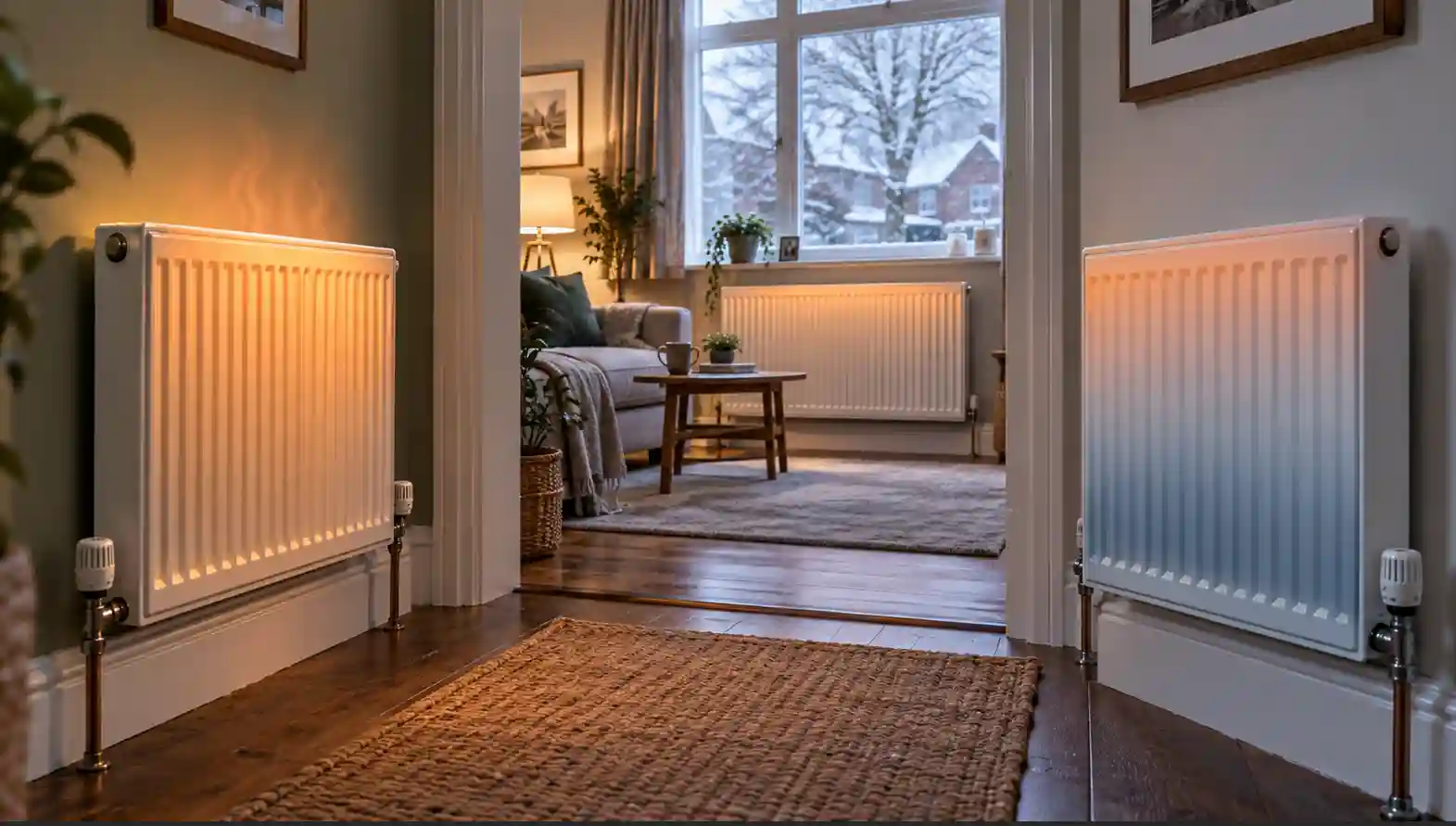
The heating’s on. Most of the house is warm. But one radiator is stone cold, the top of another feels fine while the bottom stays stubbornly cool, or the upstairs rooms never quite catch up with downstairs. Nothing’s actually broken in the sense of the whole system failing — it’s running, just unevenly — and that unevenness has a pattern worth reading before reaching for a fix.
The familiar answers are easy to reach for: bleed it, balance it, flush it. Sometimes one of those is exactly right. The problem is that they deal with quite different faults, and treating every cold radiator as the same problem is how a five-minute valve issue turns into a discussion about flushing the whole heating system.
The useful starting point is therefore not simply which radiator is cold? It is whether that radiator should actually be heating at that moment, where the cold area sits if it should, and whether the problem belongs to one radiator, several radiators or an entire part of the house.
Where on the radiator matters more than which radiator
Before diagnosing anything from the temperature pattern, make sure the radiator is genuinely being asked to heat the room. A thermostatic radiator valve, or TRV, is supposed to reduce the flow of hot water once the temperature around it reaches the setting you’ve chosen. A radiator cooling down in an already-warm room can therefore be evidence that the control is working rather than that the radiator is failing.
Where the TRV is sitting matters as well. It senses the air immediately around itself rather than somehow knowing the average temperature across the room, which is why a valve hidden behind heavy curtains, large furniture or an enclosed radiator cover can be fooled by a pocket of warm air and throttle the radiator earlier than intended. Drayton’s household guidance on thermostatic radiator valves specifically warns that TRVs need free airflow around them to sense room temperature properly.
For a useful comparison, start with the system cool, make sure the heating is calling for heat and that the radiator control is open, then watch how the problem radiator warms compared with the others. A radiator does not have to be precisely the same temperature at every point — the water is giving up heat as it travels through it — but a substantial area that remains distinctly cold while the room still needs heat is a useful clue.
Cold across the top while the lower part heats properly is the classic trapped-air pattern. Air collects at the highest part of the radiator and prevents hot water filling that space, leaving a recognisable cold band. Bleeding is the direct first response to that particular symptom, provided it is done safely: turn the heating off, allow the radiator to cool and open the bleed valve carefully until the trapped air has escaped. Worcester Bosch’s radiator bleeding guidance also points out that pressure can fall after bleeding on a sealed system, so the boiler pressure should be checked afterwards and restored in accordance with the manufacturer’s instructions where necessary.
If the radiator then heats properly and continues doing so, the diagnosis may genuinely have been that simple. What deserves more attention is a radiator that repeatedly fills with air. Bleeding the same emitter every few weeks is not really a permanent repair; at that point, recurring air ingress, corrosion, pressure loss or another system issue deserves investigation rather than turning radiator bleeding into routine housekeeping.
Cold at the bottom while the upper section becomes properly hot points in a different direction. Deposits and corrosion products can accumulate in the lower waterways of a radiator and restrict circulation, particularly in older systems where magnetite sludge has developed. That makes sludge a credible explanation for a broad, persistent bottom-cold pattern — but not proof of one.
A modest temperature difference between the top and bottom is not the same thing as a large area that refuses to heat. Poor flow, valve position or another circulation restriction can also create an uneven temperature pattern, which is why bleeding a bottom-cold radiator is unlikely to solve the underlying issue and why one cold patch is not sufficient evidence that the entire house needs flushing.
A radiator that’s cold from top to bottom while others around it are heating normally tells you something different again: little or no hot water is reaching that emitter. The TRV may be shut, satisfied or stuck; a manual valve may be closed; the lockshield may have been altered; or an airlock, blockage or other local restriction may be preventing flow. If the problem appeared immediately after decorating, radiator removal or other heating work, that history is particularly useful because valves are often moved during those jobs and previous settings are not always restored.
Several radiators underperforming together should make you widen the investigation. If radiators nearer the heat source consistently warm quickly while others farther along the circuit lag behind, poor balancing is a classic possibility. If an entire floor or heating zone behaves differently, though, the problem may sit elsewhere — in controls, circulation, a zone valve, system pressure or another shared part of the heating system — rather than in several individual radiators developing the same fault simultaneously.
What balancing is actually trying to achieve
Most radiators in a conventional wet heating system have a user control at one end — usually a thermostatic or manual valve — and a lockshield or balancing valve at the other. The everyday control determines how much heat that room is asking for; the balancing valve is normally set as part of commissioning the system so that one radiator does not take more than its fair share of the available flow.
Without adequate balancing, water favours the easier routes through the system. Radiators closer to the heat source can receive more flow than they need while those farther away receive less, creating exactly the pattern in which some rooms heat quickly while others continually struggle to catch up. Government research into domestic heat-distribution systems describes the same effect and notes that system balance can also change over time as sludge accumulates or radiators are removed and refitted. UK government research on domestic heat-distribution systems examines hydraulic balancing and the wider factors affecting radiator performance.
That is why balancing is fundamentally a whole-system exercise. Opening the lockshield on the coldest radiator can increase its flow, but doing it blindly may simply deprive another part of the circuit. Proper balancing adjusts the radiators in relation to one another rather than treating each valve independently.
The useful homeowner observation is simpler than the engineering process itself. Start with the heating cool and watch the order in which the radiators warm. If the same group consistently races ahead while another group lags well behind, balancing becomes more plausible. If one previously healthy radiator suddenly stops heating while everything else remains unchanged, look locally before assuming the whole system has somehow fallen out of balance.
Recent history matters here too. If the problem began after radiators were removed for decorating, replaced during renovation or altered as part of heating work, tell the engineer. That can be much more useful than simply reporting that “upstairs has never seemed quite as hot”.
Balancing is possible as a careful DIY exercise on some systems, but repeated trial-and-error adjustment can make a confusing system more confusing. Where several rooms remain uneven after obvious control problems have been ruled out, systematic balancing by someone who can assess the whole system is often more productive than another round of guesswork.
Sludge, and why “just get it flushed” isn’t automatically the answer
Sludge is a real heating-system problem. Internal corrosion can produce magnetite and other debris that circulates with the system water before settling in radiators, valves and other low-flow areas. Over time that can restrict circulation, reduce heat transfer and contribute to the broad cold-bottom pattern that homeowners commonly associate with dirty radiators.
The mistake is moving directly from possible sludge to the house needs a powerflush.
If one radiator has a pronounced cold lower section while the rest of the system heats normally, the problem may be largely local to that radiator or caused by another restriction. If several radiators show the same pattern, circulation has deteriorated across the system or an engineer finds clear evidence of contamination, the argument for investigating system-water condition becomes considerably stronger.
Even then, system cleaning and powerflushing are not interchangeable terms. Current Heating and Hotwater Industry Council guidance on system-water treatment describes several recognised approaches, including flushing individual radiators, power flushing, mains-pressure flushing, gravity flushing and other cleaning methods. Which approach is appropriate depends on the system, the contamination and what the engineer is actually trying to remove.
That is where the commercial judgement matters. A homeowner offered a substantial whole-system clean should be able to ask a straightforward question: what evidence shows that the problem is system-wide, and why is this particular cleaning method appropriate for this system?
A convincing answer might involve several radiators showing similar symptoms, contaminated system water, repeated debris captured in a filter or a broader deterioration in circulation. “One radiator is cold at the bottom” is evidence worth investigating; on its own, it is a thin justification for assuming the most extensive treatment is necessary.
The fuller question of when a heating system really needs flushing — and when a powerflush is being oversold — deserves its own article rather than turning every uneven radiator into a water-treatment discussion.
Reading your own pattern
The patterns are most useful when they tell you where to investigate next, not when they’re treated as infallible diagnoses.
| What you notice | What it reasonably suggests | What else still needs considering |
|---|---|---|
| Clearly cold across the top, properly warm below | Trapped air is likely | If it repeatedly returns, the underlying reason needs investigating rather than endless bleeding |
| Broad cold section across the bottom while the upper radiator is properly hot | Sludge/deposits or another restriction to flow | Valve position and circulation faults can produce a similar pattern; a small temperature gradient is normal |
| One radiator completely cold while nearby radiators heat normally | Little or no flow through that radiator | TRV/manual valve, lockshield setting, airlock, blockage or local pipework restriction |
| Several radiators consistently warm much later than others | Poor balancing or a wider circulation issue | Compare the system from a cold start rather than judging one radiator in isolation |
| An entire floor or heating zone underperforms | Look beyond individual radiators | Controls, zone valves, circulation, pressure or another shared component may be involved |
Real systems can produce overlapping symptoms. A dirty system can contain trapped air; an unbalanced system can also have one sticking valve; one radiator can be partially blocked while the rest of the heating remains perfectly healthy. The purpose of the pattern is to narrow the possibilities before the remedy is chosen.
Heat pumps make this distinction matter more, not less
A radiator supplied by a heat pump may feel noticeably cooler than a radiator on a traditional high-temperature boiler even when the heating system is operating exactly as intended. Heat pumps generally work most efficiently at lower water temperatures, so the relevant question becomes whether the room reaches and maintains the temperature it was designed for rather than whether the radiator feels extremely hot to the touch.
That makes emitter sizing and system balance more important, but it also means the symptom needs interpreting in the correct context. A room that has always struggled since conversion to a heat pump may have an undersized radiator or another design issue rather than a new balancing fault, while one radiator suddenly developing a cold top remains a useful sign of trapped air whatever is heating the water.
The wider question of whether existing radiators are suitable for a heat pump belongs in our separate Property Front Page coverage on heat-pump readiness; the useful point here is simply that “this radiator doesn’t feel as hot as it used to” means something different after the whole heating system has been moved to a lower operating temperature.
For landlords, agents and larger heating systems, report the pattern rather than the complaint
The same diagnostic logic is useful in rented homes, HMOs, offices and other properties with wet heating, but the best contribution from the occupier is usually observation rather than attempted repair. “The heating isn’t working properly” gives a landlord, agent or engineer very little to work with. “The three first-floor radiators stay cold while every radiator downstairs heats normally” immediately points the investigation in a more useful direction.
The same applies to individual symptoms. A tenant who reports that one bedroom radiator is cold across the top but warm below has supplied more useful information than somebody repeatedly bleeding it without telling the landlord why. If several radiators change behaviour together, particularly within the same floor or zone, the common parts of the heating system deserve attention before anyone assumes that several radiators have independently failed.
Commercial systems can be more complicated, with additional pumps, controls and zones, but the principle remains the same: establish whether the fault follows one emitter, a group of emitters or a whole circuit. The larger the system, the less useful random adjustment of individual valves becomes.
That does not mean tenants or office occupants should be expected to diagnose or dismantle heating equipment. The gain is simply giving whoever is responsible for the repair better evidence before attendance is arranged.
The pattern is the clue, not the cure
None of these observations fixes anything by itself. They narrow down what’s actually worth doing next, which is considerably more useful than bleeding every radiator on the assumption that air is always the problem or booking a powerflush on the assumption that sludge always is.
Start by checking whether the radiator should actually be heating. If it should, look at whether the problem belongs to the top, the bottom or the whole emitter. Then widen the view: is it one radiator, several radiators warming in the same pattern, or an entire floor or zone? Finally, ask whether something changed shortly before the problem appeared — a radiator was removed, controls were altered, a heating appliance was replaced or the system was drained.
Those observations will not turn a homeowner into a heating engineer, and they do not need to. Their value is that they help separate a likely trapped-air problem from a control issue, a local flow restriction from poor balancing, and genuine evidence of contamination from a sales recommendation looking for evidence after the fact.
A heating system that’s running but distributing heat unevenly is usually telling you something more specific than “the heating isn’t right”.
Read the pattern before buying the remedy.
This article provides general property information, not legal, financial, heating-engineering or other professional advice for individual circumstances. Radiators and heating water can become hot enough to cause burns. If bleeding a radiator, switch the heating off and allow the radiator to cool first, follow the heating-appliance manufacturer’s instructions and check system pressure afterwards where applicable. Repeated air ingress, persistent pressure loss, suspected system contamination, hydraulic-balancing problems and work involving the boiler or gas appliance should be assessed by an appropriately competent heating professional. Gas work must only be carried out by someone legally entitled to undertake it.

