

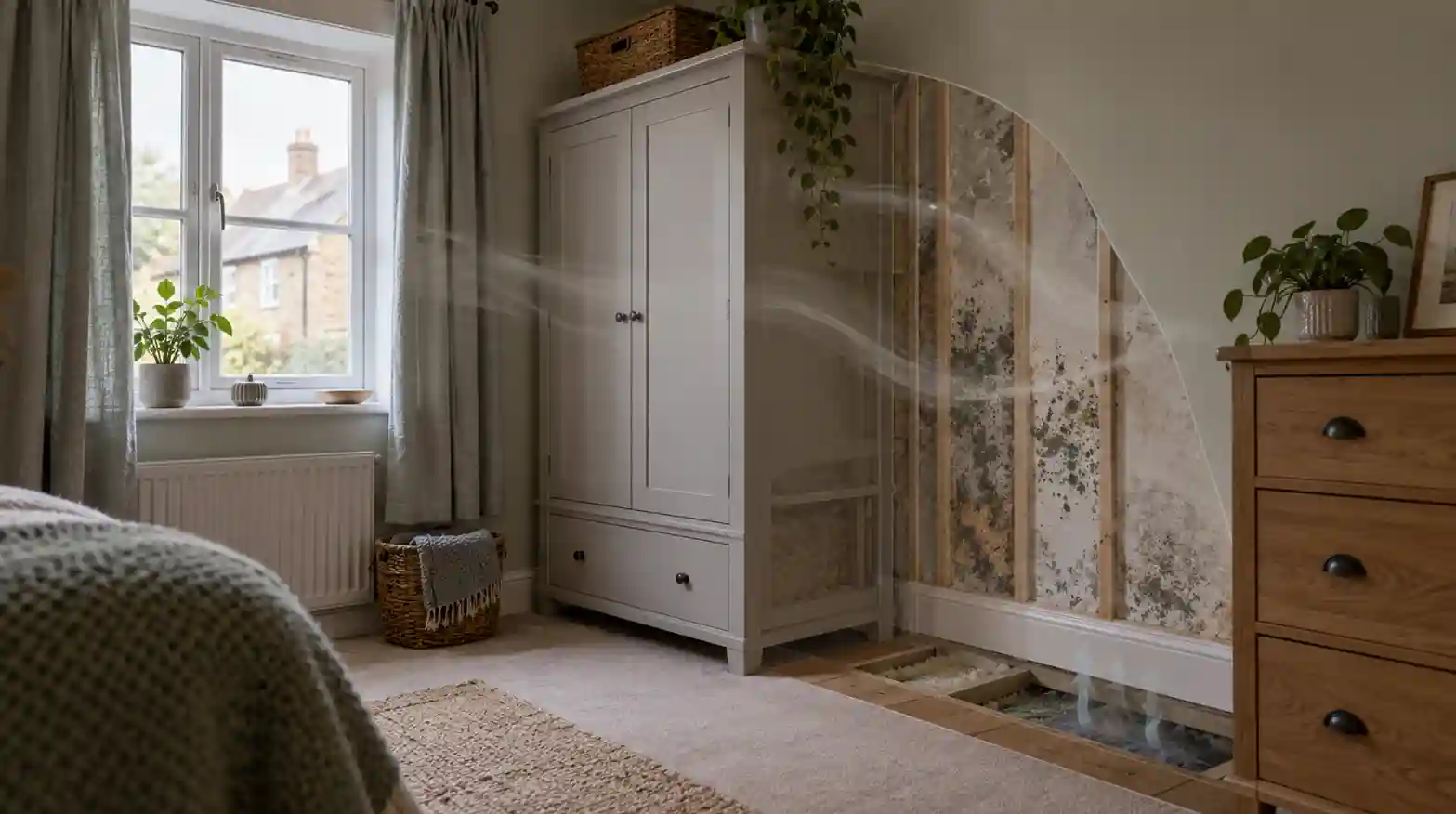
A room can smell like a problem for months before it looks like one. Someone opens a cupboard, or steps into a spare bedroom that’s been shut up for a while, and catches that unmistakable damp, earthy smell — with nothing to see. No stain, no mould, no obvious cause.
It’s tempting to assume it’s nothing, or to assume the worst. Neither reaction is particularly useful.
A persistent musty smell is better treated as evidence. It doesn’t tell you what the problem is, but where the smell is strongest, when it appears and what makes it return can narrow the search considerably before anybody starts opening floors or walls.
Why smell arrives before sight
Moulds and other microorganisms can release volatile compounds as they grow, some of which contribute to the familiar earthy or mouldy smell associated with damp buildings. But smell is not a mould test, and there is no particular odour that reliably tells you what kind of moisture problem a building has.
What the smell can do is alert you to something you cannot yet see.
Current government guidance on damp and mould specifically warns that the smell of mould without visible mould may indicate growth behind wallpaper or panelling, beneath carpets, behind pipes or furniture, or within heating and ventilation equipment. It also cautions against casually disturbing suspected concealed growth because doing so can release mould spores.
That doesn’t mean every closed room with a stale smell contains hidden mould. Furnishings, old carpet, stored clothing, cardboard boxes, dust and limited air exchange can all contribute to an enclosed smell that gets described as “damp”.
A useful first distinction is what happens after the room is aired and returned to normal use. If the smell disappears and stays away, that points in a different direction from an odour that disappears temporarily and then repeatedly comes back.
The return is often more informative than the first smell.
Where hidden moisture actually collects
Behind furniture pushed against an external wall is one of the first places worth checking. The internal surface of an external wall can become considerably colder than the room around it, particularly in winter. Put a wardrobe or bed tightly against it and the restricted airflow can leave the surface behind much colder and more humid than the rest of the room.
Visible droplets are not required before mould becomes possible. Persistently high humidity immediately beside a cold surface can create favourable conditions well before somebody notices water running down the wall.
That makes the familiar mouldy wardrobe back or blackened patch behind a bed quite different from a concealed plumbing leak. Both may smell musty; the route by which moisture got there is completely different.
Inside fitted cupboards and beneath kitchen units, poor visibility adds another complication. These areas may sit against cold external walls, but they may also contain water supplies, wastes, appliance connections and seals capable of leaking slowly for a long time without producing a dramatic puddle.
Under baths, showers and boxed-in pipework, the same applies. A small leak can wet chipboard, timber, plasterboard or insulation somewhere that is almost never inspected during ordinary use.
Suspended timber floors deserve particular attention where the smell seems strongest at skirting or floor level. The void beneath the boards is normally ventilated to the outside, and government best-practice guidance on suspended timber floors recognises the importance of assessing moisture, ventilation and the condition of the floor structure before work is carried out. Blocked or covered air bricks, high external ground levels, plumbing leaks or excessive moisture beneath the floor can leave the void damp. In a prolonged case, the concern is not simply smell or mould: timber can begin to decay.
Roof spaces and chimney breasts provide another set of hiding places. Defective roof coverings, flashings and rainwater goods can admit relatively small amounts of water intermittently, while disused chimney flues can develop damp problems if their ventilation and weather protection have been altered badly. The first visible ceiling stain is not necessarily the first moment moisture entered the building.
And sometimes the strongest clue is not the location but the timing.
A smell that becomes noticeably stronger after sustained rain raises different questions from one that appears almost entirely during cold winter weather. If it worsens after showers, cooking or drying laundry, indoor humidity and cold surfaces become more relevant. If it appears after a bath, shower, washing machine or dishwasher has been used, nearby supply and waste pipework deserves attention. If it is concentrated at floor level, the floor void or services below move higher up the list.
None of those patterns proves anything. Their value is that they stop every musty smell being investigated in exactly the same way.
The same principle works in reverse when investigating a smell: pay attention to what was happening in the building immediately before it appeared.
Buyers, viewings and the fresh-paint question
A musty smell at a viewing is worth taking seriously without jumping to conclusions about it.
A property that’s been vacant for a while, has been inadequately heated or has had its windows shut for an extended period can smell quite different from an occupied house. Old carpets and furnishings can add to it.
But an unexplained persistent damp smell is still information.
What’s worth asking, calmly, is when the property was last occupied, whether there has been any history of roof or plumbing leaks, whether damp investigations or repairs have been carried out and whether the area concerned has recently been redecorated.
Fresh paint is worth recording as a fact, not treating as evidence of concealment. Sellers decorate properties before marketing them for perfectly ordinary reasons. Fresh decoration becomes more interesting when it coincides with a persistent smell, an isolated area of new plaster or an explanation that doesn’t quite account for what you’re noticing.
Tell the surveyor exactly where the smell was strongest rather than simply asking them to “check for damp”. A smell concentrated inside one fitted cupboard, around a chimney breast or close to one section of flooring gives them considerably more to work with than a generic concern that the house seemed musty.
And remember what even a good survey cannot automatically do: the surveyor will not normally start dismantling somebody else’s property simply because there is an unexplained odour. If the evidence points towards a concealed defect, further investigation may therefore be recommended rather than the first survey producing a definitive answer.
If a survey has already produced a series of electronic damp readings, our companion article on what those readings actually mean is worth reading before treating the number itself as a diagnosis.
Landlords, managers and unoccupied spaces
A musty smell in an empty rental property, communal area, infrequently used office or storage room deserves at least as much attention as it would in an occupied home.
The problem with an unoccupied space is obvious: nobody is there every day to notice that the smell is getting stronger, that it follows heavy rain or that a cupboard suddenly smells different after the heating has been off.
For landlords and letting agents, an occupier reporting a persistent mouldy smell should not be dismissed merely because the photograph they send shows a clean wall. The government guidance cited above explicitly recognises mould odour without visible growth as a possible indication of mould behind surfaces.
The practical response is to inspect and record rather than wait for the problem to become photographable. Where was the smell reported? Was it present when the property was inspected? Is it localised? Does it coincide with plumbing, a cold outside wall, a roof or chimney, a suspended floor or an obvious ventilation defect? What was done, and did the smell return?
That history becomes valuable if the problem proves intermittent.
For landlords, agents and building managers, it can also prevent a small maintenance issue becoming a much larger one. A minor waste leak discovered while the damage is confined behind a kitchen plinth is one job. The same leak discovered after it has affected flooring, joinery and the room below is another.
The detailed legal duties surrounding rented-property damp and mould belong in our separate landlord coverage. The relevant point here is simpler: absence of visible mould does not demonstrate absence of a moisture problem.
What a moisture meter can and can’t tell you
A moisture meter can be useful when investigating hidden damp. The mistake is assuming that every number it displays means what it appears to mean.
There isn’t one universal type of damp meter.
Pin-type electrical resistance meters are particularly useful on timber, where they can estimate actual wood moisture content. Other instruments use capacitance, radio frequency or microwave techniques to look for differences in building materials without necessarily inserting pins.
On plaster and masonry, interpretation becomes much more complicated.
Some commonly used resistance meters display readings as wood moisture equivalent, or WME. That distinction is easy to miss. A reading displayed as, say, 20% on a masonry wall does not necessarily mean that 20% of the plaster or brick is water. It may be telling you how the electrical behaviour compares with the instrument’s calibration for timber.
Historic England’s comparative research into moisture measurement in porous masonry tested resistance, capacitance and microwave meters alongside invasive techniques on brick, lime mortar, limestone and sandstone. The research illustrates why readings need interpretation in relation to the material and method rather than being treated as universal moisture percentages.
Salts within masonry can interfere with electrical readings. So can differences between materials, and metallic components close to the area being tested may complicate some measurements.
That doesn’t make the meter useless. It changes the question you ask of it.
A series of readings can help identify whether one area behaves differently from the surrounding material and can help an experienced investigator decide where to look next. A single high reading does not tell you whether the cause is condensation, rain penetration, a plumbing leak or moisture originating elsewhere in the building.
A simple room hygrometer answers a different question again. It measures temperature and relative humidity in the air rather than moisture content in the wall. Watching those readings over time can be useful when the smell appears linked to occupation, showers, drying laundry or winter condensation, but even persistently high room humidity does not prove that a particular wall is damp.
Likewise, a smell improving while a dehumidifier is running doesn’t prove that humidity was the original cause. The machine has changed the indoor environment; it has not identified why excess moisture was there.
The useful principle is the same throughout: measurement should narrow the investigation, not replace it.
Where to look first
If you’re chasing a smell with no visible source, start without dismantling anything.
Pull freestanding furniture far enough away from external walls to inspect behind it properly. Empty the cupboard where the smell is strongest rather than trying to smell through its contents. Check beneath sinks, around appliance connections and accessible wastes for staining, swollen boards, corrosion or evidence of a slow leak.
Look outside as well as in.
Check whether gutters are overflowing or leaking, whether downpipes appear defective, whether seals around openings are obviously damaged and, on a property with a suspended timber ground floor, whether low-level air bricks have been covered by soil, paving, planting or later alterations.
Then think about the pattern rather than simply continuing from room to room.
If the smell follows rain and is high on a wall or around a chimney, the next sensible investigation may be the external envelope or roof. If it appears when a bathroom is used, plumbing deserves more attention. If it is strongest beside the floor in an older house with suspended timber floors, somebody who can properly inspect the sub-floor void may tell you more than another surface reading on the wall.
That distinction also helps decide who to call.
An accessible leaking waste pipe is fundamentally a plumbing problem. A weather-related defect around a roof or chimney may need a competent roofer or building surveyor. An unexplained pattern involving walls, floors, ventilation and previous alterations is much more suited to an independent building surveyor experienced in building pathology than to choosing a remedial treatment first and asking whether the house needs it afterwards.
“Damp survey” on its own is not a qualification or a diagnosis. If the cause is unclear, ask what the investigator will inspect, what measurements they use, how they distinguish between possible sources of moisture and whether their business also sells the treatment they may subsequently recommend.
None of this means opening the building blindly.
Government guidance warns that pulling up mould-contaminated carpet or removing wallpaper can release spores. There is a separate hazard in older homes: asbestos-containing materials may be concealed within walls, flooring, panels and other parts of the building fabric.
The Health and Safety Executive’s guidance on where asbestos may be found explains that asbestos can remain in buildings built or refurbished before 2000 and that fibres can be released when asbestos-containing material is disturbed or damaged.
So don’t start drilling exploratory holes, cutting into boxing, ripping up suspect flooring or opening a wall simply because your nose suggests the source is behind it.
The point at which accessible checks stop producing answers is usually the point at which a more competent investigation should begin — not the point at which the homeowner becomes more destructive.
The smell is data, not diagnosis
A musty smell with nothing to see is neither something to dismiss nor something to panic about.
It may be the first noticeable sign of hidden moisture or concealed mould. It may also turn out to be a stale room, damp stored possessions or another source that has little to do with a serious defect.
The way to distinguish between them is not to give the smell a diagnosis it cannot support. Look at where it is strongest. Notice when it comes back. Check what sits on the other side of the wall, above the ceiling or beneath the floor. Pay attention to rain, heating, ventilation, showering and plumbing use. Inspect what can be reached safely.
If that produces a plausible cause, investigate that cause.
If the smell persists while the source remains hidden, that’s useful information too. It means the search has reached the point where the building needs to be investigated rather than guessed at.
Treating the smell as either nothing or proof of a major damp problem are both ways of getting to the wrong answer faster. The more useful approach is to let it tell you where to look next.
This article provides general property information, not legal, financial, surveying or other professional advice for individual circumstances. Persistent unexplained damp or mould odours should be investigated where reasonable accessible checks do not reveal the cause. Avoid disturbing potentially mould-contaminated materials or opening concealed building fabric beyond your competence. Buildings constructed or refurbished before 2000 may contain asbestos-containing materials that require appropriate assessment before disturbance.

