

A flood door looks like the obvious answer. Fit one, and surely the water stays out.
Except water rarely enters a property through the front door alone. It can come through air bricks and service penetrations, back through drainage, across thresholds, through walls and floors or, in some circumstances, up from the ground itself. A flood door can perform exactly as intended while the building still floods through a route nobody dealt with.
That is the mistake worth avoiding. Property flood resilience works best as a system matched to the way a particular building is likely to flood, not as a collection of products bought one at a time.
Three different jobs, not one
England’s current FloodReady action plan separates property-level flood resilience into three broad areas: resistance, recoverability and reduction.
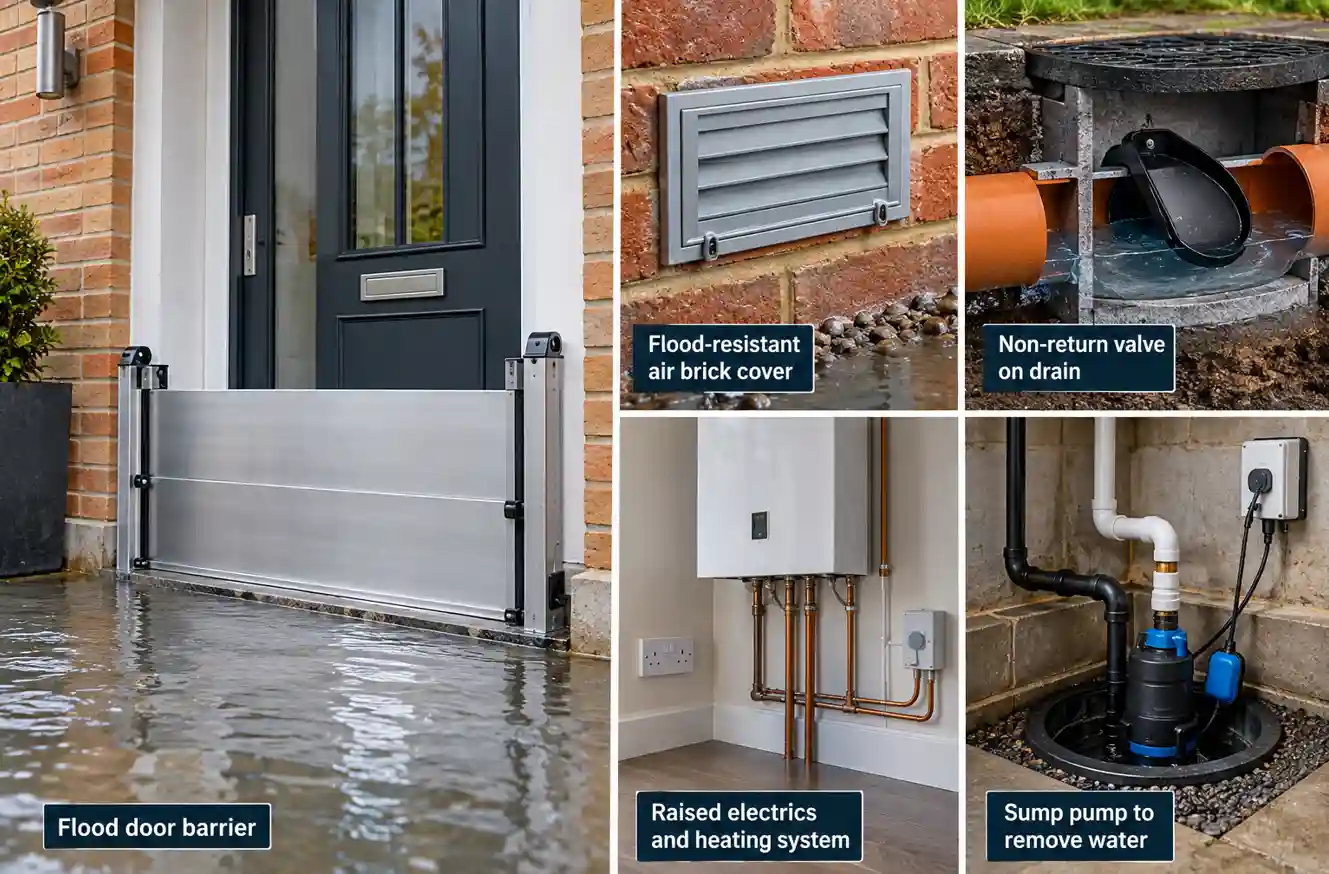
Resistance is about keeping as much water out of the building as reasonably possible. Flood doors and barriers, automatic anti-flood air bricks, appropriately sealed service penetrations and non-return valves are examples.
Recoverability accepts that some floods will overwhelm resistance measures and asks a different question: if water gets in, how much of the property will have to be stripped out afterwards? Flood-tolerant floors, raised electrical accessories and kitchens designed with materials that can better survive wetting can reduce the damage and shorten the route back to occupation.
Reduction operates outside the building, slowing or reducing rainwater runoff before it reaches the walls and doors. Permeable paving, rain gardens, rainwater storage and suitable site drainage can all contribute where surface water is part of the problem.
They are different jobs. A rain garden will not hold back river water already surrounding a house. Raised sockets will not stop a sewer backing up. A flood door will not protect an open air brick beside it.
The useful question is therefore not simply which flood-resilience product looks strongest. It is which combination addresses the routes the water is actually likely to use.
Follow the water before choosing the products
A sensible resilience plan begins with the flood hazard rather than the shopping list.
Where is the water expected to come from — surface runoff, a river, the sea, groundwater or overwhelmed drainage? How deep could it become? How quickly might it arrive, how long might it remain, and where is it most likely to meet the building first?
The UK-wide CIRIA C790 Property Flood Resilience Code of Practice, Edition 2 follows that principle. Its process starts with understanding the flood hazard and surveying the property before moving through options, design, installation, handover and maintenance.
That matters because buildings offer water many more routes than their doors.
Air bricks are an obvious example. Temporary covers can protect them if somebody is present and receives enough warning to fit them, while automatic anti-flood air bricks can close as floodwater rises. Either approach still has to respect the ventilation the building needs when it is not flooded.
Before covering or replacing an air brick, establish what it actually ventilates. The Health and Safety Executive warns that fixed ventilation serving gas appliances must not be obstructed because adequate airflow can be essential to safe combustion. HSE guidance on gas-appliance ventilation
Service penetrations deserve the same attention. Pipes, ducts, meter boxes, cables and other openings through an external wall can create small but important pathways that are easily overlooked when attention is focused on doors and windows.
Drainage can work backwards too. A correctly specified non-return valve can prevent water or sewage flowing back through a particular drainage route when the external system is overwhelmed. It protects that route; it does not make the whole building watertight.
Walls are more complicated than simply making them “waterproof”. Defective pointing, cracks and vulnerable junctions may need repairing, but the material and treatment have to suit the construction. This is particularly important with older solid-wall and other traditional buildings, where impermeable coatings, tanking or inappropriate cementitious work can inhibit drying and cause longer-term damage.
Historic England’s flood-resistance guidance stresses that the building’s construction needs to be understood before resistance measures are specified. Listed buildings and other protected properties may also need consent or agreement before permanent alterations are made, so significant historic fabric should not simply be changed because a modern flood product can be fitted.
The same discipline should apply when buying flood doors and barriers. FloodReady emphasises independently tested and certified flood-resistance products, including BSI Kitemark or equivalent certification. That still does not mean that every product carrying a flood-resistance label performs identically.
Ask what standard the particular product has been tested or certified against, what conditions it was tested under and what water depth the manufacturer and certification evidence support for that product. “Flood-resistant” is not the same thing as unlimited protection.
What recoverability buys you when water still gets inside
No realistic resilience plan should assume that every flood can be kept outside.
Recoverability starts from that fact and asks how much damage the water needs to cause.
Floor finishes are an obvious example. Materials that can be cleaned, dried and retained after flooding offer a very different recovery prospect from absorbent finishes and composite products that may have to be removed.
The same thinking applies to kitchens. Raising vulnerable appliances where practical and using materials that tolerate wetting can prevent a relatively shallow flood from automatically destroying an entire fitted kitchen.
Electrical installations can also be designed with flood risk in mind. Raising sockets, wiring routes and vulnerable equipment above the anticipated flood level can reduce the amount exposed to shallow flooding. Anything actually affected by floodwater still needs appropriate electrical safety assessment before being put back into service, but moving vulnerable components away from predictable flood depths can substantially reduce the repair.
This is what recoverability buys: not immunity from flooding, but less material to replace, easier cleaning and drying, and a shorter period before the property can reasonably be used again.
A sump-and-pump arrangement can form part of the wider strategy where it is appropriate to the building and the flood pathway. But it is not a device that guarantees a dry property during a serious flood. Capacity has to match the likely inflow, the system needs maintaining, and a pump relied upon during flooding also needs a realistic answer to the possibility of mains electricity failing.
There is a point where keeping water out can become the wrong objective
“More resistance” sounds automatically better. Structurally, it is not always that simple.
Floodwater outside a building creates pressure against walls, floors and foundations. If the water becomes substantially deeper outside while the inside remains dry, that difference in pressure is transferred to a structure that may never have been designed to withstand it.
Current Environment Agency standing advice for England says structural-engineer advice should be obtained where a design aims to keep out more than 600mm of floodwater. That is an engineering trigger, not a guarantee that excluding water up to 600mm is automatically safe for every property. Construction, condition, flood duration and the way the water acts on the building all matter.
Groundwater introduces another complication. A building that is aggressively sealed against water rising through the surrounding ground can experience pressure beneath floors or, in the wrong circumstances, retain water rather than allowing it to drain away.
This is why a professionally designed scheme may eventually move away from the objective of keeping every drop outside. Once safe resistance limits are reached, allowing water to enter in a controlled way while making the interior easier to recover can be preferable to asking walls and floors to withstand pressures they were not designed for.
Matching the measure to the problem
| Measure | Main job | Where it can help | The catch |
|---|---|---|---|
| Flood door or barrier | Resistance | Water approaching a door or opening | Other pathways still need protecting; demountable barriers need deploying in time |
| Automatic anti-flood air brick / temporary cover | Resistance | Low-level entry through suitable ventilation openings | Must not compromise required ventilation and needs checking after flooding |
| Non-return valve | Resistance | Backflow through an appropriate drainage connection | Protects that route only and requires correct specification and maintenance |
| Compatible repairs to walls and service penetrations | Resistance | Cracks, defective joints and identified entry routes | Materials must suit the construction; indiscriminate waterproofing can cause problems |
| Flood-tolerant floors and kitchen materials | Recoverability | Reducing stripping-out and replacement after flooding | Does not prevent water entering |
| Raised electrical accessories and equipment | Recoverability | Reducing exposure to anticipated shallow flooding | Flood-affected electrical installations still require safety assessment |
| Permeable paving, rain gardens or rainwater storage | Reduction | Reducing and slowing rainfall runoff around the property | Primarily helps surface-water management; it cannot stop river or coastal water already reaching the building |
| Sump and pump system | Water management | Removing water from an appropriate basement, sub-floor or low point | Needs correct sizing, maintenance and a plan for power failure |
The useful comparison is not which measure sounds strongest. It is whether the measures deal with the important routes without creating a weakness somewhere else.
The measures have to work on the day of the flood
A resilience design can be technically sound and still fail operationally.
A permanently installed flood-resistant door requires relatively little intervention. A removable barrier stored in a garage or shed requires somebody to receive sufficient warning, be at the property, find the equipment and install it correctly before the water arrives.
That difference matters for rented homes, second homes and commercial premises as much as it does for owner-occupied houses.
FloodReady specifically warns against treating property flood resilience as “fit and forget”. Resistance products need appropriate storage, regular checks and maintenance. It also says private landlords should make sure tenants understand the property’s flood risk and know how installed measures are stored and operated.
The commercial equivalent can be even more consequential. A relatively shallow flood may threaten electrical plant, stock, refrigeration, communications equipment or a server room long before it causes serious structural damage. Those assets can therefore influence which areas receive protection or are moved above likely flood levels.
The operational test is straightforward:
Will the resilience measures still work if the flood happens at 3am, the usual person responsible is away and the electricity fails?
A resilience plan that cannot answer that question is not finished.
Build Back Better can change the economics after a flood
For some insured residential properties, the best opportunity to improve flood resilience arrives when the building is already being repaired after a flood.
Flood Re’s Build Back Better scheme enables participating insurers to provide additional funding for property flood-resilience measures as part of an eligible flood claim, over and above ordinary reinstatement costs. The scheme allows measures worth up to £10,000, including surveys, flood-resistance work and more recoverable replacement materials.
“Up to £10,000” matters. Flood Re states that individual insurers set their own limits and may apply additional criteria, so a policyholder should not assume that every participating policy automatically provides the full amount.
It is also more nuanced than simply “homeowners qualify, landlords do not”. Flood Re’s published eligibility criteria list some residential buy-to-let properties among those that may qualify where all the underlying scheme criteria are satisfied, while many commercial, portfolio and larger multi-unit arrangements fall outside the scheme.
The practical point is to check the actual policy and insurer before budgeting around Build Back Better. The detailed mechanics of Flood Re and post-flood insurance belong in PFP’s separate flood-insurance coverage; here, the significance is that a flood claim can sometimes fund improvements rather than merely recreating the property exactly as it was before.
Where the opportunity exists, that can be a particularly sensible time to raise vulnerable services, choose more recoverable finishes and correct known entry routes while reinstatement work is already under way.
Resilience is a system, not a single purchase
The strongest resilience plans start with the same question as any good building investigation: how is water likely to reach this particular property, and what happens if it gets inside?
From there, the decisions become much clearer. Resistance is used where water can reasonably and safely be kept outside. Recoverability reduces the damage where exclusion may fail. Reduction measures help manage rainfall and runoff before it reaches the building. Products that depend on somebody taking action are matched with realistic warning, access and maintenance arrangements.
That is a very different process from buying a flood door simply because the front door looks like the obvious weak point.
A flood-resilient property is not necessarily one that can keep every flood outside. It is one where the likely pathways have been understood, the useful routes have been defended, the structure is not being asked to resist unsafe pressure and the consequences have been designed down for the water that still gets through.
That is what turns flood resilience from a product purchase into damage reduction.
Important: This article provides general property information, not structural, surveying, flood-risk, insurance, electrical, gas-safety, planning or other professional advice for an individual property. Appropriate flood-resilience measures depend on the source, likely depth and duration of flooding, the construction and condition of the building and the way the property is occupied. Seek appropriately qualified property flood-resilience and, where necessary, structural advice before specifying measures intended to exclude significant flood depths. Traditional, listed and otherwise sensitive buildings require particular care before permanent alterations, waterproof coatings, tanking or other changes to the way the fabric manages moisture.

