

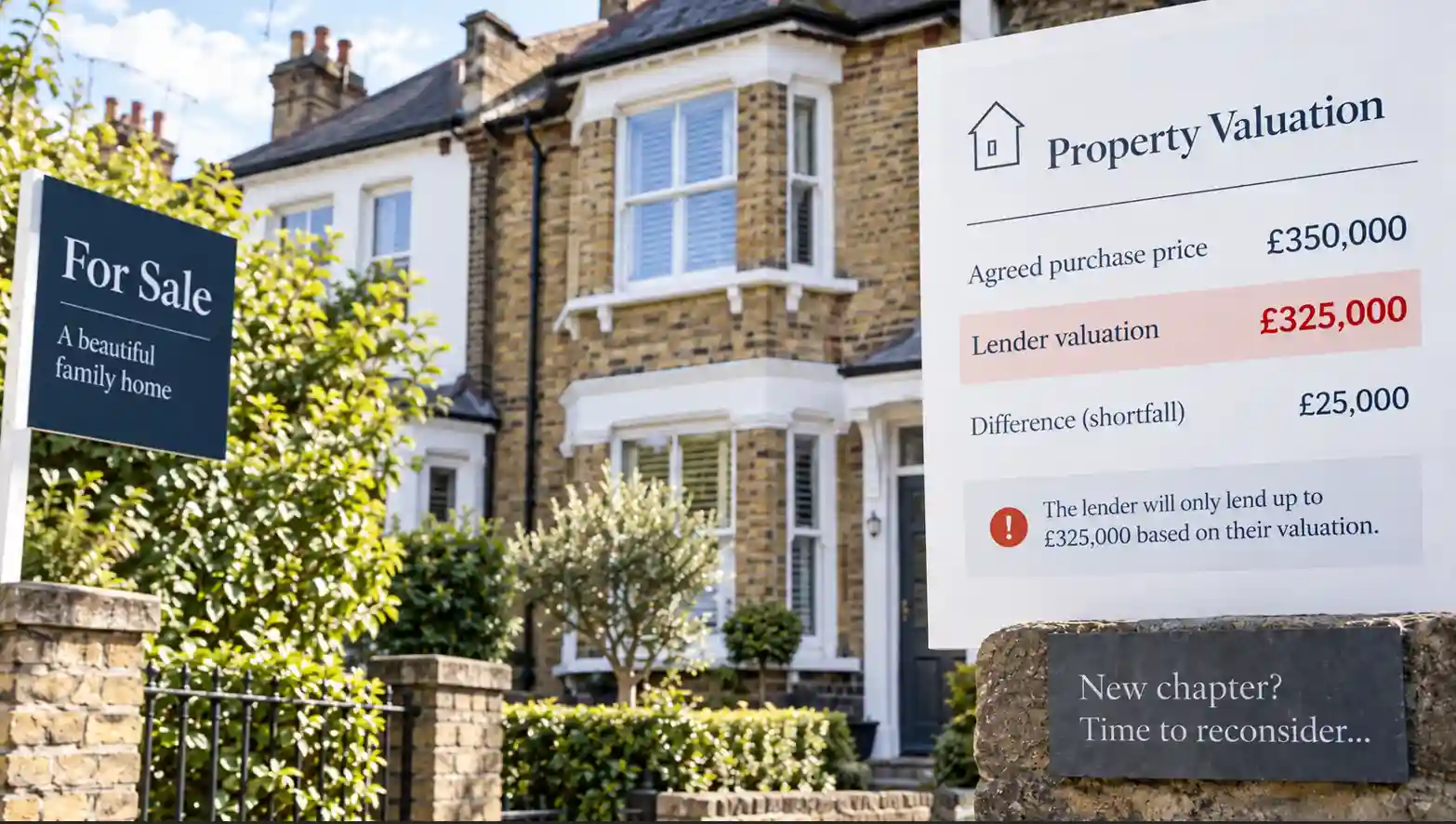
Agreed price: £350,000. Lender’s valuation: £325,000.
It’s a gap that arrives by email or through a broker, usually without much warning, and the first reaction is rarely calm. Is the house overpriced? Has the seller been trying it on? Is the lender simply wrong?
None of those questions, on their own, actually moves the transaction forward.
The more useful starting point is understanding what a “down-valuation” actually is, and isn’t.
What the term actually means
A valuer isn’t reducing an established, objective value that everyone already agreed on.
They’re providing a professional opinion of value, for a specific purpose, on a specific date, based on the evidence available to them — most significantly, recent comparable sales. “Down-valuation” is the term buyers and brokers commonly use when that opinion comes in below the agreed purchase price, and it’s a useful shorthand, but it shouldn’t be read as a verdict that the agreed price was necessarily wrong, that the seller was dishonest, that the estate agent misled anyone, or that the buyer made a mistake agreeing to it.
Two professionally qualified valuers can, entirely legitimately, reach different figures for the same property on the same day, particularly where comparable evidence is limited, the market is moving quickly, or the property has unusual features that make direct comparison difficult.
What matters is more practical than philosophical: the lender will only lend against the value its own process accepts, not the price the buyer hoped to pay.
Why it happens
A handful of reasons account for most down-valuations.
The property may genuinely have been priced ambitiously relative to recent comparable sales. Buyers can, and do, agree to pay more than a valuer’s evidence-based opinion supports, particularly in competitive situations where more than one buyer was interested.
The comparable evidence may be thin or dated, especially for unusual properties or in areas with low transaction volumes, forcing the valuer to rely on sales that aren’t a perfect match. The market may also be moving faster than the available data reflects, in either direction.
Sometimes the lender’s valuation method is part of the story. A desktop or automated assessment may produce a different figure from a physical inspection, though that doesn’t automatically make the lower figure wrong.
And occasionally the problem is not just the headline comparable evidence but something about the property itself — its condition, saleability, construction type or another feature the lender views as affecting value or lending risk.
Whatever the reason, the practical consequence is the same: the lender is only prepared to lend against the value it has confirmed.
The financial mechanics
This is where the gap actually bites.
For ordinary residential lending, lenders typically assess the relevant loan-to-value ratio against the lower of the agreed purchase price and the valuation they are prepared to accept.
Take a buyer who agreed to purchase at £350,000, planning a 90% mortgage — a £315,000 loan against a £35,000 deposit.
If the lender’s valuation comes back at £325,000, a 90% loan against that figure is £292,500, not £315,000.
To complete at the original £350,000 price, the buyer would now need to find an extra £22,500 in cash on top of the deposit already planned, unless the price is renegotiated down or the funding structure changes.
That is why a down-valuation is a real financial event, not just an inconvenient number.
It can also affect the mortgage product itself. If the buyer has to change deposit size, loan amount or lender, that may alter the loan-to-value band they now fit into, which can in turn affect interest rates and product availability. This is a point to work through with a mortgage broker or adviser against the buyer’s actual circumstances.
What options are actually available
Renegotiate the price with the seller. Where the valuation evidence is credible, asking the seller to reduce the price to match, or closer to, the lender’s figure is a normal response. A seller may not accept it, but a down-valuation gives the buyer a concrete reason for revisiting the price: the lender will not fund the deal on the terms originally expected.
Bring additional cash to the purchase. Where the buyer has the means, covering some or all of the gap between the mortgage now available and the agreed price allows the purchase to proceed.
But that is not simply a question of whether the money exists.
Bridging the gap means accepting that the additional amount is being funded entirely from the buyer’s own capital rather than mortgage borrowing. That doesn’t automatically make the decision wrong, but the buyer should be comfortable with why they’re paying above the lender’s accepted value and what using that extra money does to the cash they retain after completion.
A buyer who can technically find the additional £22,500 but would be left with almost no emergency fund afterwards is making a very different decision from somebody who can bridge the same gap without materially weakening their finances.
Ask about the lender’s valuation review or appeal process. Some lenders allow valuations to be challenged, usually through the broker, where there is genuinely strong supporting evidence.
That typically means recent completed sales of genuinely comparable nearby properties, rather than asking prices, listings still on the market or properties merely under offer. Requirements differ between lenders, and some set threshold conditions before a review will even be considered.
Strong comparable evidence may justify asking for a review, but submitting one does not mean the valuation will change. It is worth pursuing where there is a genuine evidence-based case, rather than treating an appeal as a routine route back to the original figure.
Apply to a different lender. Because valuations are professional opinions rather than fixed facts, a different lender — potentially using a different valuer or method — may reach a different figure.
This is a legitimate option, but not a cost-free one in the broader sense. It normally means another application, more time and no guarantee of a better outcome. It may also mean giving up the mortgage product originally selected.
Repeatedly trying lender after lender purely in the hope that one eventually produces the desired figure is therefore not the same thing as having good evidence that the first valuation was unusually cautious.
Commission an independent valuation. A separately commissioned RICS valuation can provide useful support for a renegotiation or valuation review. It may also help the buyer understand whether the lender’s figure looks broadly reasonable or unusually cautious.
What it will not do is bind the mortgage lender. The lender decides what valuation evidence it is prepared to rely on for its own lending decision.
Walk away. Sometimes the gap is simply too large, the seller will not move, and the buyer either cannot or should not bridge the difference.
A down-valuation does not automatically mean the property is a bad buy. It can, however, make clear that it is no longer the right purchase on the terms available.
A short note on timing
In England, Wales and Northern Ireland, this is usually still a pre-contract problem.
That matters because it means the buyer is normally still in a position to renegotiate, switch lender or withdraw before becoming legally committed.
Scotland starts differently because the seller usually provides a Home Report before the property is marketed, including a Single Survey and valuation. Even so, a mortgage lender may still rely on its own processes or reach a different funding decision. If a valuation or lending shortfall emerges in Scotland, it is something to address before missives are concluded, not after.
The practical principle is the same everywhere: deal with the funding gap while there is still room to change the transaction.
Is this becoming more common?
There is no single definitive public statistic that neatly tracks down-valuations across the market as a whole.
That makes sweeping claims about how much more common they have become harder to prove than many headlines imply.
What is clear is that a down-valuation is a recognised feature of mortgage lending, not an extraordinary event that means something has gone uniquely wrong with this transaction.
The useful question isn’t how unusual the event is.
It’s what the valuation now does to the buyer’s funding position.
A brief word for sellers
A single buyer’s down-valuation doesn’t, on its own, establish a new market price for a property.
It is one valuer’s opinion, on one valuation basis, for one lender.
But it is still information, and it becomes more meaningful if it happens more than once. If a second or third buyer, using a different lender and valuer, encounters a similar figure, that pattern is harder to dismiss as bad luck or one cautious lender.
At that point, it may be worth reconsidering the price rather than assuming each buyer’s lender has simply got it wrong.
The decision that actually matters
A down-valuation doesn’t automatically mean the deal is off, and it doesn’t automatically mean the buyer overpaid.
It means the numbers the buyer originally planned around no longer match what the lender will fund, and a real decision now needs making.
Bridge the gap, renegotiate, challenge the figure, change lender, or walk away — those are the live options. Which one makes sense depends on the buyer’s finances, how much they still want this specific property, how credible the lender’s figure appears, and how flexible the seller is prepared to be.
MoneyHelper’s home-buying timeline notes that a buyer may need to reconsider or renegotiate where the mortgage valuation comes in below the offer made.
That’s the useful frame.
The question isn’t who was “right” in the abstract. It’s whether the property still makes sense at the price being asked, using the mortgage actually available and the buyer’s own money needed to bridge whatever remains.
Working through those options with a mortgage broker and, where the price is being revisited, the estate agent is a far more productive response than spending the first few days trying to establish who got the value wrong.
Important: This article provides general information about mortgage valuations and home-buying processes. It is not mortgage, legal, surveying or financial advice for a particular purchase. Lender criteria, valuation processes and buying procedures vary by lender, property and jurisdiction. Buyers should discuss the implications of any down-valuation with their mortgage broker or lender and obtain appropriate legal or financial advice before becoming legally committed.

