

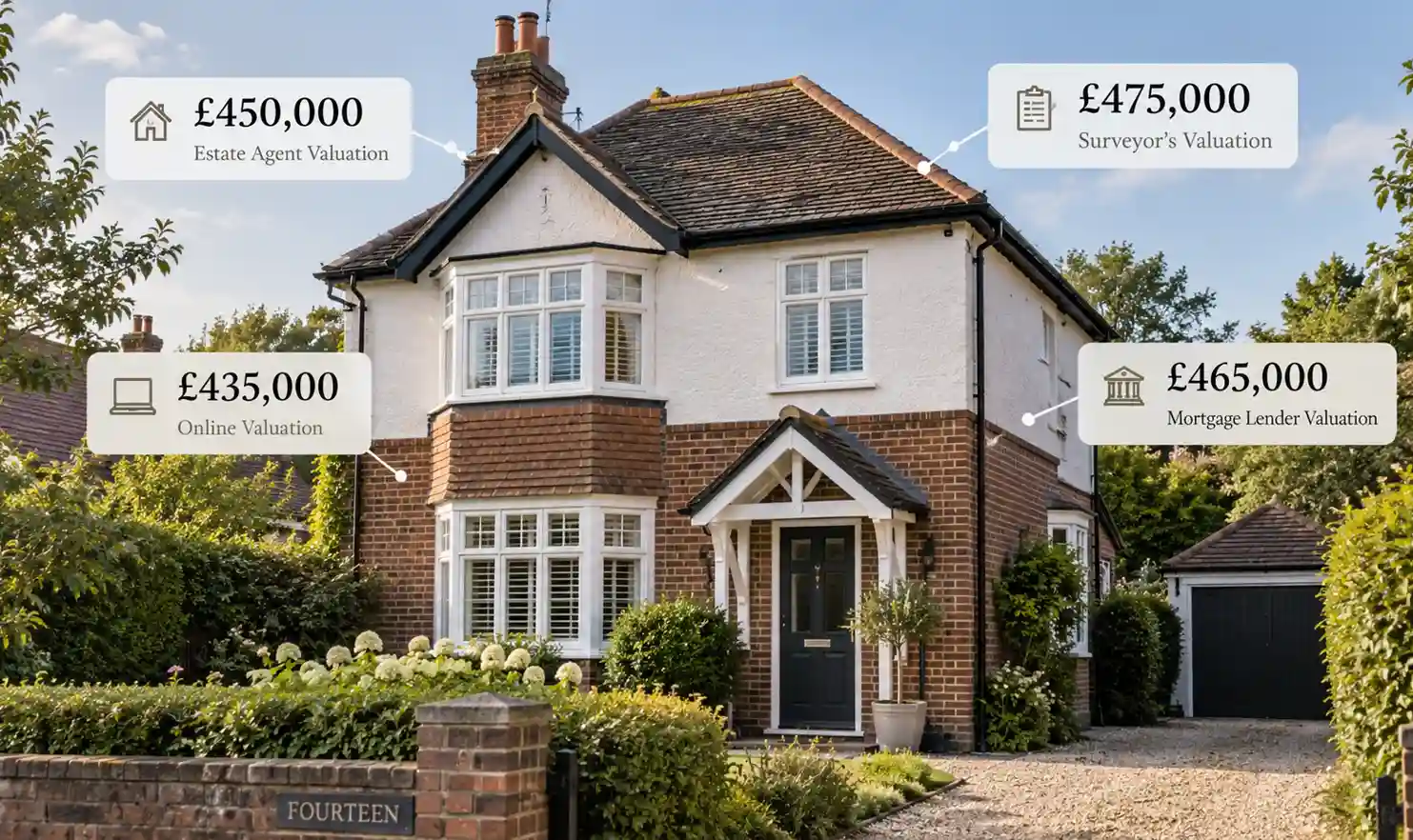
Five figures, one house.
An estate agent’s market appraisal of £450,000. A seller’s chosen asking price of £475,000. An accepted offer of £465,000. An independent professional valuation of £450,000. A mortgage lender’s valuation of £435,000.
Nobody involved has necessarily made a mistake, and nobody is necessarily misleading anyone.
The natural question — which one is right? — is reasonable. It’s also, more often than not, the wrong question.
A more useful one is: what is each of these figures actually trying to represent, who produced it, and why?
A number without a purpose is just a guess
The first distinction worth making is between price and value.
An asking price is a price somebody hopes to achieve. An accepted offer is a price one buyer has agreed to pay. A professional valuation is an opinion of value reached for a defined purpose and at a particular date.
Those figures can overlap. They don’t have to.
Every number exists because somebody needed an answer to a particular question, and those questions are not the same question asked five different ways.
The estate agent’s market appraisal is an opinion about the price the property might realistically achieve and how it should be positioned for sale.
It should be grounded in comparable evidence. Government selling guidance makes clear that an estate agent’s appraisal is not the same thing as a formal professional valuation and recommends asking agents for evidence supporting the figure they suggest.
There is also an unavoidable commercial context: the agent is pitching for the instruction to sell the home.
That doesn’t mean an agent offering the highest figure is necessarily being dishonest. It means the seller should ask how the number was reached rather than treating the number itself as proof.
The asking price is not, by itself, a valuation at all.
It is a marketing decision.
A seller might list above the figure they realistically expect to achieve because they want negotiating room. Another might price more keenly to generate early competition. A seller prioritising speed may make a different choice from one willing to wait for a particular figure.
Two identical homes could therefore be marketed at different asking prices without anyone holding different professional views about their underlying value.
The accepted offer is different again.
It tells you what one particular buyer was willing to pay at one particular moment.
That is meaningful evidence. A genuine buyer committing £465,000 tells you more about demand than a seller simply asking £475,000.
But an accepted offer is still a single transaction.
One buyer may be especially motivated because the house is beside family, fits a very specific requirement or is the third property they’ve pursued after losing two others. Another may negotiate particularly hard because the seller wants a quick sale.
The agreed price is real.
What it doesn’t automatically prove is that every normally motivated buyer in the market would reach the same figure.
A professional market valuation answers a more formally defined question.
Where a valuation is undertaken by an appropriately qualified RICS valuer under the RICS Valuation – Global Standards, commonly known as the Red Book, the figure is produced within a professional framework covering matters such as competence, evidence, assumptions, objectivity and reporting.
One commonly used basis is market value: broadly, the estimated amount for which a property should exchange on the valuation date between a willing buyer and willing seller after proper marketing, with both acting knowledgeably and without unusual pressure to transact.
That makes it different in kind from an asking price or one buyer’s offer.
It is still a professional opinion rather than an objective fact, but it is an opinion produced on a defined basis, at a defined date, and expected to be supported by evidence.
The lender’s valuation has another purpose again.
A mortgage lender needs to know whether the property provides acceptable security for the loan it is considering. Its valuation is therefore commissioned for the lender and produced within that secured-lending context.
RICS consumer guidance describes a mortgage valuation as a limited check carried out for the lender’s benefit rather than a buyer’s condition survey.
That does not mean lender valuations are automatically lower than independent valuations.
They may arrive at exactly the same figure.
Where they differ, the lender’s instruction, the evidence available, the property itself and the lending context can all matter.
A £435,000 lender valuation therefore does not automatically prove that the £450,000 professional valuation, £465,000 accepted offer or £475,000 asking price was wrong.
It tells the buyer something narrower: this is the figure the lender is prepared to support for the purposes of its mortgage decision.
Occasionally, another valuation appears for an entirely different reason.
A property being valued after somebody has died, for example, may need to be valued as at the date of death rather than at today’s date. HMRC guidance requires estate assets to be valued at the relevant date for inheritance-tax and estate purposes.
That illustrates the underlying point especially clearly.
Change the purpose, assumptions or valuation date, and the appropriate figure can change even though the bricks and mortar have not.
Why professionally qualified people can genuinely disagree
Even when the purpose is the same — two qualified valuers assessing the same property on the same date using the same basis of value — legitimate differences are still possible.
Comparable evidence is rarely perfect.
A conventional three-bedroom semi might have several nearby sales to work from, but none will necessarily be identical. One has been comprehensively renovated. Another has a larger garden. One has a garage; another backs onto a busy road.
Floor area, condition, extensions, parking, exact position and specification can all require judgement.
The valuer isn’t simply averaging three sold prices.
They’re deciding how relevant each sale is and what adjustment, if any, those differences justify.
That’s where professional judgement enters.
The stronger and more plentiful the comparable evidence, the more closely professional opinions are likely to cluster. The weaker the evidence, the more room there is for reasonable judgement to differ.
Markets move too, and every professional valuation belongs to a valuation date.
A figure reached in March and another reached in September are not necessarily competing opinions about the same market conditions. Prices, buyer demand, borrowing costs and the amount of property available may have changed in between.
Unusual properties amplify all of this.
A standard modern house on an estate containing hundreds of similar homes gives a valuer plenty of evidence.
A converted chapel, one-off architect-designed house, unusual rural property or home using uncommon construction methods may have very few genuinely comparable transactions.
Two competent valuers can therefore examine the same imperfect evidence, give different weight to individual comparables and reach different defensible conclusions.
None of that means valuation is “just opinion” in the sense of being arbitrary.
The figure is an opinion.
The evidence and professional process behind it are what give that opinion weight.
What to actually do with five different figures
Faced with the spread of numbers at the beginning of this article, the useful exercise isn’t ranking them by size and assuming the middle figure, the newest figure or the most professional-sounding one must be closest to some hidden true value.
Start by asking what each number actually is.
The £475,000 asking price is a marketing position.
The £465,000 accepted offer tells you what one buyer agreed to pay.
The £450,000 estate-agent appraisal is an opinion about what the seller might achieve in the market.
The £450,000 professional valuation is an evidenced opinion produced on a defined basis.
The £435,000 lender valuation is the figure supporting one lender’s mortgage decision.
Seen that way, much of the apparent contradiction disappears.
The numbers can still matter enormously. If a lender will only support £435,000 while the buyer has agreed £465,000, the difference creates a very real funding problem. If several agents independently support something around £450,000 while the seller insists on £500,000, that pattern tells the seller something useful. If a formal valuation differs materially from the evidence behind an estate-agent appraisal, it is reasonable to ask why.
But the right response is not simply to ask which figure is “the real value”.
Ask instead:
Who produced it?
For what purpose?
Using what evidence?
On what basis?
And at what date?
Only then are the numbers genuinely comparable.
A house does not carry one objectively correct price inside it waiting for somebody to discover.
It has a market, evidence, potential buyers, professional opinions and particular transactions — all operating at particular moments and for particular purposes.
That is why the same home can honestly produce several different figures without the system being broken.
The apparent contradiction mostly resolves itself once you know what question each number was answering.
Important: This article provides general information about residential property valuations and prices. It is not a valuation, mortgage, tax, legal or financial opinion for a particular property or transaction. The appropriate basis, assumptions and valuation date depend on the purpose for which a valuation is required. Where a formal valuation is needed, use an appropriately qualified professional and make sure they understand the purpose of the instruction.

