

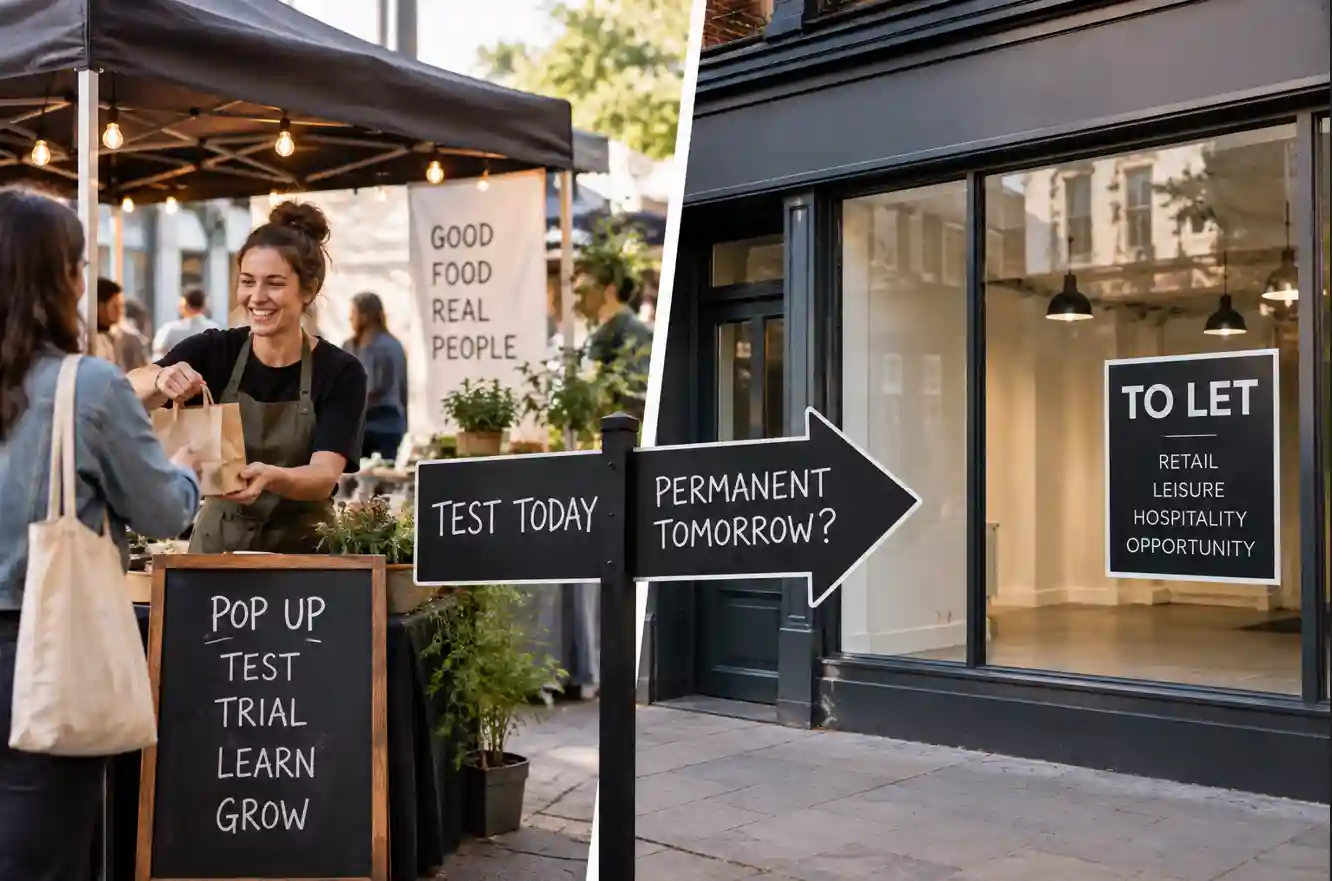
Growth doesn’t automatically mean premises. That’s an uncomfortable thing to say to a business that’s been selling well online, building a following through markets or pop-ups, and has started to feel that a permanent shop, restaurant or venue is simply “the next step.”
Sometimes it is. Sometimes it’s a multi-year commitment taken on the strength of evidence that would barely survive scrutiny — strong weekend sales at a market stall, for example, treated as proof that the same concept will work as a seven-day-a-week operation carrying rent, rates, staffing and fit-out costs in a different location entirely.
This article isn’t an argument against taking premises. It’s an argument for proving the business before locking in the property, because the two decisions — is this concept genuinely working, and does permanent occupation make commercial sense? — are not the same decision. Treating them as one is how good ideas end up trapped in bad leases.
What permanent premises genuinely offer
It’s worth being honest about the advantages, because they’re substantial and this isn’t an anti-premises argument.
A permanent location can provide consistent visibility that a pop-up or market stall cannot match, a predictable place customers can return to and recommend, proper storage and equipment that does not need setting up and breaking down every trading day, a stronger platform for brand-building and genuine operational efficiencies once routines are established.
It can also make staffing, stockholding, equipment and opening hours easier to organise, while permanence itself can strengthen customer confidence in a business that previously appeared only periodically.
For some concepts, the premises become part of the product. The atmosphere of a restaurant, the environment of a gym, the experience of browsing a specialist shop or the sense of community around a leisure venue cannot always be reproduced meaningfully through temporary trading.
None of that means the move should happen automatically. It means there can be a substantial prize if the model genuinely supports it.
And what it genuinely costs, beyond the obvious
Set against those advantages, permanent premises create exposure that does not disappear simply because trade has a poor month.
Rent, business rates, service charges and many utilities continue. Staffing requirements can become higher and less flexible once regular opening hours are established. Capital becomes tied up in fit-out and equipment. Insurance, repair obligations and other lease liabilities arrive alongside the commercial opportunity.
Some costs may be delayed by rent-free periods or other incentives, but the underlying commitment remains.
The detailed affordability calculation — occupancy costs, contribution margin, turnover requirements and cash runway — belongs properly elsewhere in this section. The point here is simpler: permanent premises turn assumptions about demand into fixed financial commitments. That is why testing first matters.
Testing before committing: the options worth considering
There is no single correct way to test a concept before taking long-term premises.
A pop-up shop can put the business into a real trading environment without the same length of commitment. UK Government business guidance specifically identifies temporary pop-up retail space as one way to test demand before establishing permanent retail premises.
UK Government — setting up new consumer and retail premises
Markets and trading stands can test products, pricing and customer reaction at comparatively low commitment. Concessions and shop-in-shop arrangements can expose a concept to an established customer base. A temporary unit occupied under an appropriately documented short lease, licence to occupy or other arrangement can get closer to permanent trading conditions without necessarily taking on the same length of commitment.
Food businesses can use shared or production kitchens, residencies, markets, events or delivery models. Leisure businesses can hire halls, studios or other venues by the session. Retail concepts can combine ecommerce with periodic physical trading. Some businesses may discover that this hybrid model is not merely a test at all, but a better long-term model than maintaining a permanent location.
Not every route suits every concept. The important question is not “what is the cheapest way to test this?” but “what uncertainty are we trying to remove, and what kind of test would genuinely give us evidence about it?”
What the test actually needs to prove
This distinction matters because different tests prove different things.
A market stall may tell a product business a great deal about pricing, product mix and whether customers are prepared to buy. It tells considerably less about whether the particular high street being considered can support the same business from Monday to Sunday.
A concession within a successful department store may prove that customers like the product, but some of that demand may belong to the host retailer’s brand and footfall rather than the concession itself.
A delivery-only food concept can test menu demand, pricing, ingredient costs and operational consistency without paying for a dining room. It cannot establish whether customers will fill a 60-cover restaurant at the rent being asked for a particular unit.
A series of paid fitness classes in hired venues can establish whether customers repeatedly pay for the concept. It will not by itself prove that those same customers will travel to one fixed location often enough to support a dedicated gym.
And a pop-up in one part of a city cannot automatically validate permanent premises somewhere else.
The closer the eventual decision gets to a specific unit, the more the evidence needs to address the specific risks attached to that unit: its catchment, footfall, trading pattern, accessibility, competition, opening hours and occupancy cost.
The purpose of testing is therefore not simply to generate some sales. It is to gather evidence about the assumptions permanent occupation depends on: genuine demand at realistic prices; average transaction value under normal rather than exceptional conditions; repeat custom; gross and contribution margins; busy and quiet trading periods; staffing requirements; conversion from potential customers into actual transactions; customer acquisition costs where they matter; and whether the proposed catchment can deliver enough business consistently.
And the results need to be normalised before they are carried into a permanent-premises forecast.
A pop-up may appear highly profitable because the space was cheap, subsidised or available only for a few days. The founder may have worked far more hours than would be sustainable in a permanent operation. Launch publicity may have inflated demand. Introductory pricing may have depressed margin. Customers may have travelled specifically because the event was temporary. Business rates, service charges, full staffing and other permanent costs may barely have featured.
Those advantages do not make the test worthless. They simply need stripping out of the extrapolation.
The useful question is not only “did the test make money?” It is “would this level of demand, at normal pricing and realistic staffing, still support the cost base of the permanent operation we’re considering?”
That is a much harder test — and a much more useful one.
Hospitality: several ways to test before opening a full restaurant
Food and hospitality businesses have an unusually wide range of testing routes available.
Residencies within existing venues, pop-up kitchens, food markets, event trading, catering and delivery can all test different parts of a concept without immediately taking on a restaurant lease.
Temporary does not, however, mean regulation-free. Food businesses generally need to register with the relevant local authority before trading. For England, Wales and Northern Ireland, the Food Standards Agency states that registration should normally take place at least 28 days before food operations begin.
Food Standards Agency — register a food business
Scotland operates through Food Standards Scotland, which similarly requires food-business registration at least 28 days before trading where registration is required.
Food Standards Scotland — starting a food business checklist
Normal food-law obligations, including applicable allergen requirements, still apply to temporary trading. Alcohol, late-night refreshment and entertainment can also bring separate licensing requirements. In England and Wales, some temporary licensable activities can be authorised through a Temporary Event Notice, subject to the statutory limits and requirements; Scotland and Northern Ireland use different arrangements.
GOV.UK — Temporary Event Notice in England and Wales
The point is not to turn a temporary test into a compliance exercise. It is to run it sufficiently like a real business that the evidence it generates is worth trusting.
Leisure concepts: testing without a lease
Hired halls, studios and leisure venues can let a fitness, wellness or activity business establish whether customers will repeatedly pay before capital is committed to a dedicated property.
Repeatability matters more than a packed launch event. A class that fills because friends, existing followers and promotional customers attend once has demonstrated something. A programme that repeatedly fills at sustainable pricing, including during less convenient times and quieter periods, demonstrates considerably more.
Testing can also reveal operational information that a business plan cannot: how much time is required between sessions, staffing ratios, equipment movement, storage requirements, cancellation behaviour and how far customers are genuinely willing to travel.
Those findings can then inform the type and location of permanent premises rather than the business choosing a building first and trying to force its operating model into it afterwards.
Retail: testing without a shop
Markets, pop-ups, concessions and temporary stores can test pricing, product mix, stockholding and physical customer behaviour in ways online sales cannot.
But here too, the evidence needs interpreting carefully. An ecommerce audience that travels deliberately to a three-day pop-up may not represent the passing trade available to a permanent shop. Conversely, a physical test may reveal demand from customers the online business had never reached.
The strongest evidence comes when the test starts answering the questions the permanent operation actually needs answered: what sells without heavy promotion, how often customers return, what happens on ordinary weekdays rather than launch weekends, how much stock needs holding and whether the likely location creates enough transactions at normal margins.
How much evidence is enough? There’s no universal number
It would be convenient to offer a threshold — a certain number of trading days, a revenue figure or a repeat-purchase rate — above which a concept becomes “proven”.
No such universal number is credible.
What counts as enough evidence varies with the size of the commitment, the volatility of the concept, the amount of capital at risk and how difficult the property commitment would be to reverse.
A relatively inexpensive unit with modest fit-out requirements and a genuine early break option presents a different decision from a restaurant requiring substantial building works and hundreds of thousands of pounds of capital before the first customer arrives.
Evidence should therefore become stronger as the irreversible commitment becomes larger.
More importantly, look for repeatability rather than a single result. Have sales remained credible outside launch periods? Has the business traded through both strong and weak days? Do margins remain acceptable without introductory pricing? Are customers returning? Does the result survive when the founder is no longer personally driving every sale? Does demand still exist once novelty wears off?
And distinguish between things already proven and things still being assumed.
A business may have excellent evidence that customers want the product while still having almost no evidence that they will visit the proposed location. That uncertainty does not disappear because another part of the concept has already been validated.
Commitment length is itself a decision, not just a lease term
Testing does not have to stop the moment a business moves towards permanent occupation. Lease structure can form part of the risk management.
A shorter commitment, an appropriately negotiated break clause or a more flexible occupation arrangement may reduce exposure compared with accepting the longest term initially offered. But a break clause only protects the tenant if its timing and conditions are properly understood and can actually be complied with.
RICS’s Code for Leasing Business Premises in England and Wales specifically identifies lease duration, break rights, rent deposits, incentives, permitted use, alterations and other major commitments as matters that should be addressed clearly during lease negotiations.
RICS — Code for leasing business premises
The detailed mechanics deserve their own treatment. The principle here is simply that commitment length should be chosen deliberately rather than accepted passively because it happens to be the landlord’s opening proposal.
Fit-out risk: the capital that locks in the mistake
The property commitment is only part of the risk.
A business can negotiate a comparatively flexible lease and then remove much of that flexibility itself by spending heavily on fit-out, specialist equipment and signage. That capital may have little value anywhere else.
Some concepts cannot be tested properly without meaningful investment, so the answer is not always “spend nothing until everything is proven.” The more useful principle is to stage irreversible expenditure where possible.
Test the product before building the flagship store. Test repeat demand before constructing a highly specialised venue. Establish whether the location works before investing in finishes whose value depends entirely on remaining there.
Landlord contributions and incentives can reduce the tenant’s own capital exposure, but they do not make an unsuccessful concept successful. Nor should money already committed become the justification for committing more.
The sunk-cost trap, named plainly
Once substantial money, time and personal effort have gone into a concept, walking away becomes psychologically harder. That is exactly why the stopping conditions are best considered before the money is spent.
A test should ideally begin with an idea of what failure would look like as well as success.
Not an arbitrary universal number, but a business-specific threshold: demand that remains too weak after a defined test period; customer acquisition that is too expensive; repeat custom that never develops; a margin that fails once introductory pricing ends; or a location that cannot generate enough transactions even though customers like the concept.
If the business decides those tests only after disappointing results arrive, it becomes much easier to keep changing the threshold in order to justify carrying on.
The purpose is not to make entrepreneurs pessimistic. It is to make the experiment capable of producing an answer.
The question to answer before the lease, not after
Not “are we ready to grow?” Almost every business with momentum can feel ready to grow.
The more useful question is:
“Which parts of this business have actually been proven, which parts are still assumptions, and is the evidence strong enough to justify the scale and irreversibility of the property commitment we’re about to make?”
A successful pop-up can prove a great deal without proving everything. A thriving online business can demonstrate demand without proving a high-street location. A full market stall can validate a product while leaving permanent staffing and occupancy economics unanswered.
Permanent premises can still be exactly the right next move.
But when they are, the evidence should lead the property decision — not be created afterwards to justify one the business has already emotionally made.
This article provides general commercial property and business information, not financial, legal, licensing or professional advice for individual circumstances. Temporary and permanent trading can be subject to planning, licensing, food-safety, lease and other regulatory requirements that differ across the UK and according to the activity and premises involved. Appropriate professional and local-authority advice should be obtained where required before trading or entering into a substantial property commitment.

