

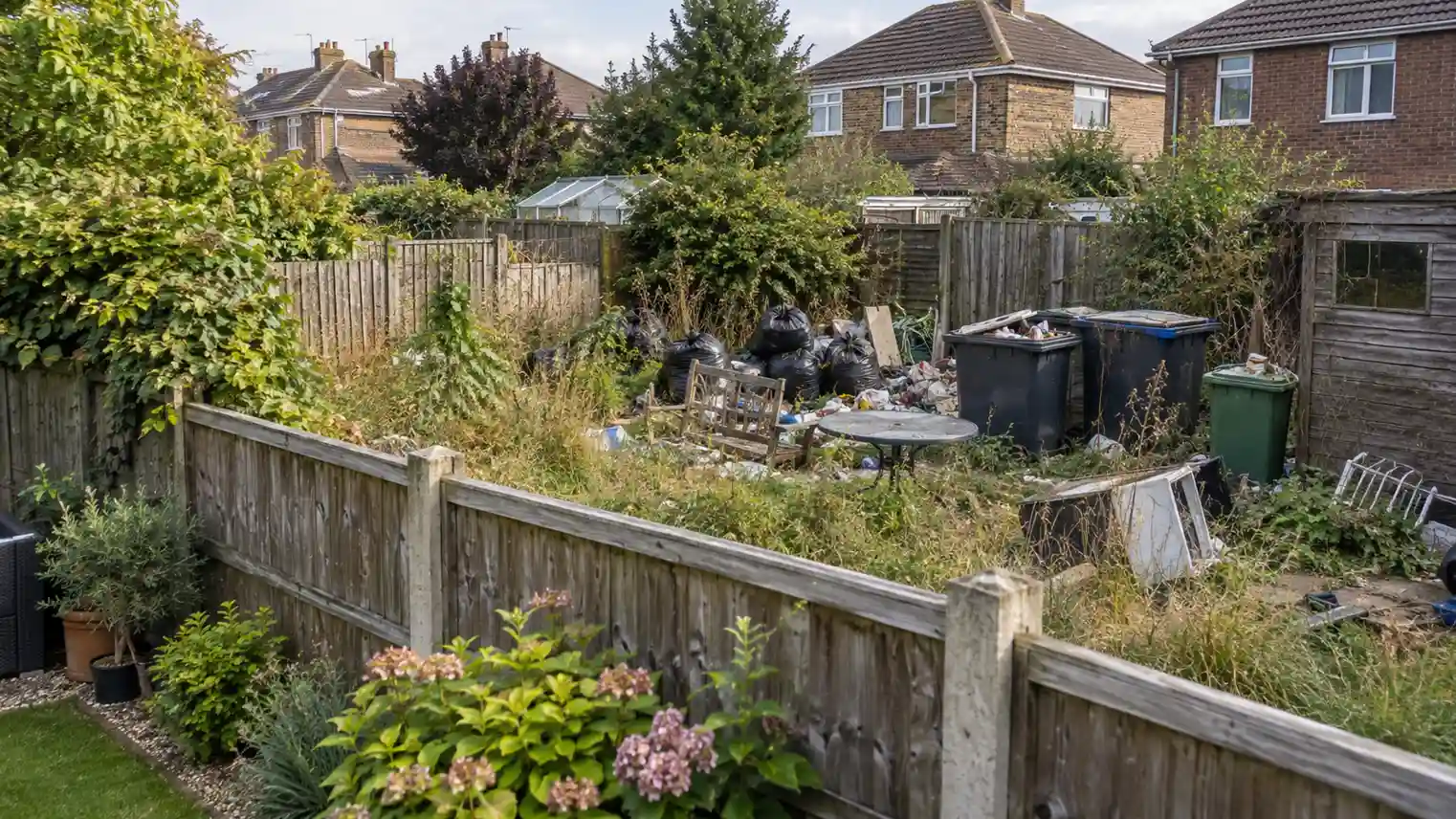
There’s a real difference between a neighbour whose garden isn’t to your taste and a neighbour whose garden is genuinely making your own home unpleasant to live in — and the law draws that line in a place that surprises a lot of people the first time they encounter it. An overgrown lawn and a few weeds, however untidy it looks over the fence, generally isn’t something environmental health can do anything about. Rotting food waste breeding flies against your shared boundary is a different matter entirely.
The difficulty is knowing which kind of problem you’re dealing with, because the council’s powers depend much more on what the rubbish is actually causing than how unpleasant the garden looks. Smells, rats, flies and serious accumulations can all bring different legal provisions into play, while a garden that simply looks neglected may fall outside environmental health’s remit altogether.
Untidy is not the same as unlawful
This needs saying plainly, because it’s the single biggest source of frustration in this category: an overgrown or visually unpleasant garden is very unlikely to count as a statutory nuisance on its own. An untended lawn, old furniture, discarded timber or a pile of genuinely inert rubble may look dreadful without creating the kind of health or nuisance problem environmental health is empowered to address. Councils don’t exist to enforce a particular standard of gardening, however much the appearance of next door’s property irritates the people living around it.
Under Part III of the Environmental Protection Act 1990, an accumulation or deposit of rubbish can become a statutory nuisance where it’s prejudicial to health or amounts to a nuisance. The Government’s guidance on statutory nuisance complaints specifically identifies piles of rotting rubbish as something councils can investigate. The legal question isn’t whether the garden is attractive but whether its condition is causing a genuine problem, such as a health risk or substantial and unreasonable interference with the use and enjoyment of neighbouring property.
There is, however, another planning power worth knowing about. Under Section 215 of the Town and Country Planning Act 1990, local planning authorities in England and Wales can require land to be cleaned up where its condition adversely affects the amenity of the area. Government guidance on Section 215 notices explains how that power can be used, including for seriously neglected land. It’s discretionary, though, and doesn’t create a general right to demand that a neighbour cuts their grass or removes every unsightly object from view.
The distinction is therefore between environmental health dealing with genuine nuisance or health problems and planning enforcement potentially addressing land whose condition seriously affects local amenity. Neither provides a simple legal remedy for disliking somebody else’s garden.
What actually crosses the line
Rubbish becomes a potential statutory nuisance when the accumulation is genuinely prejudicial to health or causes substantial and unreasonable interference with neighbouring property. In practice, councils are interested in specific, observable conditions rather than general untidiness.
Accumulated food waste is an obvious example. Bin bags left to rot in warm weather can produce persistent odours, attract flies and create conditions that are very different from an ordinary untidy garden. Rotting or contaminated materials may also attract rodents or other pests, particularly where waste has remained undisturbed for a long period. And an accumulation severe enough to create a genuine health hazard can justify investigation even where the neighbour insists the contents of the garden are their own business.
There’s a technical distinction concerning smells that matters more than most homeowners would expect. The Environmental Protection Act contains a specific statutory nuisance category for smells arising from industrial, trade or business premises, but that provision doesn’t automatically extend to every unpleasant smell coming from a domestic garden. Rotting household rubbish can still constitute a nuisance through the provisions covering accumulations, deposits or the condition of premises. The council therefore needs to investigate the underlying rubbish problem rather than assume that every domestic odour falls within the separate business-smell provision.
That doesn’t make a persistent smell irrelevant. If decomposing food waste beside the fence repeatedly makes your kitchen unpleasant to use, the odour is evidence of what the accumulation is causing. But a complaint saying “their garden smells horrible” is much weaker than one explaining that rubbish has been collecting against the boundary for three weeks, the smell enters the house most afternoons and flies are gathering around the waste.
A skip full of clean rubble or discarded furniture might be an amenity problem, potentially, without necessarily meeting the statutory nuisance test. The same skip filled with decomposing food, contaminated materials or waste attracting pests presents a different situation. It’s the condition of the accumulation and its actual effects that matter, not simply how long the items have been sitting outside.
Pests specifically
If rubbish is attracting or harbouring rats or mice, councils have separate powers available under the Prevention of Damage by Pests Act 1949. The legislation places duties on local authorities concerning rats and mice and allows them, in appropriate circumstances, to require owners or occupiers to take reasonable steps to control an infestation. Where rodents are the immediate problem, identifying them clearly when reporting the garden can be more useful than making a general complaint about rubbish.
That doesn’t mean seeing a rat near your fence automatically proves it came from next door, or that the neighbour is necessarily responsible. Rodents can travel between properties, outbuildings, drains and other sources of food or shelter. But a consistent pattern of rats moving around a large accumulation of waste is worth recording and reporting, particularly if you’ve also found droppings, gnawing damage or other evidence of activity on your own property.
If the infestation has already reached your home, it’s sensible to deal with that problem directly through appropriate pest control rather than waiting for the neighbour dispute to be resolved. Protecting your own property and establishing who may be responsible for the source are separate questions, and the first shouldn’t have to wait for the second.
Insects are treated more narrowly than most people expect. In England and Wales, the specific statutory nuisance provision for insects applies to insects emanating from relevant industrial, trade or business premises, rather than ordinary domestic gardens. A fly infestation coming from a neighbour’s rotting household waste may therefore need to be addressed through the nuisance provisions relating to the underlying accumulation or the condition of the premises, rather than the separate insect provision. Scotland has wider statutory insect-nuisance provisions, so this is one area where the legal route differs across the UK.
At the extreme end, councils in England and Wales also have powers dealing with seriously filthy or verminous premises. Section 83 of the Public Health Act 1936 provides for notices requiring premises to be cleansed or disinfected, or vermin dealt with, where the statutory conditions are met. This isn’t a provision for ordinary garden clutter. It’s aimed at substantially more serious conditions, potentially including a property that has become heavily contaminated or verminous.
For a homeowner, the practical point is that a complaint about rats, flies or decomposing waste needs to explain the actual problem. A council may have meaningful powers to investigate an unhealthy accumulation even where it has no reason to intervene over an overgrown lawn.
Communal areas and bins
Where rubbish is affecting a shared area — a communal bin store, side passage, leasehold building’s garden or another managed space — the first question is often who controls that area rather than which neighbour left the bags there. A freeholder, residents’ management company, managing agent or housing association may be responsible for arranging collections, maintaining bin stores or enforcing rules about how residents use the shared facilities.
Raising the issue with whoever manages the building can sometimes be faster than approaching environmental health, particularly if the problem comes down to overflowing bins, missed collections or inadequate storage arrangements. But the two routes aren’t mutually exclusive. If a communal accumulation is also producing a genuine statutory nuisance or a significant pest problem affecting individual flats, the council can still have a role.
A slightly different situation arises where one neighbour repeatedly dumps rubbish outside your boundary, uses your bins without permission or leaves waste in a shared passage after being asked to stop. That can become a question of persistent unreasonable behaviour rather than simply the condition of somebody’s garden. In England and Wales, Community Protection Notices may be available to authorised bodies where conduct is persistent or continuing, unreasonable and has a detrimental effect on local quality of life, subject to the necessary warning procedure.
That isn’t a notice you can simply apply for and demand the council issue. Nor does an isolated dispute over a misplaced bin necessarily meet the threshold. But where rubbish dumping has become a repeated problem, reporting the actual behaviour to the council or housing manager may open up options different from an ordinary statutory nuisance complaint.
What to actually do
1. Establish whether this is a genuine nuisance or an appearance issue. An unkempt lawn and unwanted garden ornaments are unlikely to get far with environmental health. Rotting waste, persistent smells, evidence of pests or contamination affecting your home provide a much stronger reason for investigation. If the land is principally an extreme visual eyesore rather than a health problem, ask whether the council’s planning enforcement team deals with seriously neglected sites.
2. Talk to the neighbour first, if that feels reasonable. As with noise and bonfires, some situations resolve with a straightforward conversation, particularly where the person hasn’t realised what’s happening on the other side of the fence. A missed waste collection, broken bin or temporary personal difficulty may explain an accumulation without making its effects any less unpleasant. Explain what’s affecting you rather than beginning with a judgement about how the garden looks. If the relationship is already hostile or approaching the neighbour feels unsafe, there’s no obligation to do so.
3. Keep a record. Photographs with dates, notes about when smells are strongest, the appearance of flies and any evidence of rats or mice give the council something concrete to assess. Record whether waste is accumulating, whether liquid is crossing the boundary and how the problem affects ordinary use of your home. A note that the kitchen has been affected by the smell of rotting rubbish on several afternoons is more useful than simply saying the neighbour’s garden is disgusting. Take photographs lawfully from your own property or public areas rather than entering the neighbour’s garden.
4. Report the actual problem to environmental health. If the nuisance continues, explain whether the concern is decomposing waste, a substantial accumulation, odour, contamination or another identifiable issue. Councils have a duty to take reasonably practicable steps to investigate complaints that could amount to statutory nuisance. Where the authority is satisfied that a statutory nuisance exists, or is likely to occur or recur, it generally must serve an abatement notice requiring it to be stopped or restricted. That may involve removing an accumulation or dealing with its effects, depending on what has been established.
5. Report suspected rodents separately and promptly. Rats and mice can trigger specific pest-control powers, so don’t bury those details within a general complaint about an untidy garden. If rodents are entering your house or outbuildings, take appropriate steps to protect your own property while the source is investigated. Seeing rodents doesn’t automatically establish that your neighbour caused the problem, but recording where and when they appear can help identify what’s happening.
6. If the property appears abandoned or seriously neglected, explain that too. An empty house with extensive rubbish, signs of vermin or conditions suggesting a genuine public-health problem may justify consideration under powers beyond the ordinary accumulation provisions. The council needs to know the actual circumstances to decide which route applies. A report describing suspected vermin, severe filth and a deteriorating empty property is more useful than one simply stating that the garden hasn’t been maintained.
The aim isn’t to turn every untidy garden into an environmental health investigation. It’s to identify where the condition has moved beyond appearance into something the council can lawfully and usefully address. If your first complaint goes nowhere, asking which legal threshold wasn’t met and whether another council team is more appropriate can be more productive than simply submitting the same description again.
If the affected — or affecting — property is rented
If you’re a tenant affected by rubbish or pests next door, you can report a potential statutory nuisance directly to the council. You don’t need to own your home before environmental health can investigate something affecting it. If the problem has also brought pests into your rented property, exposed a building defect or caused damage, tell your own landlord or managing agent as well, since there may be separate responsibilities concerning the condition of your home.
Where the rubbish is coming from a rented property, its landlord or housing association may have another route to address the issue. Tenancy agreements sometimes contain provisions about garden maintenance, storing rubbish, controlling pests or avoiding nuisance to neighbours. A housing provider may be able to contact the tenant, arrange an inspection or take appropriate action under the tenancy without waiting for a formal statutory nuisance finding.
That doesn’t mean every private landlord is automatically liable for whatever a tenant leaves in the garden, or that an untidy tenant can immediately be forced to clear everything. The landlord’s contractual rights, the condition of the property and the council’s environmental health powers are separate matters, but they can operate alongside one another where the circumstances justify it.
The broad distinction between untidiness and genuine nuisance also applies elsewhere in the UK, although the legislation isn’t identical. Scotland operates under the Environmental Protection Act’s statutory nuisance framework as amended by Scottish legislation. The Scottish Government’s guidance addresses accumulations and deposits as well as Scotland’s wider insect-nuisance provisions.
Northern Ireland has its own statutory nuisance framework under the Clean Neighbourhoods and Environment Act (Northern Ireland) 2011. The Department of Agriculture, Environment and Rural Affairs publishes guidance for district councils on those powers, including the treatment of accumulations or deposits capable of causing a nuisance or prejudice to health. Homeowners there should contact their district council rather than assume the exact England-and-Wales procedures apply.
Ultimately, a neighbour’s garden doesn’t have to meet your standards of tidiness. But neither does the law require you to accept persistent rotting waste, serious pest activity or a substantial nuisance simply because the source happens to be on private property.
The difference lies in what the condition of the garden is actually causing. Long grass and an old sofa may be something you have to tolerate. Food waste decomposing against your fence, flies gathering at your back door and rats moving towards your shed are a different proposition. Describe those facts clearly, keep a reliable record and approach the council through the route that fits the problem. That’s considerably more likely to produce a useful result than expecting environmental health to intervene because next door’s garden looks a mess.
This article provides general property information, not legal, medical, pest-control or other professional advice for individual circumstances. Council enforcement powers depend on the condition of the land, the effects being caused, the available evidence and the applicable UK jurisdiction. If waste, contamination or pests are creating a significant health risk or damaging your home, take appropriate steps to address the immediate problem and obtain professional advice where necessary.

