

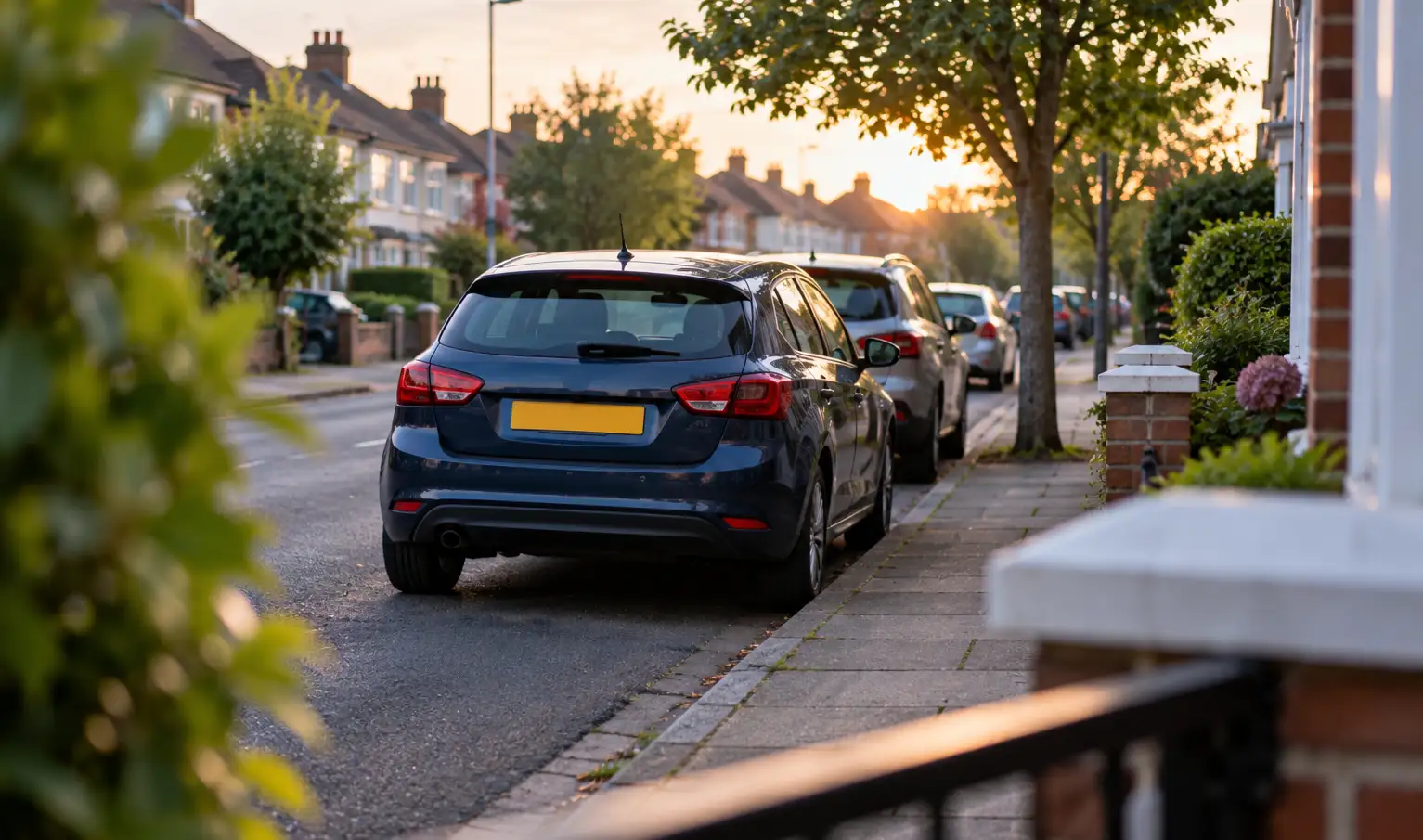
Every evening, the same car takes the spot directly outside your front window. It’s not your neighbour’s own car — it’s a visitor, or a second vehicle they can’t fit on their own drive — and it’s parked legally, causing no obstruction, on an ordinary residential street. It still feels like something has been taken from you. Has it?
The answer, in most circumstances, is no. But there’s a distinction between somebody parking outside your house and somebody parking in a way that interferes with your rights, obstructs access or breaches a particular restriction. Understanding where that line sits can save you an unnecessary argument — or help you identify a genuine parking problem the relevant authority can actually do something about.
No — and it’s worth saying plainly before getting into the exceptions
Living in a house does not give you a right to the road space outside it. This is one of the clearest, most consistently confirmed points in UK parking guidance, and it doesn’t change because you’ve lived there for decades, have no driveway of your own or usually park in the same place every evening.
Gloucestershire County Council’s guidance on vehicles parked outside homes puts the underlying principle directly: there is no general individual right to park in a particular position on the public highway, including outside your own property. The primary public right over a highway is to pass and re-pass, while roadside parking is subject to the restrictions and permissions applying to that particular road.
That is slightly different from saying the road simply “belongs to everyone”. Ownership of the land beneath a highway can be more complicated, and a public highway isn’t an unlimited public car park. But for the homeowner looking out at somebody else’s car, the practical position is straightforward: your property frontage doesn’t normally give you an exclusive parking right over the carriageway beside it.
Paying council tax doesn’t change that. Nor does being elderly, having mobility difficulties, working shifts, having young children or being the only household on the street without off-road parking. Those circumstances may make nearby parking especially important, and some may justify asking the council about additional arrangements, but they don’t automatically reserve the nearest space for you.
A resident parking there legally is therefore in much the same position as anybody else entitled to use that section of road. You cannot require them to move simply because you would prefer to park outside your own home.
The same principle usually applies to residents’ parking permits, which are often misunderstood. A permit generally gives you permission to park in eligible bays within a particular zone during controlled hours. It doesn’t guarantee a space will be available, much less reserve the one outside your front door.
This is frustrating precisely because the space feels connected to the house. It’s where you unload shopping, where visitors expect to stop and where you’ve perhaps parked for twenty years. But long-standing habit doesn’t normally become a legal entitlement, and an unrestricted public parking space doesn’t belong to whichever house happens to be nearest.
Where this changes — and where it doesn’t
That’s the baseline. It doesn’t mean every parking situation outside your home is untouchable, and it doesn’t mean you have no options at all. Several distinctions matter, some much more than people expect.
You can’t reserve the space with cones, bins or other obstacles. Placing traffic cones, wheelie bins, chairs or other objects in the road to discourage parking doesn’t create a private right over it. Depending on the circumstances, the objects themselves may amount to an obstruction of the highway. There are legitimate arrangements for authorised roadworks, temporary parking suspensions or traffic management, but those aren’t the same as putting a bin outside every evening to claim your preferred spot.
If you genuinely need temporary access for a removal van, building work or another particular purpose, ask your council whether a parking suspension or other authorised arrangement is available. That’s a more sensible route than trying to reserve public space yourself.
Parking restrictions change the picture entirely. Yellow lines, permit-holder bays, time-limited parking, loading restrictions, school entrance restrictions and other traffic controls can make parking unlawful even where the road would otherwise be available.
The Highway Code’s rules on waiting and parking explain the general requirements, including restrictions on reserved spaces and dangerous or obstructive parking. The relevant road markings, signs and traffic orders determine what applies at the particular location.
In areas operating civil parking enforcement, the council or relevant parking authority can act against many contraventions. That’s very different from asking it to penalise somebody whose only offence, from your perspective, is taking the space you’d like to use.
Disabled parking bays are more complicated than they look. A residential disabled bay doesn’t necessarily belong to the particular Blue Badge holder who requested it. Many enforceable bays can be used by any eligible Blue Badge holder, even where the bay was originally installed to help one resident.
There is another complication. Some councils provide advisory disabled bays in residential streets, often marked on the carriageway but without the traffic order required to make them legally enforceable. In those circumstances, another motorist using the space may be inconsiderate without committing an enforceable parking contravention.
The Department for Transport’s guidance on local parking measures for disabled people also recognises that specially designated individual bays can be created where the necessary legal arrangements and permit identifiers are in place. So the position isn’t simply that every disabled bay is either personally reserved or open to all Blue Badge holders.
If there’s a dispute about a bay outside your home, check whether it’s advisory, generally enforceable for eligible users or specifically designated under a local scheme. The parking authority can establish that. The painted wheelchair symbol alone may not tell the whole story.
Blocking your driveway is a different question from parking near it. A car parked lawfully outside your front window isn’t in the same position as one standing across the dropped kerb that provides vehicle access to your drive.
In England and Wales, Section 86 of the Traffic Management Act 2004 prohibits parking beside certain lowered or raised footways in designated enforcement areas, including those providing vehicle access to premises, subject to specific exceptions.
One exception concerns parking outside residential premises with the occupier’s consent, although that exception doesn’t apply to a shared driveway. Local enforcement arrangements also matter: some councils have particular reporting procedures for residential dropped kerbs, and enforcement doesn’t automatically mean the vehicle will be removed.
The distinction between a car preventing access to your drive and one merely occupying the nearest available space is legally important. Property Front Page’s separate guide to blocked driveways addresses that problem in detail.
Parking opposite your driveway isn’t automatically unlawful either. On a wide road, a vehicle parked directly opposite your entrance may make no practical difference. On a narrow street, the same vehicle might make turning into or out of the drive difficult, or genuinely prevent access.
The Highway Code advises drivers not to park in front of property entrances and not to leave vehicles where they cause unnecessary obstruction. But there’s no general rule giving you an automatic right to keep the opposite side of the road clear simply because you have a driveway.
A difficult manoeuvre isn’t always the same thing as legal obstruction. If the vehicle genuinely prevents access or creates a significant hazard, describe that specific problem to the relevant authority rather than relying on the fact that it’s opposite your entrance.
Dangerous or genuinely obstructive parking is different from merely inconvenient parking. A vehicle may be on a road without yellow lines yet still be unlawfully positioned. Highway Code Rule 242 prohibits leaving a vehicle in a dangerous position or where it causes unnecessary obstruction.
Examples could include a vehicle seriously obstructing the road, preventing emergency access, creating a significant visibility hazard or blocking a pavement in a way that forces pedestrians into traffic. Whether enforcement falls to the police or a parking authority depends on the conduct, applicable law and local arrangements.
This doesn’t mean that a car parked close to a junction, opposite another vehicle or near a driveway automatically meets the legal threshold in every case. It means the location and actual consequences matter, rather than whether someone has taken a space you consider yours.
Residents’ parking schemes can improve matters, but they don’t give you ownership of a space. Where a street suffers sustained parking pressure from commuters, nearby businesses or households with several vehicles, asking the council to consider a residents’ parking scheme may be worthwhile.
Councils can examine parking demand, traffic conditions, displacement onto surrounding streets, local support and the cost of introducing controls. A scheme may improve residents’ chances of parking nearby, but it can also introduce permit charges and still leave households competing for limited spaces.
That distinction matters commercially and practically. A residents’ parking scheme is a potential response to a street-wide parking problem, not an enforcement mechanism for preventing one particular neighbour from parking outside one particular house.
Private roads and estates require a different investigation. If the road or parking court is genuinely private land with restricted access and defined parking rights, the position may depend on the title deeds, lease, easements, allocated parking arrangements or management company’s rules.
A property owner might have an express right to use a numbered space, a shared right over a private parking area or no right to park on a particular section of land at all. Unauthorised parking may involve private parking conditions or trespass, depending on the arrangements.
But there’s an important qualification: an unadopted road isn’t necessarily a road without public highway rights. Adoption concerns who maintains a road at public expense; some privately maintained streets remain public highways, and highway or traffic law can still apply. As Barnsley Council’s guidance on adopted and private streets explains, an unadopted street can still be subject to public rights of way.
So don’t assume that because the management company pays for road maintenance, residents can automatically exclude everybody else from parking there. Equally, don’t assume that a private parking court is available to the public simply because there’s no barrier across its entrance. Establish the road’s legal status and the property rights applying to it before deciding what can be enforced.
An apparently abandoned vehicle is another separate issue. A car that hasn’t moved for several days, or even several weeks, isn’t automatically abandoned. Nor does expired vehicle tax, by itself, prove that its owner has discarded it.
The Government’s guidance on abandoned vehicles explains that councils consider a range of indicators, potentially including the vehicle’s condition, whether a keeper can be identified, missing parts and how long it has remained stationary.
A genuinely abandoned vehicle can be reported to the council. An untaxed vehicle on a public road has a separate DVLA reporting route. Those are legitimate procedures, but they shouldn’t be used as a way of trying to remove a roadworthy, lawfully parked car simply because its owner rarely drives it and you want the space back.
The four nations also have some important differences. The basic principle about not owning the space outside your house applies across the UK, but particular parking restrictions aren’t identical.
In Scotland, national prohibitions on pavement parking, double parking and parking at certain dropped kerbs became enforceable from December 2023. Transport Scotland’s guidance explains those rules and the limited exceptions.
There’s an important detail concerning dropped kerbs. Scotland’s national dropped-footway prohibition is directed at pedestrian and cyclist crossing points; Section 57 of the Transport (Scotland) Act 2019 expressly excludes lowered kerbs intended to provide access to driveways or garages from that particular prohibition. Other rules concerning obstruction or dangerous parking can still apply.
Northern Ireland operates its own parking and traffic-management system. Its official guidance on residents’ parking zones expressly confirms that holding a permit doesn’t guarantee an available space or give a resident the position immediately outside their property.
The lesson is the same throughout the UK: knowing that somebody has parked outside your home isn’t enough to establish whether an offence has occurred. You need to identify the road’s status, any applicable restrictions and what the vehicle is actually doing.
When it’s really about the relationship, not the parking
Sometimes the parking itself is legal, but the pattern feels deliberate. A neighbour might start choosing the spot outside your house after a disagreement, continue doing so when other spaces are available and appear to take satisfaction from the fact that it annoys you.
On its own, that doesn’t necessarily change the legal position. Somebody can know you’d prefer them to park elsewhere and still be entitled to use an unrestricted public parking space. Repeatedly doing something lawful that another person dislikes doesn’t automatically make it harassment.
The position can become more serious where parking forms part of a wider pattern of conduct.
Imagine that the neighbour begins waiting for you to leave before moving their vehicle into the space, repeatedly confronts you when you return, sends threatening messages or uses parking alongside other targeted behaviour intended to cause alarm or distress. At that point, the concern may no longer be only where the car is parked.
Harassment law looks at the course of conduct rather than assuming every individual act must independently be unlawful. Lawful parking can therefore form part of the wider factual background to a harassment allegation, although parking in a disliked position is a long way from proving harassment on its own.
This is a distinction worth handling carefully because accusations of deliberate intimidation can quickly escalate an ordinary neighbour disagreement. If there’s a genuine pattern involving threats, repeated unwanted confrontation, monitoring or other potentially harassing behaviour, document the incidents together rather than trying to turn otherwise lawful parking into a parking offence.
Property Front Page’s separate guide to neighbour harassment and intimidation explains when hostile conduct may cross that legal line and which reporting routes are appropriate.
In the ordinary case, though, the best explanation may simply be that your neighbour finds that space convenient. You don’t have to like that, and they may be inconsiderate in choosing it repeatedly, but neither of those things automatically makes their parking unlawful.
Who to actually contact for what
The right organisation depends on the specific problem, and approaching the wrong one can produce a great deal of frustration without changing anything.
| Situation | Most useful starting point |
|---|---|
| A vehicle legally parked on unrestricted public road outside your house | No parking enforcement solely because you want that space |
| Yellow lines, permit restrictions or enforceable parking bays being breached | Council or relevant civil parking authority |
| A vehicle parked across a dropped kerb serving your drive | Check the local council’s dropped-kerb enforcement procedure |
| Dangerous parking or genuine unnecessary obstruction | Police or relevant highway/parking authority, depending on the circumstances |
| An apparently abandoned vehicle | Local council or relevant local vehicle-removal authority |
| An untaxed vehicle on a public road | DVLA vehicle-tax reporting service |
| Parking on a private estate or parking court | Landowner, managing agent and property title or lease |
| Parking forming part of threatening or persistently harassing conduct | Record the wider behaviour and use the appropriate police or harassment-reporting route |
The table is deliberately based on the problem rather than the person causing it. “My neighbour keeps parking outside my house” doesn’t, by itself, identify an offence or an enforcement power.
If the parking creates an actual obstruction, take photographs that show the road layout, vehicle position and access difficulty rather than simply photographing the number plate. If there’s a restriction, record the relevant signs or road markings. If the problem is persistent and affects the whole street, a discussion with the council’s highways or parking team about local arrangements may be more productive than repeatedly reporting the same legally parked car.
For ordinary neighbourhood parking disputes, it’s also worth recognising what councils and police generally cannot do. They can’t simply order somebody to park further away as a favour to another homeowner. They need an enforceable restriction, legal obstruction, road-safety concern or another relevant power.
The realistic starting point
Before any of this, a straightforward, calm conversation resolves a genuine share of these situations. Many people parking somewhere inconvenient for a neighbour simply haven’t considered the effect on the household beside it. A visitor may not realise the space is regularly used by somebody with mobility difficulties, or a new resident may have no idea how difficult parking becomes on the street each evening.
If relations are good enough, asking whether they would mind leaving the space free when alternatives are available may be worth trying. Frame it as a request rather than an entitlement. You might explain that you regularly unload shopping there, have difficulty walking from further away or would appreciate their consideration.
They are entitled to say no.
That’s the part that can be hardest to accept, because a courteous request doesn’t create a legal obligation. But it also helps distinguish somebody who is willing to accommodate a neighbour from somebody who simply prefers a convenient parking space and has no legal duty to give it up.
If nearby parking is essential because of disability or serious mobility difficulties, ask the council whether a suitable disabled parking arrangement is available. If the whole street is struggling, explore whether a residents’ parking scheme could realistically help. And if the issue is access, obstruction or a genuine restriction being breached, pursue that particular problem through the appropriate enforcement route.
What generally won’t help is repeatedly insisting that somebody has no right to park outside your home when, on an ordinary unrestricted public street, they usually do.
You may reasonably think of it as the space outside your house. You may have parked there for twenty years, and you may be frustrated every evening when somebody else gets there first. But unless a particular restriction or property right changes the position, the fact that it’s outside your house doesn’t make it your parking space.
Important: This article provides general property and parking information, not legal or other professional advice for individual circumstances. Parking rights and enforcement depend on the road’s legal status, local traffic restrictions, civil enforcement arrangements, rights of access and the applicable UK jurisdiction. If parking presents an immediate safety danger or forms part of threatening or intimidating conduct, use the appropriate emergency, police or enforcement route.

