

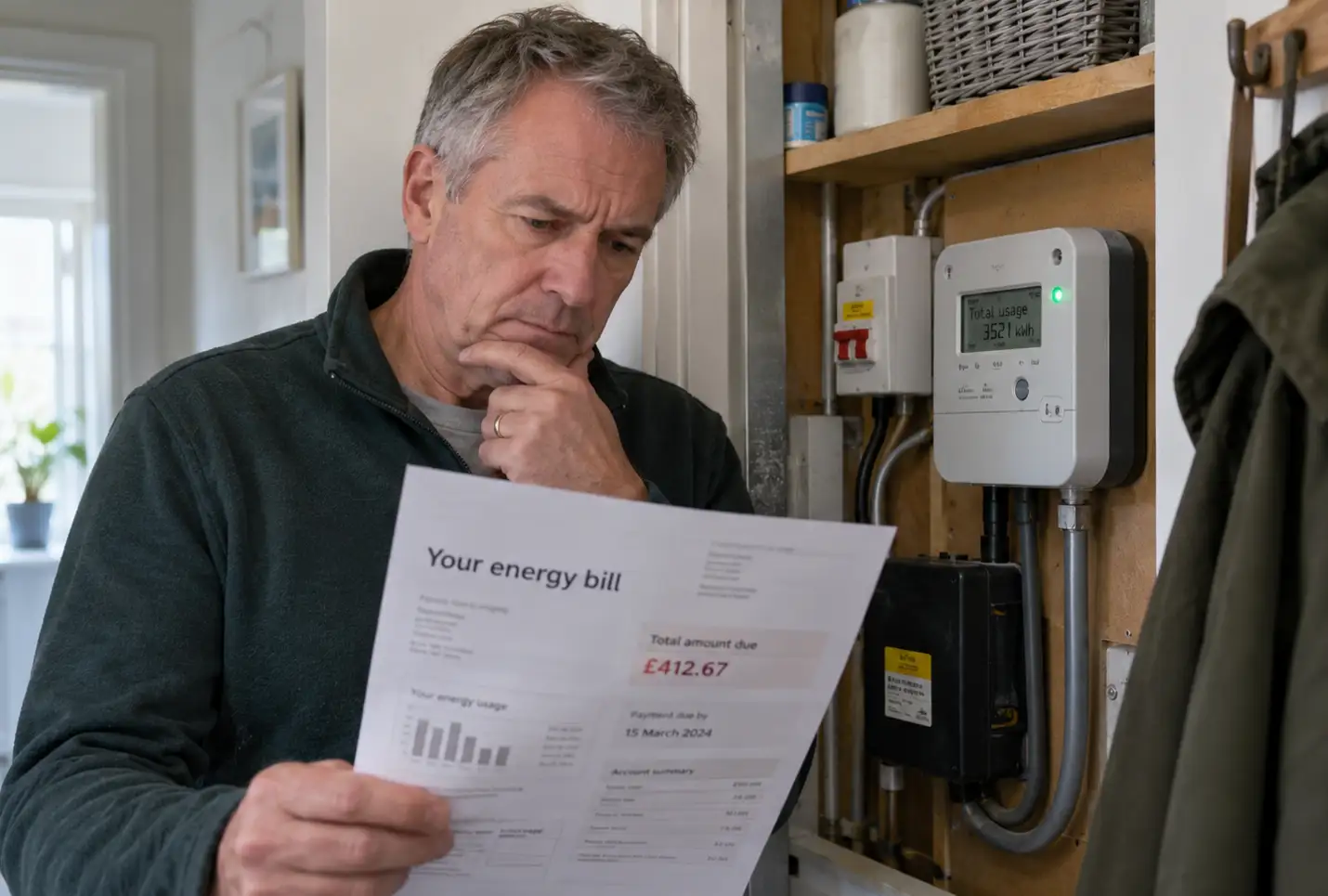
The in-home display has gone blank, or a bill has arrived that bears no resemblance to what you’d expect, or you’ve suddenly been asked to hand over meter readings again after months of not needing to. “My smart meter’s broken” is the phrase most people reach for, but it’s worth untangling first, because several genuinely different problems can produce very similar-sounding symptoms — and the right response depends on knowing which one you’re actually dealing with.
The distinction that matters first: display, or meter?
Your in-home display and your actual smart meter are two separate pieces of equipment, and mixing them up is one of the most common sources of confusion in this whole subject.
The in-home display is simply the screen showing you information about your energy consumption and, usually, an estimate of what that energy is costing. It isn’t the thing actually measuring your gas or electricity use. The smart meter itself, normally fixed to a wall or housed in a meter cupboard or box, is doing the measuring.
A blank or frozen display therefore doesn’t automatically mean your smart meter has failed. The display may have lost power, lost its connection to the meter, or developed a fault of its own while the meter continues recording perfectly normally. Government smart-meter troubleshooting guidance recommends checking that the display is powered and, where possible, trying it closer to the meter before assuming anything more serious has happened.
Even a display that is working can occasionally show misleading cost information without the underlying meter reading being wrong, because the tariff information used to calculate pounds and pence can become out of date. The consumption recorded by the meter and the cost estimate displayed in the kitchen are related, but they’re not the same piece of information.
Equally, a smart meter can stop automatically sending readings to your supplier while continuing to measure your consumption correctly. That’s a communications problem rather than necessarily a metering problem — an important distinction once a strange bill arrives.
Four genuinely different problems
Once you’ve separated the display from the meter, most “smart meter” complaints fall into one of four broad categories.
The in-home display specifically isn’t working — blank, frozen, disconnected or displaying information that clearly doesn’t make sense — while your actual meter and bills appear otherwise normal. This is normally the least consequential version of the problem. It affects the convenience of seeing your usage in real time, but doesn’t by itself mean the energy isn’t being measured.
The meter has stopped communicating automatically, sometimes described as operating in “dumb mode”. The meter may still be recording every unit correctly, but the supplier is no longer receiving those readings automatically. Until communication is restored, the practical consequence is usually that you’ll need to provide readings yourself if you want to avoid the account drifting back onto estimates.
Your supplier is using estimated, outdated or apparently incorrect readings despite the meter itself working normally. This can be a billing or account-processing problem rather than a hardware fault. In that situation, comparing the reading on the actual meter with the reading shown on the bill often tells you considerably more than staring at the in-home display.
There’s a genuine problem with the meter itself, or with which meter your account is actually linked to. This is less common but more consequential. Meter faults can happen, while flats, conversions and buildings with several meters introduce the separate possibility that the wrong meter has been associated with the wrong account.
Each of those situations calls for a different response, which is why “my smart meter’s broken” is only the beginning of the conversation rather than the diagnosis.
Taking a manual reading
If the meter appears to have stopped communicating automatically, taking a manual reading is a sensible way of keeping the account grounded in actual consumption while the communications problem is being sorted out.
Take the reading from the meter itself rather than relying on the in-home display. Smart-meter interfaces vary considerably between makes and models, so the safest route is to use your supplier’s instructions for the particular meter rather than assuming every set of buttons works in the same way.
It’s worth comparing that physical reading with the latest figure on your bill or online account. If the bill is clearly marked as estimated and the actual meter has moved well beyond — or sits substantially below — that estimate, you’ve already learnt something useful without needing to decide whether the meter itself is faulty.
A photograph showing the meter reading and serial number can also be useful if the account later becomes disputed. It gives you a dated record of what the physical equipment actually showed before anyone changes the account or meter.
When a genuinely large catch-up bill arrives
This deserves careful treatment, because it’s the point at which a technical inconvenience becomes a financial problem.
A long period of estimated billing, or of a smart meter failing to communicate without the issue being resolved, can eventually end with the supplier reconciling the account against actual usage. Where the estimates were consistently too low, the result can be a bill dramatically larger than the ones that came before it.
That doesn’t automatically mean the bill is wrong. If the energy was genuinely used but never fully charged for at the time, at least some of the correction may be legitimate.
The useful approach is to test the calculation rather than react only to the total. Put the evidence side by side:
| Check | What you’re looking for |
|---|---|
| Billing period | Has the new bill covered or corrected a longer period than you realised? |
| Start and end readings | Do they make sense compared with previous bills and the physical meter? |
| Reading type | Are the readings actual, smart-meter readings or estimates? |
| Current meter reading | Is today’s physical reading consistent with the bill’s closing reading? |
| Meter serial number | Does the number on the bill match the meter serving your property? |
| Tariff | Are the unit rates and standing charges the ones you expected? |
This matters because a large total can arise from several very different things: genuine catch-up consumption, incorrect readings, an account calculation error, the wrong tariff, or even the wrong meter. The amount at the bottom of the bill doesn’t tell you which one it is.
The back-billing rule, precisely
At this point, where you live starts to matter.
For households in England, Scotland and Wales, Ofgem’s back-billing protection means a supplier normally cannot charge you for energy used more than 12 months ago where you had not previously been correctly billed or informed about those charges.
Ofgem’s current back-billing guidance explains the protection and its exceptions.
It isn’t an unconditional cancellation of every old charge. The protection can be lost where the customer has behaved unreasonably — for example by deliberately preventing access to the meter, interfering with it or otherwise stopping the supplier from billing accurately.
But that is different from simply having a smart meter that wasn’t sending readings properly, or from a supplier relying on estimates for a long time despite having opportunities to resolve the problem.
It’s also worth keeping the rule in proportion. A back-billing restriction may protect you against charges relating to consumption more than 12 months old while leaving the most recent 12 months legitimately payable. A large catch-up bill can therefore be partly valid and partly open to challenge rather than falling neatly into “right” or “wrong”.
Northern Ireland operates under a separate energy regulatory system and doesn’t use Ofgem’s Great Britain framework. Its Utility Regulator introduced a 13-month back-billing limit for domestic and small-business customers, subject to its own conditions and exceptions. Northern Ireland readers should therefore use the rules that apply there rather than assuming the 12-month Ofgem position applies unchanged.
Meter mix-ups in flats, conversions and multi-meter buildings
Properties divided into flats, converted buildings and communal meter cupboards introduce another possibility that has very little to do with smart-meter technology itself: the supplier may have the wrong physical meter associated with your account.
The useful number here is the meter serial number. The serial number printed on your bill should correspond with the physical meter serving your home.
That’s different from an MPAN or MPRN. An MPAN identifies an electricity supply point and an MPRN identifies a gas supply point; the serial number identifies the physical meter installed there.
If the numbers on the paperwork and the equipment don’t correspond, or you’re genuinely unsure which meter serves your flat, that is worth resolving with the supplier before spending time arguing about consumption figures. A beautifully accurate reading from the wrong meter is still the wrong basis for your bill.
Again, a photograph of the reading and serial number is useful evidence. It gives both you and the supplier something concrete to compare with the account records rather than trying to reconstruct the situation later.
Is a non-communicating smart meter necessarily inaccurate?
No — and keeping these two ideas separate prevents a lot of unnecessary confusion.
A meter can fail to communicate automatic readings and still measure the energy passing through it accurately. Losing the smart function doesn’t, by itself, prove that the measurement function has also failed.
Actual metering faults do occur, but they’re a separate problem and need evidence of their own. If the physical readings themselves appear implausible, keeping a short record of readings over time can help establish whether something genuinely doesn’t add up.
In Great Britain, billing meters are subject to legal accuracy requirements and formal testing procedures exist where a genuine accuracy dispute can’t otherwise be resolved. The government’s gas and electricity meter regulation guidance explains how meters used for billing are regulated.
That doesn’t mean formal meter testing should be the first move whenever a bill looks high. If the meter is tested and found to be accurate, costs can potentially arise from the testing process. It makes more sense first to establish whether the apparent problem is really measurement, rather than estimates, communications, account data, tariff information or simply higher consumption than expected.
Escalating a complaint properly
If the readings, account data or catch-up calculation still don’t make sense after you’ve checked the evidence, the next step is the supplier’s formal complaints process rather than continuing an ordinary customer-service conversation indefinitely.
Keep the relevant bills, meter photographs, readings and correspondence together. The stronger the factual trail, the easier it is to explain exactly what you believe has gone wrong.
For households in England, Scotland and Wales, an unresolved complaint can normally be taken to the Energy Ombudsman once the supplier has had eight weeks to resolve it, or sooner where the supplier issues a deadlock letter. The service is independent and free to consumers.
Northern Ireland again uses a different route. Unresolved household energy complaints can be taken to the Consumer Council for Northern Ireland after first raising the problem with the supplier.
And billing accuracy isn’t the same question as ability to pay. If the bill turns out to be correct but the size of the catch-up makes it unaffordable, tell the supplier that directly. A repayment problem needs a repayment conversation rather than an argument about a meter that may in fact be working perfectly well.
The sequence worth working through
Before accepting an unexplained or alarming bill at face value, the useful task is to separate several problems that can look remarkably similar from the customer’s side.
A failed in-home display may have no effect on the meter at all. A smart meter that has stopped communicating may still be recording every unit accurately. Estimated or mismatched readings can turn a perfectly sound meter into an apparently inexplicable bill, while a genuine metering fault is a separate and much less common problem requiring its own investigation.
That distinction matters because each problem leaves different evidence behind. The reading on the physical meter, the reading and serial number shown on the bill, whether the bill is based on actual or estimated data, and the history of previous bills together tell you considerably more than the total at the bottom of the page. Where the figures don’t reconcile, keeping photographs and copies of the relevant bills gives you something concrete to challenge rather than simply arguing that the amount feels wrong.
And where a large correction reaches back into older usage, the age of those charges matters as much as the meter itself. Great Britain’s back-billing protection and Northern Ireland’s separate rules can limit what a supplier is entitled to recover in the right circumstances, which is why an unexpected catch-up bill should be checked rather than either automatically accepted or automatically assumed to be invalid.
The aim isn’t to turn yourself into a metering expert. It’s simply to establish which part of the chain has actually failed — the display, the communications link, the supplier’s billing data, the account-to-meter match or, more rarely, the meter itself. Once you know that, both the problem and the route to resolving it become considerably clearer.
This article provides general property information. The established national smart-meter framework described here applies principally to England, Scotland and Wales; Northern Ireland operates a separate energy market and is developing its own smart-meter programme. Billing protections and complaint routes also differ. Always check current regulatory guidance and your supplier’s own records when disputing a bill.

