

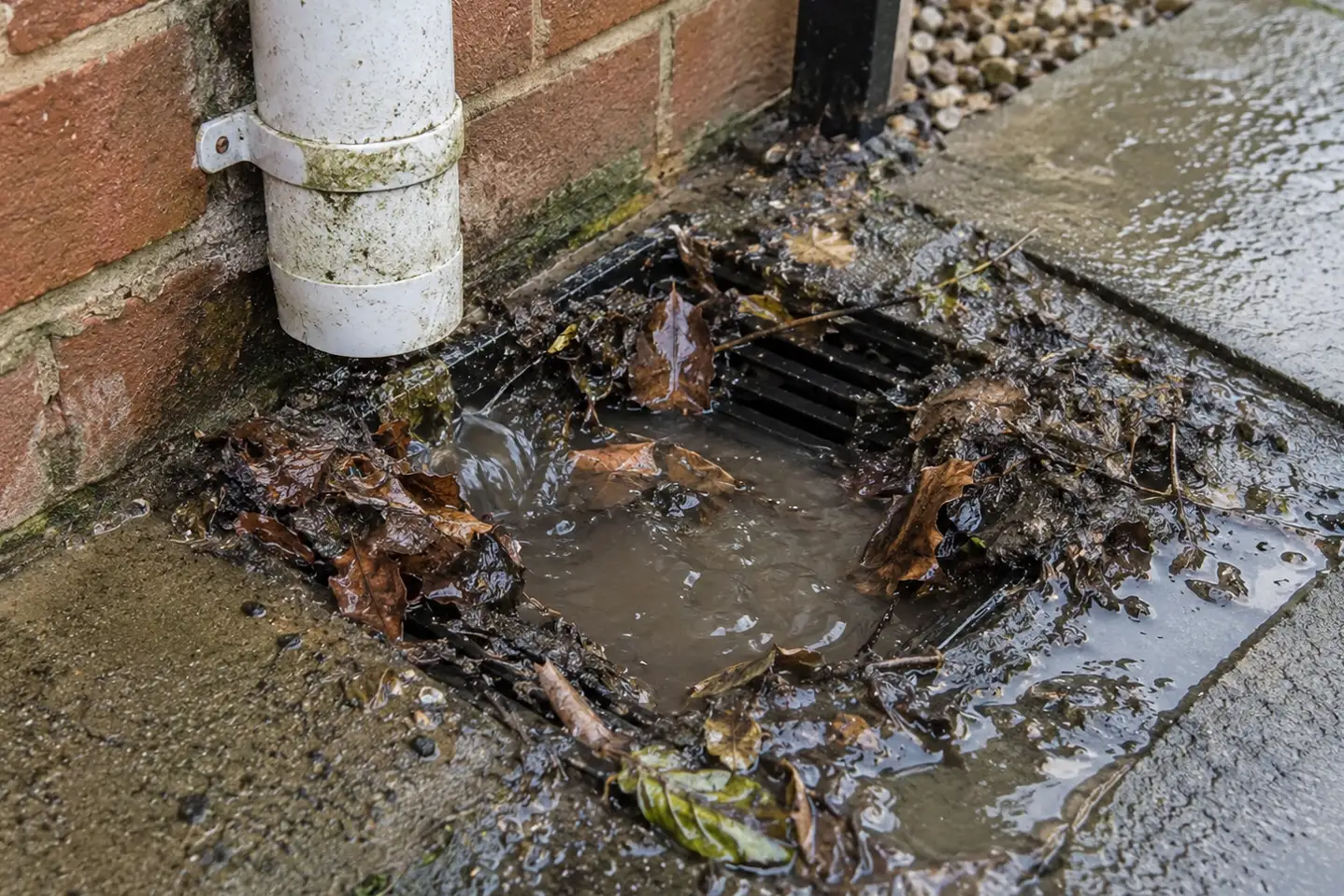
A blocked drain sits at an awkward decision point: reach for a plunger and risk making a mess of something that needed a professional, or call someone out for a problem that would have cleared with five minutes of ordinary effort. Getting this right starts with correctly identifying what’s actually blocked, because “a blocked drain” covers several genuinely different situations, not one problem with one answer.
Work out what’s actually blocked first
A single slow-draining kitchen sink is a different problem from a toilet that won’t flush, which is different again from water backing up out of an external gully, an inspection chamber overflowing in the garden, or drainage across the whole house behaving oddly. Before doing anything else, work out which of these you’re actually facing, because the sensible response — and the level of risk in attempting it yourself — varies enormously between them.
It’s also worth stopping the repeated “testing” once you know there’s a serious blockage. If flushing a toilet or emptying a sink causes wastewater to rise somewhere else, repeatedly doing it again to see whether the problem has cleared simply sends more water into a drainage system that is already struggling to take it away.
Reading the pattern
The pattern of what’s affected tells you a great deal before you touch anything.
One fixture draining slowly, on its own, with everything else in the house behaving normally — a single sink, bath or shower, for example — usually points towards a local restriction in that fixture’s trap or waste pipe. This is generally the lowest-risk situation to investigate yourself.
Several fixtures backing up around the same time, particularly ones in the same part of the house, suggests the restriction may sit further downstream, where several wastes join. A toilet that bubbles when a basin empties, or a shower tray that begins filling when another fixture is used, is a much stronger reason to suspect a shared section of drainage than a fault confined to one plughole.
Water or sewage appearing in an external inspection chamber or gully, or sewage backing up at the lowest fixtures in the house, points towards the underground drainage system rather than simply the trap below a sink.
None of these patterns proves the location on its own, but they provide a much better basis for deciding what to do than repeatedly attacking whichever plughole happens to be draining most slowly.
What’s reasonable to try yourself
For a genuinely local blockage — a slow kitchen sink, basin, bath or shower with everything else working normally — a few low-risk steps are worth trying before calling anyone.
A plunger can clear some simple obstructions close to the fixture. It needs to form a proper seal around the waste opening, with enough water present to cover the edge of the plunger, and works through repeated controlled strokes rather than one violent push. On a basin with an overflow opening, temporarily covering the overflow can improve the seal.
Hair and soap build-up that is visible immediately beneath a bath, shower or basin waste can sometimes be physically removed without dismantling the drainage system. An accessible sink trap can also be cleaned by somebody comfortable with basic household maintenance: put a bucket underneath, take note of how the components fit together, and make sure the joints are properly reseated afterwards.
The important limit is knowing where ordinary maintenance ends. Don’t start dismantling concealed pipework, opening underground drainage or improvising with high-pressure equipment because a plunger hasn’t worked. A blockage further into the drainage system may need rods, mechanical cutting, jetting or investigation equipment, but those methods bring a much greater risk of damaging pipework or turning a straightforward blockage into a more complicated repair when they’re used without knowing what the pipe contains or what condition it is in.
If you’ve already poured a chemical unblocker into the drain, don’t then casually dismantle the trap or start plunging without checking the product instructions. Corrosive liquid may still be sitting in the pipework and can splash back when the system is disturbed.
Chemical drain cleaners: proceed carefully
Chemical drain cleaners are widely available, but “sold for household use” shouldn’t be confused with harmless. Some strong drain unblockers contain corrosive substances capable of causing serious skin and eye injuries, so the product label and safety instructions matter.
Most importantly, never mix drain cleaner with bleach, toilet cleaner, limescale remover or another cleaning product, and don’t pour one chemical product on top of another because the first hasn’t worked. Chemical combinations can release dangerous gases or produce other hazardous reactions.
The London Fire Brigade’s guidance on mixing household cleaning chemicals follows real incidents involving people becoming ill after combining cleaning products, including bleach and drain cleaner. Its advice is to follow the label, keep products in their original containers and avoid using one cleaner immediately after another.
Chemical products also don’t solve every type of blockage. A solid object, collapsed or displaced pipe, root intrusion or restriction further down an underground drain isn’t made accessible simply by adding more chemical.
If you choose to use a drain unblocker, use only a product intended for the particular application and follow its instructions exactly. If one correctly used treatment hasn’t solved the problem, escalating by adding more product or combining treatments isn’t a sensible next step. Stop, ventilate the area where appropriate, keep the product container so you know what has been used, and tell any drainage professional before they start work.
Warning signs that mean it’s time to stop and call someone
A handful of signs point clearly towards professional help being the right response rather than continuing with DIY.
Sewage backing up inside the property is an immediate hygiene problem. Stop using the affected toilets, sinks, showers and appliances where possible so you’re not deliberately sending more wastewater towards the blockage, keep children and pets away from contaminated areas, and arrange appropriate help.
Several fixtures affected simultaneously suggests the blockage sits further into the shared drainage system than a household plunger can reasonably address. A blockage that repeatedly returns after apparently clearing also warrants investigation: grease and debris can certainly recur, but persistent problems can also be caused by root ingress, displaced joints, deformation, damaged pipework or another restriction that temporarily catches waste again after each clearance.
External drainage needs one further check before you automatically pay a private drainage company: whose pipe is actually blocked?
In England and Wales, Ofwat’s guidance on drainage responsibility explains that a homeowner is normally responsible for a drain serving their property within its boundary, while the sewerage company is responsible for public sewers and most lateral drains once they become part of the public network. A public sewer can sometimes run through private land, so a manhole being inside your garden does not by itself prove that the pipe beneath it is your responsibility.
The arrangements aren’t identical across the UK. Scottish Water generally places the private drain from the home to the property boundary with the homeowner and maintains the public sewer network beyond it. Northern Ireland Water likewise distinguishes between private drains and the public sewer system.
The practical point is simple: where an external blockage may be in a shared or public sewer, contacting your sewerage provider before paying a contractor can establish whether the blockage is actually yours to deal with.
And don’t enter an inspection chamber or manhole yourself. Underground drainage spaces can contain sewage, hazardous gases and other risks entirely different from clearing a sink trap at floor level.
Emergency, or can it wait?
Sewage actually backing up into the house, wastewater threatening electrical equipment or causing active property damage, or a complete blockage affecting the only usable toilet in the property generally justifies prompt attention.
A single slow-draining sink or bath, with every other fixture working normally and no sewage or active property damage, usually doesn’t carry the same urgency. In that situation there’s rarely a good reason to pay an out-of-hours premium simply because the water is taking longer than usual to disappear.
An external sewer problem affecting several properties may also be something to report directly to the relevant sewerage company rather than treating automatically as a private emergency call-out.
What matters is the consequence of waiting. If continued use risks bringing sewage into the home or causing damage, stop using the affected system and deal with it promptly. If the problem is local, contained and stable, arranging a normal appointment is usually proportionate.
The point of this article
This isn’t a recommendation to call a drainage company at the first sign of trouble — plenty of blockages are genuinely simple, low-risk and entirely reasonable to deal with yourself using basic methods. Nor is it an encouragement to keep persisting with DIY once the pattern points towards something further into the drainage system.
The sensible dividing line isn’t really “DIY versus professional”. It’s whether you understand where the likely blockage is, whether you can reach it without dismantling or pressurising significant parts of the system, and whether anything you’re doing risks sewage exposure, chemical injury or damage to the pipework.
Try the proportionate, low-risk things first for a genuinely local blockage. Stop when the evidence says the problem is further downstream, recurring, inaccessible or potentially structural. And before paying someone to clear an underground blockage, establish whether that section of drainage is actually your responsibility.
If a blockage keeps coming back despite being properly cleared each time, that’s usually a sign that treating the obstruction alone isn’t answering the more important question of why it keeps forming — a subject covered in more depth in our companion Property Front Page article on recurring drain blockages and when a CCTV drain survey is worth paying for.
This article provides general property information, not a diagnosis of your specific drainage problem. Where sewage backup, suspected pipe damage, a public or shared sewer problem, or a recurring blockage is involved, seek appropriate professional or sewerage-provider advice rather than continuing DIY attempts.

