

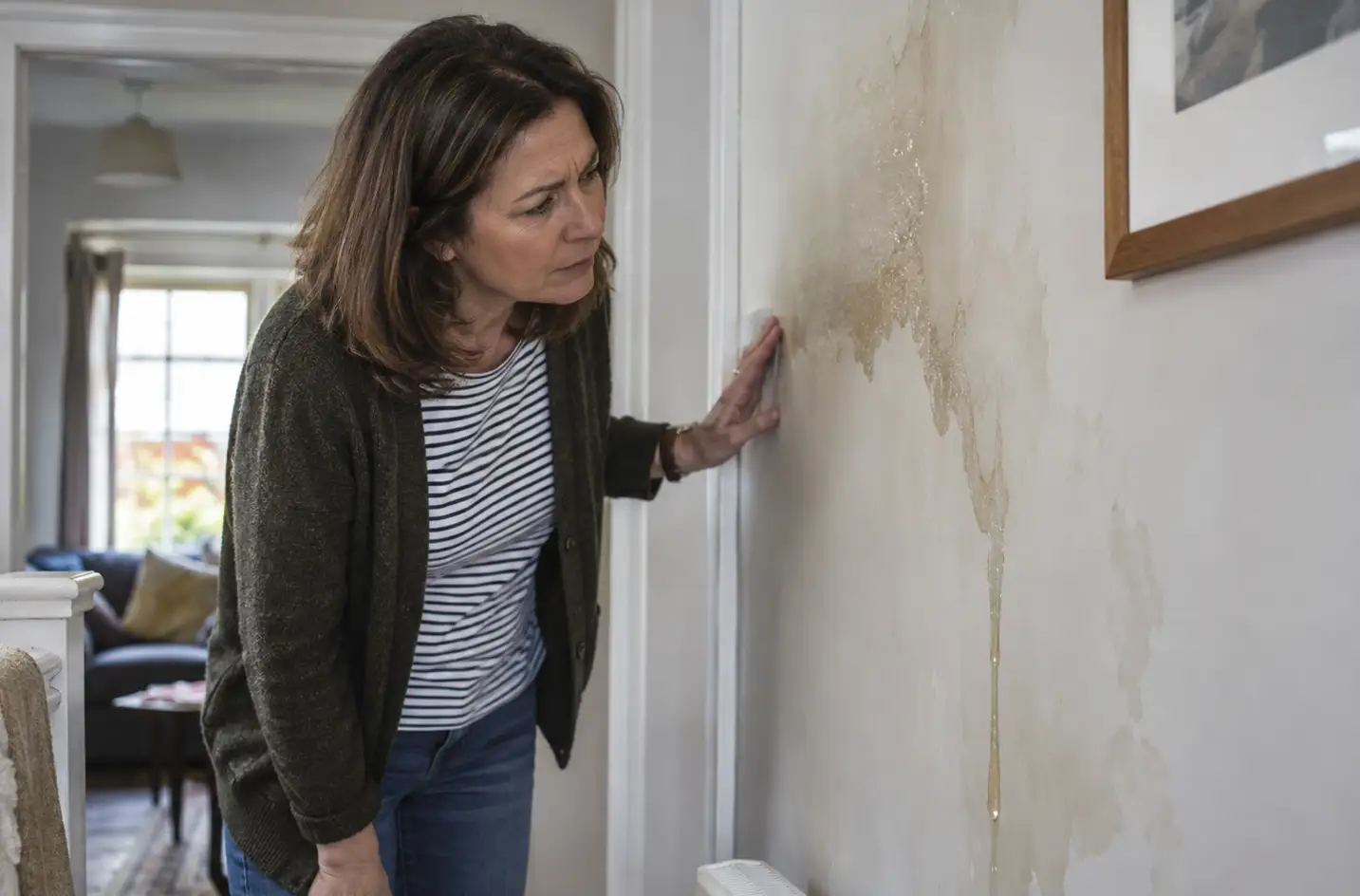
Water is coming through a ceiling, or pooling on a floor, or appearing somewhere with no obvious pipe anywhere near it. Right now, you need three things in order: stop the water, protect the property, and work out roughly what you’re dealing with. Everything else — who to call, what it’s likely to cost — comes after that.
First, stop the water
If the leak is clearly coming from a specific appliance or fitting — a washing machine, a dishwasher, a leaking pipe under a sink — look for an isolation valve on the pipe feeding it. The type varies: some use a small lever, while others have a slotted valve operated with a screwdriver. If you can clearly identify the correct valve, closing it can isolate that fitting without cutting the supply to the whole house. Don’t force a valve that’s seized or difficult to move.
If you can’t identify a specific source, or the leak is significant, go straight to the property’s main internal stop tap, sometimes called a stopcock or stop valve. In many UK homes this is under the kitchen sink, though it can also be in a kitchen cupboard, downstairs bathroom, garage, cellar or under the stairs — every property is laid out slightly differently, so this is worth knowing before an emergency, not during one. A traditional stop tap is closed by turning it clockwise, slowly and without forcing it, and it may take a few minutes for the flow to stop completely.
WaterSafe’s guidance on shutting off a household water supply recommends knowing where the internal stop tap is before you need it and warns against forcing one that won’t move.
If your home has a cold-water storage cistern in the loft, closing the mains supply doesn’t instantly remove the water already stored in the property. Outlets supplied from the cistern can therefore continue releasing water for a while. Water already sitting in pipework, cylinders or other parts of the system can also continue draining after the incoming supply has been shut off, so don’t assume that a drip continuing for a short period means the stop tap hasn’t worked.
For a significant plumbing leak, WaterSafe also advises opening cold taps after shutting off the supply to help drain the pipework and storage system, while avoiding the hot taps, and switching off the central heating and any electric immersion heater where appropriate.
If the internal stop tap is stiff, seized or doesn’t properly stop the flow, there is usually an external stop tap serving the property, often near the boundary beneath a small cover. That valve isn’t simply a second household tap to operate casually. WaterSafe says external stop taps normally belong to the water supplier, should ideally be operated by the supplier or a qualified plumber, and may serve more than one property. Permission may be required to operate one, even in an emergency, and damage caused by operating it can potentially become your responsibility.
For an ordinary internal leak, the internal stop tap is therefore the correct first move. If it won’t work and water is escaping significantly, contact an emergency plumber and, where necessary, your water supplier rather than forcing an external valve.
Then, protect the property
Once the water’s under control, move anything valuable out of the way and put containers beneath active drips where it’s safe to do so. Towels or other absorbent materials can help stop water spreading across a hard floor, and moving furniture, electrical equipment and belongings early can prevent a comparatively small leak becoming a much larger loss.
If a ceiling is visibly bulging with trapped water, keep people and possessions clear from beneath it. A waterlogged plasterboard ceiling can fail unexpectedly, and deliberately puncturing it isn’t a sensible general DIY recommendation: there may be electrical cables, fittings or pipework immediately above it, and releasing a large amount of water suddenly can create another hazard. A large or rapidly increasing bulge warrants professional help rather than standing underneath it trying to drain it yourself.
Once the immediate problem is under control, photograph the affected areas and the apparent source if you can do so safely. Those pictures can help whoever comes to investigate the leak and provide a useful record if an insurance claim follows.
Water and electricity: treat this seriously
If water is anywhere near light fittings, sockets, switches or a consumer unit, don’t touch wet electrical equipment, don’t operate switches with wet hands, and don’t stand in water while trying to reach anything electrical.
Electrical Safety First’s guidance on water-damaged electrics advises switching off the electricity at the consumer unit only if it is safe to do so. If there is water inside or around the consumer unit, visible damage, arcing, overheating or exposed wiring, don’t approach or operate it.
Electrical equipment, fixed wiring and fittings that have actually been affected by water may need checking by a registered electrician before being put back into service. Something can look dry externally while moisture remains inside a fitting or connection, so drying the outside of a light fitting or socket doesn’t establish that it’s safe to use again.
Why the water you can see may not be where it entered
This is worth understanding before you start hunting for the cause, because it changes where you actually look. Water doesn’t necessarily travel straight down from where it starts. It can follow the run of a pipe, track along a floor joist, spread beneath flooring, or migrate a genuine distance through a ceiling or wall cavity before it becomes visible as a stain or a drip.
A leak appearing on a ground-floor ceiling doesn’t automatically mean the source is directly above it — it could originate from a bathroom, pipe or appliance some distance away, with water travelling through the structure before finding somewhere it can escape.
This is exactly why guessing at a repair based on where the damage is visible so often fails to actually fix anything.
What kind of leak is this, roughly?
Different types of leak behave differently, and recognising which broad category you’re likely dealing with helps enormously in working out what to do next.
A pressurised supply leak — from mains-fed pipework carrying water into and around your home — will often continue while that pipework remains under pressure, regardless of whether a tap is being used. Closing the appropriate stop tap should eventually reduce or stop it, although residual water can continue draining for a period afterwards.
A waste-water leak, from pipework carrying used water away, is typically intermittent, appearing mainly when the relevant sink, bath, shower or appliance is being used. Closing the main stop tap won’t necessarily make an existing waste leak stop immediately because water already held in a bath, basin, appliance or waste pipe can still escape.
A heating-system leak can show up around radiators, heating pipes, the boiler or concealed pipe runs. On a sealed central-heating system, an unexplained fall in the boiler’s pressure reading can be a useful clue, although not every heating system is sealed and a pressure drop by itself doesn’t identify where the leak is.
An appliance leak — from a washing machine, dishwasher, fridge with a water connection or similar equipment — is often concentrated near the appliance, but water can travel beneath flooring or kitchen units before it becomes visible.
A bath or shower leak doesn’t necessarily come from the supply pipework at all. Failed sealant, movement around a shower tray or bath, defective waste fittings, pipe connections and failed waterproofing can all produce water below or beside a bathroom, often only while the fixture is being used.
A toilet or cistern leak can be surprisingly difficult to notice. Some faults send water continuously into the toilet pan and may first show themselves through increased water use rather than property damage; others occur at supply, waste or cistern connections and can wet the surrounding structure.
And water entering from elsewhere entirely — through a roof, wall, window or other part of the building rather than the plumbing — remains a real possibility, particularly where the problem coincides closely with heavy or wind-driven rain. If that pattern fits, our companion coverage in Roofs, Walls & External Fabric is the more useful place to continue the investigation.
Tracing the likely source yourself
Before assuming the worst, a methodical look can often narrow things down considerably. Check above and around the affected area for visible pipework, appliances, bathrooms, toilets or heating components, but remember that the water path may not be vertical.
If you have a loft with a safe, properly boarded route or platform, a torch may reveal staining or a water track leading towards the source. Don’t improvise a route across insulation, plasterboard or exposed ceiling joists simply to follow a leak.
The timing of the water is often one of the strongest clues. Does it appear constantly, only when the shower is running, when a washing machine empties, when the heating is on, or only after rain? A repeated relationship between one activity and the leak is much more useful evidence than the position of the stain by itself.
Closing the main stop tap can also provide a clue, but it isn’t a perfect diagnostic test. If a persistent leak reduces and eventually stops after the mains supply is isolated and residual water has drained, a supply-side leak becomes more plausible. If nothing changes, the source might instead be a waste pipe, heating circuit, stored-water system or external water ingress — but the result has to be interpreted alongside the way the particular property is plumbed.
If the property has a water meter, unexplained movement on the meter when every known outlet and water-using appliance is off can provide another indication that water is being used or escaping somewhere on the metered supply. It still doesn’t tell you where the leak is, but it can help establish that there is something worth investigating.
When it’s worth paying for proper leak detection
Not every leak needs specialist technology to find — plenty become obvious once the pattern of water use and nearby pipework is understood. But where a leak clearly exists and can’t be traced without opening floors, ceilings or walls speculatively, professional leak detection can be a much less disruptive next step.
The tools used depend on the pipework and the suspected problem. They can include pressure testing to see whether an isolated section loses pressure, acoustic equipment to listen for pressurised water escaping, thermal imaging to identify useful temperature patterns, and approved tracer-gas or dye techniques in suitable systems.
None of these methods is a magic scanner that reveals every leak through every building material, and a competent specialist may use more than one technique before reaching a conclusion. The value is in narrowing the search area before somebody starts removing finishes simply to see what’s behind them.
That can make specialist detection more cost-effective than repeated exploratory opening-up, particularly where the source is concealed — but it’s worth checking your insurance position first if the potential damage is substantial, because some policies include specific “trace and access” cover and may have requirements about how investigation work is authorised.
A brief word on insurance
Escape of water from pipes, tanks, fixed heating systems or domestic appliances is a common insured event under UK home policies, but that doesn’t mean every cost arising from a leak is automatically covered.
The damage caused by escaped water, the cost of finding and gaining access to a hidden leak, and the cost of repairing the pipe or appliance that actually failed can all be treated differently under a policy. Some policies include separate trace-and-access cover, often subject to its own limit, while the defective pipe or fitting itself may not be covered unless another part of the policy applies.
Gradual leaks need more nuance than simply saying that insurers don’t cover them. Policies commonly contain exclusions for gradual damage and wear and tear, but the Financial Ombudsman Service’s current guidance on gradual damage makes clear that the circumstances matter. Even where damage developed gradually, the Ombudsman may consider it unfair for an insurer to reject a claim where the damage resulted from an insured event, the homeowner couldn’t reasonably have known it was happening — for example because the leak was concealed — and they acted promptly once they became aware of it.
If the damage is significant, photograph it and check your policy or contact your insurer before authorising extensive destructive investigation or reinstatement work. Emergency action to stop water and prevent further damage comes first, but preserving evidence and understanding any claim requirements before walls or floors are opened can avoid problems later.
What to actually take from this
Stop the water first, using whichever isolation point actually addresses the problem — a local valve where the source is obvious, or the main internal stop tap where it isn’t. Don’t force seized valves or assume the external supplier stop tap is yours to operate.
Keep away from water-affected electrics, and don’t puncture a bulging wet ceiling simply because it looks like the quickest way to drain it.
Then pay attention to the pattern: whether the water is constant or intermittent, what was being used when it appeared, whether shutting off the supply changes it, and whether rain has anything to do with it. Where water shows up isn’t necessarily where it started — which is exactly why a methodical trace, or a properly conducted professional investigation when the source stays hidden, beats a repair based on guesswork.
This article provides general property information and does not replace professional plumbing, electrical or leak-detection advice for your specific situation. In an emergency involving uncontrolled water, unsafe electrics or a ceiling at risk of collapse, prioritise personal safety and professional assistance over further investigation.

