

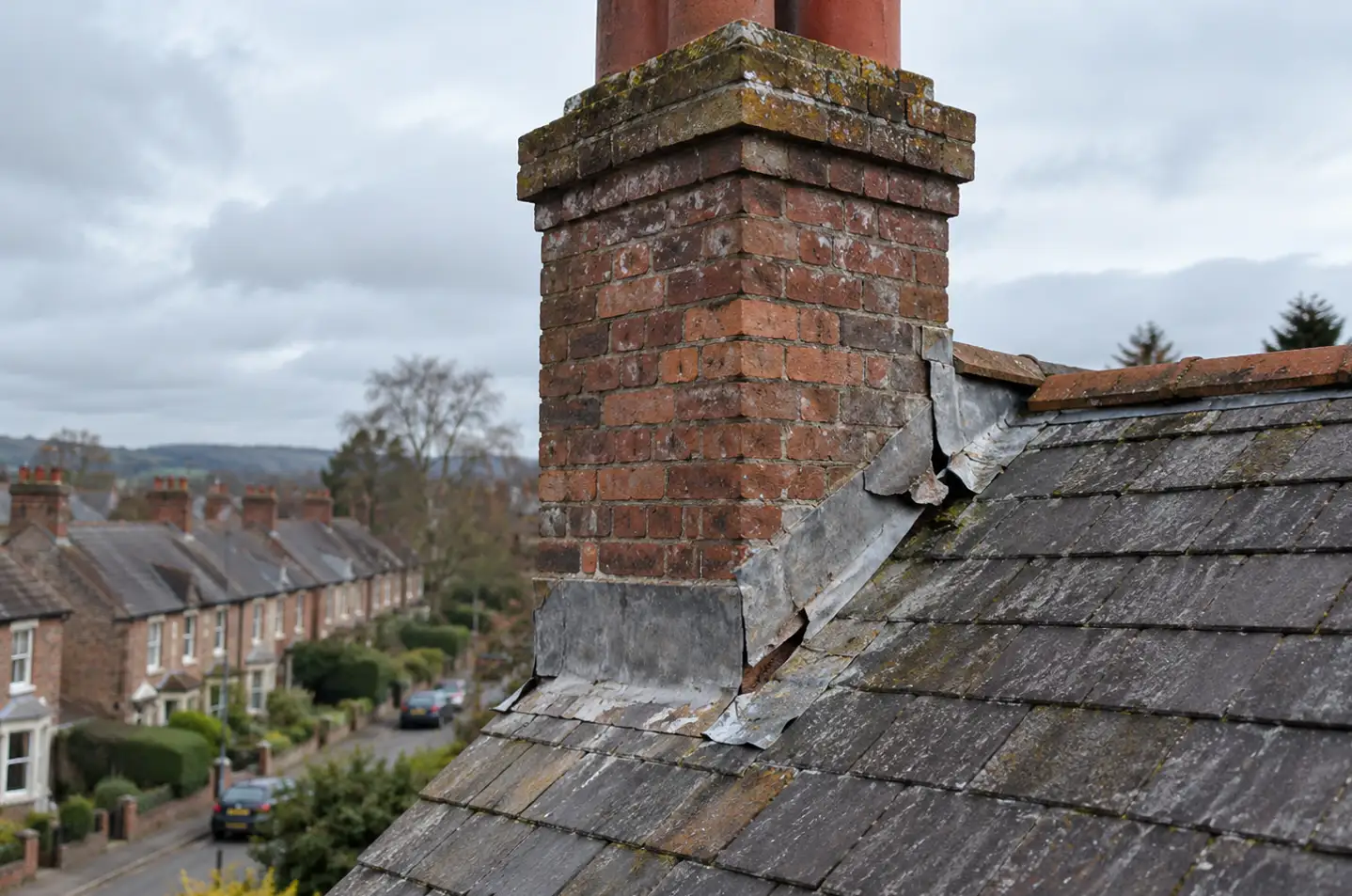
Damp appearing on a chimney breast, or a stain spreading from the corner of a ceiling where the stack passes through the roof, sends a lot of homeowners down the same frustrating road: pay for a repair, watch it hold for a while, then watch the damp return. Chimneys are particularly common trouble spots on UK roofs — and the reason isn’t bad luck. It’s that a chimney concentrates several genuinely separate components, each capable of failing independently, into a very small area.
Why chimneys are such common trouble spots
A roof covering, left alone, is a relatively simple, repeated system — the same tile or slate, laid the same way, again and again. A chimney interrupts that system completely.
It’s a masonry structure passing through the roof plane, which means the roof covering has to be weathered against brick or stone on every side, using details entirely different from the tiling itself. Put another way: a plain roof slope has to keep water out in one broadly repeated way. A chimney has to do it through several separate junctions simultaneously — and any one of them failing on its own can be enough to let water in.
The components involved, and what each one does
Step or cover flashing runs along the sides of the chimney where it meets the sloping roof. On traditional lead details it is commonly stepped into joints or chases in the masonry and dressed over the roof covering, working together with the soakers beneath. The exact arrangement varies with the type of tile or slate, so what looks like one simple strip of lead from the ground is often part of a more complicated weathering system.
Soakers sit beneath the tiles or slates alongside the chimney and are usually among the least visible parts of the whole system — you generally can’t inspect them properly without lifting the surrounding covering. Traditional soakers may be lead, while modern roofing systems can use other materials. If they are damaged, poorly installed, missing or deteriorated, they can provide a hidden route for water even when the visible flashing above appears reasonable.
Apron flashing sits at the front, or lower side, of the chimney where the roof slope meets the stack. It directs water from the face of the chimney back onto the roof covering below.
The back gutter sits behind the chimney on the higher, or up-slope, side. Its job is particularly important because rainwater running down the roof above the stack has to be collected and diverted around it. A poorly detailed, obstructed or damaged back gutter can allow water to build up behind the chimney even while the more visible flashing at the front and sides looks sound.
It’s also worth clearing up a terminology trap: a back gutter and a saddle aren’t simply two names for the same component. Lead saddles are used in particular roof junction details, including some ridge situations, whereas a chimney positioned within a roof slope normally has a distinct back gutter behind it.
Pointing is the mortar between the bricks or stones of the chimney stack itself, and like pointing anywhere else on a building, it weathers, cracks and eventually fails — a subject explored in full in our companion article on repointing. Failed pointing on a chimney is particularly consequential because it’s often within centimetres of the flashing. Water entering open joints can penetrate the masonry and appear as damp internally even when the leadwork itself isn’t the problem.
Flaunching is the sloping mortar at the top of the stack, around the chimney pots. It helps secure the pots and sheds rainwater away from the top of the chimney. Cracked, loose or missing flaunching can allow water into the top of the stack and surrounding masonry — a source of damp that is completely separate from the flashing lower down at roof level.
The Society for the Protection of Ancient Buildings’ guidance on chimney maintenance covers pointing, flaunching, flashings and back gutters in more detail, particularly where an older chimney is involved.
Deteriorating or highly exposed masonry on the stack itself can also absorb water during prolonged wet weather. Weathered bricks or stone, damaged faces, open joints and repeated freeze-thaw cycles can all contribute, so looking only at the leadwork can miss a problem higher up the stack.
What the pattern of damp can tell you
Where and when the damp appears won’t diagnose the defect with certainty, because water can travel through a roof or chimney before becoming visible. It can, however, give a competent roofer a much better starting point.
| What you notice | Areas worth investigating |
|---|---|
| Damp appears around roof or ceiling level after rain | Flashings, soakers, back gutter and roof/chimney junction |
| Leak is worst during wind-driven rain | Exposed side flashing, pointing or masonry on the weather-facing side |
| Damp starts higher on the chimney breast after prolonged wet weather | Pointing, flaunching, pots or exposed stack masonry |
| Water seems to come directly down the flue | Open pot or flue, defective terminal, flaunching or top of stack |
| Brown or yellow staining persists regardless of rainfall | Soot contamination, hygroscopic salts or condensation may be involved |
| Damp persists after external repairs appear successful | Re-check the original diagnosis rather than automatically repairing the flashing again |
The useful evidence is often the pattern rather than the stain itself. Note whether the problem coincides with heavy rain, prolonged rain, a particular wind direction or cold weather. Photographs taken when the damp is active can also be much more informative than a dry wall by the time somebody comes to inspect it.
“The roofer sealed the flashing, but it’s still leaking”
This is one of the most common frustrations in the whole subject, and it follows directly from everything above: sealing or repointing the most visible, most obviously accessible part of the chimney junction doesn’t help if the actual defect is one of the less visible components — a failed back gutter, defective soakers, deteriorated masonry or a problem further around the stack than the section that was worked on.
A repair that treats the symptom that happens to be easiest to reach, rather than tracing water back to its actual entry point, produces exactly the pattern so many homeowners experience: a temporary improvement, followed by the same leak returning, sometimes appearing to move slightly as water finds a marginally different route through the same underlying defect.
A properly diagnosed chimney leak therefore involves considering the whole junction — side flashings, soakers, apron, back gutter, pointing, flaunching and the condition of the stack itself — rather than assuming the answer from whichever element is easiest to see from the ground.
When it isn’t rain penetration at all
Damp on a chimney breast doesn’t always mean water is getting in from outside. Other, quite different mechanisms can produce remarkably similar symptoms.
Hygroscopic salts are particularly relevant to old chimney breasts. Decades of coal or wood combustion can leave salts and other contamination within chimney masonry and plaster. Some of those salts attract moisture from humid air, so a chimney breast can continue to look or feel damp even when an external leak has already been repaired.
Condensation is another possibility, particularly in a redundant or rarely used flue that has been blocked, sealed or left without adequate ventilation. Warm, moisture-laden air meeting cold chimney masonry can produce condensation within the flue and staining internally.
An open flue presents a different problem: rather than being a condensation issue simply because it is uncapped, it can allow rain directly into the chimney if it has no suitable terminal or weather protection.
Historic England’s guidance on fireplaces, chimneys and flues specifically identifies water penetration, deteriorated pointing, ineffective flaunching and condensation in blocked or inadequately ventilated flues as possible causes of chimney damp.
This is a large enough subject in its own right that it’s covered properly in Property Front Page’s Damp, Mould & Condensation section; it’s mentioned here so that a chimney breast that stays damp despite apparently sound flashing and pointing isn’t automatically assumed to need yet another leadwork repair.
Older chimneys need particular care
Many traditional solid-masonry buildings — particularly older houses dating from before widespread use of modern cavity-wall construction — were built using lime-based mortars. That doesn’t mean the age of a house alone tells you exactly what mortar is present, particularly where a chimney has been repaired or rebuilt previously, but it does mean compatibility matters.
On an older stack originally constructed in lime, replacing weathered joints indiscriminately with a hard, dense cement-rich mortar can cause problems. Traditional lime mortar is generally softer and more vapour-permeable than the surrounding historic masonry, allowing moisture to move and evaporate through the joints. An excessively hard or impermeable replacement mortar can instead encourage moisture and frost damage to occur through the bricks or stone themselves.
The right approach isn’t simply “old house equals one standard lime mix”. Existing sound original mortar, the masonry, exposure and construction all need to be considered so that the replacement is compatible. SPAB advises that mortar used for repointing old chimney stacks should normally be lime-based and appropriate to the existing construction.
Lead detailing on older chimneys similarly benefits from somebody experienced in traditional roof work, because apparently small details around soakers, back gutters and junctions can determine whether the repair works for years or merely survives until the next spell of difficult weather.
What this means for getting it fixed properly
Given how many separate things can go wrong in such a small area, a chimney leak is rarely well served by a quick, single-point repair carried out without a proper look at the whole stack — flashing, soakers, back gutter, pointing, flaunching and masonry together, not just whichever element happens to be easiest to see from the ground.
If you’re being quoted for a repair, three questions are particularly useful:
What do you believe is actually letting the water in?
What evidence points to that rather than another part of the chimney?
Is the proposed work repairing the defective detail properly, or simply sealing over it?
Those questions don’t require a homeowner to become a roofing expert. They simply force the proposed repair to have a diagnosis behind it.
It’s also, unambiguously, not a sensible DIY investigation at roof level. Chimney work combines height, exposed roof surfaces and awkward working positions, often close to roof edges. The Health and Safety Executive’s roof-work guidance describes roof work as highly dangerous and stresses the need for proper planning, competent people and suitable access equipment.
A roofer or specialist who’s prepared to inspect the whole system, explain where they believe the water is entering and specify how that defect will be repaired is worth considerably more than a quick patch applied to the most obvious piece of lead.
This article provides general property information and does not replace a proper inspection of your specific chimney. Chimney and roof work involves significant work-at-height risks and should be carried out by appropriately competent and insured professionals.

