

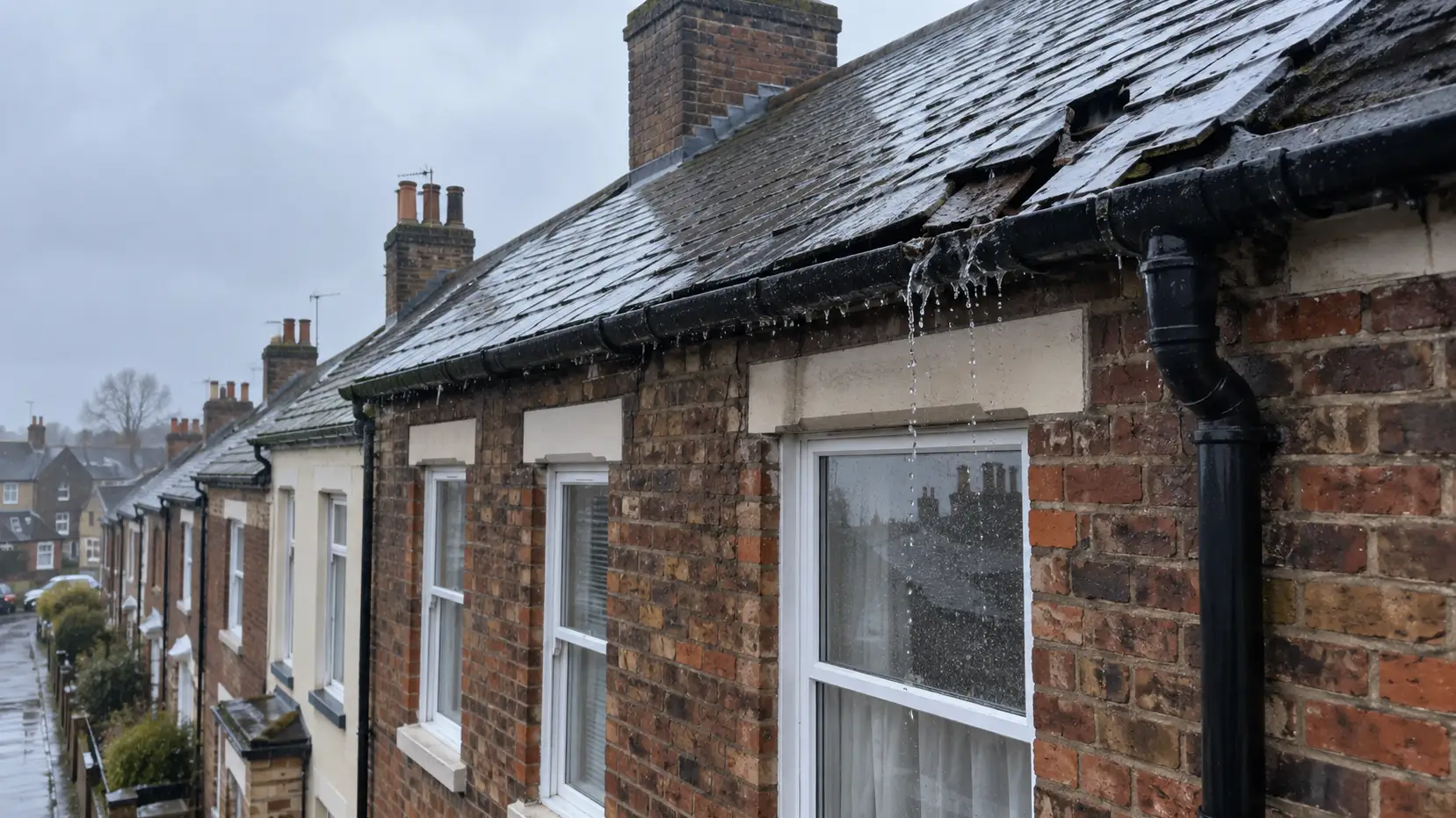
There’s a damp patch spreading across the ceiling, or water is actually dripping, and the instinctive assumption is that the roof directly above that spot must be where it’s coming in. That assumption is very often wrong, and it’s one of the main reasons roof repairs fail on the first attempt: someone fixes the roof exactly above the stain, and the leak comes back the next time it rains.
Water doesn’t fall in a straight line
Once rain gets past a roof’s outer covering — a tile, a slate, a flashing junction — it doesn’t necessarily drop straight down onto the ceiling below. It can land on the underlay or directly onto a timber, and from there travel along the slope of a rafter, batten or other surface, sometimes for a surprising distance, before it reaches a low point, a gap, a fixing hole or somewhere it can finally enter the room below.
A leak that entered the roof a metre or more up-slope, and off to one side, can therefore show up as a stain that looks as though it’s sitting directly beneath a perfectly sound section of roof.
This matters practically, because it means the most useful question isn’t “what’s wrong with the roof directly above this stain?” It’s “where could water be entering that would end up travelling to this exact point?” — which usually means looking further up the slope, and sometimes to one side, not just straight above.
Where to actually look
A relatively small number of locations account for many roof leaks, and knowing them means you’re not searching blind.
Slipped, cracked or missing tiles and slates are the most obvious starting point, and sometimes the easiest to spot — a gap in an otherwise even pattern, visible from the ground with binoculars, or a tile lying in the garden after a windy night. A tile or slate doesn’t necessarily have to fall off completely to cause trouble; slipping out of position can open a route for wind-driven rain.
Flashing — the lead or other weathering material used to seal the junction wherever the roof meets something else, most commonly a chimney, a wall or a rooflight — is a frequent culprit. These junctions are inherently more vulnerable than an unbroken expanse of tiles because they depend on several materials and details working together.
Valleys, where two roof slopes meet at an angle and channel a large volume of water down a single line, take significant punishment during heavy rain, and a defect in the lining, joints or surrounding tiles can let through a disproportionate amount of water.
Ridge and verge details — the mortar or dry-fix systems protecting and securing the tiles along the top and sloping edges of the roof — can deteriorate, loosen or become damaged over time. Older mortar bedding in particular can crack or break away.
Rooflights and other penetrations — anything that interrupts the roof covering, from a skylight to a soil vent pipe — are, like flashing, junctions between materials rather than a continuous roof surface, and are correspondingly worth checking carefully.
Underlay failure can also matter, particularly where older bituminous felt has become brittle, torn or sagged, or a newer membrane has been damaged. The important distinction is that the underlay beneath a conventional tiled or slated pitched roof is normally a secondary weather barrier, not the roof’s primary covering. The tiles or slates provide the main weathering surface; the underlay provides additional protection against water that gets past them, including wind-driven rain.
Flat roofs — commonly found on extensions, garages, dormers and porches — fail differently again: through split or punctured felt, failed laps or seams in membrane systems, defective upstands or outlets, and water ponding where drainage isn’t working properly. The visible damp internally may still be some distance from the defect.
Overflowing gutters and rainwater goods, while not strictly a roof-covering failure at all, can produce very similar symptoms — water backing up beneath the eaves, running behind a fascia or spilling against the building and finding its way into the roof structure exactly as though the roof itself had failed.
The clues worth paying attention to
A few observations, made without going anywhere near the roof yourself, can genuinely narrow things down.
Does the leak only appear during, or shortly after, rain — and does it correlate with wind direction? A leak that only shows up when rain is being driven from a particular direction can point towards a flashing, verge, rooflight or other junction on that side of the roof, since wind-driven rain can reach defects that more vertical rainfall doesn’t.
Does it appear during heavy downpours specifically, or does it show up even during light, persistent rain? Heavy-rain-only leaks can point towards a valley, outlet, gutter or downpipe struggling to discharge water quickly enough. A leak that develops during prolonged lighter rain can indicate a smaller but more direct route through the covering or a junction.
Is it near a chimney? Chimneys bring together several separate junctions in a small area and are a disproportionately important place to investigate — this is explored fully in our companion article on chimney leaks specifically.
Can you see actual water tracks in the loft, rather than just a stain on the ceiling below? If the loft has a safe boarded route or platform and you can enter it without climbing across unprotected joists, insulation or plasterboard, a torch can sometimes reveal staining on a rafter, timber or the underlay that leads your eye a surprising distance from where the water eventually shows up in the room below. Don’t improvise a route across an unboarded loft simply to trace a leak.
Are the gutters actually clear and running properly during rain? This is one of the easier things to observe from ground level and can rule out — or point towards — a common source of water ingress that isn’t a defect in the roof covering itself.
What the timing of the leak can tell you
None of these patterns proves the cause on its own, but they can make the first inspection considerably more focused.
| What you notice | Areas worth investigating |
|---|---|
| Leak mainly during wind-driven rain | Flashings, verges, rooflights, wall abutments and other exposed junctions |
| Leak mainly in very heavy rain | Valleys, gutters, outlets, downpipes and flat-roof drainage |
| Damp close to a chimney | Flashings, soakers, back gutters and the chimney/roof junction |
| Water appears some time after rain starts — or after it stops | Water may be travelling or temporarily collecting elsewhere before reaching the ceiling |
If possible, note what the weather was doing when the leak appeared, how quickly it started, whether the wind was coming from a particular direction and whether you could see overflowing rainwater goods. A few photographs taken at different stages can give a roofer substantially more useful information than a dry ceiling when they arrive several days later.
What to do immediately, safely
While you’re working out the cause, or waiting for a professional, a few sensible steps can limit the damage without putting anyone at risk. Move furniture, electrical equipment and anything valuable away from the affected area, and place a container beneath an active drip where it is safe to do so.
Water and electricity need particular caution. If water is reaching, or close to, a ceiling light, wiring, socket, appliance or other electrical fitting, don’t touch the fitting or wet equipment. Electrical Safety First advises switching off the electricity supply at the consumer unit if it is safe to do so and getting professional electrical advice where water has affected the installation.
A visibly bulging ceiling also needs caution. Keep people and possessions clear from underneath it rather than assuming it is safe to pierce the plasterboard. A waterlogged ceiling can fail unexpectedly, and deliberately puncturing it can release a large quantity of water or create an additional electrical risk if wiring or fittings are nearby. If the bulge is substantial, growing quickly or anywhere near electrics, professional help is the safer response.
What you shouldn’t do is go up onto the roof yourself to investigate or attempt a repair, particularly in wet or windy conditions. Wet tiles and slates can be extremely slippery, and some roof surfaces or rooflights may not safely support a person’s weight. The Health and Safety Executive’s guidance on roof work illustrates how seriously work at height and fragile roof surfaces need to be treated.
Inspection from the ground, or from a safely accessible part of the loft, is where a homeowner’s investigation should normally stop.
Why the “obvious” repair so often doesn’t work
This is worth its own section, because it’s the pattern behind a huge amount of homeowner frustration: a roofer patches the spot that looks most likely, the leak stops for a while, and then it comes back — sometimes in the same place, sometimes somewhere slightly different.
The most common explanation is straightforward once you know to look for it: the repair addressed a visible symptom rather than the actual point of entry. Sealing a crack in a tile that happens to sit near where a stain appears feels like a fix, but if the real problem is a failed flashing two metres away, sending water travelling along a rafter to exactly that spot, the repair was never going to solve anything.
This is also why a leak that seems to have “moved” between repairs isn’t necessarily a sign of a new, separate problem. It can be the same entry point, with water finding a marginally different route to the ceiling depending on wind direction, how much rain has fallen, the state of the insulation or how saturated the surrounding materials already are.
A repair that hasn’t actually traced water back towards its true origin, rather than working outward from where the damage is visible, can therefore amount to little more than a temporary interruption.
When it’s time to bring in a professional
A single missing tile that you can identify clearly from the ground, with damage limited to one small, obviously explicable area, is often a straightforward job for a competent local roofer.
Beyond that — leaks appearing in more than one place, leaks that persist after an apparent repair, damage that seems out of proportion to any single visible defect, water close to electrical fittings, or simply not being able to identify a plausible cause from the ground or a safely accessible loft — is where it’s worth paying for a proper inspection rather than guessing repeatedly.
A roofer who genuinely traces the likely water path, checking the internal evidence, roof junctions and covering together rather than assuming the answer from a five-minute look at the outside, is worth more than a quick quote based on a glance from the pavement. Ask what they believe the actual entry point is, what evidence led them to it, and whether the proposed work is intended as a temporary repair or a permanent one.
This article provides general property information and does not replace a proper professional inspection of your specific roof. Roof access carries real safety risks; inspection and repair work at height should be left to insured, competent professionals.

