

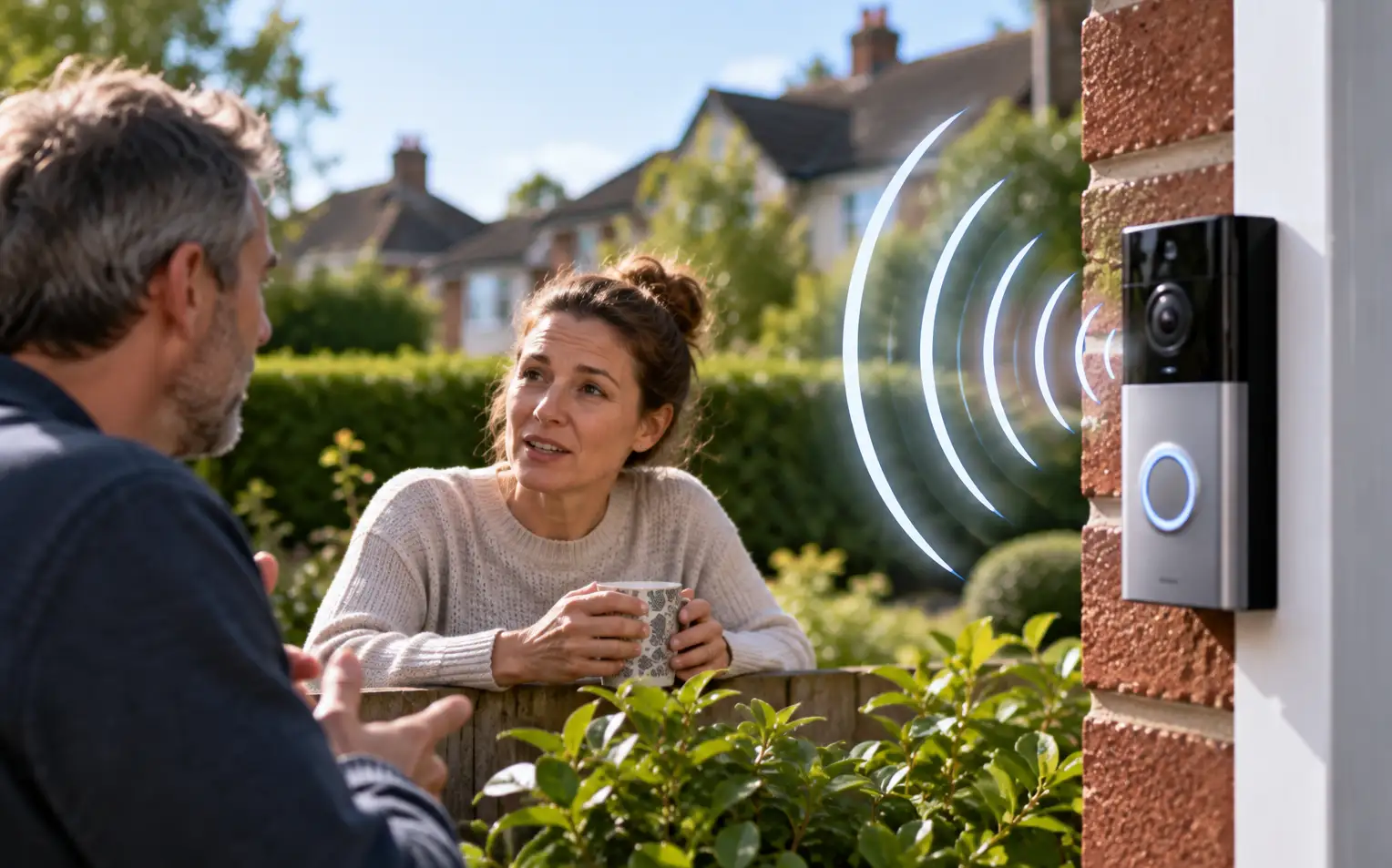
A conversation on your own doorstep, or over the garden fence, isn’t something most people think of as being “recorded” in any formal sense — it’s just talking. Then you learn that the neighbour’s video doorbell forty feet away has a microphone sensitive enough to pick up ordinary speech at that distance, and the conversation you thought was private turns out to exist as a stored audio file on someone else’s account. Does that change anything legally?
It does — more than most people expect, and the reason is worth understanding properly rather than reducing it to a single alarming headline.
A camera showing that you walked past somebody’s house is one thing. A microphone capturing what you said to your partner, discussed with a friend or mentioned during a private telephone conversation is another. Both can involve personal information, but the second may reveal considerably more about your life than the first.
That doesn’t mean every video doorbell with a microphone is unlawful, or that somebody must obtain your permission before their home-security system records your voice. The law recognises legitimate reasons for recording sound, particularly when somebody is speaking directly to a doorbell or security camera.
What it doesn’t automatically justify is allowing a microphone to collect conversations taking place beyond the property it is supposed to protect, simply because the equipment is capable of doing so.
For homeowners concerned about next door’s camera, and for those operating cameras themselves, the important questions are what is actually being recorded, why the sound is needed and whether the intrusion can reasonably be justified.
Why a microphone is different from a lens
Video surveillance ordinarily shows where somebody was and what they were doing. Audio can reveal what they were thinking about, worrying about or discussing with another person. A recording might capture a medical concern, a financial difficulty, a family disagreement or an otherwise unremarkable conversation that the people involved never intended to share with a neighbour.
It’s that additional intrusion which makes sound recording particularly sensitive.
The Information Commissioner’s Office addresses this directly in its guidance on audio recording and surveillance. It describes recording conversations between members of the public as highly intrusive and advises that audio capabilities should normally be disabled unless there is a clear, evidenced need for them.
The guidance is directed at organisations using surveillance systems rather than specifically at domestic video doorbells. An ordinary household installation doesn’t automatically carry every organisational compliance requirement. Nevertheless, the underlying privacy concern is directly relevant: a legitimate reason to watch an entrance doesn’t necessarily provide a good reason to record everything said within microphone range.
Many modern doorbells and home cameras offer audio alongside their video functions. Some have microphones enabled when first configured, while others give owners more control over when sound is captured. It’s entirely possible for someone to install a camera, concentrate on the picture and never give the microphone much thought.
That can produce a surprisingly intrusive result without any deliberate intention to listen to the neighbours.
Imagine a homeowner fitting a video doorbell because parcels have been disappearing. The camera shows the front entrance and records movement around the doorstep, which is a perfectly understandable security purpose. But if every clip also captures conversations between people walking along the pavement, the system is collecting information that may contribute nothing to solving the parcel problem.
A camera overlooking a rear garden presents a similar difficulty. Its owner may reasonably want to know if somebody enters their property at night, but a microphone capable of recording conversations from the adjoining patio raises a rather different question. Why does detecting an intruder require collecting what the neighbours say over dinner?
None of this means video is harmless. A camera deliberately trained through somebody’s window may create serious privacy concerns without recording any sound at all. Audio simply adds another layer of information, often one that is much harder to connect to an ordinary home-security purpose.
Where recording conversations crosses the legal boundary
For domestic CCTV, the underlying legal framework is much the same whether a system records pictures, sound or both.
Where surveillance is used purely for personal or household purposes and remains within the operator’s private domestic property, the activity will generally fall within the household exemption from UK data protection law.
The position changes when the system records identifiable people beyond that boundary. If a doorbell or garden camera captures personal information about neighbours, visitors or passers-by outside the owner’s private property, UK data protection law can apply.
That includes identifiable voices, not just images. The ICO’s guidance on home CCTV systems explains that householders recording people beyond their private boundary can become data controllers, with responsibilities for the information they collect.
The fact that a microphone captures sound outside the boundary doesn’t automatically make the recording unlawful. A doorbell may reasonably record a short conversation with someone standing at the entrance. The owner might need to hear a visitor speaking through the device or preserve an exchange connected with a genuine security incident.
Two neighbours chatting in their garden while a nearby security camera records their conversation present a considerably harder case. Neither person is approaching the camera owner’s property, and the content of their discussion has no obvious connection with protecting it.
Distance alone doesn’t settle the question. A conversation close to a property boundary may be less intelligible than one further away, depending on traffic, wind, microphone direction and other conditions. Nor does a manufacturer’s advertised microphone range prove that meaningful speech is actually being recorded.
The practical issue is what the equipment captures during normal use. A microphone capable of detecting distant sound isn’t necessarily storing intelligible conversations, although assuming that it probably cannot hear the neighbours clearly is no substitute for checking.
There’s also a legal misconception that can make these disagreements sound more dramatic than they need to be.
People sometimes assume that recording a conversation without permission must amount to telephone interception. The interception provisions of the Investigatory Powers Act 2016 concern communications intercepted during transmission through specified communications systems. An ordinary doorbell microphone picking up two people speaking directly to one another in a garden is not normally that kind of activity.
That doesn’t make the recording unrestricted. Data protection and privacy law may still apply, and deliberately targeted surveillance can raise harassment concerns in more serious circumstances. The point is simply that ordinary ambient sound picked up by a security microphone isn’t the same thing as intercepting a telephone communication.
Consent is another area where assumptions can be misleading.
A camera owner doesn’t normally need to obtain permission from every person whose voice may appear in a proportionate home-security recording. Where data protection law applies, a legitimate security interest may provide the lawful basis for processing personal information beyond the property boundary.
But protecting a home doesn’t automatically justify capturing unrelated conversations. The person operating the microphone still needs to consider whether recording that speech is necessary and proportionate to the security purpose.
And with audio, that can be a much more difficult case to make than with the corresponding video.
The difference between hearing the doorstep and listening to the neighbourhood
Much of the practical difference comes down to how and when the microphone operates.
A video doorbell that captures a short exchange after someone presses the button has a relatively clear purpose. The visitor is interacting with the household, and the audio is connected with identifying or communicating with the person at the entrance.
A system that records sound continuously, or activates frequently because it detects movement across a wide area, can collect hours of unrelated activity. That might include conversations on the pavement, people speaking on adjoining driveways or neighbours using their gardens.
The Government’s guidance on responsible domestic CCTV use encourages householders to consider whether their cameras need to record continuously and whether sound recording is necessary at all.
A short recording triggered by a genuine event will often be less intrusive than an always-on microphone collecting everything within reach. But describing a system as event-triggered doesn’t, by itself, establish that the recording is proportionate.
Consider a doorbell configured to record whenever somebody walks along the pavement outside a terraced house. It might activate dozens of times a day, saving clips that include conversations between people with no connection to the property. The owner may regard the system as motion-activated rather than continuous, yet the practical result could still be extensive collection of unrelated speech.
A recording activated when somebody actually presses the doorbell has a more obvious connection with the purpose of the device.
The settings can introduce complications that aren’t immediately apparent. A privacy mask that obscures the neighbour’s patio in the video doesn’t necessarily prevent the microphone from capturing conversations taking place there. Similarly, narrowing a motion-detection zone may reduce unwanted alerts without changing what the microphone records once a clip begins.
Someone could therefore take considerable care to keep a neighbouring garden out of the picture while continuing to record what people say in it.
If you operate a camera, check the audio settings separately. Find out when the microphone is active, whether two-way conversations are saved, whether live viewing captures sound and whether exported clips contain an audio track. The behaviour can vary between devices, even within the same manufacturer’s range.
Where audio and video can be controlled independently, disabling sound that serves no clear purpose is often the easiest solution.
There are circumstances in which recording speech may genuinely contribute to security. A homeowner experiencing repeated threatening behaviour at their front entrance, for example, may have a more specific reason to preserve what is said during an incident than somebody whose only concern is identifying who delivered a parcel.
Even then, a need to record particular interactions doesn’t necessarily justify collecting unrelated conversations elsewhere throughout the day.
The better question isn’t whether continuous or triggered recording is automatically legal. It’s whether the way the system operates captures more speech than the security purpose reasonably requires.
What a responsible camera owner should do with audio
For most ordinary home-security installations, leaving audio disabled unless there’s a clear reason to use it is a sensible starting point.
Video alone can often show who approached the front door, when a parcel arrived or whether somebody entered the garden. If those images already provide the security information you need, the microphone may be collecting additional personal information without adding much protection.
If sound is genuinely necessary, its operation should be as limited as the circumstances and equipment allow. Recording an interaction when somebody presses the doorbell is easier to connect to that device’s purpose than storing every conversation within range throughout the day.
Transparency matters too. People may be accustomed to seeing CCTV notices without realising that a camera is also recording what they say. The ICO’s wider surveillance guidance recommends making audio recording clear to the people affected, rather than assuming a general indication of video surveillance adequately explains the collection of conversations.
For a householder recording identifiable people beyond their private boundary, that means considering whether neighbours, visitors and others have been appropriately informed about the nature of the surveillance. A camera symbol may tell somebody they’re being seen; it doesn’t necessarily tell them they’re also being heard.
There is also the question of what happens to recordings after they’ve been made.
A clip containing threats or evidence of a suspected offence may have a legitimate reason to be preserved. Routine footage containing unrelated neighbouring conversations is considerably harder to justify retaining indefinitely.
There isn’t a universal legal requirement to keep domestic CCTV recordings for a fixed number of days. Where data protection law applies, the appropriate retention period depends on the purpose, and information shouldn’t be kept longer than necessary. Audio saved alongside video deserves the same attention as the images, including copies downloaded to phones or stored separately in the cloud.
Those recordings also need to be secure. An account that can be accessed without proper protection creates a privacy risk for everybody whose conversations it contains, not just the person who owns the camera.
Sharing footage brings a further problem.
If a security recording contains evidence of a suspected crime, preserving it and providing it to the police can be appropriate. Uploading an identifiable neighbour’s conversation to Facebook, Nextdoor or another public forum is a very different use of that information.
This is particularly tempting during neighbour disputes. Somebody records an argument or an irritating exchange and decides to publish it to prove that they’re in the right. But a conversation being captured by your equipment doesn’t automatically give you a legal entitlement to circulate it for public judgement.
The camera was installed to protect the property. It shouldn’t become an unrestricted archive of what everybody nearby has said, much less a source of material to embarrass people when relationships deteriorate.
What if next door is recording what you say?
For somebody concerned about a neighbour’s microphone, the difficulty is often not knowing what is actually happening.
A video doorbell is visible. Its audio settings aren’t. From outside, there’s rarely any reliable way to establish whether sound recording is enabled, how often it operates or whether conversations from your garden are intelligible in saved clips.
That uncertainty can be particularly uncomfortable when the camera overlooks a patio, shared access or another area where your household regularly spends time.
If communication is comfortable and safe, asking the neighbour about the microphone is usually the sensible first move. Many homeowners concentrate on the camera’s picture when installing it and may never have considered whether it is collecting conversations beyond their boundary.
A specific question is more useful than a general accusation of eavesdropping. Explain that you’ve noticed the device has audio capability and ask whether it records sound from your garden or driveway. You might also ask whether the microphone operates continuously, during motion alerts or only when somebody interacts with the doorbell.
The neighbour may discover that audio is enabled without serving any particularly useful purpose. Switching it off could resolve the concern without either household becoming involved in a formal dispute.
If the problem remains, a short written explanation of what you believe is happening and what you’d like changed gives the owner an opportunity to respond. Keep the concern factual, particularly if you don’t yet know exactly what the system captures.
Where data protection law applies, you may also have rights concerning recordings containing your identifiable voice.
A subject access request may entitle you to obtain personal information about yourself held in audio recordings, subject to the applicable legal conditions and the rights of other people whose conversations may also have been captured. The normal response period is one calendar month, although exceptions and extensions can apply.
You may also have a right to object to processing based on legitimate interests. That doesn’t automatically require the homeowner to disable the microphone, but it does mean the grounds for continuing the recording must be considered under the relevant rules.
The distinction between a short exchange at the door and routine recording across somebody else’s garden is particularly relevant here. One may have a clear security purpose; the other may be difficult to justify if the same protection could be achieved without collecting neighbouring speech.
If a genuine concern remains unresolved, the ICO’s published complaints process provides a route for raising data protection issues. It isn’t an emergency neighbour-dispute service, and a complaint won’t necessarily result in immediate changes to the equipment, but it can be appropriate where excessive recording continues or legitimate information-rights requests are ignored.
A useful complaint explains what appears to be recorded, why the sound collection seems unnecessary and how the camera owner responded when the concern was raised.
Simply knowing that a device contains a microphone isn’t proof of unlawful surveillance. But a homeowner who records intelligible conversations beyond their boundary without a clear security reason may have considerably more to explain than somebody whose doorbell captures a brief exchange with a visitor.
When recording becomes something more troubling
There’s a substantial difference between a video doorbell accidentally collecting background speech and a neighbour deliberately using audio surveillance to monitor or intimidate somebody.
The first may be an unnecessary setting on an otherwise reasonable security system. The second can form part of a wider pattern of conduct, particularly where recordings are used to confront a neighbour about private conversations or the equipment is repeatedly repositioned to monitor their activities.
In England and Wales, the Protection from Harassment Act 1997 addresses courses of conduct amounting to harassment in the circumstances set out by the legislation. Scotland and Northern Ireland have their own relevant legal provisions and procedures.
An intrusive recording doesn’t automatically establish harassment, and the fact that somebody’s voice has been captured more than once isn’t enough, by itself, to determine the legal position. The wider behaviour, circumstances and effect on the person concerned matter.
Where surveillance is accompanied by threats, repeated confrontation, stalking or deliberate intimidation, it’s sensible to keep evidence of the broader conduct rather than treating the microphone settings as the entire problem. Police involvement or specialist advice may be appropriate where there are safety concerns or suspected criminal behaviour.
Most domestic audio disputes are considerably less dramatic. A homeowner has installed a security device, left the microphone enabled and never properly considered what it might collect from beyond their property. The neighbour discovers that private conversations may be recorded and understandably wants to know why.
That situation doesn’t always require a regulator, solicitor or serious falling-out. Sometimes it requires the camera owner to examine the settings, establish what the device actually records and decide whether sound serves any useful security purpose.
A microphone built into a video doorbell is a technical capability, not a reason in itself to use it.
Recording somebody speaking directly to you through your doorbell may be a perfectly reasonable part of home security. Routinely collecting conversations from a neighbouring garden is much harder to defend if those conversations have nothing to do with protecting your property.
And if video already tells you everything you need to know, there’s a remarkably simple way to avoid turning an ordinary security camera into a recorder of somebody else’s private conversations: leave the microphone off.
This article provides general property and data protection information, not legal or other professional advice. The legal position depends on what audio is actually captured, whether identifiable people are recorded beyond the operator’s private domestic property, why the recording takes place and how it is retained or used. UK data protection principles apply across the four nations, while other legal remedies and procedures can differ. If surveillance forms part of threatening, stalking or harassing behaviour, consider the wider circumstances and seek appropriate assistance, including contacting the police where necessary.

