

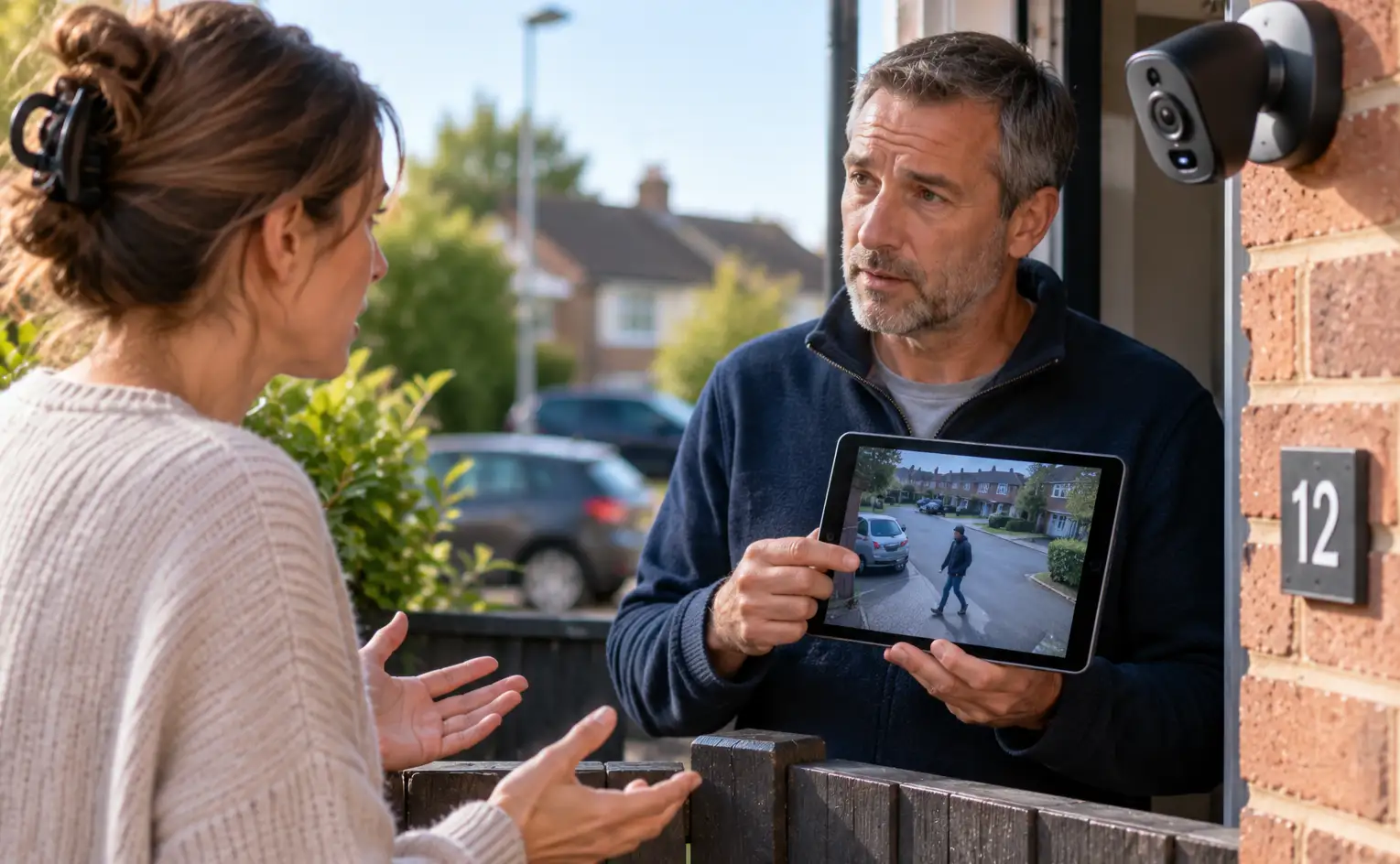
Something happened outside your house — a near-miss with a car, a delivery that went missing, an argument you’d rather have evidence of — and you know your neighbour’s camera was pointed the right way at the time. Can you just ask them for the footage?
The genuine answer depends on a distinction that’s easy to miss: whether you’re asking for footage of you, or footage that happens to be useful to you. These are not the same request, and the law treats them very differently.
If your neighbour’s camera recorded you, UK data protection law may give you a right to obtain the personal information it holds about you. If it recorded something that happened while you weren’t there, the situation can be quite different. You might desperately need the video for an insurance claim, to identify someone who damaged your property or to settle a disagreement, but that doesn’t automatically entitle you to a copy.
It’s an important distinction because CCTV is often most valuable when something goes wrong. A recording might show exactly how a collision happened or establish whether somebody approached your property. But the legal right to access your own information isn’t a general right to search through somebody else’s security recordings.
There is also a more immediate problem. While you’re working out whether your neighbour is obliged to help, the footage might be quietly disappearing through the camera’s automatic deletion system.
The distinction that decides what you’re entitled to
Imagine you’re standing outside your house when a driver reverses dangerously close to you. Your neighbour’s camera records the incident, including your movements and the vehicle passing by. If you’re identifiable in the footage, it contains personal information about you.
That brings a legal right into consideration: the subject access request, usually shortened to SAR.
Under UK data protection law, individuals can request access to personal information held about them by a data controller. The Information Commissioner’s Office guidance on home CCTV specifically explains that people may ask for recordings in which they can be seen or heard.
You don’t necessarily need a clear close-up of your face to be identifiable. Your voice, distinctive clothing, location or other details might establish who you are when considered alongside the circumstances. A vehicle registration can also be personal information where it relates to an identifiable individual, although footage of a car isn’t automatically personal data about its owner in every situation.
Now imagine another incident. Your car is parked outside while you’re at work, and somebody drives into it before leaving the scene. Next door’s CCTV captures the collision, but you aren’t there.
The recording could be enormously useful. It might identify the driver, prove how the damage happened or help your insurer establish responsibility. But if the footage doesn’t contain personal information relating to you, your right of access doesn’t automatically give you a legal entitlement to receive it.
You can still ask your neighbour, of course. Many people will happily share footage of a genuine accident or theft, particularly when they know it could help someone living nearby. That’s cooperation rather than an unrestricted legal right, and it’s often the simplest way to obtain a recording.
The distinction isn’t always perfectly clear. A clip involving your vehicle might contain information about you even when you’re not directly visible, depending on what it shows and how the information relates to you. What matters is the content of the recording, not simply whether the event affects your property.
There is another qualification specific to domestic cameras.
A homeowner using CCTV purely for personal or household purposes will generally fall within the domestic purposes exemption where recording remains confined to their own private domestic property. If the system captures identifiable people beyond that boundary — on the pavement, a shared access or neighbouring land, for example — data protection law can apply to that processing.
That is why a video doorbell recording you walking along the public pavement may bring information rights into play, while a camera used purely within somebody’s own private garden may fall outside the same rules.
For the right of access to apply, the relevant personal information must be subject to data protection law. The mere fact that somebody owns a security camera doesn’t automatically mean they have a legal duty to disclose everything it records.
Asking for the footage — and why timing matters
Making a subject access request is usually much less formal than people imagine.
You don’t need a solicitor, a particular application form or a letter quoting the UK GDPR. The ICO’s guidance on subject access requests confirms that a request can be made verbally or in writing, without using any special terminology.
A straightforward message asking for the CCTV recording containing you outside your house at a particular time can be enough.
The more detail you provide, the easier it will be for the camera owner to locate the correct footage. Suppose you were involved in an incident outside number 18 at around 8.15pm. Explaining where you stood, what you were wearing and the approximate period you want recorded is far more useful than asking for every video the camera has ever taken of you.
You can also make clear whether you want to see the footage or receive a copy. For somebody simply trying to understand what happened, viewing the relevant recording may resolve the immediate concern. Where the information is needed for another purpose, obtaining an appropriate copy may be more important.
Being specific also helps with what is often the biggest practical obstacle: the footage may not remain available for very long.
Domestic security systems commonly delete or overwrite routine recordings automatically. There is no universal legal retention period, and the amount of footage a camera stores depends on its settings, storage arrangements and the choices made by its owner.
A recording that could have settled a disagreement today may no longer exist several weeks later.
Imagine a neighbour’s camera captured a near-miss outside your home. You don’t initially think much of it, but later discover that the other driver has given a very different account of the incident. By the time you ask for the recording, the system may already have overwritten it.
If the footage was deleted through an ordinary retention process before you made your request, the neighbour cannot provide something they no longer hold. That doesn’t automatically mean they’ve done anything wrong.
The sensible approach is to ask promptly, identify the relevant period and explain that the footage may be important. Where possible, ask the owner to preserve the clip while the request is being considered.
The legal position is different if somebody deliberately destroys personal information to prevent you exercising a valid access right.
Section 173 of the Data Protection Act 2018 creates an offence involving the alteration, erasure, destruction or concealment of personal information with the intention of preventing disclosure following a qualifying access request. The legislation contains defences, including where deletion would have happened regardless of the request.
An ordinary automatic overwrite is therefore not necessarily criminal simply because a request has been made. Deliberately deleting identifiable footage to frustrate someone’s right of access is another matter.
There’s no advantage in beginning an otherwise straightforward request by accusing your neighbour of planning to destroy evidence. Many homeowners will never have dealt with a SAR before, and a clear explanation of what you need is much more likely to achieve cooperation.
Once a valid request has been made, the usual response period is one calendar month, with an obligation to respond without undue delay. Where a request is genuinely complex, or a person has made a number of requests, that period can be extended by up to a further two months. The requester should be informed of the extension and the reason within the initial month.
Your neighbour can also take reasonable steps to confirm your identity before releasing information about you. Between people who know one another, that may be straightforward. An unfamiliar requester or somebody claiming to act on your behalf might reasonably be asked for additional verification. Any checks should be proportionate, rather than an excuse to create unnecessary delay.
Changes under the Data (Use and Access) Act 2025 also allow the response clock to pause where clarification is reasonably necessary to identify the information being requested. That could matter if somebody asks for every recording ever made of them without identifying a relevant period, leaving the operator genuinely unable to conduct an effective search without more detail.
It isn’t a general right to delay answering an inconvenient request. The clarification must be reasonably required, and the time limit resumes once the necessary information has been provided.
For somebody requesting one short recording from a known incident, these complications will often be avoidable. A reasonably precise date, time and location usually make everyone’s job easier.
Why you might not receive the original recording
Even where your right of access is clear, there’s another complication that can make a simple request unexpectedly difficult.
Your neighbour’s footage may show other identifiable people.
Imagine the camera records an argument involving you and another resident. A delivery driver walks past, several pedestrians appear in the background and somebody else stops to watch.
The footage contains your personal information, but it also contains information about those other people. Your right to obtain information about yourself doesn’t automatically entitle you to receive all of theirs.
That doesn’t mean the camera owner can simply refuse because somebody else appears in the picture.
They need to consider whether the recording can be provided while protecting the personal information of third parties. Depending on the circumstances, that might involve blurring faces, obscuring part of the image or determining whether disclosure without consent would nevertheless be reasonable.
For a homeowner using an ordinary video doorbell, this can be a genuine practical difficulty. A camera app may make it easy to download a clip but offer no straightforward way to blur other people before sharing it.
Lack of professional editing equipment isn’t automatically a complete answer to a valid request, however. The operator still needs to consider reasonable ways of providing the information and whether any restrictions on disclosure are justified.
Sometimes a redacted video will be appropriate. In other circumstances, relevant still images may be sufficient. Where the requester agrees and the arrangement satisfies the applicable requirements, viewing the footage may offer a practical alternative to receiving an unrestricted file.
The nature of the recording matters. A still image might establish that you were present outside the property at a particular time, but it may be inadequate where your movements during an incident are an important part of the personal information being requested.
This is why the right is better understood as access to personal information rather than ownership of somebody else’s CCTV recording.
For a reader hoping to obtain evidence after a collision or confrontation, that distinction can be frustrating. The unedited footage might show exactly how somebody else behaved, whereas a version provided under data protection rules may have been altered to protect other people.
But a subject access request isn’t the same as a court order requiring the disclosure of evidence, and it doesn’t override everybody else’s privacy rights simply because the information could be useful to the requester.
The homeowner operating the camera has responsibilities in both directions: to respond properly to your request and to avoid unnecessarily disclosing information about other identifiable people.
The same balance applies if you want a recording deleted instead of disclosed.
Where data protection law applies, you may have a right to request erasure of personal information about you or to object to certain continuing processing. Neither right is absolute. A neighbour may have legitimate grounds for retaining particular footage, for example where it is genuinely needed in connection with an incident or for establishing, exercising or defending legal claims.
A camera that unnecessarily records most of your garden may also raise questions about the lawfulness of continuing surveillance, quite apart from your right to obtain an earlier clip. That’s a related but separate issue, covered in Property Front Page’s guidance on neighbours’ CCTV and privacy.
For the present question, the important point is that asking to see footage, requesting its deletion and objecting to future recording are different rights. A neighbour shouldn’t dismiss them simply because the camera belongs to them, but neither does every request automatically require the outcome the requester wants.
What happens if your neighbour ignores you?
In most cases, asking politely and explaining what you need will be the easiest approach. But some requests are ignored, while others receive a refusal based on the mistaken belief that private home CCTV is exempt from every data protection obligation.
If the camera falls within data protection law and the recording contains personal information you’re entitled to access, ownership of the equipment isn’t a sufficient reason to refuse the request.
Start with a written follow-up. Refer to when you made the original request, identify the footage again and explain that you’re still awaiting a response. If the normal deadline has passed, say so.
Keeping a record of these exchanges is useful if the dispute later needs regulatory attention. It also gives the neighbour an opportunity to correct a misunderstanding before the matter becomes more formal.
There is an additional complaints process worth knowing about.
The Data (Use and Access) Act 2025 introduced a statutory duty for data controllers to handle data protection complaints, with the relevant requirements taking effect on 19 June 2026.
Where a homeowner is acting as a data controller because their CCTV processing falls within the law, they must take applicable complaints about personal information and data protection rights seriously. The requirements include acknowledging a complaint within 30 days, taking appropriate steps to investigate it, keeping the complainant informed and communicating the outcome without undue delay.
That doesn’t mean your neighbour needs a corporate complaints department. A clear written message identifying the problem and explaining that you’re making a data protection complaint can provide the opportunity for them to address it.
It’s important not to confuse the deadlines. The normal one-calendar-month period for responding to a subject access request is separate from the 30-day complaint-acknowledgement requirement. Acknowledging your complaint doesn’t, by itself, satisfy an outstanding request for personal information.
The ICO’s guidance on making a data protection complaint explains the process and how unresolved concerns can be raised with the regulator.
You can contact the ICO about data protection issues, although its guidance generally recommends giving the person responsible for the information an opportunity to deal with the complaint first.
For ordinary domestic CCTV disputes, expectations should remain realistic. The regulator can consider complaints and has enforcement powers, but it isn’t a service that will normally retrieve the footage for you or ensure that an individual recording is handed over immediately.
If your neighbour has misunderstood their responsibilities, a clear explanation may resolve the matter more quickly than a formal complaint. If they’re persistently ignoring legitimate requests, the correspondence will provide a useful record of what happened.
There is also little benefit in becoming caught up in the regulator’s change of statutory structure. The Information Commission took over the former Commissioner’s functions in September 2026, while the ICO name continues to be used publicly. The practical route remains the complaints process published on the official ICO website.
For somebody facing an unresolved request, the immediate concern is usually simpler than the regulatory terminology: whether the neighbour is dealing with the request properly and whether the recording is still available.
If the footage is evidence of a crime, don’t rely on a SAR
There is one situation in which concentrating entirely on your data protection rights can be a mistake.
If your neighbour’s CCTV may contain evidence of a crime, serious collision or another incident requiring investigation, obtaining that evidence may involve a different process from requesting personal information about yourself.
Imagine your parked car is damaged while you’re away from home. You have a strong reason to want the footage, but your absence from the recording may mean a subject access request isn’t the right route to obtain everything the camera captured.
That doesn’t make the evidence any less important.
If you believe a crime has occurred, report it promptly and tell the police that nearby CCTV may have recorded the incident. The police can seek relevant evidence through appropriate investigatory processes, which don’t depend on you personally appearing in the footage.
The same urgency applies to insurance claims. If a third-party camera may have captured a collision or property damage, tell the insurer promptly rather than waiting until the recording has been overwritten.
You can still approach the neighbour directly and ask whether they’re willing to preserve or share the clip. Many homeowners will cooperate willingly when they understand that the footage could help establish what happened.
Where a recording is important to substantial legal proceedings, a solicitor may also be able to advise on appropriate routes for obtaining evidence.
The essential distinction is between exercising an information right and gathering evidence. They may overlap, but they’re not interchangeable, and choosing the wrong approach can waste valuable time.
The request that’s most likely to work
In practice, the best first message is usually short, polite and specific.
If your neighbour’s camera appears to have recorded you outside number 18 at around 8.15pm, explain that you were standing beside the silver car, give the approximate period you want and ask for a copy of the footage containing you. Mention what you were wearing if that will help identify the recording, and ask whether the relevant clip can be preserved while the request is considered.
That is much more useful than a lengthy legal letter demanding access to everything the camera has ever recorded.
It gives the owner a realistic chance of finding the footage, makes clear that you’re asking for information about yourself and reduces the risk of an important recording disappearing through routine deletion.
You can always rely on your formal rights if cooperation fails. But there is little advantage in making the first exchange unnecessarily confrontational, particularly when a neighbour may be perfectly happy to provide the relevant clip once they understand what you’re asking for.
The legal distinction is worth understanding, but it shouldn’t obscure the practical purpose of the request.
If the recording contains personal information about you and falls within data protection law, you may have a genuine right to access it. If it simply shows something that would help you, a voluntary request, police investigation, insurance process or another legal route may be more appropriate.
And whichever situation applies, the most important first step is often the same.
Ask while the footage still exists.
This article provides general property and data protection information and does not constitute legal or other professional advice. Whether CCTV footage contains personal information about you, whether the domestic purposes exemption applies and what information can lawfully be disclosed depend on the content of the recording and the circumstances in which it was made. Data protection rights are subject to legal conditions and exceptions. Where footage may be important evidence of a crime, collision or substantial legal claim, notify the appropriate authority, insurer or legal adviser promptly rather than relying solely on a subject access request.

