

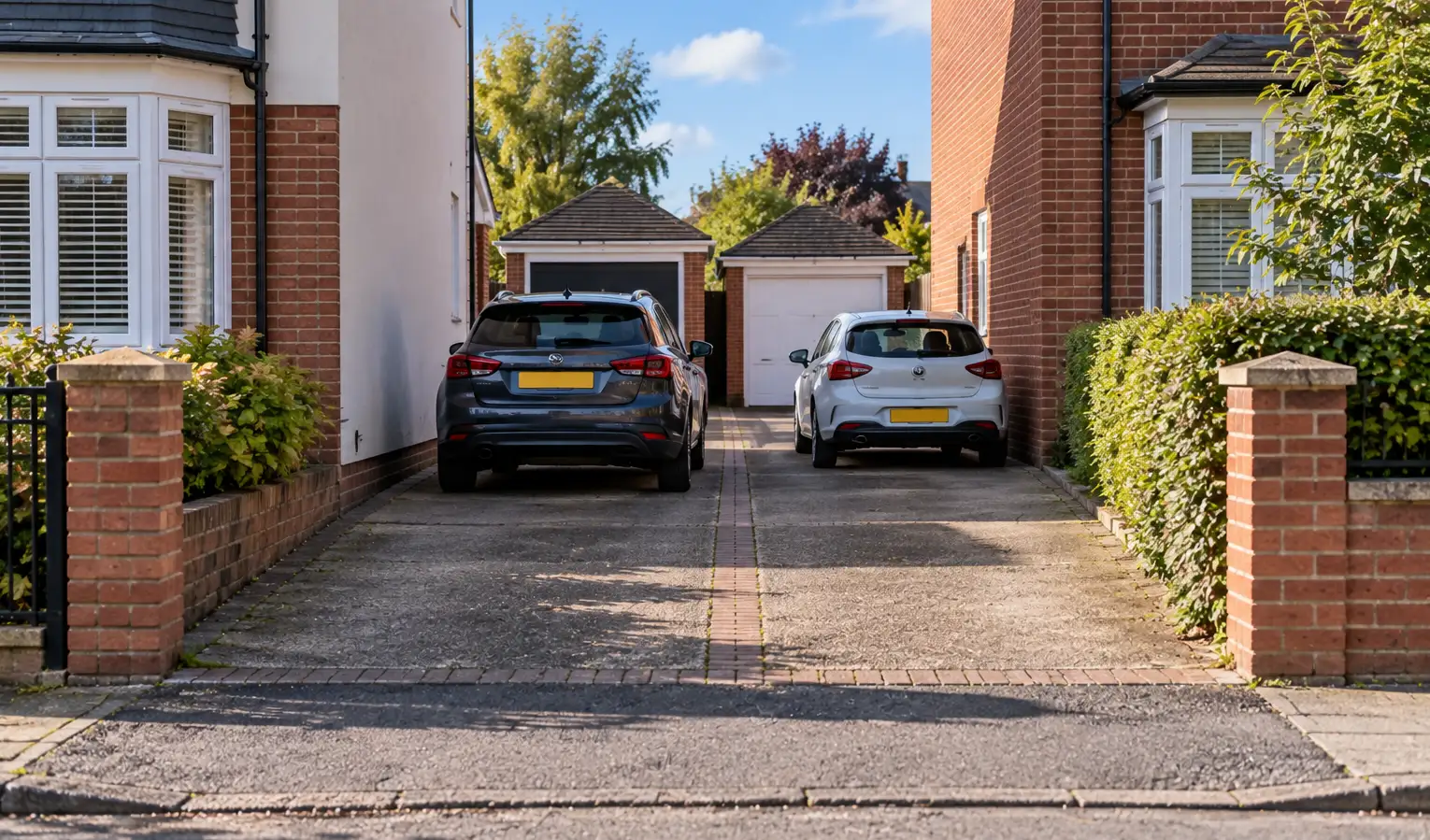
Two houses, one strip of tarmac between them, and a question that never quite got asked before either of you moved in: whose is it, actually? “Shared driveway” is the phrase everyone uses, and it’s precisely the phrase that causes the trouble, because it describes how the space looks, not what anyone’s actual legal rights over it are.
Perhaps your neighbour has started leaving a second car where you normally turn. Perhaps their visitors treat the shared section as extra parking, or you’ve been told you cannot install a gate across a driveway that appears to belong to you. Sometimes the disagreement is less dramatic: the surface needs repairing, one household wants the work done, and neither agrees who should pay.
What makes these disputes particularly frustrating is that both neighbours can be entirely convinced they’re right. One points to the title plan and says they own the land. The other points out that they’ve crossed it for 20 years without anybody objecting. Neither argument necessarily settles what either household is legally entitled to do.
The answer lies in understanding three things that often get confused: ownership of the land, the rights other people have over it, and the difference between using a driveway for access and treating it as somewhere to park. Once those distinctions are clear, many of the everyday arguments become considerably easier to assess.
The legal explanations below focus primarily on England and Wales. Scotland and Northern Ireland have their own property-law systems, which are addressed separately later.
“Shared” is a description, not a legal category
There’s no single legal arrangement that “shared driveway” refers to. In practice, most residential arrangements fall into one of four broad setups, and which one applies changes almost everything that follows.
One of the most common is a driveway owned entirely by one property, with the neighbouring property holding a legal right to cross it. In England and Wales, this type of right is generally called an easement. The property benefiting from it is the dominant land, while the property carrying the burden is the servient land. The owner may possess every square inch of the driveway, but that ownership remains subject to the neighbour’s established right of access.
Another arrangement involves each household owning a different section, with reciprocal rights over the other’s land. Your neighbour might own the part closest to the road while you own the section leading to your garage. If both households need to cross each other’s land to reach their properties, neither can decide what happens on the whole driveway simply by pointing out where their boundary lies.
Then there is genuine joint ownership, where both properties have an ownership interest in the driveway itself. This is not necessarily the same as each neighbour owning one physical half. It may be subject to trust arrangements or agreements governing how the land can be used, maintained or altered. One household cannot safely assume that owning a share gives it an exclusive parking space wherever it chooses.
On newer estates, a management company, freeholder or estate company may own the land instead. Individual properties have rights to use the access, but parking restrictions, visitor arrangements and maintenance obligations may be controlled through estate documentation. The relevant rules might therefore involve more than the two households who regularly use the drive.
These distinctions matter because a person who owns land may still be prevented from obstructing somebody else’s access over it, while somebody with a perfectly valid right of way may have no entitlement to park there. Where ownership is joint, the question is not simply whether a right of way has been obstructed, but whether one owner’s use is compatible with the other’s ownership rights.
It is worth establishing the arrangement properly before a dispute becomes entrenched. What a previous owner permitted, how the neighbours have always behaved and where everyone habitually parks may all be relevant, but none should automatically be confused with the underlying legal position.
Finding out what you actually have
For registered property in England and Wales, HM Land Registry is the sensible starting point. Its title register service allows you to obtain information about registered ownership and rights affecting the land. In a shared-driveway dispute, it is usually worth examining the records for both properties rather than relying solely on your own.
The title register may identify a right of way benefiting or burdening a property, but it will not necessarily reproduce the wording of the document that created it. An entry might refer to rights contained in an earlier transfer or conveyance, sometimes indicating that a copy has been filed. Where that happens, the underlying document is important. HM Land Registry explains how to request copies of filed deeds, which may contain the precise wording needed to establish what use is permitted.
Consider the difference between a right described as “a right of way on foot” and one granting passage “at all times and for all purposes with or without motor vehicles”. Both are rights of way, but they plainly do not authorise the same activities. Another deed might expressly permit parking, limit use to particular purposes, identify a specific route or contain separate obligations concerning maintenance.
Plans deserve similar attention. A Land Registry title plan generally indicates the extent of registered ownership under the general boundaries system; it does not necessarily determine the exact legal boundary to the last centimetre. An older transfer may contain a plan marking a particular access route in colour or hatching. If the dispute concerns whether a vehicle stands inside the area covered by a right of way, or whether a proposed bollard would encroach upon it, that older document may be especially important.
Sometimes the paperwork is incomplete or difficult to interpret. The original conveyance may be old, the register may refer to documents that are not readily available, or the physical driveway may have changed since the rights were created. An absence of obvious wording in the current register should not always be treated as conclusive proof that no right exists. Historic documents, the circumstances in which the properties were divided and potentially long-established use may need investigating.
Where the documents remain ambiguous, paying a property solicitor to examine the actual title position can be worthwhile before either household spends money on alterations or threatens proceedings. The objective is not simply to obtain another copy of a title plan, but to understand what the relevant documents and any other legally established rights actually permit.
A right of way does not automatically give you somewhere to park
This is the single most important distinction in many shared-driveway disagreements.
A right of way allows passage over land. It does not, by itself, provide an unrestricted right to leave a vehicle standing there.
Suppose your neighbour owns the driveway and your title grants a right of way, with or without vehicles, over it to reach your garage. Driving across the driveway is an ordinary exercise of that right. Leaving your second car on the neighbour’s land overnight because your garage is already occupied is a different proposition.
The fact that you can lawfully drive over the land does not necessarily mean you can use it as an additional parking space. Parking can be a legally recognised property right, and some deeds expressly grant it, but it needs a proper legal basis rather than an assumption that vehicular access includes every possible use of a vehicle.
This cuts both ways. An owner who discovers that their neighbour has no general parking right may have grounds to object to parking on their land, even if they can still get through. Conversely, a landowner who blocks a neighbour’s established access cannot necessarily defend the obstruction by saying the vehicle is parked entirely on land they own.
These are related but distinct issues. One concerns whether somebody has permission or a property right to park in a particular place. The other concerns whether somebody’s actions substantially interfere with an existing access right. Confusing the two can lead neighbours to argue about the wrong thing.
There is also a difference between leaving a vehicle parked and stopping temporarily as part of ordinary access. A delivery van may need to stop while furniture is unloaded. A taxi might pause to collect a passenger, or a tradesperson might need a reasonable opportunity to bring equipment into the property. Those activities are not necessarily equivalent to leaving a car on the access route for hours, although their permissibility still depends on the scope of the right and their practical effect.
The same applies to visitors. Where a residential property benefits from an ordinary right of access, the practical use of that right may extend to visitors, delivery drivers and people providing services to the household, subject to the terms of the grant. That does not mean visitors acquire an independent entitlement to park on the neighbouring land.
A particularly common disagreement arises when a visitor leaves a vehicle on the shared section while calling at one of the houses. The homeowner may insist that their visitors are entitled to use the driveway, which may be perfectly true as far as access is concerned. The difficulty begins when that entitlement is treated as permission to occupy the access area as a parking place.
Turning and manoeuvring can produce similar arguments. A driver may need to manoeuvre as part of reaching or leaving a garage, particularly where the layout makes a straight approach impractical. Whether that use falls within the right may depend on its purpose, wording and defined area. Using somebody else’s driveway as a convenient turning space for unrelated journeys should not simply be assumed to be the same thing.
The useful question is therefore not merely whether a vehicle entered or stopped on the driveway, but what the person was doing, whether the activity falls within the right granted and what effect it has on others entitled to use the land.
When does parking become an unlawful obstruction?
Picture a driveway owned by one household but used by two. The owner parks near the entrance, leaving just enough room for a small car to squeeze through. Their neighbour can technically get past, but only after folding in the mirrors and making several awkward manoeuvres.
The owner insists that access has not been blocked because passage remains physically possible. The neighbour argues that a right to use the driveway should not require such difficulty every time they return home.
That disagreement illustrates why the law does not necessarily draw the line at complete physical obstruction.
In England and Wales, a central principle in easement disputes is whether there has been substantial interference with the reasonable exercise of the right. The practical impact matters. A right of way may be substantially interfered with even where passage has not become completely impossible, particularly if ordinary access is materially more difficult than the right permits.
A vehicle left across the only entrance to a garage is an obvious potential obstruction. But a car regularly occupying essential manoeuvring space, narrowing the practical vehicle route or preventing ordinary access by vehicles within the scope of the right may also create a serious problem. The circumstances, including the layout and intended use of the access, need to be considered.
At the other end of the scale, a vehicle parked well clear of the usable route may have little effect on the exercise of an access right. Merely disliking the presence of a car on neighbouring land does not establish substantial interference with a right of way.
This does not necessarily mean that the parking is authorised. Someone could be parking without any entitlement to occupy the land while causing no substantial obstruction to access. Equally, a landowner might obstruct a neighbour’s rights by leaving their own car in a place where parking would otherwise be entirely lawful.
The distinction becomes important when deciding how to approach the dispute. If your neighbour repeatedly blocks your garage, the interference with access may be the central problem. If they park on your land without an established parking right but leave your route clear, your objection may concern unauthorised use of the land rather than obstruction of an easement.
The practical evidence will also differ. Where access is substantially affected, photographs showing the position of vehicles, the width left available and any difficulty entering or leaving can help establish what actually happened. Repeated incidents, including their frequency and duration, may matter more than a single photograph of a car standing somewhere you would rather it wasn’t.
An argument about an inconveniently positioned vehicle is one thing. A persistent arrangement that makes the normal use of the driveway seriously difficult is another, and it may justify more formal action.
Gates, bollards and changes to the driveway
The same underlying principles help explain why some gates across shared driveways are acceptable while others become the subject of legal proceedings.
A gate is not automatically unlawful merely because it crosses a right of way. In Bradley v Heslin, the High Court considered the principles governing gates and substantial interference with access. Their practical effect can be more important than the mere fact that a gate exists.
An unlocked gate that is straightforward to operate may be compatible with the access rights granted. A permanently locked gate for which the neighbouring property has no key is a much stronger candidate for substantial interference. Electronic gates can introduce further complications if access codes, remotes or opening arrangements prevent the right from being exercised conveniently and reliably.
For instance, imagine one neighbour installs electronic gates for security but provides the other household with only a single remote. If several people living at the neighbouring property are entitled to use the driveway, that arrangement could create practical access difficulties that need considering. Providing a means of opening the gates is important, but the full effect of the installation and the terms of the right still determine whether the arrangement is acceptable.
Bollards and other physical obstructions raise similar questions. A removable bollard placed outside the access route may interfere with nobody’s rights. The same bollard positioned where vehicles need to pass or manoeuvre could create a serious restriction. Wheelie bins left at the side of a wide driveway may be harmless, while bins repeatedly positioned across the only usable route could constitute an obstruction.
The fact that something is temporary does not necessarily make it irrelevant, particularly where the problem is repeated. Equally, the beneficiary of a right of way cannot insist that every part of the land must remain perpetually unused if the activities taking place do not materially affect their rights.
Physical alterations require particular care because their effects may be permanent. Resurfacing an existing driveway, widening it, changing its alignment or installing additional drainage can involve very different legal considerations. A landowner may be able to improve their own property, but not by trespassing onto another owner’s land, breaching an applicable covenant or substantially interfering with an established easement.
A right of way also does not necessarily permit its beneficiary to redesign the neighbouring land for their own convenience. Someone who wants to widen the shared entrance because they have bought a larger vehicle cannot simply assume their access right authorises them to take additional land or move an established route.
Where the driveway is jointly owned or subject to reciprocal rights, the position may require particular care because both households can hold relevant interests. Before contractors arrive, the parties should establish precisely what land is being altered, which existing rights may be affected and whether consent or a formal agreement is necessary.
Installing a barrier first and asking what the deeds say afterwards is a particularly poor way to test the strength of a legal argument.
Who pays when the shared driveway needs repairing?
A damaged shared driveway can generate just as much resentment as a badly parked car, particularly when one household believes it is paying to maintain something the other uses equally.
There is an understandable assumption that two properties using the same driveway should split the bill. Sometimes that is exactly what the legal documents require. Sometimes it is merely what one neighbour considers fair.
The first place to look is the transfer, conveyance, lease or other documents governing the land. These may specify maintenance responsibilities, require contributions in stated proportions or establish arrangements through a management company. Where enforceable obligations exist, they provide the starting point for determining who must contribute.
Where the deeds grant a straightforward right of way and say nothing about repairs, there is no automatic rule requiring the two households to split every resurfacing bill equally.
The general easement position is more nuanced. The owner whose land is burdened by a right of way is not ordinarily required, simply because that right exists, to maintain the route for the beneficiary. Conversely, somebody benefiting from an easement may have an ancillary right to carry out reasonably necessary repairs to preserve its use, provided the work is undertaken reasonably and remains within the scope of the right.
That does not automatically entitle the person arranging the work to send half the invoice to the neighbouring owner. Nor does it necessarily entitle either household to undertake whatever improvement it considers desirable.
Imagine two neighbours faced with a deteriorating driveway. One wants to repair the potholes and restore the existing surface. The other proposes replacing the whole area with expensive decorative paving, new edging and lighting, arguing that the total cost should be shared because both properties will benefit.
Even where both agree that repairs are needed, that does not establish agreement about the specification, the additional improvements or responsibility for the bill. Keeping an access usable and upgrading it to a higher standard are not necessarily the same thing.
Another common problem arises where one household refuses to contribute at all. The neighbour who wants the repairs completed may feel that years of shared use make a contribution morally unavoidable. But an argument about fairness cannot create a legal maintenance obligation where none otherwise exists.
Joint ownership, reciprocal easements, leases, positive covenants and estate-management arrangements can produce different outcomes, which is why the underlying documents should be checked before making demands or commissioning substantial work.
If the documents do not clearly allocate costs, a practical written agreement may provide a better solution. It should identify the work, the contractor, the standard of finish, who pays what and how future maintenance will be handled. That is especially worthwhile where both households intend to continue using the driveway for many years.
For anything intended to bind future owners, advice may be needed about creating a formal, enforceable arrangement. A friendly letter agreeing to split the next repair bill can be useful, but it should not automatically be treated as a permanent maintenance obligation that follows both properties indefinitely.
The sensible commercial lesson is straightforward: don’t order a £10,000 resurfacing job on the assumption that next door legally owes £5,000. Establish the obligation, the scope of the proposed work and the other household’s agreement before committing the money.
“We’ve always parked there” can matter — but it doesn’t settle everything
One of the more difficult shared-driveway disputes begins when a longstanding arrangement changes after a property is sold.
Perhaps the previous owner never objected to the neighbouring household parking an additional vehicle on the driveway. Perhaps both families used the space interchangeably for decades, with no written agreement and no reason to examine the title documents. A new owner arrives, reads the deeds and announces that the arrangement must stop.
The fact that a practice has continued for years does not automatically make it legally enforceable. But it would be equally mistaken to assume that long use can never create property rights.
In England and Wales, certain rights can sometimes arise through prescription. HM Land Registry’s guidance on easements acquired by prescription explains that qualifying claims generally involve at least 20 years’ use and particular legal requirements.
An important condition is that the use has been exercised as of right — without force, without secrecy and without permission. The last of those requirements can be particularly significant in neighbourly arrangements.
If the previous owner expressly permitted the neighbour to park whenever necessary, the use may have been permissive rather than an assertion of a permanent legal entitlement. The fact that the arrangement continued for 25 years would not, by itself, overcome that distinction.
By contrast, where a household has openly exercised a claimed parking or access right for decades without permission, there may be a basis for investigating whether an enforceable right has arisen. Parking claims can raise their own legal complexities, including the nature and extent of the use, so elapsed time alone is never a sufficient answer.
The difficulty is often evidential. The present owners may not know what previous neighbours agreed, whether permission was ever granted or how consistently the disputed area was used. Old letters, conveyancing documents, historic plans and other records may become important.
If an alleged long-established right is at the centre of the disagreement, neither side should assume that putting up a barrier or demanding the immediate removal of a vehicle will conclusively settle matters. Where a claim is arguable, it deserves proper examination before somebody takes action that could interfere with a legal right.
Joint ownership, management companies and rented properties
Where the driveway genuinely belongs to both properties, the familiar distinction between the owner of burdened land and somebody benefiting from an easement may no longer provide the complete answer.
Both households may have ownership interests in the same land, and the arrangements governing those interests need to be understood. A person who owns a half share does not necessarily own a physically identifiable half of the driveway, nor can they necessarily appropriate the shared area for their exclusive use.
Consider a jointly owned entrance where one neighbour begins parking permanently against a wall. The vehicle may not physically prevent the other household from driving past, but the effect on the other owner’s ability to use the jointly owned space could still raise questions. The relevant ownership arrangements and agreements matter, rather than simply applying the substantial-interference test used for an ordinary access easement.
Where a management company owns the driveway, the focus shifts again. Estate regulations may identify where parking is permitted, who can use visitor spaces, whether barriers can be installed and how maintenance charges are collected. The individual homeowners may have substantial rights of access without having authority to change the rules for the common land themselves.
This can be particularly relevant on newer housing estates where a driveway looks like a simple shared entrance but forms part of a wider privately managed access network. Before assuming a disagreement is exclusively between two neighbours, check whether the estate company or another owner has a role in enforcing the relevant arrangements.
Tenants and leaseholders face another layer of complication. A tenant occupying a property with the benefit of vehicular access will ordinarily need to be able to exercise that access, subject to the tenancy and underlying property rights. But a permanent disagreement about whether an easement exists, where it runs or what it permits may require the landlord’s involvement.
That does not mean occupiers necessarily have no rights of their own. The position can depend on their legal interest and the interference involved. Nevertheless, asking the landlord to examine the title and participate in any formal dispute is generally sensible where the disagreement concerns rights intended to endure beyond the current tenancy.
Leaseholders should also check their leases and any superior-title arrangements. A right to cross the driveway, permission to use an allocated space and an obligation to contribute to maintenance may be recorded in different provisions. The fact that a parking space has always been used with a flat does not necessarily establish that it is included in the lease on the terms the occupier assumes.
A driveway dispute can become a problem when selling
Shared access often receives surprisingly little attention until one of the properties is put on the market. A buyer viewing an attractive house with a broad driveway may reasonably assume that the visible space is available for parking, turning or reaching the garage. The paperwork can reveal a less straightforward position.
A legal right of way ordinarily benefits or burdens the land rather than merely the original people involved in creating it. Selling the property therefore does not normally extinguish a properly established easement. A buyer may acquire a home with access over neighbouring land, or purchase land that must remain available for another property’s lawful use.
An informal personal favour is different. If a previous neighbour allowed the owner to leave a second vehicle on their driveway, that permission does not necessarily become an enduring property right simply because the house is sold.
This distinction can have real financial consequences. A property advertised with convenient parking may be less attractive to a buyer if one of the apparent spaces depends entirely on another household’s goodwill. Uncertainty over access to a garage can prompt enquiries, complicate mortgage or conveyancing arrangements in particular circumstances, and make buyers reconsider what they are actually purchasing.
Sellers also need to consider whether an existing disagreement should be disclosed. The TA6 Property Information Form used in conveyancing in England and Wales asks about neighbour disputes and relevant rights or arrangements. The Law Society’s TA6 sixth-edition explanatory notes specifically use a shared driveway as an example of a right or arrangement that may need to be described.
An argument does not necessarily have to reach court before it becomes relevant. Repeated objections to parking, correspondence about blocked access, unresolved maintenance disagreements and threatened legal action may all need consideration when answering conveyancing enquiries.
For buyers, the lesson is to ask what use of the driveway is legally included rather than judging it from the width of the tarmac during a viewing. For sellers, resolving an uncertainty early is likely to be preferable to discovering shortly before exchange that the neighbouring household has a very different understanding of the arrangement.
The best time to find out that nobody agrees what the driveway clause means is not two days before exchange.
Scotland and Northern Ireland: similar disputes, different legal systems
The practical questions surrounding shared driveways arise across the UK, but the property-law rules and terminology are not identical.
In Scotland, an access right over neighbouring land is generally known as a servitude, rather than an English easement. A driveway may involve ownership in common, a servitude benefiting one property over another or rights and obligations established through title conditions.
Registers of Scotland explains how ownership and servitude rights may be recorded in title sheets, and its guidance on rights and title sheets provides a starting point for examining the position. Parking itself can also be capable of existing as a servitude under Scots law, making it particularly important not to import blanket assumptions about English rights of way.
Northern Ireland has its own Land Registry and Registry of Deeds arrangements. A registered folio may record ownership and rights affecting the property, including rights of way. The official nidirect guidance on finding property and land information explains where relevant records can be obtained.
Older easements can add complexity, particularly where the full history of a right is not apparent from the modern folio. Historic deeds, maps and relevant instruments may need examining together.
In either jurisdiction, the sensible starting point remains identifying who owns the land, what rights have been established and how those rights affect the proposed activity. But a dispute that requires legal interpretation should be considered under the law of the country concerned, not by assuming that English easement principles provide the complete answer.
When talking to the neighbour doesn’t resolve it
There’s a point in many shared-driveway disagreements when another conversation about whose car belongs where is unlikely to achieve very much. Both neighbours have repeated their positions, neither accepts the other’s interpretation, and the original practical inconvenience has become a dispute about legal entitlement.
At that stage, the most useful thing is often to stop arguing in general terms and establish precisely what needs resolving. Is the other household claiming a permanent right to park? Has someone installed a barrier that interferes with access? Are the parties disputing the boundary, or simply disagreeing about how to divide a maintenance bill?
These are different problems. They may involve different rights, different evidence and different ways of achieving a satisfactory outcome.
If a neighbour regularly obstructs access, recording the incidents can be sensible. Photographs, dates, the approximate duration of each blockage and an explanation of how ordinary access was affected can provide a clearer account than competing recollections. Where a vehicle prevents you using the garage, documenting that practical impact is likely to be more useful than simply photographing a car on the driveway.
If the issue is unauthorised parking rather than obstruction, the focus may instead be on establishing ownership and whether a parking right or permission exists. A complaint based solely on the inconvenience of the parked vehicle may miss the central question if the real objection is that someone is occupying land they have no right to use.
Where the parties have not yet examined the deeds, obtaining and sharing the relevant wording may resolve an argument that has developed from mistaken assumptions. It is not always necessary to begin with a solicitor’s letter. A calm explanation of the documents and a practical proposal may achieve more, particularly where the households must continue living beside one another.
If the disagreement persists, a measured written communication setting out the problem, the relevant right as understood, the incidents causing concern and the practical change being requested can help establish a clear record. It should be factual rather than accusatory. The purpose is to explain what needs resolving, not to turn every parking disagreement into an immediate legal confrontation.
Some cases are particularly suitable for mediation. Neighbours who accept that both properties need access but disagree about parking positions, gate arrangements or maintenance contributions may be able to reach a workable arrangement without asking a court to decide every disputed detail.
Any agreement should be recorded clearly. If both households decide that the central access must remain free of parked vehicles, that bins will be kept elsewhere or that essential repairs will be shared in particular proportions, putting those arrangements in writing can prevent a repeat argument. Where the agreement is intended to create, change or permanently regulate property rights, legal advice is important to establish whether a formal deed or other step is required.
There will nevertheless be situations where informal discussion is not enough. A locked gate preventing access, repeated serious obstruction, an arguable prescriptive parking right or proposed work that may permanently interfere with an easement can justify specialist advice. The appropriate legal response depends on the particular right and interference, and courts may grant remedies including injunctions in suitable cases.
It is also important to distinguish a dispute involving private land from one involving a vehicle parked on the public highway. The relevant powers and possible enforcement routes can differ, so council or police involvement should not automatically be assumed to provide a solution to an ordinary private-right-of-way disagreement.
Above all, avoid attempting to enforce your own interpretation by damaging property or physically removing a disputed obstruction without appropriate advice. Cutting a lock, uprooting a bollard or dismantling a gate may create additional problems, even where you believe the original obstruction was unlawful.
The cost of escalating a dispute can extend beyond legal fees. Neighbours may stop communicating, routine maintenance becomes contentious and an argument about a single parking space develops into a continuing problem affecting both households and future owners. A practical resolution that protects established rights without making everyday life intolerable is often worth pursuing before litigation becomes unavoidable.
What the driveway actually belongs to — and what it allows
The difficulty with shared driveways is that ordinary language makes the arrangement sound simpler than it is. People see one driveway serving two houses and assume that shared use must mean shared ownership, shared parking and shared responsibility for every repair.
Those assumptions can all be wrong.
Someone can own the driveway without being entitled to obstruct another property’s access. Someone can have a right to drive across it without acquiring an extra parking space. Two households can own the land together without either having an exclusive claim to a physical half. And years of neighbourly cooperation do not necessarily establish the permanent rights either party believes they have.
For anyone buying a property, the important question is whether the driveway provides the access and parking they actually need, on rights they can rely upon. For existing neighbours, it is whether their everyday arrangements reflect those rights and, where they do not, whether a workable agreement can be reached.
The documents are the place to begin, although historic use and the practical circumstances can sometimes be equally important to the eventual legal assessment.
That may feel like an unnecessarily complicated answer to a straightforward question about where somebody can leave a car. But it is considerably better than discovering, after a confrontation, an expensive alteration or a failed property sale, that the familiar phrase “shared driveway” never meant what either household thought it did.
This article provides general property information and does not constitute legal, conveyancing, surveying or other professional advice. Shared-driveway rights and disputes depend on the relevant jurisdiction, ownership documents, the wording of any easement or servitude, historical use and individual circumstances. If a dispute involves persistent obstruction, disputed parking rights, gates, significant alterations or threatened legal proceedings, seek advice from an appropriately qualified property solicitor before taking action.

