

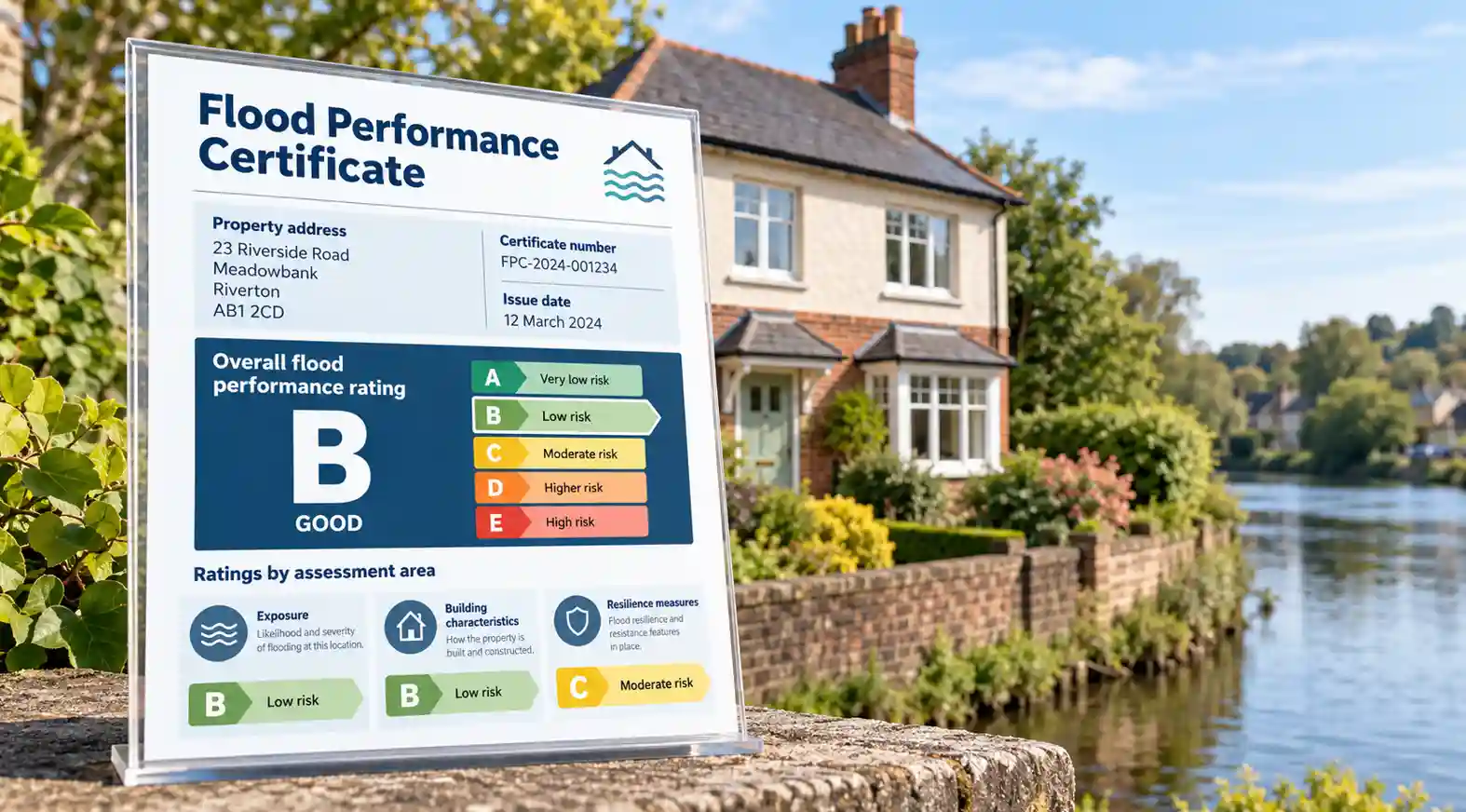
A new certificate rating a home’s flood risk and resilience is about to be piloted in England. It could reward owners who protect their homes. It could also put a number on a risk some sellers would rather buyers did not dwell on.
A document that spells out how likely your home is to flood does not sound like something that would help you sell it. Yet that is part of the case for Flood Performance Certificates, the scheme the government and Flood Re announced on 13 October 2026.
The argument runs like this. Two houses on the same street, in the same flood zone, can look identical on a postcode-based risk map. One has self-closing air bricks, a flood door, raised electrical sockets and a tiled floor that can be cleaned after flooding. The other has none of these. Today, a buyer or insurer may struggle to tell them apart. A certificate that captures the difference could help protect the value of the first house. It could also make the second one’s weaknesses much harder to overlook.
What has actually been announced
The Defra and Flood Re announcement describes Flood Performance Certificates (FPCs) as a standardised way of showing a property’s flood risk and resilience, including measures already in place and where further action would help. The government compares them to Energy Performance Certificates.
The detail is still being designed. One approach to be tested is a “Flood Performance Rating” breaking risk into three elements: exposure, drawing on existing flood-risk information; the property’s characteristics; and its resistance, including the measures installed to keep water out or limit the damage it causes.
The status is the most important thing to understand. These are pilots, not a national certification scheme ready for homeowners to use. Initial testing is expected before the end of 2026, with further pilots planned throughout 2027 and beyond. Flood Re says the work will begin through the Environment Agency’s property flood resilience framework before potentially expanding into insurance claims, wider housing-market initiatives and new-build construction. Individual pilot locations have not yet been confirmed publicly.
The government announcement is directed at homeowners in England, although Flood Re itself operates across the UK.
FPCs are not a legal requirement. No requirement to obtain one when selling or letting a home has been announced, and they are not equivalent to EPCs, which already form part of the legal framework for property transactions. Nor has the government identified any insurer or lender offering better terms specifically in return for an FPC.
The intended benefit, and the conditions attached
The case for FPCs rests on a gap in today’s system. Much of the flood information available to homeowners describes the surrounding area rather than how an individual building would withstand water entering it.
The government’s long-term flood-risk checking service, based on Environment Agency information, provides an assessment of an area’s risk from rivers, the sea, surface water and other sources. It explicitly does not establish the likelihood of an individual property flooding. Nor can it tell you whether a particular house has been made more resilient.
Flood Re, the joint government and insurance industry scheme that helps keep flood cover available for eligible higher-risk homes, wants that distinction to become more meaningful.
The aim is for households that invest in resilience to have those improvements recognised, potentially including through insurance pricing. Flood Re also wants app-based self-assessments to become a routine way for homeowners to understand their risk and identify useful improvements.
That would be a significant change in how flood resilience is recorded. A property owner who has spent thousands of pounds installing barriers, adapting floors or protecting electrical systems currently has no widely adopted certificate demonstrating those improvements to a future buyer, mortgage lender or insurer.
But the government’s announcement is careful about what that recognition might mean. It says FPCs could support more affordable or available insurance where improvements are sufficient to change an insurer’s assessment of risk.
Aviva and Nationwide have welcomed the pilots. Their support matters because insurers and mortgage lenders would need to find the assessments credible for certificates to influence financial decisions. Welcoming an idea, however, is not the same as promising to offer cheaper cover or more favourable lending.
For now, a better premium for a certified home remains a possibility rather than an established product.
Better information is not lower risk
The first thing worth saying clearly is that a certificate does not reduce flooding. Only the measures behind it can reduce the likelihood of water entering a property or lessen the damage when it does.
That leads to some difficult questions which the pilots will need to answer.
Can a certificate prove the measures work? A flood door is only useful if it is correctly installed, maintained and closed when needed. Removable barriers depend on somebody being available to fit them. A certificate based largely on a homeowner’s own answers could be quick and inexpensive, but potentially less reliable than an assessment supported by an inspection and evidence of installation.
A professionally verified assessment would carry greater weight with an insurer or lender, but would also cost more. The balance between affordability and reliability could determine whether the scheme becomes widely used or remains a specialist exercise.
Will it go out of date? Flood risk changes. New defences can reduce exposure; climate change, altered drainage or development elsewhere can affect it. Resilience measures can also deteriorate or be removed during refurbishment. A certificate that stays valid for years without appropriate review could give buyers more confidence than the underlying evidence justifies.
Who pays? The announcement does not establish a nationwide charging model. If homeowners eventually have to fund their own assessments, those expecting favourable results may be more willing to obtain them. If certificates are to become useful across the wider market, the scheme must also find a way to represent properties that have not been improved.
Flood Re has already been working on the information needed to record property-level resilience consistently. That should help establish a common standard. Whether the resulting certificate is trusted will depend on how well the information is checked, maintained and understood.
There is another distinction worth keeping in view. Some improvements are designed to prevent water entering a home; others allow the building to recover faster and with less damage after a flood. Both may be valuable, but they do different things. An effective rating needs to explain those differences rather than reduce a complicated risk to a reassuring-looking score.
The double edge for sellers
For a homeowner who has been flooded before, the potential benefits are clearest. A certificate could guide which measures to prioritise and provide evidence that money has been spent on worthwhile protection. If insurers eventually recognise those improvements, it might also help demonstrate that the property presents a different level of risk from an otherwise similar home.
For a buyer and their conveyancer, standardised information could make it easier to compare properties and identify vulnerabilities that an area-level flood search cannot establish. That would be a genuine improvement on relying solely on mapping, seller disclosures and whatever evidence happens to be available about the building.
It could also change negotiations.
Consider two similar houses advertised at comparable prices. One has documented flood protection and the other has no such measures, despite sharing the same environmental exposure. If certificates became sufficiently trusted, buyers might be more willing to pay for the first property or demand a discount on the second to reflect the cost of improvements.
That is a plausible consequence, not an established effect of the pilots. House prices depend on many things beyond flood resilience, and it remains to be seen whether certification would make a measurable difference.
The concern is greater for owners of high-risk homes with little protection. A certificate in a voluntary pilot is unlikely to transform the market. But if certificates became common, their absence could start to raise questions, while an unfavourable assessment might encourage insurers, surveyors or mortgage lenders to scrutinise a property more closely.
For some sellers, that could mean harder negotiations, additional enquiries or a longer sale. At the same time, buyers might benefit from avoiding expensive surprises after completion.
A particularly difficult question is what happens to owners who cannot afford the improvements needed to achieve a better assessment. Making the risks clearer does not give those households the money to address them. Without accessible funding or practical assistance, the scheme could improve transparency while leaving some of the most vulnerable properties behind.
It is fair to add that the underlying flood risk already exists whether or not it appears on a certificate. Sellers must not misrepresent a property’s flood history, and should answer relevant conveyancing enquiries accurately. Buyers can already obtain flood searches and investigate previous incidents.
An FPC would not create those risks. It would make particular aspects of them easier to compare.
That distinction matters because greater transparency can benefit the housing market overall while proving uncomfortable for individual sellers.
Insurers’ and sellers’ interests do not always align. An insurer wants dependable information to assess risk and potential claims. That might eventually support better terms for resilient homes, but it could also expose vulnerabilities in properties that have made few improvements. More accurate risk assessment would not necessarily produce cheaper insurance for everybody.
Insurance, Flood Re and newer homes
The insurance context explains why this matters now.
Flood Re was established to help make household flood insurance more affordable and available for eligible properties at greater risk. Its rules generally restrict cover to homes built before 1 January 2009, although other eligibility conditions also apply.
The distinction is especially important for newer developments. A house built after that date cannot normally benefit from Flood Re, even if it subsequently proves vulnerable to flooding. In the government announcement, Aviva specifically drew attention to the lack of Flood Re protection for newer homes.
Larger blocks of flats also face different eligibility restrictions for buildings insurance, although contents policies for individual residents may qualify in circumstances where the building itself does not. Flood Re’s eligibility criteria make clear that cover depends on more than a property’s location or age.
There is a longer-term reason for developing better assessments. Flood Re is scheduled to end in 2039, when the insurance market is intended to operate without the scheme and move towards pricing that more directly reflects flood risk.
That transition has always presented a challenge. If insurance is to remain affordable for flood-prone homes without the existing support mechanism, reducing the damage those properties are likely to suffer becomes increasingly important.
A credible way of showing that a home has been made more resilient could therefore matter far more in the 2030s than it does today.
But a certificate cannot resolve every difficulty. Some properties face exposure that household-level improvements can only partly address. Others may need protection involving local drainage, flood defences or wider infrastructure. The long-term availability of affordable insurance will depend on more than whether individual homeowners obtain favourable ratings.
Flood Re has also announced a separate change aimed at households on lower incomes. From April 2027, it plans to reduce the reinsurance premium it charges participating insurers for eligible contents-only policies in Council Tax bands A and B from £52 to £25. Insurers are expected to pass the saving on to customers, but £25 is not the price a householder will necessarily pay for their contents insurance.
That measure is separate from Flood Performance Certificates, although both form part of Flood Re’s wider work on insurance affordability and flood resilience.
What the pilots need to prove
The pilots will show whether Flood Performance Certificates can become more than another document in an already complicated property transaction.
The first test is whether assessments can be produced consistently and at a reasonable cost. The second is whether homeowners understand them well enough to take useful action. The third, and potentially most consequential for the housing market, is whether insurers and lenders consider the evidence dependable enough to influence their decisions.
Those outcomes are not guaranteed. A scheme that identifies vulnerabilities but offers little practical route to resolving them could be less useful than its supporters hope. Equally, a trusted assessment that recognises genuine improvements could give owners an incentive to invest and buyers more confidence in what they are purchasing.
The important developments to watch are where the pilots take place, how assessments are verified, who pays, how ratings are updated, and whether insurers or lenders begin using them in practice.
Until then, anyone buying or selling a property in a flood-risk area should rely on the checks already available: the Environment Agency’s long-term flood-risk information, appropriate flood searches through a conveyancer, accurate seller disclosures, and specialist assessment of the building where necessary. Buyers can also request information about historical flooding from the Environment Agency, although its records are not complete.
A Flood Performance Certificate may eventually bring several strands of that information together. Whether it helps a home sell, makes it harder to sell, or simply gives everybody a clearer picture will depend on how the scheme develops.
For now, it remains a promising idea with a difficult test ahead: making flood risk more visible without leaving the people most exposed to it with fewer options.
This article provides general information about Flood Performance Certificate pilots announced for England in October 2026. Certificates are not currently mandatory, and potential effects on insurance, lending and property values remain uncertain. Flood Re eligibility depends on individual circumstances. Anyone buying, selling, improving or insuring a property at risk of flooding should obtain appropriate advice from a conveyancer, qualified surveyor or insurance professional.

