

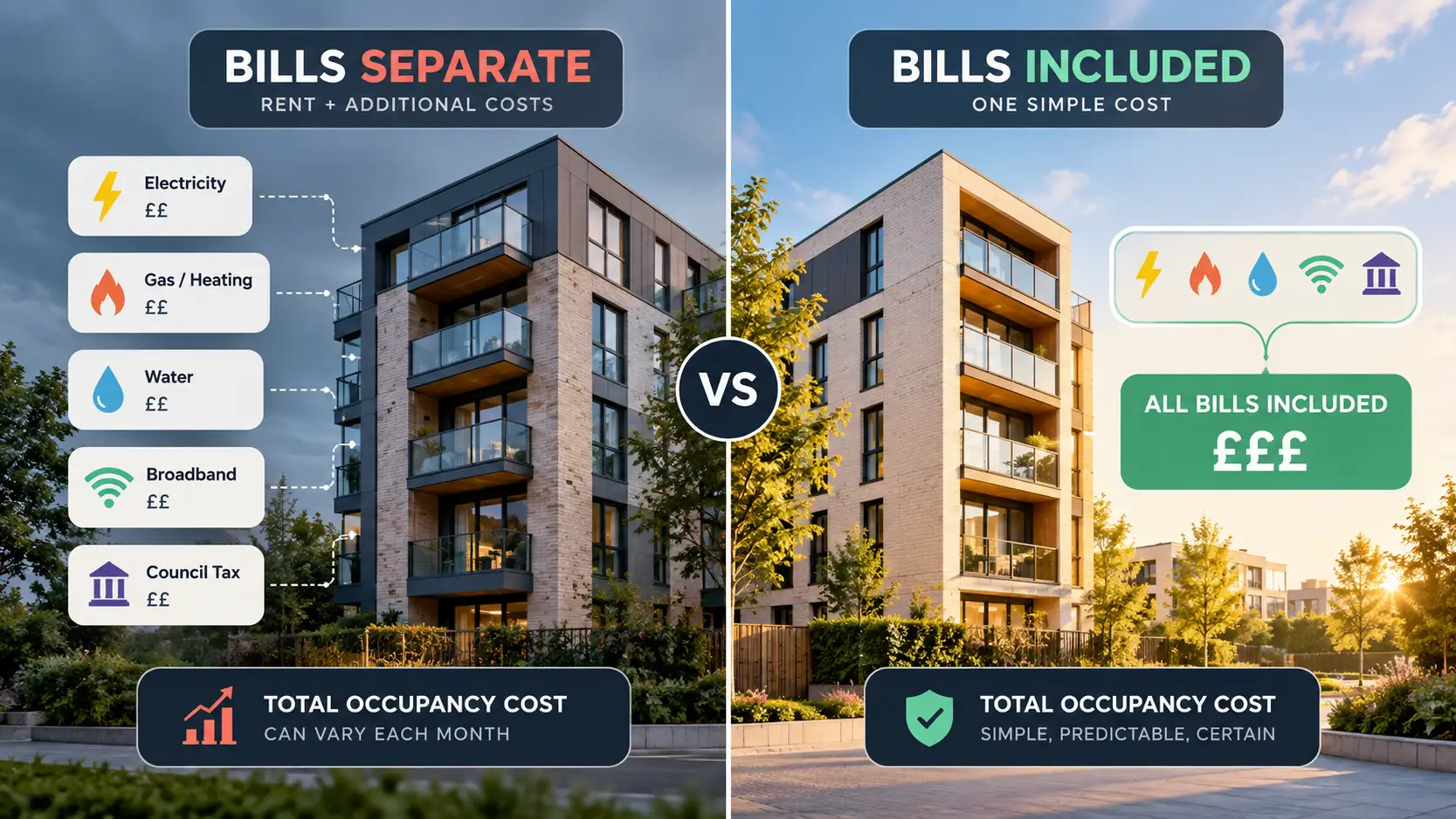
Two listings, same street, similar-looking flats. One advertises £950 a month with bills separate; the other, £1,150 with bills included. The instinctive comparison — £200 a month, so the cheaper one wins unless the bills would obviously cost more than that — is exactly the comparison that can send a renter towards the more expensive home.
The problem is not simply that one property has hidden costs. It is that the two prices describe different financial arrangements. With one, much of the running cost remains with you and moves with energy prices, usage and the property itself. With the other, some of that uncertainty has been wrapped into the advertised price — although “bills included” can turn out to leave considerably more exposure with the tenant than the phrase suggests.
The useful comparison is therefore not £950 against £1,150. It is what each home is likely to cost over a full year, what could push that cost higher or lower, and how much control you retain over those moving parts.
What you’re actually comparing is certainty as well as cost
A bills-separate tenancy leaves you directly exposed to the property’s running costs. Use more energy, experience a particularly cold winter or move into a home that is expensive to heat, and you see the effect in your own accounts. The upside is control: where you pay the energy supplier directly, you can normally choose your tariff or supplier and keep the benefit if your consumption falls. Ofgem: switching your home energy supplier
A genuinely inclusive tenancy moves some of that uncertainty elsewhere. You may know that the same amount leaves your account every month whether January is unusually cold or unexpectedly mild. For a renter trying to keep monthly outgoings predictable, that certainty has value of its own.
But “included” is not automatically cheaper and “separate” is not automatically better value. Nor is it particularly useful to speculate about what margin a landlord may or may not have built into an inclusive price. The only figure that matters to the renter is what each property is likely to cost them.
That means putting both options into the same unit: expected annual occupancy cost.
Build the separate-bills figure from the property you’re actually considering
Start with twelve months of rent, then add the costs that would genuinely fall to you.
Depending on where in the UK you live and the type of property, that may include energy, Council Tax or domestic rates, water and sewerage, broadband and a TV Licence if the way you watch television requires one.
The important part is resisting the temptation to type “average UK household bills” into a search box and treat the result as though it belongs to this particular flat.
Council Tax illustrates the problem. In England, Scotland and Wales, check the actual band, the local authority’s current charge and any discount or exemption that genuinely applies to your household. Liability can also work differently in shared properties: in some HMOs the owner rather than the individual occupiers is responsible, so an advert saying “Council Tax included” may be describing a bill the tenant would not have been personally liable for in the first place. GOV.UK: Council Tax treatment of HMOs
Northern Ireland uses domestic rates instead, and responsibility between landlord and tenant depends on the property and circumstances. nidirect: rates on rental properties
Water can trip up the comparison in a similar way. In England and Wales the property may be metered or unmetered. In Scotland, domestic water and sewerage charges are normally collected by the local authority alongside Council Tax, so adding a generic separate “water bill” on top can result in counting part of the cost twice. Scottish Government: water charges and billing
The calculation therefore needs to start with the home and the household, not with a generic renter budget.
Use the EPC as a clue, not a forecast
Energy is usually the most uncertain part of the exercise because the building and the occupants both matter.
The EPC can help. Two otherwise similar flats with significantly different energy performance, heating systems or insulation deserve different running-cost assumptions. You can check the registered certificate yourself rather than relying only on the letter shown in the advert. GOV.UK: find an energy certificate
But an EPC should not be treated as your future bill. It is based on modelled assumptions rather than your particular household’s behaviour. Somebody working from home throughout the week, heating several rooms all day and using substantial electrical equipment can spend very differently from somebody who is out for most of the day, even in the same property.
How the property is heated matters just as much as the headline EPC letter. Modern efficient controls, insulation, electric resistance heating, heat pumps, older gas systems and communal heating can produce very different cost patterns.
The same caution applies to the energy price cap. Ofgem’s widely quoted annual figure is based on typical consumption and is not a ceiling on what a household can spend. The cap controls relevant unit rates and standing charges for covered tariffs; the more energy you use, the more you still pay. Heat-network customers and some other arrangements are not protected by the ordinary domestic cap. Ofgem: energy price cap and standing charges explained
For a property you have never lived in, the sensible aim is therefore not an energy prediction accurate to the pound. It is a plausible range.
“Bills included” really means asking what can still come back to you
The most useful way to interrogate an inclusive advert is not merely “which bills are included?”
Ask instead: after I agree this figure, what costs can still come back to me?
Gas and electricity may be included while Council Tax, rates or water remain separate. Broadband may be provided but at a speed you would not have chosen. An energy allowance may sit behind the headline, with excess usage charged separately. A service described casually in an advert as “all bills included” can therefore still leave the tenant carrying several material costs.
Fair-use arrangements deserve particular attention. Find out whether the allowance applies monthly or annually, to each tenant or to the whole household, how excess consumption is priced and whether you will be able to see the evidence supporting any additional charge.
The wording of the tenancy matters more than the wording in the listing.
There is also an important third category for renters looking at flats: communal or district heating. A heat-network customer can be billed separately for heating and hot water while having no choice of supplier because the network serves the building as a whole. Ofgem confirms that heat-network customers cannot simply switch supplier, and the ordinary domestic energy price cap does not apply to heat-network charges. Ofgem: switching your home energy supplier
That means “bills separate” does not always mean “full control”.
Another arrangement arises where the landlord holds the underlying energy contract but charges the tenant according to meter readings or estimates. Ofgem says renters in that position may have rights to see the underlying supplier contract and understand how the charge has been calculated; the landlord or site owner cannot simply profit from energy resold to the occupier. Ofgem: homes supplied through a business energy contract
These distinctions matter because three adverts can all use slightly different versions of “utilities included” while exposing the tenant to three very different financial arrangements.
A worked comparison is better when you use a range
Take the original example.
Property A is £950 a month with bills separate. That means £11,400 in rent over a year.
After checking the actual Council Tax position, heating system, EPC, water arrangement, broadband requirement and likely household usage, imagine that you think the remaining bills are likely to fall somewhere between £240 and £320 a month.
That gives Property A an estimated annual occupancy cost between £14,280 and £15,240 — roughly £1,190 to £1,270 a month when averaged across the year.
Property B is £1,150 a month with the relevant bills genuinely included and no expected fair-use excess. Its annual cost is £13,800.
On those assumptions, Property B remains cheaper even if Property A lands at the optimistic end of its estimated bill range. That makes the conclusion reasonably robust.
But imagine instead that your estimated bills for Property A were £150 to £250 a month. At one end of that range Property A would be cheaper; at the other, Property B could be. Now the calculation has not produced a clear financial winner. Small changes in energy use, tax liability or what the inclusive package actually covers could reverse the result.
That is the useful stress test.
If the same property wins at both the optimistic and pessimistic ends of a sensible cost range, price is giving you a fairly strong answer. If the winner changes depending on which reasonable assumption you use, the difference is too close to treat the calculation as decisive.
You then need to place more weight on the things the spreadsheet cannot settle: certainty, condition, location, control and the actual terms of the tenancy.
The figures here are deliberately hypothetical. The method is the point.
What you’re giving up — or gaining — in exchange for certainty
Even where the inclusive property appears cheaper, the decision is not purely arithmetic.
With separate bills, you usually carry more volatility but can retain more control. If you use relatively little energy or find a better tariff, you benefit directly. You can choose a broadband package suited to your needs and may have more freedom over the services attached to the home.
An inclusive arrangement can remove much of that administration and make budgeting considerably easier. In a shared house, that can have additional value: one predictable housing payment avoids arguments about whose name goes on which account, how a bill should be divided or what happens when one housemate leaves.
But some flexibility goes with it. A naturally frugal tenant does not usually receive a refund simply because actual usage was low. Broadband may be whatever service the landlord has arranged. A fair-use clause may leave you exposed to excess consumption in a cold winter even though you thought you had bought certainty.
And in a heat-network property, your ability to shop around for the heating supply may be constrained regardless of whether you would prefer to manage the cost yourself.
So the premium — if there is one — is not merely the price of the utilities. It may also be the price of predictability and convenience.
Whether that is worth paying is a renter decision, not a universal rule.
The comparison that actually answers the question
The useful question is not “which advertised rent is lower?” and it is not even simply “which property has the lowest estimated monthly total?”
It is:
What will each home probably cost me over the year, how wide is the realistic range around that estimate, which costs could still land on me after I sign, and how much do I value certainty compared with control?
For a separate-bills tenancy, build the estimate from the actual property and your likely household rather than an average renter.
For an inclusive tenancy, establish exactly what remains outside the headline figure and what can become variable again through allowances, top-ups or separate charges.
Then test the result rather than trusting a single number.
If one property remains cheaper under both optimistic and cautious assumptions, you have learned something useful. If the answer flips every time one assumption changes, the financial difference probably is not large enough to decide the tenancy on its own.
That is what the advertised rent cannot tell you.
It tells you the price of acquiring the tenancy.
It does not necessarily tell you the cost of living there.
This article provides general property information, not legal, financial or other professional advice for your individual circumstances. Utility charges, Council Tax, rates, tenancy terms and household costs can depend on the property, location, household and contractual arrangements. Check the actual terms and current charges that apply to the property you are considering before making a financial decision.

