

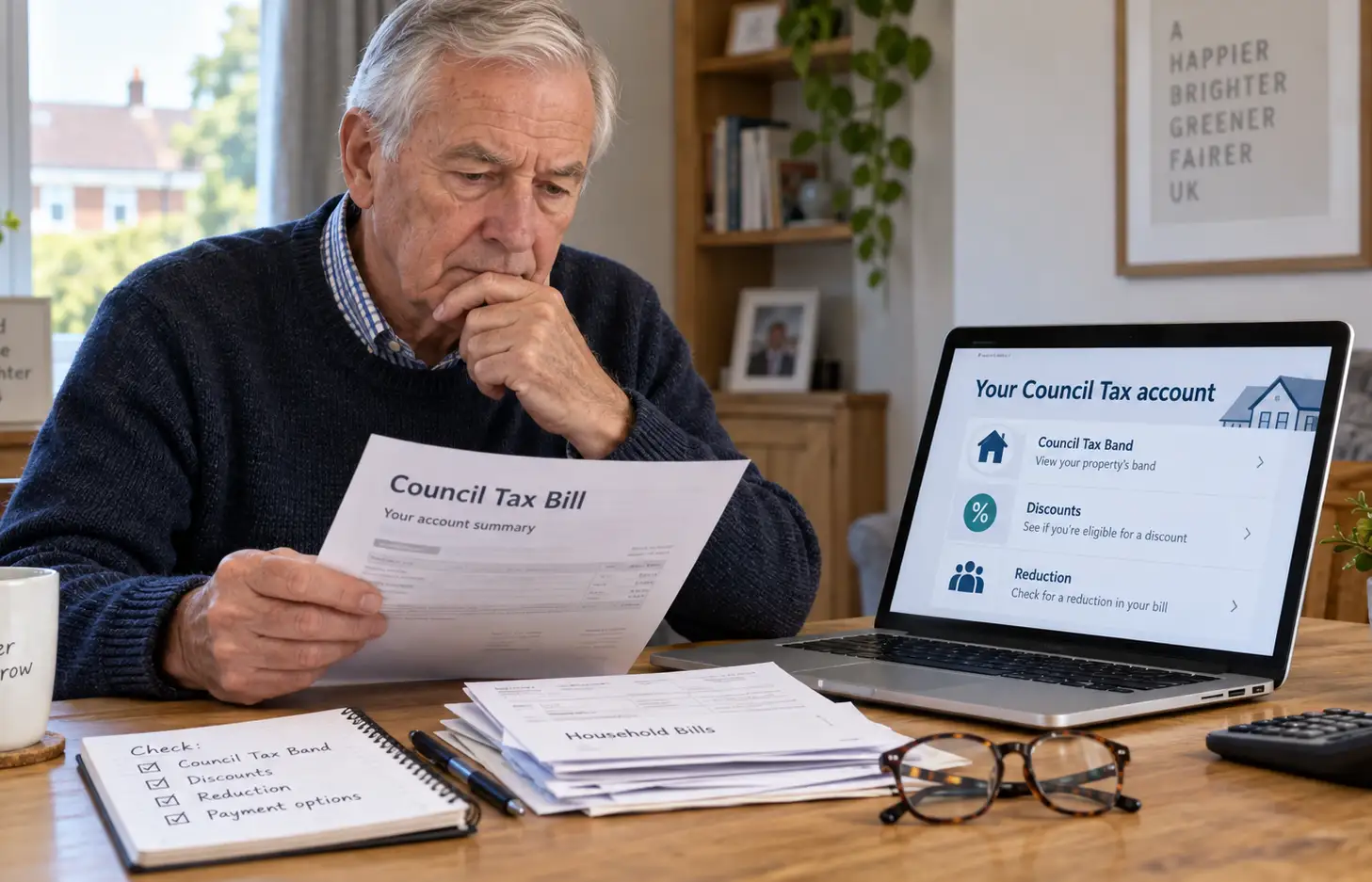
Most people who suspect they’re overpaying Council Tax go looking for one thing: proof their band is wrong. That’s a reasonable place to start, but it’s only a third of the actual question. A correctly banded property can still be on the wrong bill if a discount the household is entitled to hasn’t been applied, and a household paying the right band at the right discount rate can still be missing out on means-tested support they’d qualify for if they applied. These are three genuinely separate checks, and it’s worth treating them that way rather than assuming a band challenge is the only lever available.
First, a UK-wide clarification
Council Tax, as most of the UK understands it, doesn’t operate identically everywhere — and in one part of the UK, it doesn’t operate at all. England, Wales and Scotland each run their own Council Tax systems, with different valuation bases and, in places, different band structures and charging ratios. Northern Ireland does not use Council Tax: it retains a domestic rates system based on a property’s capital value, administered by Land & Property Services rather than a local council.
The distinction matters because a perfectly sensible piece of advice for an English household can be incomplete or wrong in Scotland, Wales or Northern Ireland. This article therefore treats the three Council Tax checks first, then deals with Northern Ireland separately.
Check one: is the property’s band correct?
How bands were set — and why the date matters more than today’s value
In England, Council Tax bands are based on what a property would have been worth on 1 April 1991. Scotland also uses a 1 April 1991 valuation date, although its actual band value thresholds differ from England’s. Wales was revalued later and uses 1 April 2003 values, with nine bands from A to I rather than eight. The Valuation Office Agency explains the England and Wales valuation basis in its official guidance on how Council Tax bands are assessed.
In every case, today’s market value is not the figure directly used to decide the band. A house now worth £500,000 is not assessed simply by asking which modern price bracket £500,000 would sit in. The question is what the property would have been worth at the relevant historic valuation date, subject to the statutory assumptions applying under that system.
That is one reason apparent anomalies remain. Council Tax banding is not the same exercise as obtaining a current survey valuation: assessors work from statutory valuation assumptions, property characteristics and comparable evidence. Genuine errors can exist, but so can legitimate differences between neighbouring homes that look similar from the street.
In England and Wales, major improvements can create another wrinkle that matters particularly to buyers. The VOA cannot normally increase a property’s Council Tax band simply because the current owner has extended or substantially improved it. Instead, it can place an improvement indicator against the property, which prompts a review once the property is sold. The VOA’s guidance on how home improvements affect Council Tax bands explains how this works.
That means somebody buying an extended house should not assume the seller’s existing band is guaranteed to remain unchanged after completion. A property currently in Band D, for example, may still be reviewed after the sale if an improvement indicator is present. A review does not automatically mean the band will rise, because the improvements may still leave the property within the same historic valuation range, but if the band is increased the change applies from the point the VOA notifies the council rather than being backdated to the purchase.
Scotland has its own separate rules for a material increase in value followed by a sale, handled through the assessor system rather than the VOA improvement-indicator process. The Scottish Assessors’ Council Tax proposal guidance explains when that can become relevant.
Scotland also differs in how the eventual bill is derived from the band. It still uses bands A to H, but the charging multipliers for bands E to H were increased in 2017 and remain higher than the equivalent English ratios. Two homes carrying the same letter band in England and Scotland are therefore not necessarily being charged on an equivalent basis.
What makes a useful comparison
Comparing your band with a neighbour’s is a sensible starting point only if the comparison is genuinely like-for-like. Property type, size, age, style and immediate locality all matter. A similar-looking house with a larger floor area, different layout or materially different characteristics can legitimately sit in another band.
For England and Wales, the VOA recommends using genuinely comparable properties and historic sale evidence rather than modern house-price estimates. Its Council Tax band challenge guidance is therefore a much better starting point than simply comparing today’s asking prices on property portals.
There is another useful check before challenging that is easy to miss. The VOA holds Property Attribute Data about homes in England and Wales — information about the physical characteristics it uses when maintaining the Council Tax list. You can ask to see the data held for your own property through the VOA’s Property Attribute Data guidance.
If the recorded property type, age or other physical details are materially wrong, that may help explain why the band looks anomalous and gives you something more concrete to investigate than a neighbour’s bill alone. Incorrect attribute data does not automatically mean the Council Tax band itself must change, because the band still depends on the statutory valuation exercise, but checking what the VOA believes it is valuing can be a much better first step than launching a speculative challenge.
So the useful question isn’t merely “is my neighbour in a lower band?” It’s “are genuinely comparable properties in a lower band, does the valuation authority have the right information about my home, and is there evidence that my own band does not fit the historic valuation range?”
Challenging your band
The challenge route itself is free, and there’s no need to pay a company simply to submit a case through an official process you can access yourself.
The procedure isn’t identical across Britain. In England and Wales, somebody with a formal legal right to challenge can make a proposal; where that formal right is not available, it is still possible to request a band review with supporting evidence. Scotland has its own proposal and appeal process through the local Assessor.
A successful challenge can reduce the band and, depending on the effective date of the correction, produce a refund or credit for Council Tax already overpaid. But “my bill has gone up too much” is not evidence that the valuation band itself is wrong. Affordability and banding are separate questions.
You must also continue paying the existing bill while a challenge is being considered. If the band is subsequently reduced, the account can be adjusted afterwards.
The real risk: a challenge is not a one-way bet
This deserves clear treatment because it’s often understated.
A band review or challenge can leave the valuation unchanged, reduce it or increase it. A review can also reveal that comparable properties nearby appear to be incorrectly banded.
That isn’t a reason to avoid a challenge where the evidence is genuinely strong. It is a reason to gather that evidence first rather than challenging speculatively on the assumption that there’s nothing to lose.
The right reason to challenge is that the current band appears wrong, not simply that a lower bill would be welcome.
Check two: are the right discounts and disregards applied?
This is a separate question from the property’s band, and it’s where a bill can be wrong even when the valuation itself is completely accurate.
Single-person discount
A full Council Tax bill is generally based on at least two adults being counted as resident. If only one adult is counted, the household normally receives a 25% discount. The current England and Wales rules, including which adults are disregarded when working out the count, are set out in the GOV.UK guidance on who has to pay Council Tax.
That can be financially significant. On an illustrative full annual bill of £2,400, a 25% discount reduces the amount by £600 a year, to £1,800.
The important point is that “one adult” doesn’t always mean only one person over 18 physically lives there. Some adults are disregarded for Council Tax purposes. Full-time students, certain apprentices and carers, and people meeting the relevant severe mental impairment criteria are among the categories that can be left out of the count where the conditions are satisfied.
So a working adult living with a qualifying full-time student may still be treated as the only countable adult and receive the 25% discount. Equally, a household that once had two countable adults may become eligible later following a bereavement, separation, a child leaving home or another change in circumstances.
The discount normally needs to be claimed, or the council needs to be told about the changed circumstances. It shouldn’t simply be assumed that the bill will correct itself.
People disregarded when counting adults in a household
Disregards matter because they can change the bill without changing the property band at all.
A household containing several adults may still receive a discount if all but one are disregarded. Where every adult is disregarded, a 50% discount or, in some circumstances, a full exemption can apply instead.
The qualifying conditions are more detailed than the labels suggest. A full-time student has to meet the relevant study requirements; a carer disregard has its own rules; and the statutory rules relating to severe mental impairment require particular medical and benefit conditions to be met.
Scotland publishes its own current Council Tax discounts, exemptions and reductions guidance, including its single-adult, student, disability and low-income rules.
That is why it’s worth checking the actual category rather than assuming either eligibility or ineligibility from a short description.
Check three: could the household qualify for further support?
Council Tax Reduction — sometimes called Council Tax Support — is another separate question. It is means-tested help for lower-income households, and it can apply even where the band itself is correct and another discount has already been awarded.
The important UK distinction is that the scheme isn’t designed identically everywhere.
In England, working-age Council Tax support is locally designed, so entitlement and the amount awarded can differ between councils. The government’s Council Tax Reduction application service takes applicants through to the relevant local authority.
Wales operates a national Council Tax Reduction Scheme administered through local authorities. The Welsh Government’s current Council Tax discounts, disregards, exemptions and reductions guidance brings together low-income support, single-person discounts, disregards, disability reductions and other forms of help.
Scotland has its own national Council Tax Reduction Scheme, administered by councils, and qualifying low-income households can have their bill reduced substantially and potentially to zero.
One practical mistake is assuming that receiving Universal Credit or another benefit necessarily means Council Tax support has already appeared on the bill. The safest approach is to check the bill itself and the relevant council’s records rather than assume another benefit claim automatically dealt with Council Tax as well.
Disability-related band reduction
This is another route that is easily confused with a normal band challenge.
Where a home has qualifying features or extra space required because a disabled resident lives there — such as an additional bathroom or kitchen, another room required for the disabled person’s needs, or sufficient indoor space for wheelchair use — the household may be able to have Council Tax calculated as though the property were in the band below its actual valuation band. GOV.UK’s Disabled Band Reduction Scheme guidance explains the current England and Wales criteria; Scotland has a comparable reduction under its own Council Tax rules.
This isn’t an argument that the original property valuation was wrong. It is a separate reduction based on the needs of the disabled resident and the property.
And the different forms of help are not necessarily alternatives to one another. Depending on the household circumstances, a property can qualify for a disability-related band reduction while the residents also qualify for a 25% adult-count discount and, if income is low enough, Council Tax Reduction as well.
That is why checking the bill in layers is more useful than finding one discount and stopping.
Empty homes and second homes: a brief flag
Councils in England, Wales and Scotland can apply different treatment to long-term empty homes and second homes, including premiums that increase the bill above the ordinary charge. The size of those premiums and the point at which they apply vary by nation and, in some cases, by local authority.
That is a different issue from checking an ordinary main-home bill and deserves separate treatment rather than turning this article into a guide to second-home charging. Anyone dealing with a second home or a property that has been empty for a prolonged period should check the current policy of the relevant council rather than assume the standard bill applies.
Northern Ireland: domestic rates work differently
Northern Ireland does not use Council Tax bands.
Domestic rates are based on a property’s capital value as at 1 January 2005, multiplied by a regional rate and a district rate. Land & Property Services assesses the property and administers the system. The official domestic property valuation guidance explains how the capital value is set and allows ratepayers to check the valuation used for their property.
There is no equivalent 25% Council Tax single-person discount. Northern Ireland instead has its own reliefs and allowances, including Rate Rebate and support for some pensioners and disabled ratepayers.
If the capital valuation itself appears wrong, Land & Property Services can review it. The official guidance for people who think their rate bill is too high also makes the risk clear: a review can result in the valuation going up or down, and the existing rates bill should continue to be paid while the review is considered.
The same underlying principle therefore applies as with a Council Tax band challenge: gather evidence first.
Moving home: when liability actually changes
Moving is another point at which a bill can look wrong even when the band and discounts are correct.
The physical day you move is important, but it isn’t always the only fact deciding liability. Ownership, tenancy and occupation can all matter. Someone who has physically left a property but still owns it, or remains liable under a tenancy, may continue to have a Council Tax or rates liability for a period; equally, overlapping bills can sometimes be legitimate where responsibility for two properties genuinely overlaps.
The practical answer is to tell the old and new councils promptly, or Land & Property Services in Northern Ireland, and provide the actual dates on which ownership, tenancy and occupation changed.
A bill covering two addresses is therefore something to check, not automatically proof that one of them is wrong.
The full audit, in order
Checking whether a Council Tax bill is right means separating three questions that are often blurred together.
First, is the property in the correct valuation band?
Second, is the council counting the right adults and applying every discount, disregard or disability-related reduction the household qualifies for?
Third, if the household is on a lower income, has the relevant Council Tax Reduction scheme actually been considered and applied?
The answers can overlap. A correctly banded property can still be overbilled because a 25% discount is missing. A household receiving that discount can still qualify for further means-tested support. And somebody whose difficulty is affordability may have a much stronger route through Council Tax Reduction than through a speculative valuation challenge.
The useful starting point is therefore the bill itself: check the band, the people and circumstances recorded against the account, every discount or premium shown, and any Council Tax Reduction award. Only then decide whether the problem sits with the valuation authority or with the billing council.
For a buyer, there is one extra check worth making before treating the seller’s existing Council Tax band as part of the long-term cost of the home: look up the property itself and see whether an improvement indicator or obvious history of substantial alteration gives any reason to expect the band to be reviewed after the sale.
That is the complete check — not simply the band dispute that tends to get all the attention.
This article provides general information about Council Tax and domestic rates and is not personalised tax, benefits or legal advice. Valuation bands, discounts, disregards, reductions, exemptions and premiums depend on the nation, local authority and household circumstances, and rules can change. Check the current position through your local council, the Valuation Office Agency, Scottish Assessors or Land & Property Services as appropriate.

