

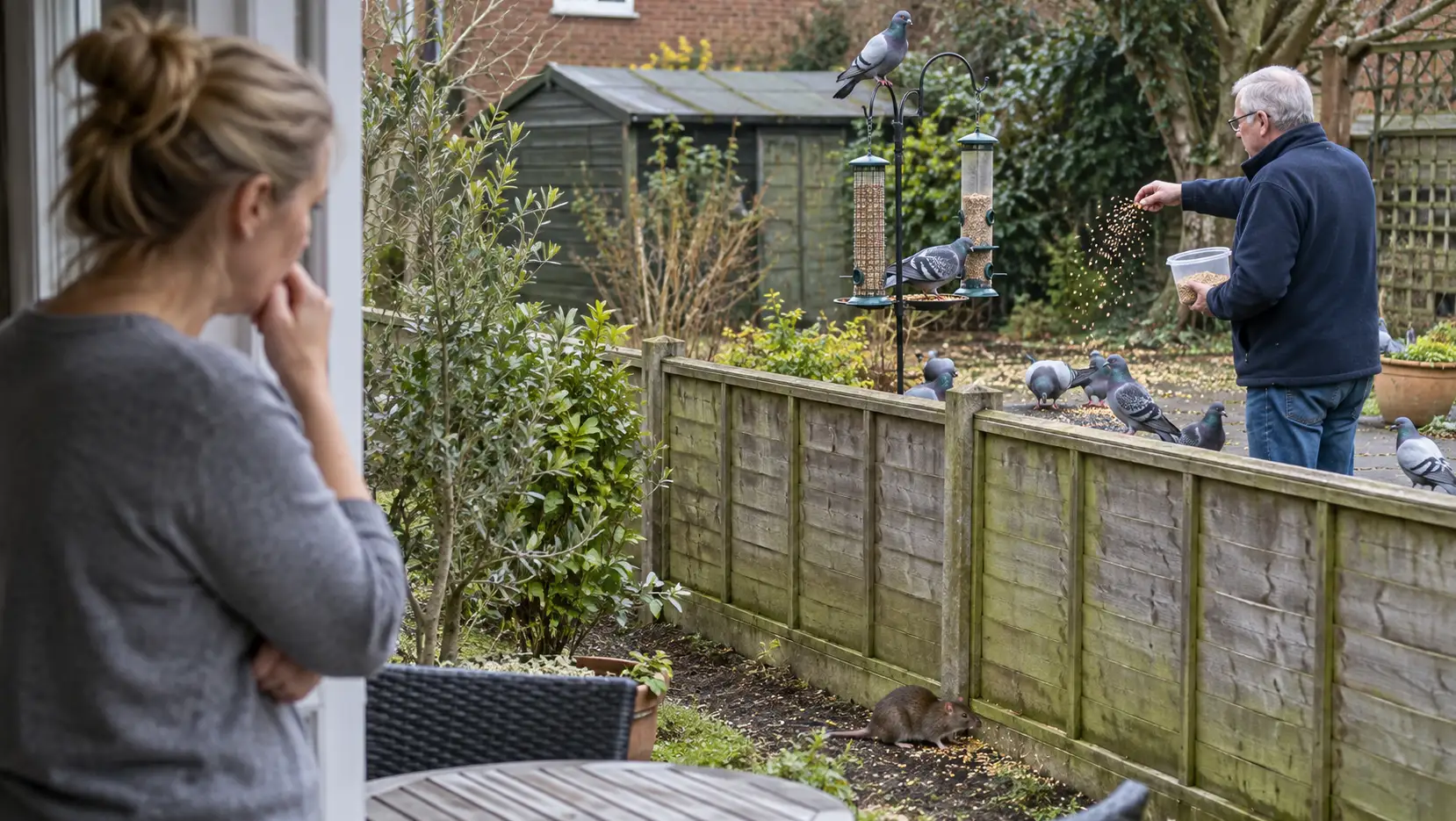
Feeding garden birds is one of the most ordinary, widely encouraged things a homeowner can do, and nothing in this article is intended to suggest otherwise. The distinction that actually matters — and the one that most online advice skips past — is that the feeding itself is rarely the thing a council has any reason to intervene over. What it can act on, in the right circumstances, is what the feeding causes: an accumulation of rotting food, a genuine rat or mouse problem, or fouling serious enough to constitute a statutory nuisance.
Getting this distinction right changes both what you complain about and how likely that complaint is to lead anywhere. It also opens up a more practical possibility: resolving the problem without demanding that somebody stops feeding birds altogether.
Why “stop feeding the birds” isn’t, by itself, a legal request
Councils are generally clear on this point, and it’s worth understanding why. There’s no general law prohibiting somebody from feeding wild birds in their own garden simply because a neighbour dislikes the birds it attracts. A handful of extra sparrows, or even a regular gathering of pigeons visiting a properly managed feeder, isn’t automatically a nuisance the council can enforce against.
Newcastle City Council’s guidance is particularly direct about the difficulty of preventing bird feeding on private land. It distinguishes between ordinary feeding, which councils have limited powers to control, and situations involving rotting food or rats and mice, where other legal powers may become available.
That’s an important distinction because the presence of birds isn’t, by itself, evidence that somebody is doing anything unlawful. A homeowner can encourage wildlife into their garden without needing the agreement of everyone living around them. Nor does a neighbour have a general entitlement to insist that no pigeons land on their roof or that a garden feeding station attracts only particular species.
What changes the picture is consequence, not the quantity of birdsong. Large amounts of food scattered on the ground, seed repeatedly accumulating beneath feeders, or feeding on a scale that appears to be sustaining rats rather than simply attracting birds can move the situation into territory where councils have real powers.
It would be too absolute, however, to say a council can never require bird feeding to stop. In sufficiently serious circumstances, enforcement action addressing an infestation, statutory nuisance or persistent unreasonable behaviour could require particular feeding practices to cease or change. That’s a consequence of meeting a specific legal test, not a general prohibition on feeding wildlife.
There may also be restrictions on feeding pigeons in particular public places under local rules or Public Spaces Protection Orders. Those are different from ordinary feeding in a private garden and shouldn’t be confused with a nationwide ban.
For most neighbour disagreements, the useful starting point remains the same: what harm is actually being caused, and is there evidence connecting it to the feeding?
The two different legal levers, and what each actually covers
Rats and mice are dealt with under specific, longstanding legislation. The Prevention of Damage by Pests Act 1949 places duties on local authorities in England, Wales and Scotland to take steps, so far as practicable, to keep their districts free from rats and mice. It also provides powers to require owners or occupiers to take reasonable measures where action is needed to control them.
If a neighbour’s feeding is genuinely sustaining a rat infestation, this can be a more direct legal route than trying to establish a general nuisance from the presence of birds. A council investigating the problem may look at the food being supplied, where it accumulates, whether rats have established themselves nearby and whether the conditions are allowing the infestation to continue.
In an appropriate case, a notice under the pest legislation can require reasonable action to control rats or mice. That may involve treatment, removal of food sources or other measures appropriate to the site. It doesn’t automatically mean every council must provide free pest treatment or that a single rat sighting requires formal enforcement.
The complication is establishing where the rats are coming from.
Rats don’t respect garden boundaries, and a feeding station isn’t necessarily their only food source. Poorly secured household bins, compost heaps, drains, food businesses and other gardens may all contribute. A rat running across your lawn after leaving the direction of next door isn’t conclusive proof that your neighbour’s bird feeder caused the problem.
But repeated rats feeding beneath the same station, visible accumulations of uneaten seed, established rodent activity around that area or findings from a competent pest controller can provide much stronger evidence. The council can then investigate the conditions rather than relying entirely on one neighbour’s suspicion.
There’s also a practical point that’s easily overlooked. Treating rats without addressing a continuing food supply may achieve little in the longer term. Even if pests are removed, the conditions that attracted them can allow the problem to return. That is why adjusting the feeding arrangement may be just as important as pest treatment itself.
If rats or mice have already entered your own property, deal with that immediate problem rather than waiting for the disagreement to be resolved. A pest controller may be able to identify entry points and recommend suitable proofing and treatment. Keeping evidence of the likely source is useful, but don’t assume your neighbour must automatically reimburse the cost simply because they feed birds. Responsibility for damage or expenses may require separate evidence and legal consideration.
Pigeons sit in a much more limited position. They aren’t treated as rats and mice under the 1949 Act, and councils generally don’t have a straightforward power to intervene because somebody is attracting more pigeons than nearby residents would prefer.
Ordinary amounts of pigeon droppings, birds congregating on roofs or the inconvenience of repeatedly cleaning a patio will not necessarily meet any statutory threshold. In practice, councils may regard those problems as matters for the neighbouring property owners to address themselves.
Where fouling becomes substantially more serious, however, the legal position may change.
Section 79 of the Environmental Protection Act 1990 includes accumulations or deposits capable of constituting a statutory nuisance where they are prejudicial to health or amount to a nuisance. Depending on the circumstances, that can potentially encompass significant accumulations of uneaten food or bird droppings.
The Scottish Government’s statutory nuisance guidance on wild birds expressly recognises that deposits of wild-bird droppings can fall within the legislation where the necessary nuisance or health threshold is met.
That doesn’t mean a council is required to take action whenever pigeons leave droppings on somebody’s property. There is a substantial difference between normal cleaning associated with birds visiting an area and serious, persistent accumulations that materially interfere with the use of premises or present a genuine health concern.
Repeated heavy fouling, contaminated areas that cannot reasonably be used, or deposits associated with blocked gutters and resulting property damage may be relevant evidence. But even damage doesn’t automatically establish which feeding activity caused the problem or whether statutory nuisance has been proved.
There is a further possible route in England and Wales where the feeding itself has become a serious, persistent and unreasonable behaviour problem.
Under the Anti-social Behaviour, Crime and Policing Act 2014, authorised bodies can issue Community Protection Notices where conduct has a persistent or continuing detrimental effect on the quality of life of people in the locality and is unreasonable. The Home Office’s guidance on anti-social behaviour powers explains the framework, including the requirement for a written warning before a Community Protection Notice can be issued.
This isn’t a routine solution to a disagreement about pigeons. A neighbour putting food out for birds doesn’t automatically come close to meeting the test. But where feeding practices have become persistent, unreasonable and seriously detrimental to neighbouring properties, the council or another authorised body may have powers beyond ordinary pest-control legislation.
The distinction is between a council being unable to prohibit bird feeding merely because it’s unpopular and having legal grounds to require changes where the actual consequences justify intervention.
What evidence actually moves this forward
Given how much depends on consequences rather than the feeding itself, the most useful evidence is specific. A photograph of twenty pigeons sitting on a roof might demonstrate that birds are present, but it tells a council relatively little about whether there’s an actionable problem.
A record showing rats repeatedly feeding on spilled seed, food accumulating beneath a feeder or serious fouling affecting a particular part of your property gives an officer something more concrete to investigate.
Worth keeping consistently:
- How the food is being put out. Is it contained within a suitable feeder, scattered across the ground or left in quantities that remain uneaten? Record what you can actually observe from your own property or a public place.
- Accumulating food. Dated photographs of spilled seed, discarded food or rotting material are considerably more useful than photographs showing birds visiting a clean feeding station.
- Rat or mouse activity. Note when rodents appear, where they’re seen and whether they’re repeatedly visiting the feeding area. Burrows, runs and other signs may be useful, provided they can be observed safely and lawfully.
- The effect on your property. Repeated substantial fouling, contamination, blocked gutters or damage are relevant to understanding the impact, rather than simply the number of pigeons present.
- Other possible sources. Nearby bins, food businesses, compost or other feeding stations may need to be considered before attributing a rodent problem to one neighbour.
- Professional findings. If you’ve already commissioned pest control, retain any written report identifying rodent activity, possible entry points or likely food sources.
It’s important not to turn suspicion into certainty. A pest controller may be able to confirm that rats are active around your home without being able to establish conclusively which property is sustaining them. That doesn’t invalidate the complaint; it simply identifies what further investigation might be needed.
The same applies to the pigeons themselves. Birds may feed in one garden, roost on another roof and leave droppings across several properties. Demonstrating that fouling is occurring isn’t necessarily the same as proving one person’s feeding is responsible for all of it.
Keep dates and observations factual, and avoid escalating the situation through trespass, confrontations or attempts to interfere with the neighbour’s feeder. There’s no need to document every individual bird. What matters is building a credible picture of the underlying problem.
A council deciding not to take formal action doesn’t necessarily mean your observations were inaccurate. It may have confirmed the presence of pigeons or occasional rodents but found insufficient evidence of an infestation, statutory nuisance or other legal threshold. Asking which part of the evidence was insufficient may be more useful than submitting the same complaint repeatedly.
Where the actual issue is pigeon fouling on your property, sensible cleaning, maintenance or professional bird-proofing may sometimes provide a more immediate solution than attempting to make the neighbour stop feeding them. That doesn’t settle any dispute about legal responsibility, and any bird-control measures must comply with wildlife protection law. But protecting your own property needn’t depend entirely on whether environmental health can establish a statutory nuisance.
A proportionate way to approach it
Talking to the neighbour directly, where that feels safe and reasonable, resolves a genuine share of these situations. The conversation is much more likely to succeed if it’s about the consequences of feeding rather than whether birds should be fed in the first place.
“Could you stop feeding the birds?” invites an argument about the value of wildlife and what somebody is entitled to do in their own garden. “We’ve started seeing rats underneath your feeder in the evenings, and there’s a lot of uneaten food collecting by the fence” identifies something that can potentially be fixed without abandoning bird feeding altogether.
There’s also a useful reason to approach the matter as a question of responsible feeding: the RSPB’s advice has changed considerably.
Under its updated 2026 guidance, the RSPB recommends that garden bird feeding should be seasonal and carefully managed, partly to reduce the spread of diseases such as trichomonosis among wild birds. Its guidance on feeding garden birds safely advises pausing seeds and peanuts between 1 May and 31 October, while small amounts of mealworms, fatballs or suet can still be offered during that period.
The RSPB also recommends cleaning and relocating feeders weekly, removing spilled food and droppings, keeping food dry and adjusting quantities to avoid waste. Importantly, it now advises avoiding flat-surfaced feeding arrangements, including bird tables and feeder trays, because contaminated food can collect on them and contribute to disease transmission.
That last point matters because catch trays have often been suggested as a simple solution to spilled seed. While reducing spillage remains important, the RSPB’s current advice means a tray shouldn’t automatically be presented as the best answer. The aim is to prevent waste accumulating without creating another potential disease risk for the birds.
Other practical adjustments may include using suitable feeders that limit access by larger animals, positioning feeding stations more carefully, removing leftover food promptly and keeping supplies in secure, rodent-resistant containers. Where rats are actively visiting, temporarily stopping or substantially reducing feeding while the infestation is addressed may be appropriate.
For a neighbour who genuinely wants to help birds, those measures may be much more persuasive than the threat of legal action. They can protect wildlife, reduce disease risk and remove the accessible food that attracts rodents.
The RSPB’s recommendations are wildlife-care advice, not statutory restrictions on what a homeowner is legally allowed to feed birds. But they’re useful, evidence-informed guidance for resolving a problem where poorly managed feeding is causing consequences beyond the garden.
If the neighbour refuses to make changes and the problem continues, the next step depends on what you’re actually experiencing.
For a genuine rat or mouse problem, contact the council’s environmental health or pest-control service and explain the sightings, food sources and evidence of infestation. If there is a substantial accumulation of rotting food or serious fouling, ask environmental health to assess whether it constitutes a statutory nuisance. If the conduct is particularly persistent and unreasonable, the council’s community safety team may be able to consider whether anti-social behaviour powers are relevant.
If the person feeding the birds is a tenant, their landlord or managing agent may provide another route where tenancy conditions address nuisance, pest problems, garden management or communal areas. That doesn’t make the landlord automatically liable for ordinary bird feeding, but it may provide a practical means of addressing a genuine infestation or serious nuisance without relying solely on formal council enforcement.
The broad principles apply across the UK, but the legal machinery isn’t identical. The 1949 pest legislation covers England, Wales and Scotland, while Northern Ireland has its own pest-control framework. The Environmental Protection Act 1990 provides the statutory nuisance framework in Great Britain, subject to differences in its application and amendments. Community Protection Notices under the 2014 Act apply in England and Wales, not throughout the UK.
Northern Ireland has its own statutory nuisance provisions under the Clean Neighbourhoods and Environment Act (Northern Ireland) 2011, including provisions concerning accumulations or deposits that are prejudicial to health or amount to a nuisance. Residents there should use their district council’s relevant environmental health or pest-control arrangements rather than assuming the England-and-Wales procedures apply unchanged.
Ultimately, the strongest complaint is rarely “my neighbour feeds too many birds”. It’s an accurate account of what the feeding is causing: rats repeatedly visiting spilled food, uneaten material collecting and deteriorating, or fouling that has crossed from an ordinary inconvenience into something materially more serious.
And the best outcome often isn’t a legal order stopping somebody from feeding wildlife. It’s a feeding arrangement that no longer sustains pests or creates a nuisance next door.
Getting that distinction right is not just useful legally. It’s also the best chance of fixing the problem without turning one badly managed bird feeder into a much wider neighbour dispute.
Important: This article provides general property, pest-control and environmental information, not legal, wildlife-care or other professional advice for individual circumstances. Council powers and enforcement procedures differ across England, Wales, Scotland and Northern Ireland. Whether bird feeding has caused an infestation, statutory nuisance or other legally actionable problem depends on the facts and evidence. Seek appropriate professional advice where significant pest activity, health concerns or property damage are involved.

