

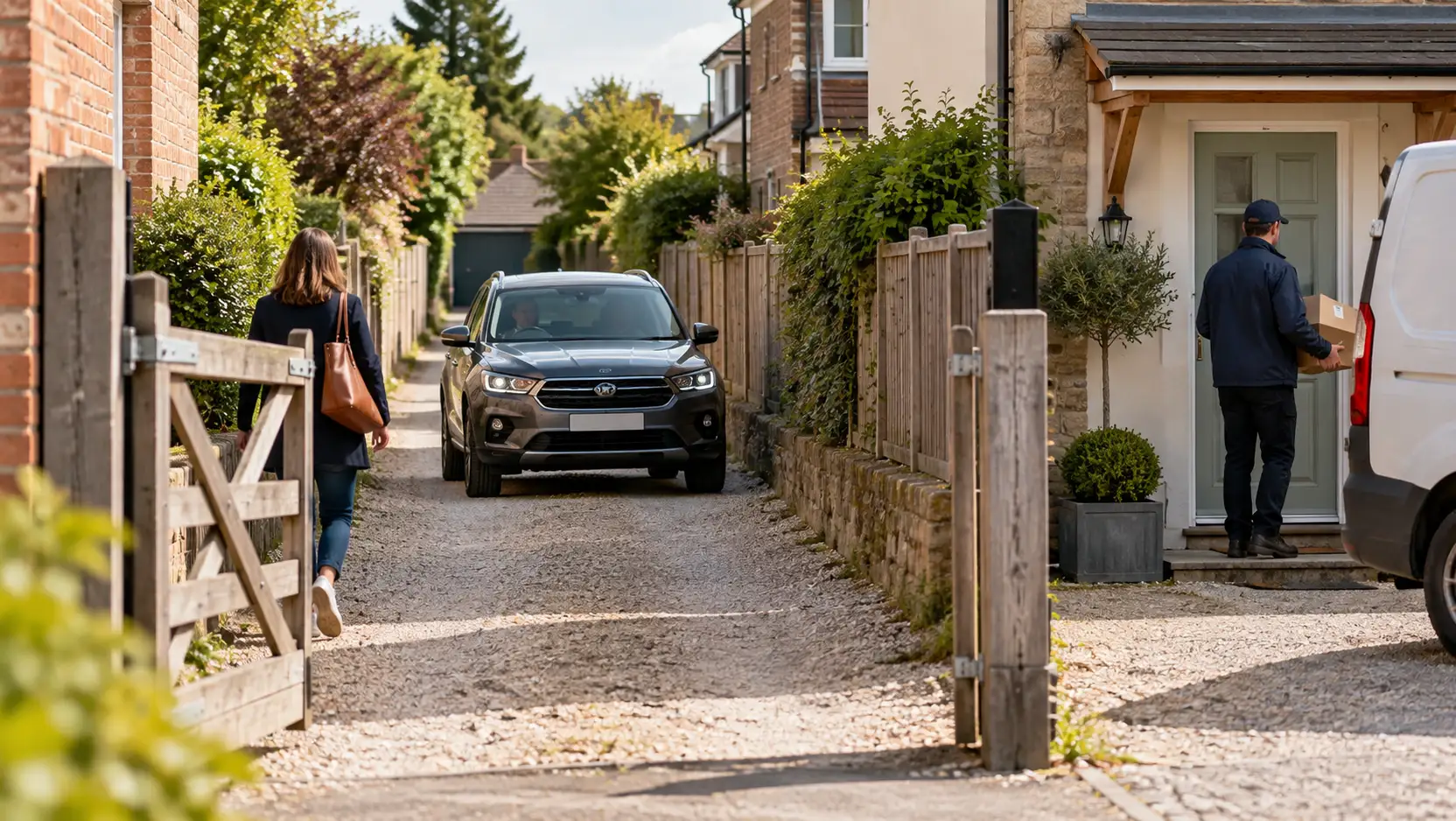
The instinct, when a disagreement flares up over an access right, is to argue from what feels reasonable: “we’ve always had deliveries come this way,” or “it wouldn’t make sense for the right to exist if I couldn’t get a car down it.” Neither of those is how the law actually answers the question. A private right of way is a specific legal right, defined by how it originally arose and, where it was expressly granted, by the wording of the document that created it. Working out what it permits means starting there — not with what seems fair, and not simply with what’s happened by habit for the last twenty years.
The problem usually becomes apparent when somebody objects to something that has never previously caused an argument. A neighbour tells a delivery driver they aren’t allowed to use the shared driveway, complains about visitors arriving by car or insists that vehicles must never stop along the access. You might reasonably wonder how a right of way intended to serve a house can be much use if the ordinary business of living there is suddenly treated as trespassing.
Sometimes the objection is misplaced. An access right benefiting a home may extend to considerably more than the movements of the person whose name appears on the title deeds. But there’s an equally important distinction between using a route to reach your property and treating somebody else’s land as an extra parking space. The two activities might take place on exactly the same stretch of tarmac without being covered by the same legal right.
For the homeowner whose property benefits from the access, the question is what they’re entitled to do. For the neighbour who owns the land, it’s what they must reasonably accommodate. And for both, the answer can be rather different from the informal arrangement they’ve become accustomed to.
The following discussion principally concerns England and Wales, where private rights of way are generally governed by the law of easements. Scotland and Northern Ireland have different property-law systems, and their access rights need to be interpreted under the relevant local rules.
The document is the starting point, not the current use
Somewhere in the property’s history is the explanation for why the right of way exists. It might have been expressly granted or reserved when a larger piece of land was divided, recorded in an old conveyance or created as part of a later transfer. In other circumstances, rights can arise through implication or sufficiently long qualifying use, even without an express grant.
Where the right was granted in writing, the original wording matters because it identifies what the parties legally established, often long before the present owners arrived. The person who created the right might have been selling a house with a rear garage, dividing farmland or ensuring that one property retained access across land being transferred to another. The purpose and circumstances of that arrangement can help explain what the right means today.
For registered property in England and Wales, the sensible place to begin is the title register. The benefiting property’s register may record a right over neighbouring land, while the neighbouring title may identify the corresponding burden. HM Land Registry’s Practice Guide 62 on easements explains how these rights are recognised and recorded.
There is a catch, though. The register may tell you that a right of way exists without reproducing the complete wording that determines its scope. Instead, it might refer to an older transfer or conveyance, sometimes indicating that a copy has been filed. In that situation, the underlying document can be much more useful than the brief entry in the register.
HM Land Registry explains how to request relevant documents in its guidance on obtaining copies of deeds. Not every original deed is necessarily held by Land Registry, so older conveyancing records may sometimes need to be traced separately. Any plan accompanying the grant deserves attention as well, particularly if a disagreement concerns where the access runs, how wide it is or which part of the property benefits from it.
The language may look familiar. Rights to “pass and repass”, to travel “with or without vehicles”, or to use an access “at all times” and “for all purposes connected with the use and enjoyment” of a property occur in conveyancing documents. But those expressions have to be read in context, rather than treated as though each comes with one universal interpretation.
An expressly pedestrian-only right is plainly different from one allowing passage with vehicles. The more awkward cases involve older documents that simply describe a “right of way” without spelling out the mode of travel. A route originally established to reach a garage may raise different considerations from a narrow footpath serving a garden, even if neither document uses language that neatly describes modern vehicle use.
This is why an argument about whether cars are permitted cannot always be settled by pointing out that cars have used the access for years. That history may be relevant, but the first question is whether the legal right actually supports vehicular passage. If the deed is ambiguous, its proper interpretation may depend on the circumstances in which the access was created, not on whichever meaning now seems most convenient to one of the neighbours.
Visitors and deliveries may be part of the right — not an extra privilege
One of the more persistent misunderstandings is that a right of way belongs personally to the homeowner, so anybody else using it must obtain permission from the owner of the land.
Ordinary property easements generally benefit the land rather than just its current owner, and a residential access right can accommodate the normal activities associated with living in a house. That matters because households don’t exist in isolation. Friends visit, carers attend, tradespeople carry out repairs, taxis arrive and delivery drivers bring everything from groceries to replacement appliances.
A right intended to provide ordinary access to a dwelling would be of limited practical value if the homeowner could travel along the route but nobody attending the property could do the same.
Consider a house reached by a private driveway belonging to the neighbouring property. Its deed grants access with vehicles for purposes connected with the use and enjoyment of the house. The occupants have guests arriving for dinner, a plumber visiting to repair the boiler and a van delivering a new washing machine. Those activities are not necessarily separate uses of the neighbour’s land merely because the vehicles belong to people who don’t live there.
The point was illustrated in the High Court’s decision in Whiston v Leonard [2026] EWHC 355 (Ch). The right in that case was broadly expressed, permitting access at all times for purposes connected with the use and enjoyment of the property, with or without vehicles. The dispute included questions about visitors, deliveries and vehicles stopping to load or unload.
The court upheld findings recognising activities including stopping for deliveries and loading or unloading, while distinguishing those activities from a general entitlement to park. The judgment is useful because it shows why residential access cannot always be reduced to the physical act of travelling continuously from one end of a driveway to the other.
It doesn’t, however, establish that every right of way automatically includes every visitor or delivery vehicle. The grant in that case was broad, and different wording or circumstances can produce a different answer. A right created for a specific agricultural purpose, for example, may not have the same scope as one intended to serve the ordinary occupation of a dwelling.
There is also a distinction between the people exercising a right and the purpose for which it is being exercised. A delivery driver reaching a home in the ordinary course of residential use is one thing. A substantial new commercial activity generating frequent vehicle movements may raise questions about whether the access is now being used for a purpose the original right was never intended to serve.
For a homeowner whose neighbour is objecting to ordinary visitors, the useful point is that the deed may not need to name every category of person entitled to travel along the access. A sufficiently broad residential right can accommodate the everyday comings and goings of a household without requiring the landowner’s individual permission each time.
Equally, the beneficiary shouldn’t assume that the reference to vehicles gives unrestricted permission for every type of traffic, regardless of its purpose or effect. The circumstances and the legal scope of the right still matter.
The distinction becomes especially important when a neighbour tries to impose their own rules. A landowner may have legitimate concerns about security, inappropriate parking or interference with their property, but those concerns don’t necessarily entitle them to exclude people who are lawfully exercising an easement. The beneficiary, meanwhile, cannot treat the existence of the right as permission to use the access for activities falling outside it.
Both positions depend on understanding what the original right actually provides.
When stopping becomes parking
This is probably where the most ordinary neighbourly disagreements become unexpectedly difficult.
A right to “pass and repass” is fundamentally a right of passage. It shouldn’t automatically be read as a right to leave a car standing on somebody else’s land whenever the beneficiary needs somewhere to park. But it would be equally misleading to suggest that the moment a vehicle stops moving, it necessarily falls outside the access right.
Imagine a delivery van arriving with a fridge-freezer. The driver travels along the shared access, stops while the appliance is unloaded and leaves once the delivery is complete. That is plainly different in character from a resident leaving their second car on the driveway overnight because the garage is full.
Both involve a stationary vehicle. They do not necessarily involve the same legal use of the land.
Depending on the wording and circumstances, stopping briefly to unload goods, allow passengers to get out or open a gate may be incidental to exercising a right of passage. The Whiston judgment illustrates why such activities cannot simply be equated with claiming a permanent or continuing parking space.
A separate right to park may exist, but it needs an appropriate legal basis. Sometimes the original documents expressly grant parking rights; in other circumstances, the position may require more detailed legal analysis. What should not be assumed is that a grant allowing vehicles to cross land automatically gives the beneficiary somewhere to keep one.
Parking easements can also raise questions about how much use of the land the burdened owner retains. The courts have considered circumstances in which extensive parking claims appear to give the beneficiary such substantial control over the area that the arrangement raises questions going beyond an ordinary right of passage. The nature and extent of the claimed right therefore matter, rather than there being a simple rule that all parking either is or isn’t capable of being an easement.
For a household sharing a driveway, this can have quite practical consequences. Your neighbour might be obliged to accommodate ordinary deliveries to your house while having a legitimate objection to your visitors leaving their vehicles along the access for several hours. Conversely, they may be wrong to describe every short stop associated with access as unlawful parking.
The distinction doesn’t disappear simply because one household finds the other’s activities irritating. A van unloading a large appliance may take longer than a parcel delivery, and what is reasonable in one access arrangement may be problematic in another. The wording of the right, the purpose of the activity and the actual circumstances need considering together.
There may also be competing rights to use the same route. A vehicle stopping to unload goods could be exercising a permitted activity while still creating a practical problem if it prevents another property from exercising its own access. Whether an activity falls within the scope of a right and whether its exercise unlawfully interferes with somebody else’s rights can be separate questions.
The useful distinction for most homeowners is nevertheless straightforward: passage, stopping as part of passage and parking as an independent use are not automatically the same thing. A disagreement becomes easier to understand once the parties stop treating them as interchangeable.
Does twenty years of use change what you’re allowed to do?
When the deed doesn’t provide the answer somebody wants, the argument often turns to history. Cars have always come down the driveway. Delivery drivers have always stopped there. The previous owners parked in a particular place for twenty or thirty years without anybody complaining.
That history shouldn’t automatically be dismissed, but it doesn’t simply rewrite the original right either.
There are two different questions. The first is whether sufficiently long use has established a separate legal entitlement. The second is whether an existing right has been exceeded because the way it is exercised has become more frequent or intensive.
In England and Wales, an easement may sometimes be acquired through prescription. HM Land Registry’s Practice Guide 52 on prescriptive easements explains that qualifying use generally needs to have continued for at least twenty years and to have been exercised as of right: without force, without secrecy and without permission.
Permission is often the stumbling block. A neighbour who allowed the previous owners to park on their land as a favour may have created a longstanding arrangement without granting a permanent property right. The fact that nobody later objected doesn’t necessarily transform that permission into an enforceable parking easement.
On the other hand, where a particular use has been exercised openly, without permission and for the necessary period, there may be grounds for investigating whether a prescriptive right exists. The evidence must support the entitlement claimed. Long pedestrian use does not automatically establish vehicular access, and a history of occasional passage cannot simply be treated as proof of unrestricted parking rights.
This is a different issue from a homeowner who already has a clear vehicular right of way but now uses it more frequently.
Over the years, a household might acquire another car, receive more deliveries or have more visitors. The neighbour may dislike the increase, but a greater number of journeys does not necessarily mean the right has been exceeded.
The Court of Appeal has recognised that mere intensification of use is not, by itself, necessarily objectionable. In Wood v Waddington, which involved an access whose use had changed in connection with a livery business, the court considered the scope of the right rather than treating increased or different activity as automatically impermissible. Falcon Chambers’ discussion of the judgment provides further context.
That doesn’t establish a general entitlement to turn any residential access into the entrance for a substantially different development. The nature of the permitted use still matters, and a more fundamental change can raise different legal questions from the ordinary increase in traffic associated with a household.
An especially important distinction arises when additional land becomes involved. Someone with a right of way benefiting their house may later buy an adjoining plot and want to use the same route to serve a new building. Owning both parcels does not automatically extend the original easement to land that was never granted its benefit.
For most homeowners, the lesson is less complicated than the case law. Using an established right more frequently is not necessarily the same thing as using it for a different legal purpose. And doing something for many years doesn’t, by itself, prove that the right was always wide enough to authorise it.
Before the disagreement hardens, find out what the right really permits
A surprisingly large number of access disputes begin with both neighbours being absolutely certain about a document that neither has actually read.
The homeowner benefiting from the right points to years of deliveries, visitors and vehicles using the route without difficulty. The landowner produces a title plan showing that the driveway belongs to them. Both facts may be correct, but neither necessarily settles what the access right permits.
The sensible starting point is to establish where the right came from and obtain the documents that define it. For an express easement, that means reading the relevant wording alongside any plan and identifying the land that receives the benefit. If the register refers to an older deed, a solicitor or conveyancer can help obtain and interpret it.
Then compare what the document actually permits with the activity causing the disagreement. A dispute about visitors driving to a house is not quite the same as an argument over overnight parking. A question about a delivery van stopping briefly differs from one involving substantial commercial traffic, and a right serving an existing home cannot automatically be treated as access for additional land.
Where longstanding use is being relied upon, evidence of how the route has been used, by whom and under what circumstances may become important. That history deserves proper attention without assuming that the absence of previous objections establishes every right now being claimed.
For somebody buying a property, the issue can be particularly significant. A driveway or garage may be visible during a viewing, but the legal right to reach it over neighbouring land still needs to be established. The Law Society’s current TA6 Property Information Form includes matters relating to rights and informal arrangements, recognising that a property’s actual access arrangements do not always correspond neatly with the formal title documents.
Where access is undocumented or uncertain, a conveyancer may need to investigate historic use and supporting evidence, including whether further documentation or other protection is appropriate. That is an issue to resolve before exchanging contracts, rather than relying on the seller’s assurance that nobody has ever complained.
The same caution applies to sellers describing a property as having vehicular access. A route that the current household uses without difficulty may still have limitations relevant to a buyer or mortgage lender. Property Front Page’s separate guidance on buying a house with a shared driveway examines those pre-exchange questions in more detail.
For an existing homeowner, however, the immediate concern may be simpler: whether a neighbour is entitled to object to a particular visitor, vehicle or activity. If the answer genuinely depends on interpreting an ambiguous grant, that is where a solicitor experienced in property easements can be more useful than a prolonged exchange of letters about what everybody believes is reasonable.
The question to put to them is not merely whether your house has a right of way. It is whether the right allows the particular use that is now being challenged.
If the problem is that somebody is physically obstructing an established access, installing gates or preventing lawful passage, the dispute may also involve interference with an easement. That is a separate issue, covered in Property Front Page’s article on neighbours blocking or restricting rights of way. But establishing the scope of the right usually comes first, because you cannot properly assess whether somebody has interfered with an entitlement until you know what that entitlement is.
A neighbour objecting to ordinary delivery vehicles may be trying to prevent a use the deed already permits. A homeowner treating vehicular access as an additional parking space may be claiming something the deed never granted. And a route that has accommodated family cars for decades may raise entirely different questions when it is suddenly expected to serve another property.
These situations can look much the same from the roadside. They aren’t necessarily the same in law.
What feels reasonable is often a good place to begin a conversation between neighbours. It isn’t a reliable substitute for establishing what the right actually says, what it was intended to provide and whether the activity in question falls within it.
The answer isn’t always the one either neighbour expects. But it is considerably better to discover that by reading the deed than by turning an assumption about cars, visitors or deliveries into a dispute neither household needed.
This article provides general property information and does not constitute legal, conveyancing or other professional advice. It principally concerns private rights of way and easements in England and Wales. The existence and scope of a particular right depend on its legal origin, the wording and plans in relevant documents, the circumstances in which it arose and any qualifying historic use. Scotland and Northern Ireland have different property-law frameworks. Where access rights are unclear, disputed or important to a property transaction or proposed change of use, seek advice from an appropriately qualified property solicitor or conveyancer.

