

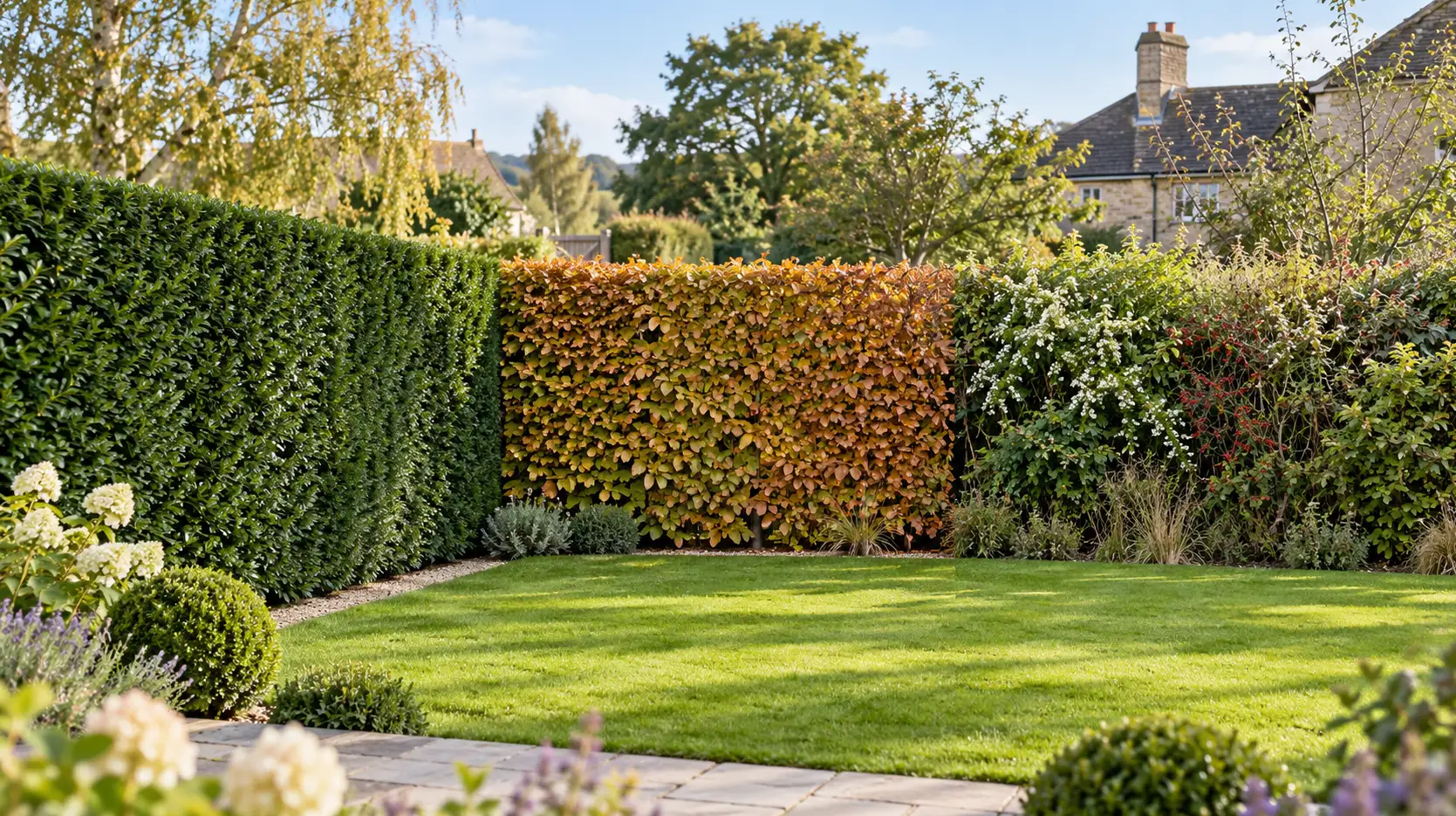
The most popular hedge isn’t necessarily the right hedge, and “fast-growing” is not the unqualified virtue it is often sold as. Rapid growth gets you screening sooner, but it also becomes a permanent maintenance commitment once the hedge reaches the height you actually wanted. Leyland cypress is the obvious example: it is genuinely useful where a quick, tall screen is the priority, but much less forgiving where the eventual aim is a modest hedge that has to be kept tightly controlled year after year.
The right question therefore isn’t which hedge is quickest or most popular. It is which hedge does what you actually need it to do, in your soil, in the space available, without becoming a problem ten years from now.
One distinction is worth making before comparing them. “Evergreen”, “deciduous” and “native” are not three completely separate categories. Yew and holly are native evergreens; beech, hornbeam and hawthorn are native deciduous plants. In practice, the more useful choice is usually between an evergreen or deciduous single-species hedge and a mixed native hedge designed to provide a broader range of wildlife value and a less formal character.
Start with the job, not the species
Before comparing plants, be honest about what the hedge needs to achieve. The RHS guide to choosing hedging plants makes much the same point: target size, soil, position and future maintenance should be considered before choosing the plant.
Year-round privacy points towards an evergreen or semi-evergreen hedge, but there is still a substantial difference between the options. Yew is the classic formal choice: dense, long-lived and slower growing than the more vigorous conifers, with the unusual advantage that an overgrown hedge can often be renovated by cutting back into old wood. It is not the choice for somebody demanding instant screening, but it is remarkably forgiving over the long life of a hedge. Yew is also highly poisonous if eaten, so its position needs particular consideration where grazing animals can reach it; the RHS yew growing guide covers both its growing characteristics and toxicity.
Portuguese laurel gives a quicker route to dense evergreen screening and tolerates sun or partial shade, while holly combines evergreen foliage with a naturally prickly structure that can make a boundary less inviting to push through. If winter berries matter, check the cultivar rather than simply buying “a holly”: most hollies have male and female flowers on separate plants, so a female generally needs a suitable pollinator nearby, although self-fertile cultivars are available.
Privet remains a useful workhorse where the aim is straightforward screening rather than a showpiece hedge. It takes clipping well and is relatively forgiving, but “evergreen” can oversell it: many privets are better thought of as semi-evergreen, retaining more foliage in milder conditions and becoming noticeably thinner in a hard winter.
A formal hedge without evergreen foliage is where beech and hornbeam earn their popularity. Both are deciduous, but clipped hedges can retain dead leaves into winter, giving far more screening than a completely bare deciduous hedge. Beech is particularly good at holding its copper-brown winter foliage and performs best on free-draining ground. Hornbeam generally holds fewer leaves for less of the winter, but it is the more tolerant choice where the soil is heavy or damp, the site is colder, or conditions are more exposed. That does not mean either should simply be planted into permanently waterlogged ground.
Wildlife value points strongly towards native planting, especially if you have room for something less rigid than a narrowly clipped formal hedge. Hawthorn, blackthorn, field maple, hazel, dogwood and other native shrubs can provide flowers, fruit, dense cover and nesting opportunities at different times of year, while climbers such as honeysuckle or dog rose can add another layer where space allows. The Woodland Trust’s guide to native hedge plants highlights the broad wildlife value of species such as hawthorn.
A mixed native hedge is not automatically maintenance-free. If you insist on keeping it as a narrow, perfectly clipped rectangle, you will still spend time controlling it. Its advantage is that it can work extremely well as a looser, slightly wider boundary where some natural variation is acceptable.
In a smaller garden, think carefully before including much blackthorn. Its suckering habit is useful in a rural hedge where you want a dense, self-thickening barrier, but it can become an unwanted maintenance problem where space is tight and spreading growth is difficult to accommodate.
Low maintenance therefore needs defining properly. Fast-growing plants are rarely low-maintenance once they have reached their required size, because all that annual extension growth has to go somewhere. But slower growth does not mean “no trimming” either. The easiest hedge to live with is usually the one whose natural vigour, mature dimensions and level of formality match the space you actually have.
That leads to an overlooked question: how much garden can the hedge take up? A hedge occupies width as well as height. On a large rural plot, allowing a mixed native hedge to broaden may be irrelevant. In a narrow urban garden, repeatedly fighting a naturally vigorous or spreading plant to keep it within a very tight strip can become the main maintenance problem. Decide the finished width you can tolerate before ordering plants, not five years afterwards when the hedge has already claimed part of the lawn or path.
Shade narrows the options but does not eliminate them. Yew and green-leaved holly cope particularly well with lower light, while hornbeam also tolerates partial shade. Expect growth and density to vary with the site; “shade tolerant” does not mean a plant will perform identically in deep shade and good light.
Wind and exposure also need separating from true coastal conditions. Hornbeam is hardy and capable of performing on exposed sites, while hawthorn is famously tolerant of open positions. A genuinely coastal garden adds salt-laden winds to the problem, so it is worth checking the exact species or cultivar and looking at what already succeeds locally rather than assuming every plant described as “wind tolerant” will be equally happy beside the sea.
Security, alongside privacy, is where thorny or spiny planting has a genuine additional role. Hawthorn, blackthorn and holly are all much less comfortable to force through than a smooth-leaved hedge. Avon and Somerset Police includes hawthorn and blackthorn among its suggested defensive plants. That does not mean the tallest, densest hedge is automatically the most secure everywhere — front-garden planting should still preserve useful visibility towards doors, windows and approaches.
A quick comparison
| Hedge | Foliage | Particularly useful for | Watch out for |
|---|---|---|---|
| Yew | Evergreen | Formal privacy, shade, long life, ability to renovate hard | Slower establishment than vigorous screens; highly poisonous if eaten |
| Holly | Evergreen | Privacy, defensive planting, shade, wildlife interest | Relatively slow; berrying depends on cultivar and pollination |
| Portuguese laurel | Evergreen | Dense year-round screening, quicker establishment | Vigorous growth still needs regular control |
| Privet | Semi-evergreen | Straightforward screening, forgiving clipping | Can lose more foliage in cold winters; needs regular trimming |
| Beech | Deciduous, usually retains dead leaves when clipped | Formal appearance, winter screening, free-draining soils | Less suited to heavy, wet ground or drought-prone sites |
| Hornbeam | Deciduous, can retain some winter leaves | Heavy or damper soils, colder/exposed sites, partial shade | Winter screening generally less complete than beech |
| Mixed native, often hawthorn-led | Mainly deciduous | Wildlife, thorny security, informal or rural character | Less winter privacy; usually needs more width; blackthorn can sucker |
The table is a shortlist, not a substitute for looking at the particular garden. Soil drainage, exposure, desired width and the amount of clipping you are prepared to do can turn a good hedge on paper into a poor choice in practice.
The mistake worth avoiding
Choosing purely on growth speed is one of the easiest ways to buy yourself years of unnecessary work.
A hedge advertised for rapid screening does not stop growing when it reaches your preferred height. Once the screen is established, the same vigour that seemed attractive at purchase becomes growth that has to be controlled year after year. Leyland cypress is the classic example: excellent where a tall screen is wanted quickly, but far less satisfactory where the aim is a smaller hedge that has to be repeatedly restrained.
That does not make fast-growing hedges bad. If you need a tall screen quickly and have the room, access and willingness to maintain it, vigorous growth may be exactly what you want. The mistake is treating speed of establishment as though it has no cost later.
A slower plant that takes another year or two to produce the finished effect can be the lower-regret decision over the following twenty years, particularly where the target hedge is relatively modest in height and width.
It is also worth deciding whether you really want a formal hedge or an informal one before planting. A mixed native hedge can certainly be clipped and controlled, but if the objective is a perfectly uniform, architectural green wall, a single species naturally lends itself to that job more easily. Conversely, selecting a wildlife-rich mixture and then repeatedly cutting it into a very narrow formal block can throw away some of the reason for choosing the mixture in the first place.
What this doesn’t cover
This is about choosing what to plant, not resolving a hedge problem that already exists.
How high a neighbour’s hedge can become, what happens when an evergreen hedge blocks light, who owns a hedge on a boundary and what you can cut back from the neighbouring side are separate issues and belong in Property Front Page’s dedicated hedge and neighbour articles rather than being repeated here.
Likewise, the purchase decision does not end with the species. Once you have narrowed the choice to two or three hedges that genuinely suit the soil, exposure, available width and amount of maintenance you are willing to accept, the next question is how quickly you want the result and how much you want to spend achieving it. Bare-root whips, pot-grown plants and instant hedging can produce very different upfront bills for the same eventual hedge, which is why Property Front Page covers planting cost separately.
The best hedge is therefore not the one with the most impressive growth rate, the species planted in the most neighbouring gardens or the plant currently being promoted by the nursery. It is the hedge whose eventual size, growth rate, foliage, tolerance of your site and maintenance demands still make sense once the novelty of planting it has worn off.
Choosing slightly slower privacy, slightly less formality or slightly less winter cover can be a very good trade if the result is a hedge that fits the property rather than one you spend the next decade trying to restrain.
This article provides general gardening and property information rather than site-specific horticultural advice. Hedge performance varies with soil, drainage, light, exposure, local climate and cultivar. Check the requirements and mature characteristics of the particular plants you intend to buy before ordering a full boundary run, particularly where drainage, coastal exposure, livestock or restricted garden space are relevant.

